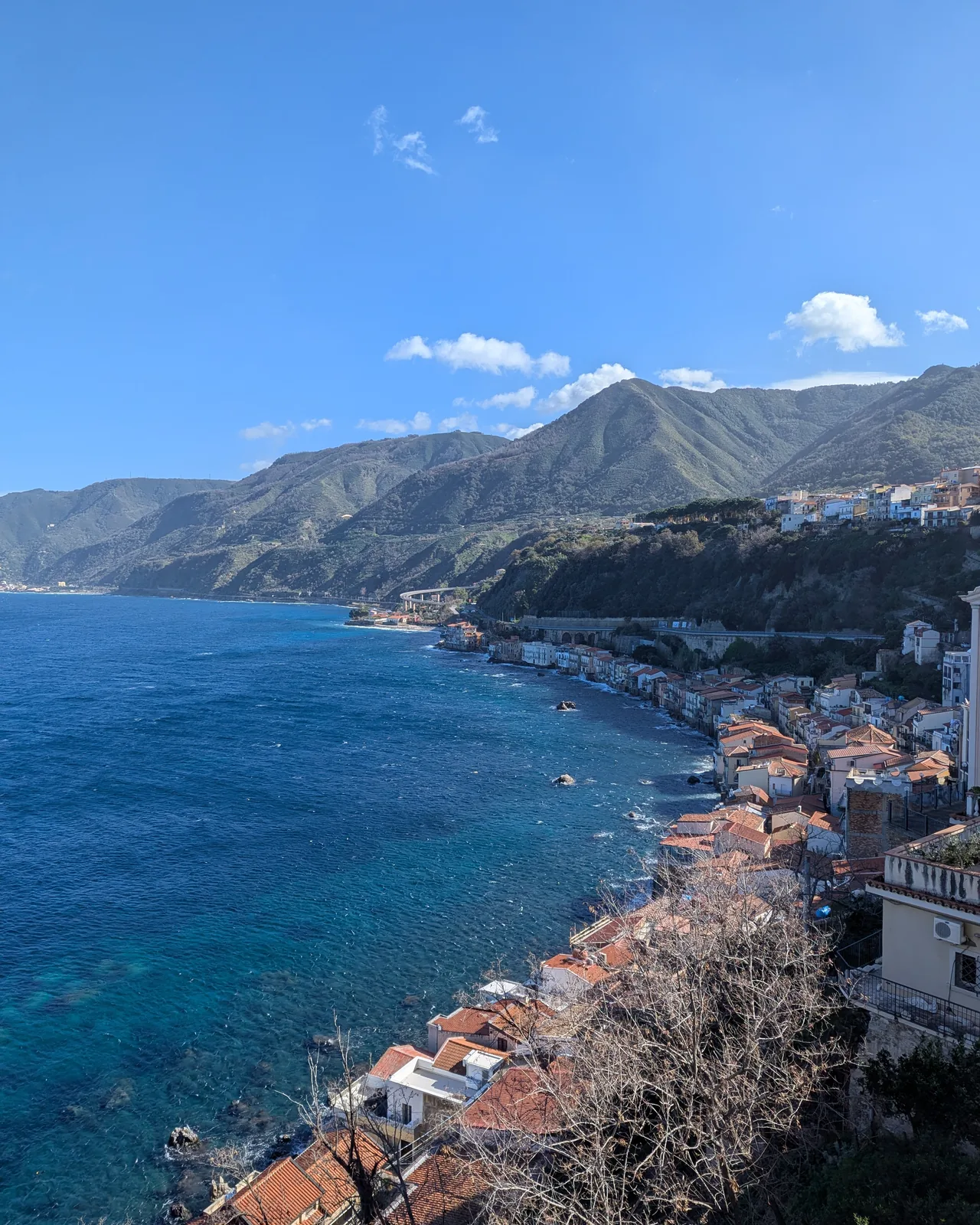
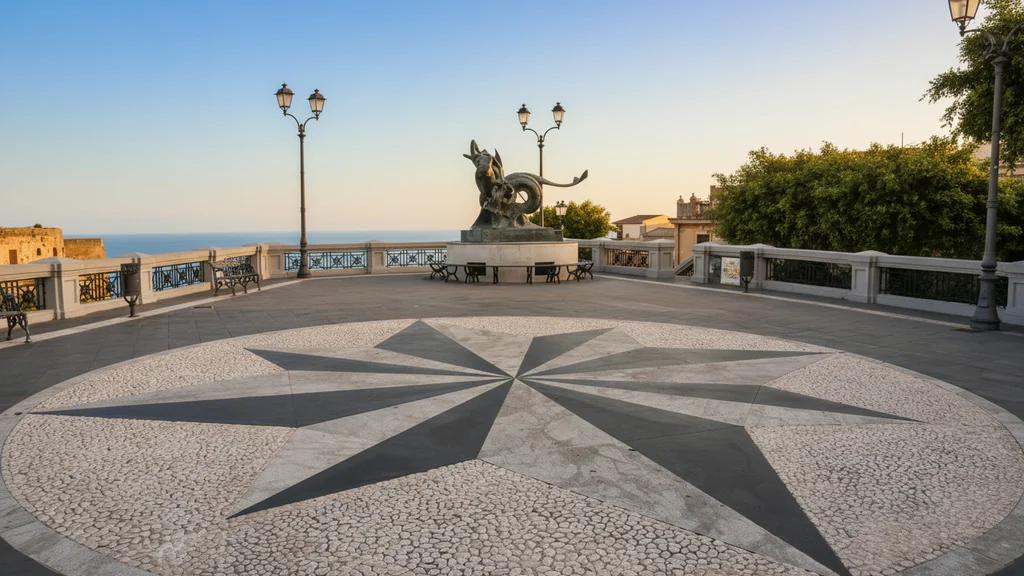
Piazza San Rocco in Scilla is one of the key sights on any Calabrian itinerary. From this square poised above the Strait of Messina, a panorama opens over the Calabrian and Sicilian coastlines, and in favourable conditions even the distant outline of the Stromboli volcano. It is also the best place to see the town's three-part layout: upper San Giorgio, beachside Marina Grande and the fishing quarter of Chianalea. Piazza San Rocco is the centre of social life in the upper part of Scilla, situated approximately 70 metres above sea level.
The square lies above Marina Grande and Chianalea. Walking up from the beach or railway station takes around 10–20 minutes – a steep climb up steps and winding lanes of the old town. Since 2021 a paid public lift (ascensore) has linked the square with Marina Grande, entered through a tunnel off the seafront promenade; it runs seasonally and is sometimes out of service, so keep the walking route in mind. The square is freely accessible and is best visited at sunset or after dark, when the lights of the Sicilian coast appear across the strait.
| District of Scilla | Location | Main Function |
|---|---|---|
| San Giorgio | Upper part (~70m a.s.l.) | Residential and social (Piazza San Rocco) |
| Marina Grande | Southern coastline | Tourist and bathing (Spiaggia delle Sirene) |
| Chianalea | Northern coastline | Fishing and gastronomy (houses on rocks) |
Table of Contents
History of Piazza San Rocco – From Myths to Modernity
Although Piazza San Rocco is known today mainly as a viewpoint over the Strait of Messina, it is a place with a long history. Its story is bound up with Scilla's position above one of the most important sea passages in southern Italy. The square is part of the upper town, from which ship traffic in the strait has been watched for centuries.
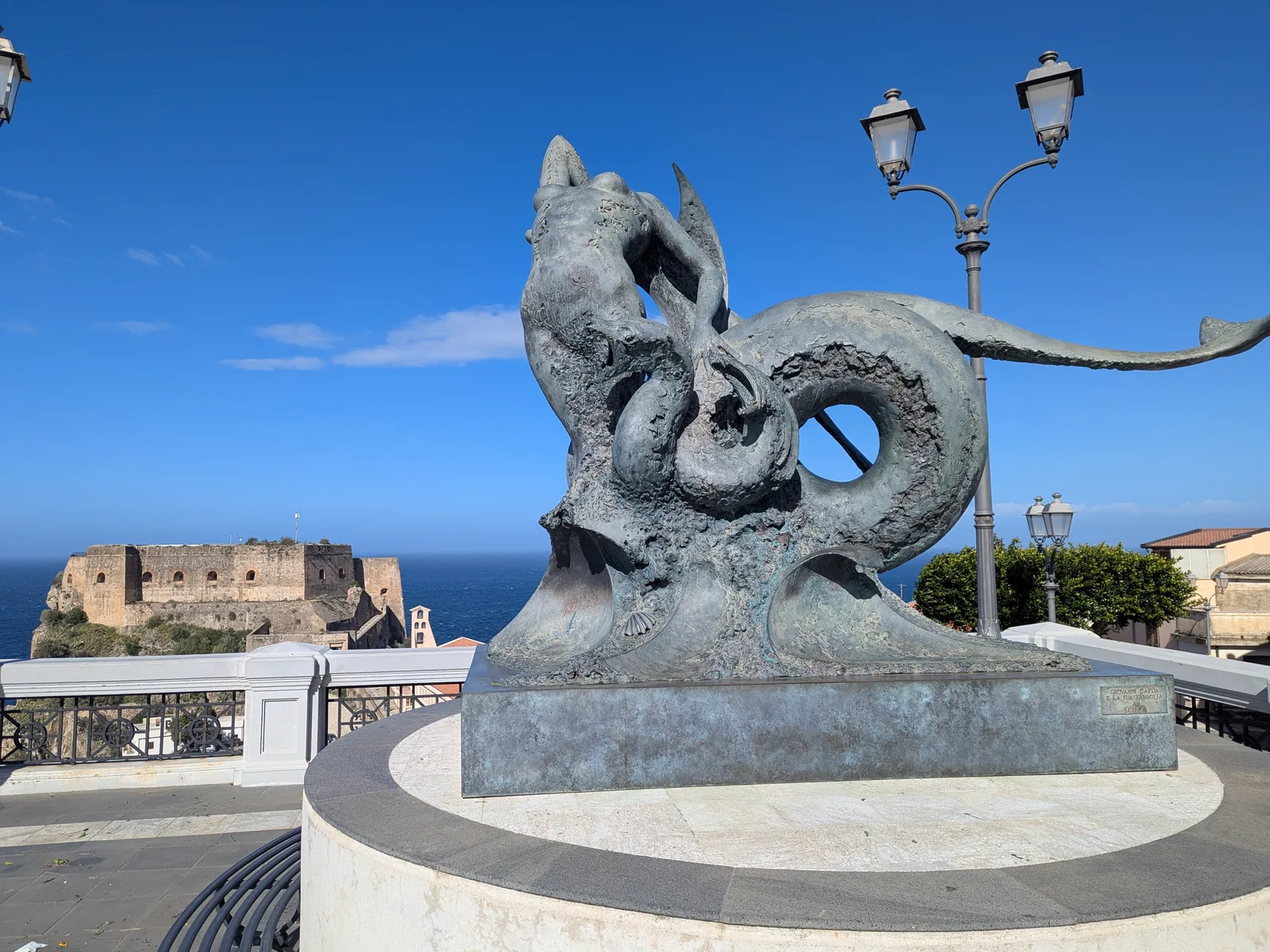
The statue, showing Scylla at the moment of her transformation into a monster, is the work of Reggio artist Francesco Triglia; it was unveiled on 26 July 2013 and, after the lift was built, moved to the top of the lift shaft. Scylla appears in Greek mythology and Homer's Odyssey as a sea monster associated with the narrow passage opposite Charybdis. Scilla sits by the Strait of Messina, at a site considered strategic for navigation between the Tyrrhenian and Ionian Seas since antiquity. Ancient authors wrote about the defensive significance of Scilla's rock, and later phases of fortification were associated with the Byzantine, Norman and early modern periods.
Medieval Roots and Urban Evolution
The square's present appearance is the result of years of transformation and reconstruction following the devastating earthquakes of 1783 and 1908, which left a clear mark on the entire town. Today's space combines the daily life of residents with the memory of successive stages in Scilla's development.
Traces of the Past in the Square's Architecture
Although precise documents describing the early development of Piazza San Rocco are lacking, it is easy to see how Scilla's past continues to influence this space to this day. The stone streets leading to the square recall that the upper part of the town was linked both to the daily life of residents and to observing the strait. The square's strategic position enabled monitoring of ship traffic, which for centuries was of defensive significance.
The Square Today
Today, Scilla attracts visitors with a combination of natural beauty and history stretching from mythology to modern times. Piazza San Rocco remains above all an important viewpoint and meeting place, where residents and visitors pause to look out over the strait, the castle, and the Sicilian lights on the other side of the water. It is one of those places that best shows the character of Scilla – a town suspended between rock, sea and legend.
Church of San Rocco – The Square's Spiritual Heart
The dominant feature of the square is the Church of San Rocco (Chiesa di San Rocco), dedicated to Saint Roch, Scilla's patron and one of the most important saints of the local cult. Its facade gives the space not only a scenic but also a religious and social character. The oldest documents confirming a church on this site come from the pastoral visit of Archbishop Annibale D’Afflitto in 1594.
The new church was built between 1738 and 1751. The earthquake of 28 December 1908 destroyed the church facade and roof; after long years of rebuilding and restoration it reopened for worship on 16 August 1990. The main altar holds a marble statue of Saint Roch from the first half of the 16th century, attributed to Giovan Battista Mazzolo.
The feast of San Rocco in Scilla begins around 16 August, the saint's liturgical feast day, while the main celebrations with processions and the trionfino usually take place on the weekend after that date; check the programme for the specific year before travelling. The celebrations include a mass, a procession carrying the saint's statue through all three districts – Chianalea, Marina Grande and San Giorgio – and evening events on the square.
The culminating moment of the procession is the trionfino on Piazza San Rocco. The saint's statue is then carried at a run by the bearers (portatori) beneath a cascade of fireworks. It is the most recognisable element of the feast and the moment when the square becomes the centre of life for all of Scilla.
The Strait of Messina – Key Hub of Mediterranean Navigation
The Strait of Messina is a narrow sea passage about 33 km long, and its width ranges from roughly 3.1 km to 16 km. The narrowest stretch lies in the north, between Capo Peloro on the Sicilian side and the Torre Cavallo area and Villa San Giovanni coast on the Calabrian side. It is from here, from Piazza San Rocco, that one can best see how close Calabria and Sicily lie to each other.
Geographically, the strait connects the Tyrrhenian Sea with the Ionian Sea and separates Sicily from Calabria. Its strong currents, well known to sailors and fishermen, lie behind the myth of Scylla and Charybdis. For visitors to Scilla, however, it is above all a landscape that changes with the weather and the light.
In good visibility the Sicilian coast is clearly visible. Etna, however, cannot be seen from the square – it is hidden by the hills rising above Scilla to the south-west; for views of the volcano, head to the seafront in Reggio Calabria. After dark the panorama changes character: instead of the coastline, the lights of Messina, Capo Peloro and towns on both sides of the strait become most visible. From Piazza San Rocco it is also easy to understand why this short stretch of sea has so strongly shaped the history of Scilla.
Watch on YouTube
Ruffo Castle – Guardian of History and Cultural Heart of Scilla
Ruffo Castle (Castello Ruffo di Scilla) is one of the most important viewpoints over the Strait of Messina. Perched on a lofty rock, the castle enables visitors to admire the landscapes of Costa Viola and the picturesque Chianalea district. The fortifications on Scilla's rock have ancient roots, and the present castle complex was rebuilt in the Middle Ages and the early modern period.
The castle has been associated with Byzantine and Norman phases, and later with the Ruffo di Calabria family. In 1533 the fortifications were expanded during the period of the Spanish viceroyalty in response to Ottoman and corsair threats, and the site continued to serve military functions into the modern era. Today the castle is open to visitors and pairs naturally with a walk around Piazza San Rocco and the upper part of Scilla.
The castle entrance is on Piazza Matrice. It is open Tuesday to Sunday, 9:00–13:40 and 15:00–20:00 (closed on Mondays). A ticket costs €3, and children under 6 and visitors with disabilities with a companion enter free. Hours can change with the season – the Comune di Scilla website has the current ones.
The Aeolian Islands and Costa Viola Seen from Piazza San Rocco
From the square you can usually see the Sicilian coast around Messina and Capo Peloro (Punta del Faro), as well as Ruffo Castle, Marina Grande and Chianalea. The cone of Stromboli appears on the horizon when the air is exceptionally clear, especially after rain or in dry conditions, while the other Aeolian Islands are not constantly or easily visible.
From the terrace, one can admire the imposing cliffs of Costa Viola, which often take on violet-pink tones at sunset. The name Costa Viola refers precisely to these colours of the sea and rocks, seen especially in the evening along the stretch of coast between Villa San Giovanni, Scilla, Bagnara Calabra and Palmi. The area is also known for traditional swordfish fishing (pesce spada) from feluccas (feluche) – boats with a tall lookout mast and a very long bow gangway (passerella), from which the harpooner spots the fish.
Frequently Asked Questions
What can you see from Piazza San Rocco in Scilla?
The square offers a panoramic view of the Strait of Messina, the Sicilian coastline around Messina and Capo Peloro, Ruffo Castle, Marina Grande and Chianalea. When the air is exceptionally clear, Stromboli can be visible. Etna cannot be seen from the square – the hills above Scilla block the view.
Where is the best viewpoint in Scilla?
Piazza San Rocco is considered the best publicly accessible viewpoint, alongside the paid terraces of Ruffo Castle. The square offers a wide perspective over the entire area from a height of approximately 70 metres.
Can you see Sicily from Piazza San Rocco?
Yes, Sicily is usually very clearly visible from the square, especially the stretch of coast around Messina and Capo Peloro. After dark, the lights on the other side of the strait are also easy to see.
How do you get to Piazza San Rocco from the beach?
On foot from the Marina Grande area or the railway station – a steep climb up steps and lanes of the old town that takes around 10–20 minutes. In season you can take the paid public lift (ascensore), which rises from Marina Grande to the square in under a minute; the entrance is through a tunnel off the promenade. The lift is sometimes out of service, so check before you go.
When does the San Rocco festival take place in Scilla?
The feast of San Rocco begins around 16 August, while the main local celebrations with processions and the trionfino usually take place on the weekend after 16 August. The programme can vary from year to year, so check the current dates before travelling.
Nearby
Sources
The information in this article was verified against the following sources:
- Castello Ruffo - Comune di Scilla – comune.scilla.rc.it
- mit.gov.it (PDF) – mit.gov.it
- Il Culto di San Rocco – Radio Scilla Web – radioscillaweb.com
- È vero che le coste siciliane e calabresi si stanno allontanano l’una dall’altra? – strettodimessina.it
- Chiesa di San Rocco - Discover Scilla – discoverscilla.com
- Wikipedia – Strait of Messina – en.wikipedia.org
Last updated: