Stilo, known as the Città del Sole (City of the Sun), is a town in Calabria set at the foot of Monte Consolino, above the valley of the Stilaro river. Its importance comes from its Byzantine heritage, medieval monuments, and links with the philosopher Tommaso Campanella. The main sight is the Cattolica di Stilo, a small five-domed church and one of the most recognisable Byzantine monuments in the region. Stilo, home to just over 2,000 residents, is best explored without rushing, combining a walk through the historic centre with the climb to Monte Consolino and trips to Bivongi, Pazzano, and Monasterace.
Table of Contents
- Byzantine heritage of Stilo – its influence on the culture of Calabria
- The significance of Stilo's architectural heritage
- Fusion of styles – Byzantine and Norman architecture in Stilo
- Stilo – the influence of Tommaso Campanella's philosophy on the town's heritage
- Stilo – a cultural gem of Calabria
- Stilo – a cycling mecca in the heart of Calabria
Byzantine heritage of Stilo – its influence on the culture of Calabria
Stilo, set among the green hills of Calabria, is one of the most important places linked to Byzantine culture in the southern part of the region. For centuries, the area around the Stilaro valley was connected with the Basilian-Greek tradition and the presence of monks who shaped local spirituality, sacred art, and the layout of settlements. One lasting trace of this heritage was the survival of Greek dialects in southern Calabria long after the Middle Ages; today, Greko-Calabrian survives only fragmentarily, mainly in the Bovesìa area.
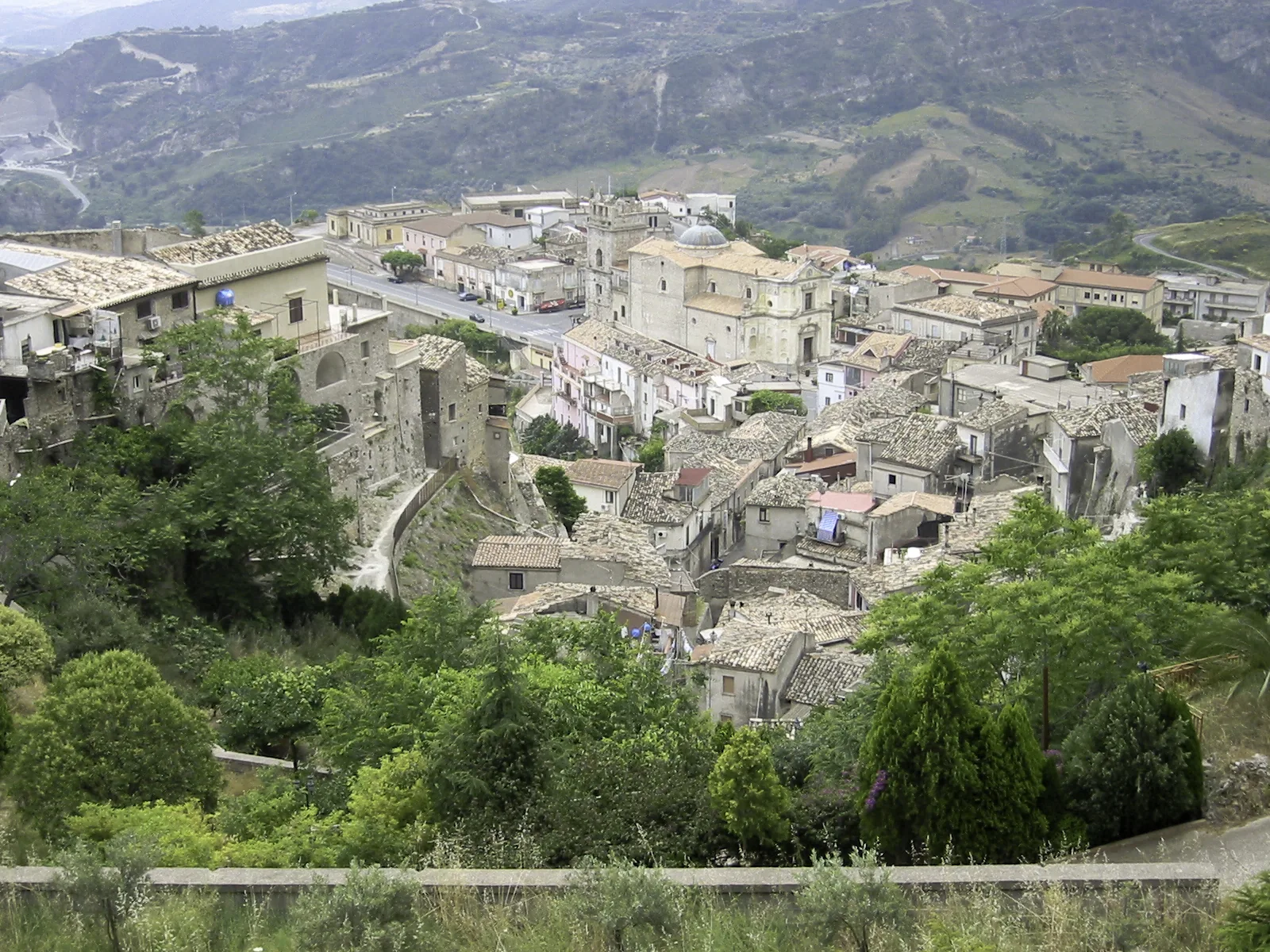
Stilo's influence on the culture of Calabria is seen above all in its sacred monuments and in the layout of the historic centre, where the Eastern liturgical tradition long coexisted with Latin church organisation. Stilo's medieval buildings show how local communities adopted and reworked Greek, Byzantine, Latin, and Norman influences. This is not an open-air museum of one single period, but a place where successive layers of history remain legible in the architecture, inscriptions, and distribution of churches.
Today's Stilo lies by the valley of the Stilaro river, at the foot of Monte Consolino, and makes a good base for Bivongi, Pazzano, and the Marmarico waterfall. Its architectural heritage and importance as a former centre of Greek-Byzantine culture make it a significant stop on the historic trail of Magna Graecia. Stilo is best understood together with its surroundings: monasteries, mountain paths, former settlements, and archaeological sites on the Ionian coast.
The significance of Stilo's architectural heritage
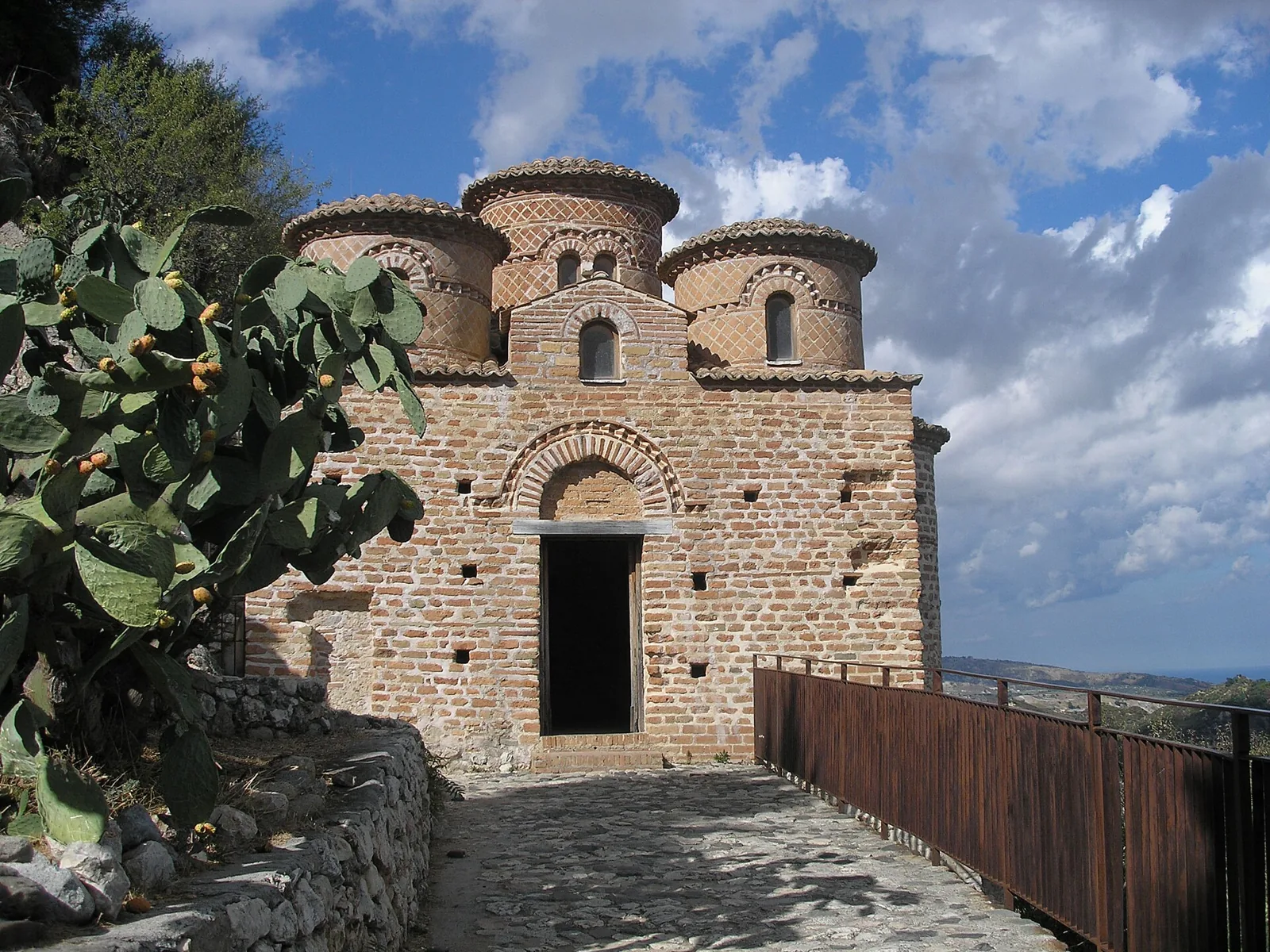
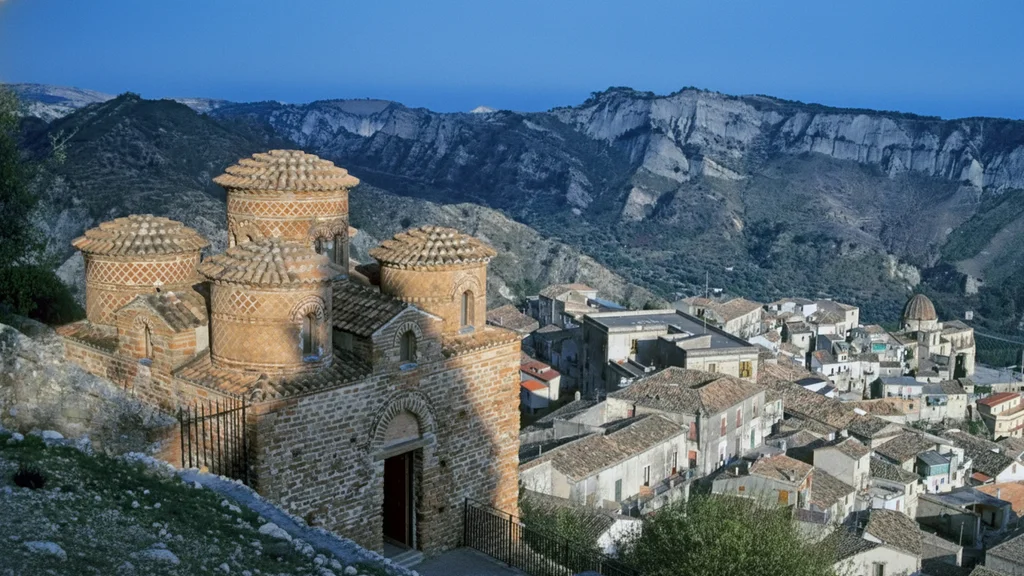
The best-known example of Byzantine architecture in Stilo is the Cattolica di Stilo. It is one of the most valuable and recognisable Byzantine monuments in Calabria; together with other Basilian-Byzantine complexes, it appears on Italy's UNESCO Tentative List. The building, erected on a square plan, preserves a compact spatial layout and five domes, and entrance costs 4 euros for a standard ticket and 2 euros for a reduced ticket.
Cattolica di Stilo – a jewel of Byzantine architecture
This small church, dating from the turn of the 9th and 10th centuries, is one of Calabria's most important monuments built in the form of a Greek cross inscribed in a square. The strength of the Cattolica di Stilo lies in its proportions, compact volume, and use of brick and stone, clearly visible in the five characteristic tile-covered domes. The church's architecture refers to Eastern models, but remains firmly rooted in the local landscape and building materials.
The interior of the church contains four columns made of spolia, probably taken from earlier Hellenistic or Roman buildings in the area; some scholars connect them with the territory of ancient Kaulon. On one of them, an Arabic inscriptions were found: the shahada (“there is no god but the one God”) and the formula “praise be to God”. Scholars explain them in several ways: temporary use of the church as a Muslim oratory, the work of Arab craftsmen, or columns brought to the site already inscribed. Either way, they reflect the multicultural context of southern Calabria. The walls are decorated with layered frescoes dated from the 10th to the 15th century, rediscovered only in 1927, with images of saints in the Eastern tradition.
Historical significance and cultural influences
Stilo developed outside the largest coastal centres, but it was not isolated from the political and religious changes of southern Italy. Its position between the mountain hinterland and the Ionian Sea encouraged contact with coastal settlements, ancient Greek centres, and later Norman strongholds. Contemporary epigraphic research and analysis of the monuments show that the local community combined Latin, Greek, and Oriental elements over the centuries.
| Feature | Technical details | Significance |
|---|---|---|
| Construction | Brick and stone (9th–10th century) | Byzantine durability and aesthetics |
| Floor plan | Greek cross inscribed in a square | Symbolism of divine harmony |
| Details | 5 domes, ancient columns | One of Calabria's most recognisable monuments |
| Inscriptions | Kufic script (Arabic) | Evidence of multiculturalism |
Fusion of styles – Byzantine and Norman architecture in Stilo
Stilo has preserved visible traces of several periods, from its Byzantine religious heritage to later rebuilding linked with the Latin and Norman order of southern Italy. One of the most important monuments in the centre is the Duomo, or Chiesa Matrice di Santa Maria d’Ognissanti, which has medieval origins, although its current form is the result of later rebuilding, especially after the earthquake of 1783. In Stilo's historic centre, it is clear that local architecture is not uniform: older sacred structures stand beside elements from later building phases and local craftsmanship.
Characteristics of the monuments
The Chiesa Matrice di Santa Maria d’Ognissanti is the main church of the historic centre and a natural reference point for a walk through Stilo. Its structure and interior are marked by simplicity, while successive rebuildings reflect the changes that affected the town after earthquakes and administrative transformations. In the façades and details of local churches, you can trace the transition from older sacred traditions to forms typical of later centuries.
Above the town rise the ruins of the Norman castle, built by Roger II on the summit of Monte Consolino. The castle is reached by a Via Crucis path of 14 stations, which begins in the area of the Cattolica. The ascent takes about 30 minutes, and from the top you can see the historic centre, the Stilaro valley, and the Ionian coast.
Stilo – the influence of Tommaso Campanella's philosophy on the town's heritage
Tommaso Campanella, who lived from 1568 to 1639, was one of the most important intellectuals of the Renaissance, and his connection with Stilo gives the town an additional historical dimension. The philosopher spent 27 years in prison for his beliefs and his involvement in a conspiracy against the Spanish, and his biography is deeply embedded in local memory. Stilo uses this theme not as decoration, but as part of the story of Calabria at the turn of the 16th and 17th centuries.
His most famous work, The City of the Sun (Civitas Solis), is a utopian vision of a society governed by sages, founded on knowledge and harmony. Although Campanella wrote it in a Neapolitan prison, many scholars connect the image of a city set on a hill and surrounded by walls with the landscape of Stilo. In Stilo you can see places associated with Campanella, including the church of San Domenico and the remains of the former Dominican monastery, where the philosopher stayed for a short time; his memory is also preserved by the Museo Civico and the municipal library.
In the centre of Stilo there are places connected with Campanella, including the philosopher's monument and the church of San Domenico with the remains of the former Dominican monastery. This theme complements visits to the Cattolica and the Duomo, because it shows the town not only as a point on the map of Byzantine architecture, but also as a place linked to the history of European political thought. A walk in Campanella's footsteps is best combined with a visit to local cultural institutions, if they are open on the day you arrive.
Watch on YouTube
Stilo – a cultural gem of Calabria
Stilo is one of the most interesting towns in Calabria for travellers who want to combine monuments, history, and landscape. Beyond the town itself, plan a trip to Monasterace, about 15 kilometres away, where the site of ancient Kaulon is located. There you can see the remains of the Greek colony and the famous mosaic with a dragon motif from the so-called Casa del Drago, now displayed in the archaeological museum by the Kaulon park.
The most important historical event in Stilo is the Palio di Ribusa, a re-enactment held on the first weekend of August. The programme includes figures in historical costumes, flag throwers, court dances, and performances referring to the 15th–17th centuries. If you plan to visit at this time, book accommodation and parking in advance, because the small centre has limited capacity.
Stilo has several specific cultural sites that help organise the town's local history. The official Calabria Straordinaria guide lists the Museo d’arte sacra, the Museo di archeologia industriale connected with the 18th–19th-century fonderie borboniche, the Pinacoteca d’arte moderna e contemporanea “Francesco Cozza”, the Museo Civico, and the Biblioteca Civica dedicated to Tommaso Campanella. Before visiting, check current opening times, as in small Calabrian towns they may change seasonally.
Tourist trails exploring history and nature
Stilo works well as a base for routes combining the nature of the Parco delle Serre with the history of the Stilaro valley. A popular destination is the Marmarico waterfall, one of the highest in the southern Apennines, as well as the lower, picturesque Pietra Cupa waterfall on the Assi fiumara in Guardavalle. These excursions require better preparation than a walk through the centre: you need trekking shoes, water, and a check of trail conditions.
A specific route for well-prepared hikers is the Ferdinandea–Marmarico trail described by the Parco delle Serre. The start is at Ferdinandea in the municipality of Stilo, and the route leads to the Cascate del Marmarico in the municipality of Bivongi; the whole walk is about 9 km there and back. Walking time is about 5 hours, elevation gain is 441 m, altitude ranges from 627 to 1060 m above sea level, and the difficulty is described as medium-high.
Following the Magna Graecia trail, travellers can plan a longer expedition: from Stilo, through Locri Epizephirii, all the way to Reggio Calabria. It is in the regional capital that the famous Bronzi di Riace are displayed, ancient sculptures retrieved from the sea, which complete the historical story of Calabria's Greek roots. Such a route allows you to compare Byzantine Stilo with the ancient heritage of the Ionian coast.
Practical tips for visitors
The best time to visit Stilo is spring and autumn, when the weather is good for walks through the centre and trekking on Monte Consolino. The most convenient way to reach the town is by car, as this allows you to combine Stilo with Bivongi, Monasterace, Gerace, or Locri in one route. For those using public transport, the nearest railway station is in Monasterace, from where local buses run, though their frequency can be limited.
The official Ministero della Cultura website gives the Cattolica di Stilo ticket price as 4.00 euros for a standard ticket and 2.00 euros for a reduced ticket. Standard opening hours on the MiC website are: Monday closed, Tuesday–Saturday 8:30–19:30, Sunday 9:30–19:30, with the ticket office closing 15 minutes earlier. However, a Comune di Stilo notice dated 27 July 2026 states that the site reopens from 29 July 2026 with temporarily different hours: Monday closed, Tuesday and Sunday 14:00–19:30, Wednesday–Saturday 8:30–19:30, the first Sunday of the month and 15 August 8:30–19:30.
Stilo – a cycling mecca in the heart of Calabria
Stilo combines steep climbs, side roads in the Stilaro valley, and views of the Ionian Sea, making it an interesting destination for cyclists looking for routes away from the crowded coast. Its position at the foot of Monte Consolino means that even short rides can be physically demanding, especially in summer. The region is developing cycle-tourism concepts, including through the “Calabria in Bici” project, but before travelling you should check the local availability of e-bike rentals.
The most natural cycling directions from Stilo lead towards Bivongi, Pazzano, the Stilaro valley, and the coast around Monasterace. Cyclists value these routes for lighter traffic than around the main resorts and for the possibility of combining a ride with short visits to villages and viewpoints. Before a longer route, check elevation gain, road conditions, and service availability, as local cycling infrastructure can be scattered.
Stilo – Byzantine gem of Calabria: frequently asked questions
What is the Cattolica di Stilo and why is it unique?
The Cattolica di Stilo is a small Byzantine church from the 9th–10th century, built on a Greek cross plan with five domes. It is unique for its architecture, surviving frescoes, and Arabic inscriptions on the columns, making it one of the most important Byzantine monuments in Calabria.
How do I get to Stilo – is there a train?
There is no railway station in Stilo itself. The nearest stop is Monasterace-Stilo, located on the coast about 11 km from the town. From the station, you can reach central Stilo by local bus or taxi, but the most convenient option is to travel by car.
How long does it take to visit Stilo?
A basic visit to the centre and the Cattolica takes about 2–3 hours. If you plan to climb to the Norman castle via the Via Crucis path and visit places connected with Tommaso Campanella, set aside a full day, or at least 5–6 hours.
Can Stilo be combined with a visit to Locri or Gerace?
Yes, Stilo is close to other important places in Calabria. Gerace is about an hour away by car, and the archaeological park at Locri is about 55 minutes. This is a popular route that allows you to explore the legacy of Magna Graecia and the Norman era in a single day.
Who was Tommaso Campanella and what is his connection with Stilo?
Tommaso Campanella was a Renaissance philosopher and theologian, author of the utopian work “The City of the Sun”. He was born in Stilo, and the town still preserves his memory through a monument, the Museo Civico, the municipal library, and places connected with the former Dominican monastery.
What other Byzantine cultural sites are worth visiting in Calabria?
Beyond Stilo, visit Rossano with the Oratorio di San Marco, the baptistery at Santa Severina, and the monastery of San Giovanni Theristis in nearby Bivongi. Together with the Cattolica di Stilo, they are among the most important points of Basilian-Byzantine heritage in the region.
Main attractions
Cattolica di Stilo
One of the most valuable Byzantine monuments in Calabria (9th–10th c.). Five domes, frescoes from the 10th–15th century, and an Arabic inscription on one of the columns.
Duomo – Santa Maria d’Ognissanti
The Duomo, or Chiesa Matrice di Santa Maria d’Ognissanti, has medieval origins, but owes its current form to later rebuilding, especially after the earthquake of 1783.
Norman castle on Monte Consolino
Ruins of Roger II's castle on the mountain summit. Reached via the Via Crucis path (approx. 30 min) – panoramic views of central Stilo, the Stilaro valley, and the Ionian coast.
Monastery of San Domenico – Campanella traces
The church of San Domenico and the remains of the former Dominican monastery, where Tommaso Campanella stayed for a short time; the philosopher's memory is also preserved by the Museo Civico and the municipal library.
Ruins of Kaulon – Monasterace
About 13 km from Stilo – the site of the ancient colony of Kaulon, founded in the second half of the 7th century BC; surviving remains include a Doric temple from 470–460 BC and mosaics from the Casa del Drago displayed in the museum.
Marmarico and Pietra Cupa waterfalls
In the Parco delle Serre – the Marmarico waterfall is among the highest in the southern Apennines, while Pietra Cupa is a lower, picturesque cascade on the Assi fiumara in Guardavalle.
Getting there
The nearest airport is Lamezia Terme (SUF) – about 100 km and 1 hr 45 min by car; the nearest station is Monasterace-Stilo, about 11 km from Stilo centre.
Lamezia Terme airport (SUF)
- SS280, SS106 and SS110About 100 km and 1 hr 45 min via Catanzaro Lido and Monasterace. Park on SS110 before the historic centre and continue on foot.
- Airlink + trainIn Trenitalia search, choose “Lamezia Terme Aeroporto”: Airlink to Lamezia Terme Centrale runs about every 30 min, with a €1.80 supplement; then take a connecting train to Monasterace-Stilo.
- Federico from the stationFrom the Monasterace FS stop, take an Autolinee Federico bus to Stilo.
Reggio Calabria airport (REG)
- By car – about 145 kmAbout 145 km to Stilo. Leave the car at the SS110 parking area before the historic centre and continue on foot through the steep lanes.
- Airport station + regional trainTake a regional train from Reggio Calabria Aeroporto to Centrale, then continue to Monasterace-Stilo – the trip from Centrale takes about 2 hr. Then take a Federico bus to Stilo.
- Autolinee FedericoAutolinee Federico operates the Reggio Calabria–Catanzaro route via Stilo and Monasterace FS – choose a service stopping in Stilo.
From Poland – direct flights
- Ryanair flights to SUFChoose SUF – it is closer to Stilo than REG. In summer 2026, Ryanair flies from Kraków, Wrocław and Warsaw-Modlin, plus Katowice from 2 June: Tue, Thu and Sat.
- Wizz Air flights to SUFWizz Air serves Katowice from 31 March 2026: Tue, Thu and Sat, and Warsaw-Chopin from April: Mon, Wed and Fri.
- Then as from SUFThe fastest option is by car: about 100 km and 1 hr 45 min via SS280, SS106 and SS110.
From Rome or Naples
- Train to LameziaFrecciarossa or Italo to Lamezia Terme Centrale: about 4–4.5 hours from Rome and 3–3.5 hours from Naples. Intercity trains are slower: about 5.5–6.5 hours from Rome.
- Car hire from the stationFrom Lamezia Terme Centrale, the quickest option is by car: about 1 hr 45 min via SS280, SS106 and SS110 to the parking area before Stilo centre.
- Long-distance coachAlternatively, take FlixBus or MarinoBus from Rome or Naples to Lamezia Terme, then continue to Stilo via Monasterace-Stilo.
From Bivongi
- Local roadAbout 4 km on the local road through the valleys; in Stilo, park on SS110 before the historic centre.
From Monasterace (Kaulon)
- SS110 uphillAbout 11 km on SS110 from Monasterace Marina to Stilo. Parking is available on SS110 before the historic centre.
- Autolinee FedericoRegional Autolinee Federico buses run from the Monasterace FS stop to Stilo.
From Locri
- SS106 + SS110About 54 km via SS106 to Monasterace, then uphill on SS110 to Stilo. Park before the historic centre.
- Regional train + busRegional trains from Locri to Monasterace-Stilo take about 35–40 min. From Monasterace FS, change to a Federico bus for Stilo.
From Gerace
- Via the Ionian coastAbout 57 km via the Locri area and towards Monasterace; the final stretch climbs to Stilo on SS110.
From Siderno
- SS106 + SS110About 43 km on SS106 to Monasterace, then SS110 to Stilo. Park on SS110 before the historic centre.
- Regional train + busRegional trains from Siderno to Monasterace-Stilo take about 25–30 min. Then take a Federico bus from Monasterace FS to Stilo.
From Parco delle Serre
- Local roadsAbout 20 km on local roads to Stilo. Leave the car at the SS110 parking area before the historic centre.
From Reggio Calabria
- SS106 + SS110About 140 km on SS106 towards Monasterace, then uphill on SS110 to Stilo. Parking is available before the historic centre.
- Regional train + busRegional trains from Reggio Calabria Centrale to Monasterace-Stilo take about 2 hr. From Monasterace FS, take a Federico bus to Stilo.
- Autolinee FedericoDirect Autolinee Federico services run on the Reggio Calabria–Catanzaro route and stop in Stilo.
From Catanzaro
- Towards SS106About 76 km towards the Ionian coast and Monasterace, then uphill on SS110 to Stilo. Parking is available before the centre.
- Autolinee FedericoAutolinee Federico operates the Catanzaro–Reggio Calabria route via Stilo and Monasterace FS – choose a service stopping in Stilo.
Journey times are approximate. Timetables: Trenitalia, Ferrovie della Calabria, local operators.
Near Stilo
Sources
The information in this article was verified against the following sources:
- La cattolica – cultura.gov.it
- musei.calabria.beniculturali.it – musei.calabria.beniculturali.it
- Stilo - Parco delle Serre – parcodelleserre.it
- Ferdinandea-Marmarico - Parco delle Serre – parcodelleserre.it
- calabriastraordinaria.it (PDF) – calabriastraordinaria.it
- Matrice di Ognissanti Stilo,XIV - XIX – catalogo.beniculturali.it
- Just a moment... – whc.unesco.org
- Parco Naturale Regionale delle Serre: L'Area Protetta – parks.it
- Cammino del Normanno - Regione Calabria – regione.calabria.it
- Lingue sotto il tetto d'Italia. Le minoranze alloglotte da Bolzano a Carloforte - 12. Le… – treccani.it
- consiglioregionale.calabria.it (PDF) – consiglioregionale.calabria.it
- Comune di Stilo – comune.stilo.rc.it
- Trenitalia – trenitalia.com
- Trenitalia – trenitalia.com
- prm.rfi.it – prm.rfi.it
- Autolinee Federico – autolineefederico.it
- Autolinee Federico – autolineefederico.it
- Comune di Stilo – comune.stilo.rc.it
- Wikipedia – Magna Graecia – en.wikipedia.org
Last updated: