In Calabria, in historic Stilo at the foot of Monte Consolino, stand the church and former monastery of San Domenico. This place brings together the town's Byzantine roots, the Dominican history of the convent of Santa Maria di Gesù, and the biography of one of the most famous thinkers of southern Italy. It is linked to the figure of Tommaso Campanella, so it clearly shows how the local history of Stilo intertwines with the history of religion, politics, and philosophy in Calabria.
Table of Contents
- Monastery of San Domenico in Stilo – from the Byzantine Church of Sant'Agata to the Dominican Convent of Santa Maria di Gesù
- Tommaso Campanella – a Philosopher within the Walls of San Domenico
- Architecture of the Monastery of San Domenico – the Uniqueness of Medieval Structures
- Monastery of San Domenico – the Heart of Calabria's Spiritual and Educational Life
Monastery of San Domenico in Stilo – from the Byzantine Church of Sant'Agata to the Dominican Convent of Santa Maria di Gesù
Introduction to the Monastery of San Domenico in Stilo
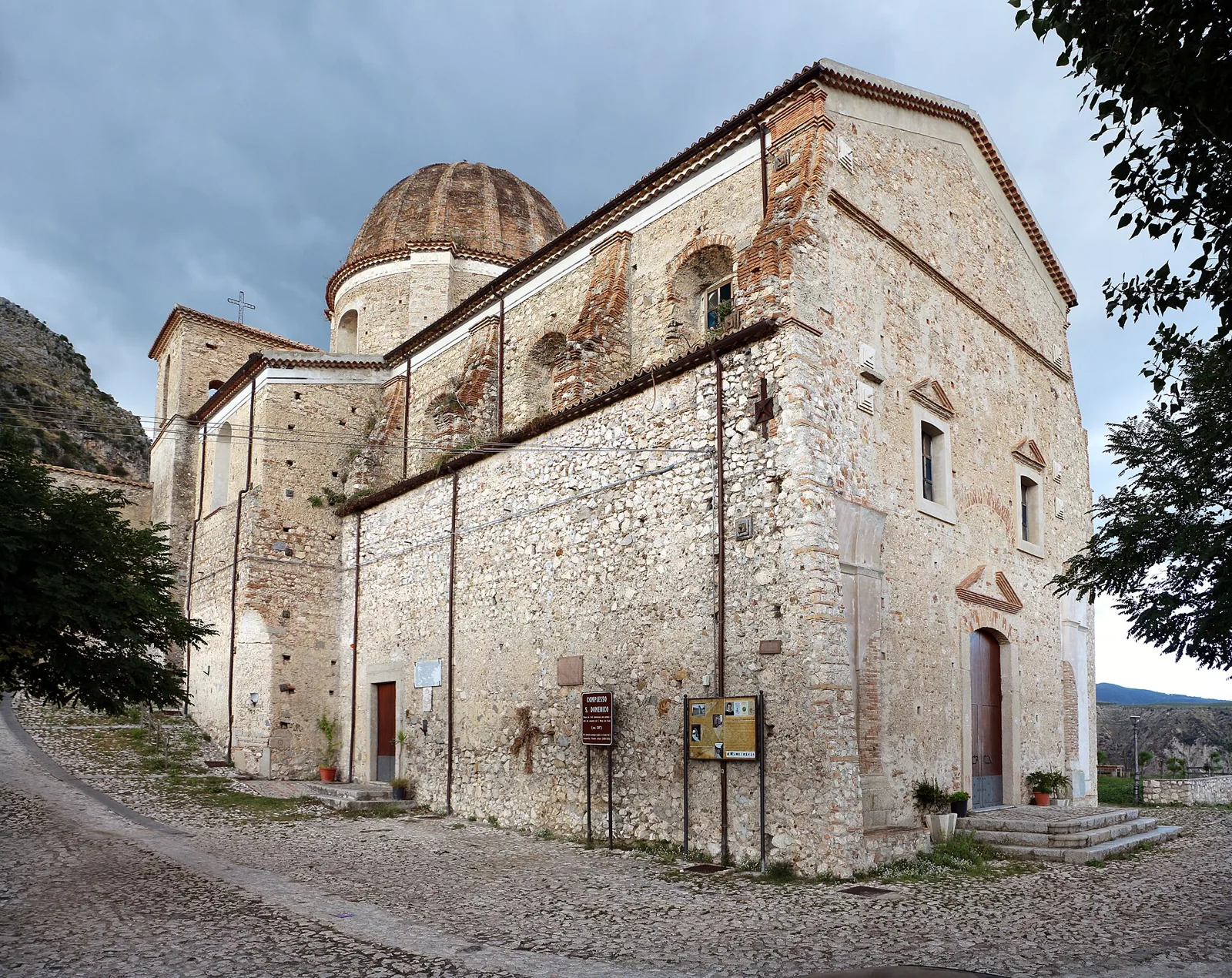
The church and former monastery of San Domenico, also known as the Chiesa del Rosario and associated with the convent of Santa Maria di Gesù, is located in Stilo, in the province of Reggio Calabria in southern Italy. The complex is one of the important monuments of the historic centre and recalls the long, layered history of this part of Calabria. Its history is a fascinating interweaving of the region's Byzantine and early modern heritage, one that resists simple classification. It is in this multicultural setting that Campanella's mind was shaped.
Stilo lies on the slopes of Monte Consolino, towering over the valley of the Stilaro river, and was an important centre during the Byzantine era. The town's most famous monument remains the Cattolica di Stilo, a small Byzantine church generally dated to the 10th century. Calabria was under strong Byzantine influence for a long time, and it was only in the 11th century that the Normans took control – a context that much better explains the presence of Greco-Byzantine tradition in the area.
Foundation of the Dominican Convent of Santa Maria di Gesù (1560)
The beginnings of the Dominican convent in Stilo should be linked to the 16th century, not to a supposed Benedictine foundation. After the preaching of Father Dionisio di Sangineto, the Dominicans received the former Byzantine church of Sant'Agata, together with the adjoining land, on 17 April 1560. On this basis the convent of Santa Maria di Gesù was established, becoming the Dominican point of reference in Stilo.
Flourishing in the Middle Ages (13th–15th Century)
Although the Dominican convent itself is an early modern foundation, the site grew out of a landscape in which the earlier layers of Stilo were still legible. Within the town and the Stilaro valley, Byzantine and Latin influences overlapped with later monastic traditions. San Domenico is therefore best understood as a bridge between the earlier memory of the site and the later history of the Dominicans, rather than as a monument confined to a single era.
Tommaso Campanella and His Connection to the Monastery
The Monastery of San Domenico in Stilo is known above all for its association with the Renaissance philosopher who came from this town. Campanella was linked to Stilo as his birthplace, but also to the Dominican environment of the convent of Santa Maria di Gesù. In 1598 he came to Stilo and lived in this very convent, which had the status of a vicariate and could house no more than six friars. Sources also record his stay in the first months of 1599 and walks with the friars in the Lanzari area.
Watch on YouTube
Tommaso Campanella – a Philosopher within the Walls of San Domenico
Tommaso Campanella was born on 5 September 1568 in Stilo as Giovanni Domenico Campanella. In September 1583 he received the Dominican habit while remaining connected with the convent in Stilo, then moved to Placanica for his novitiate year; only in 1586 was his affiliation formally transferred to the convent in Placanica. The philosopher's connection to Stilo was not limited to his birthplace: at first he was associated with the Dominican convent in Stilo, while he spent his novitiate year in Placanica and later studied, among other places, in San Giorgio Morgeto, Nicastro, and Cosenza.
|
Date |
Place |
Event |
Significance |
|---|---|---|---|
|
1583 |
Stilo / Placanica |
Receiving the habit and beginning the novitiate |
Connection with the convent in Stilo and move to Placanica for the novitiate year. |
|
1588 |
Cosenza |
Reading Bernardino Telesio |
Philosophical breakthrough and departure from syllogisms. |
|
1599 |
Calabria |
Discovery of the conspiracy |
Arrest following the anti-Spanish conspiracy. |
|
1602 |
Naples (prison) |
Writing The City of the Sun |
Creation of one of the most important utopias in history. |
Campanella was connected to Stilo as his home town and to its Dominican convent, although his formation also included other houses of the order. In 1598 he returned to Stilo and lived in the convent of Santa Maria di Gesù, and his presence is also attested in the first months of 1599. This is an important distinction, as it helps avoid both overlooking the role of Stilo and too easily reducing his entire education to one place. San Domenico therefore remains an important point in local memory, but also a concrete address in the philosopher's biography.
In 1599, Campanella was arrested after the discovery of an anti-Spanish conspiracy in Calabria. These events had both a political and a millenarian dimension, and after severe interrogations, the philosopher feigned madness to escape the death penalty. He ultimately spent about 27 years in the prisons of the Kingdom of Naples, from 1599 to 1626. It was during this long imprisonment in Naples that he wrote the philosophical utopia La città del Sole (The City of the Sun) – the text was composed in Italian around 1602, and the first edition was published in Latin in Frankfurt in 1623.
Architecture of the Monastery of San Domenico – the Uniqueness of Medieval Structures
The church of San Domenico and the ruins of the Dominican friars' convent stand on the north-eastern edge of Stilo, beside a semicircular tower and Porta Stefanina. This position clearly shows the monument's relationship with the town's former layout: it is not an isolated church, but part of the historic fabric of Stilo. Any description of the site must also take into account the effects of the catastrophic 1783 earthquake – the great earthquake that devastated the whole of southern Calabria and heavily damaged many local churches and monasteries.
Main Architectural Features
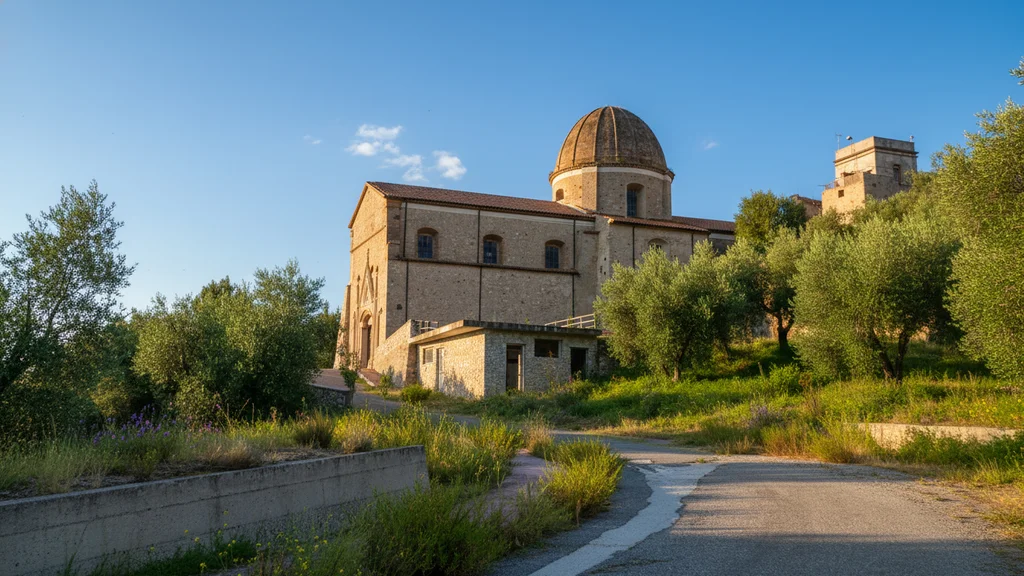
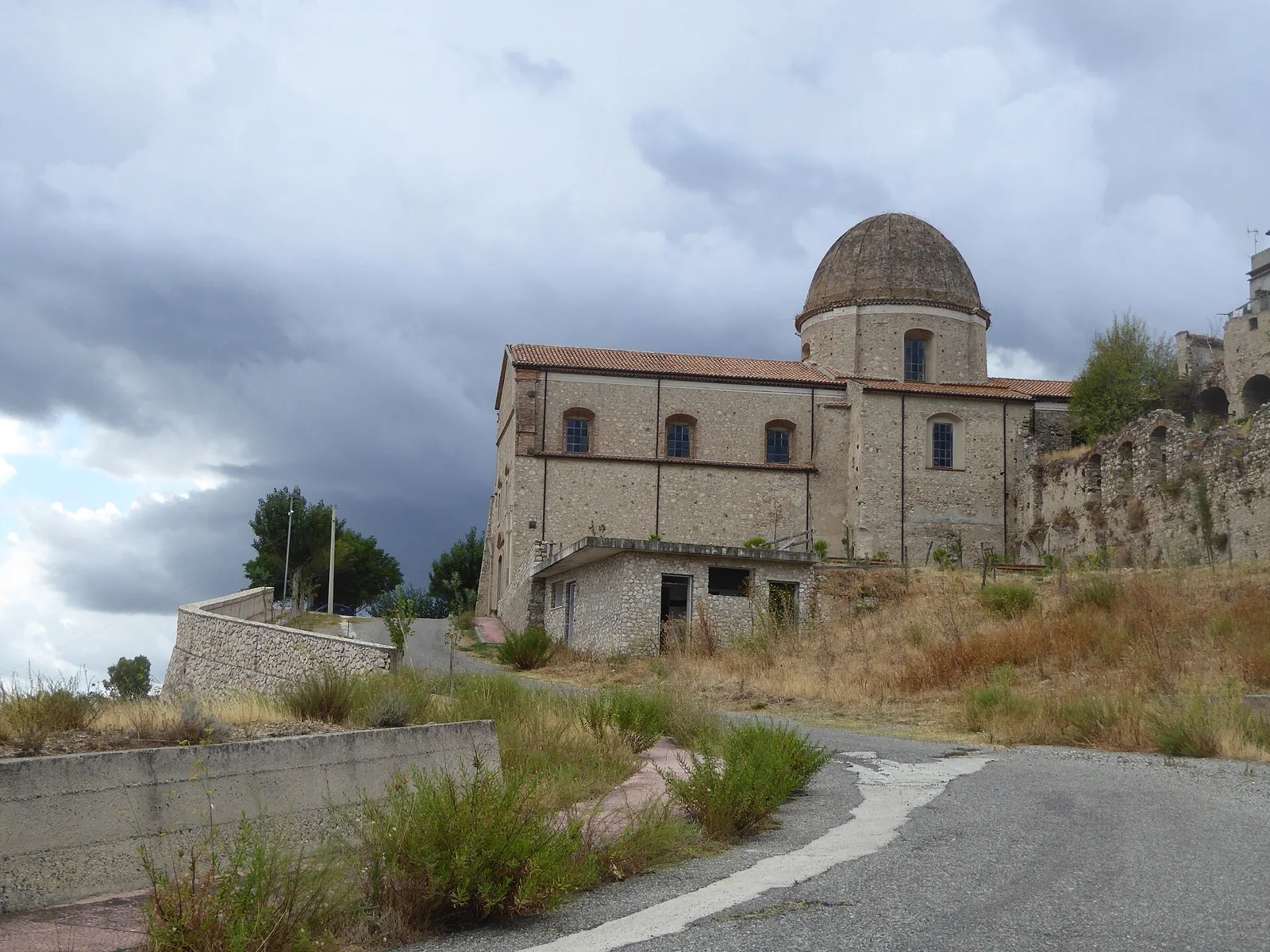
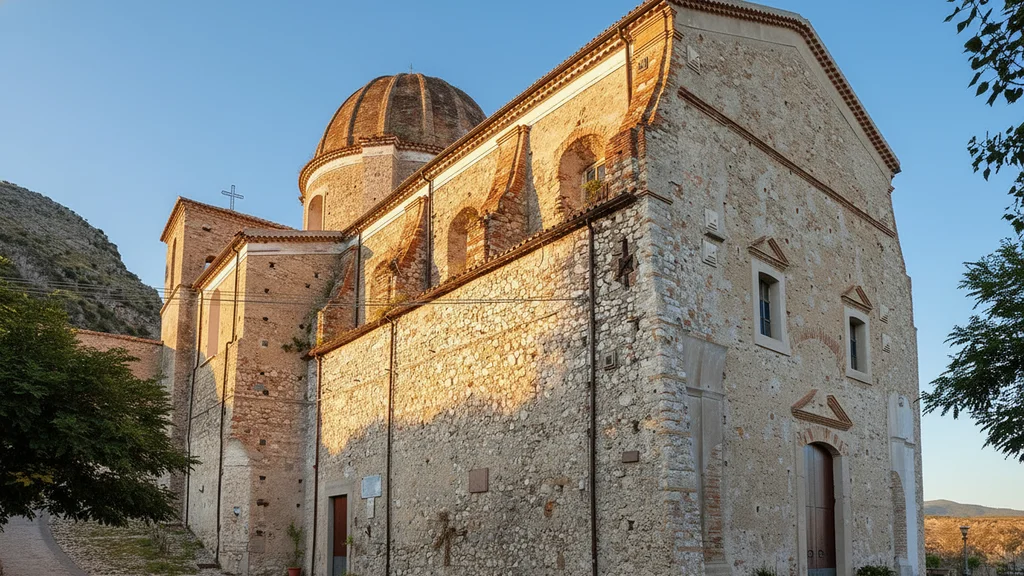
The best place to start is with the body of the church and its stark facade. The church has a Baroque-leaning character, and its most distinctive feature is the original, 17th-century dome. The interior preserves an 18th-century crucifix and a statue of Our Lady of the Rosary (Vergine del Rosario) dressed in embroidered silk. An important point is also the relationship between the church itself and the former monastic buildings that complete the layout of the complex.
-
The Monastery Church
The church is notable for its historic form, simple facade, and position beside former urban elements of Stilo. Rather than focusing on uncertain details, it is better to look at the building's proportions, the portal, and the surviving furnishings, including the 18th-century crucifix and the statue of Our Lady of the Rosary. This approach allows one to see San Domenico as a monument in which the early modern history of the Dominicans overlaps with the older layers of the town.
-
Cloisters and Monks' Cells
The remains of the monastic buildings help one imagine the daily rhythm of the former convent. The 1783 earthquake levelled the convent to the ground, which explains the present state of the ruins and the absence of the full layout of the former complex. Even if not all parts have survived, the site still shows that this was not merely a single church but an entire monastic complex.
After reconstruction in 1787, the church was chosen as the seat of the parish of Santa Marina e Lucia. In 1927 it was closed for worship after the collapse of the vault, and restoration was completed in 1998 thanks to the municipality and funds from Regione Calabria. This sequence of destruction, closure, and restoration to usable condition is essential for understanding the present appearance of San Domenico.
Monastery of San Domenico – the Heart of Calabria's Spiritual and Educational Life
San Domenico is important not only as a religious monument but also as part of a broader story about Stilo and the Stilaro valley. The area around the town combines Byzantine, medieval, and early modern heritage, which is why the monastery is best viewed in one sequence with the Cattolica di Stilo and the landscape of Monte Consolino. This way, Stilo ceases to be merely a backdrop for Campanella and reveals itself as one of the key historic towns of Ionian Calabria.
Architecture and Cultural Influence
The complex consists of a church and the remains of monastic buildings, offering a good insight into the region's historical architecture. Its cultural significance stems above all from its setting in the exceptional landscape of Stilo, between the town's monuments and the slopes of Monte Consolino. The site also recalls specific stages of local history: the Byzantine church of Sant'Agata, the Dominican foundation of 1560, the destruction after 1783, and later restorations.
Educational Legacy
The significance of San Domenico for the history of ideas today derives above all from the memory of Campanella and the local context in which he grew up. The City of the Sun is easier to understand when one remembers his long imprisonment and the tension between religion, politics, and the vision of a new social order. It is not merely a philosophical text but also a work rooted in a very specific experience of Calabria and the Kingdom of Naples.
If you are planning a visit, it is most convenient to think of Stilo as a day-trip destination from the Ionian coast. The town lies about 150 km north of Reggio Calabria and roughly 75–80 km south of Catanzaro Lido, depending on the route. The nearest station, Monasterace-Stilo, is on the Ferrovia Jonica in Monasterace Marina. From the coast to Stilo itself you can travel by local bus or by car.
For public transport, the Autolinee Federico services on the Reggio Calabria–Catanzaro route are useful. This operator's timetable shows connections linking Stilo with the railway station in Monasterace and onward towards the coast. Check the current timetable before travelling, because in small Calabrian towns the bus times are crucial for the whole day plan.
With smaller Calabrian monuments, it is best not to base your plan on opening hours found by chance online. The safest rule is simple: before visiting, check current availability at the municipal tourist information point or directly with the parish or site custodian. This way, you avoid disappointment on arrival and can more easily combine San Domenico with other points of interest in the area.
The Monastery of San Domenico is thus not only an important point on the map of Stilo but also part of a larger story of Ionian Calabria. It is best visited unhurriedly, alongside the town's other monuments and the views of Monte Consolino. It is then that you feel most strongly that Stilo remains one of those places where the region's history is still very close to the everyday landscape.
Frequently Asked Questions
Who was Tommaso Campanella and what was his connection to Stilo?
Tommaso Campanella was a philosopher and Dominican friar born in Stilo on 5 September 1568 as Giovanni Domenico Campanella. In September 1583 he received the Dominican habit while remaining connected with the convent in Stilo, and in 1598 he lived in the local convent of Santa Maria di Gesù.
Is the Monastery of San Domenico in Stilo open to visitors?
Availability may vary, so before visiting it is best to check current information at the municipal tourist information point or directly with the parish or site custodian. This is the safest way to plan a visit to smaller monuments in Calabria.
What did Campanella write in his work The City of the Sun?
In the philosophical utopia The City of the Sun (La città del Sole), he described a vision of an ideal state in which politics, religion, and social organisation form a single order. The text was composed in Italian around 1602 during his imprisonment in Naples, and the first edition was published in Latin in Frankfurt in 1623.
What are the most important architectural features of the monastery?
The most important features are the body of the church itself, the facade, the portal, the original 17th-century dome, and the relationship between the church and the ruins of the former Dominican convent. The interior preserves an 18th-century crucifix and a statue of Our Lady of the Rosary (Vergine del Rosario) dressed in embroidered silk.
What was Campanella's conspiracy of 1599?
It was an anti-Spanish conspiracy with a clear millenarian dimension, discovered in Calabria in 1599. After its exposure, Campanella was arrested, interrogated, and ultimately spent about 27 years in the prisons of the Kingdom of Naples.
Sources
The information in this article was verified against the following sources:
- Stilo - Parco delle Serre – parcodelleserre.it
- storiapatriacalabria.it (PDF) – storiapatriacalabria.it
- Wikipedia – Chiesa di San Domenico (Stilo) – it.wikipedia.org
- Wikipedia – Tommaso Campanella – en.wikipedia.org
Last updated: