Rising on the slopes of Monte Consolino, the Cattolica di Stilo is one of the most precious examples of Byzantine architecture to have survived to our times. The small brick church makes a strong impression both outside and inside, where remnants of wall paintings have been preserved. Since 2006, the monument has been on Italy's UNESCO Tentative List as part of a candidacy covering the Byzantine and Basilian religious complexes of the region.
The building overlooks the Stilaro river valley. Between the 9th and 11th centuries, Calabria was an important area of the Byzantine world, and Stilo was one of the most significant centres in this part of the region. The Cattolica probably served as the main church (Greek katholikon) of the local monastic communities – most likely the origin of its name – acting as a point of reference for the Greek religious tradition present in the valley.
The Cattolica di Stilo is most commonly dated to the 10th century, often narrowed to the late 10th or early 11th century. The building was erected at a time when southern Calabria belonged to the Byzantine political and ecclesiastical sphere, and Greek monasticism associated with the Basilian tradition was developing in the area. After the Norman conquest in the 11th century, many Greek religious institutions continued to function, even as Latin influence gradually grew.
Table of Contents
Architectural Mastery and the Style of Cattolica di Stilo
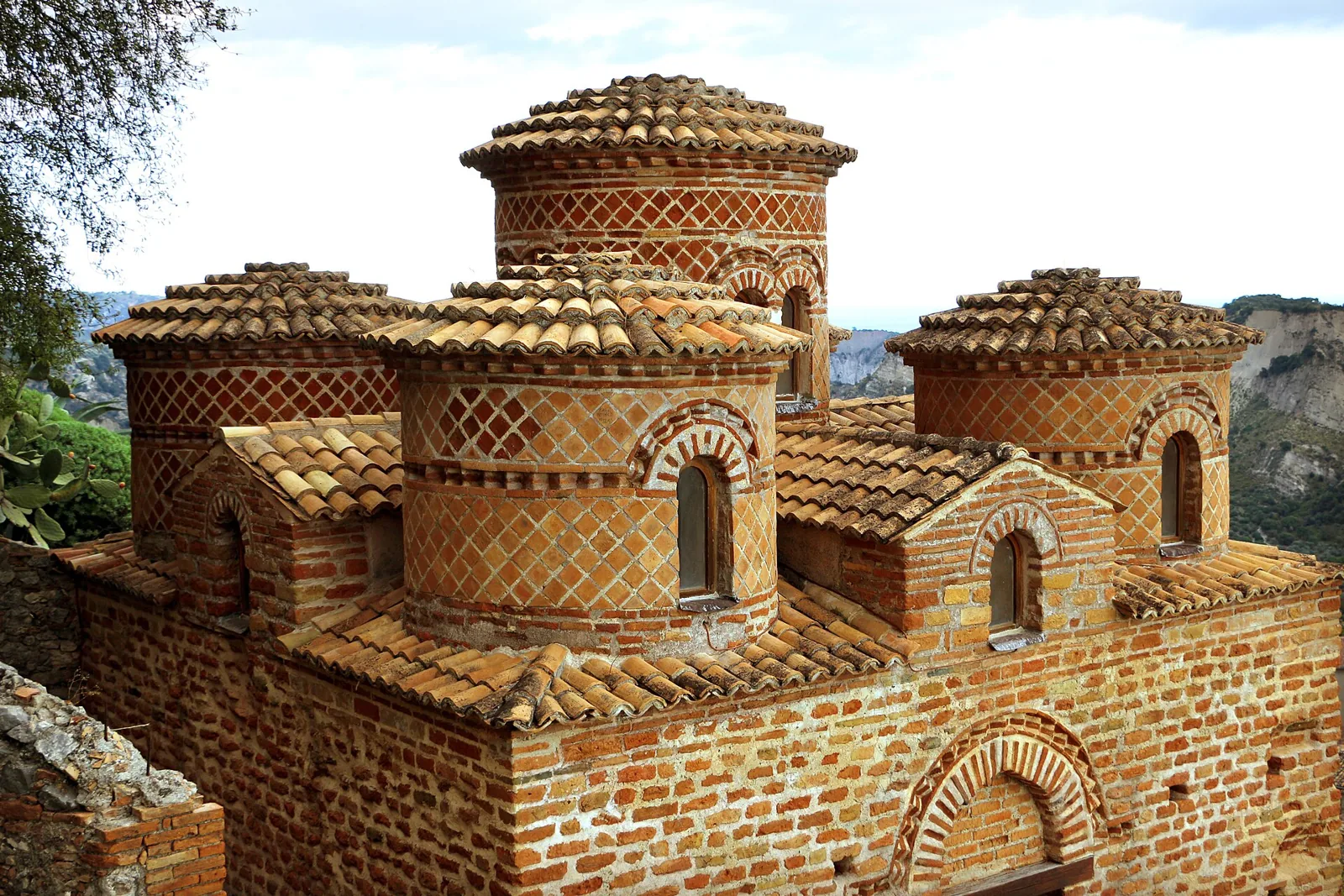
The Cattolica di Stilo is an outstanding example of Byzantine architecture in Calabria, built on a Greek cross plan inscribed within a square. This precise layout, measuring approximately 7.80 by 7.30 metres, symbolises in Byzantine theology the union of the earthly square with the heavenly sphere of the domes. The central dome rests on four columns, and the entire structure is crowned with five domes in a quincunx arrangement, resembling the pattern of dots on a die.
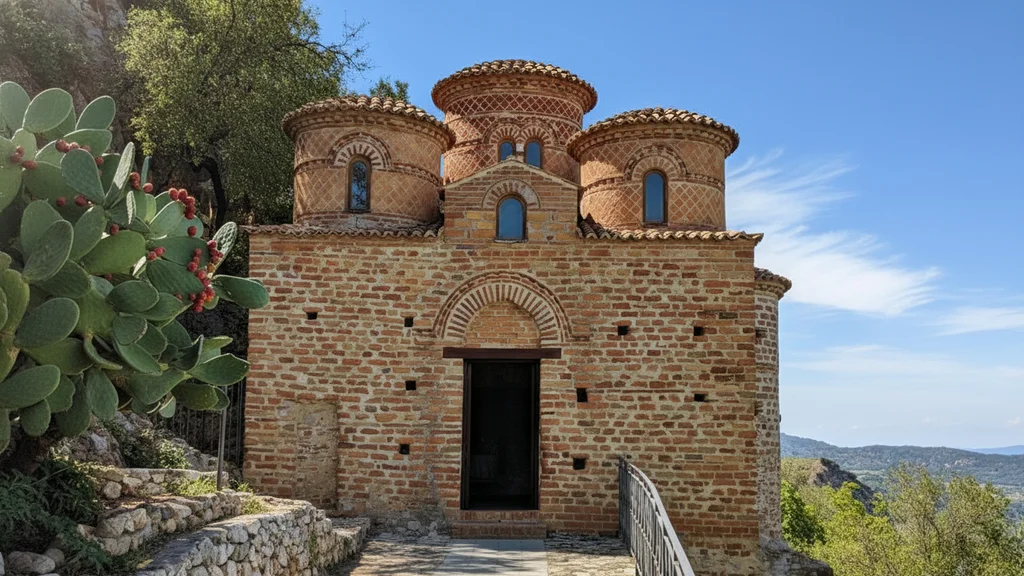
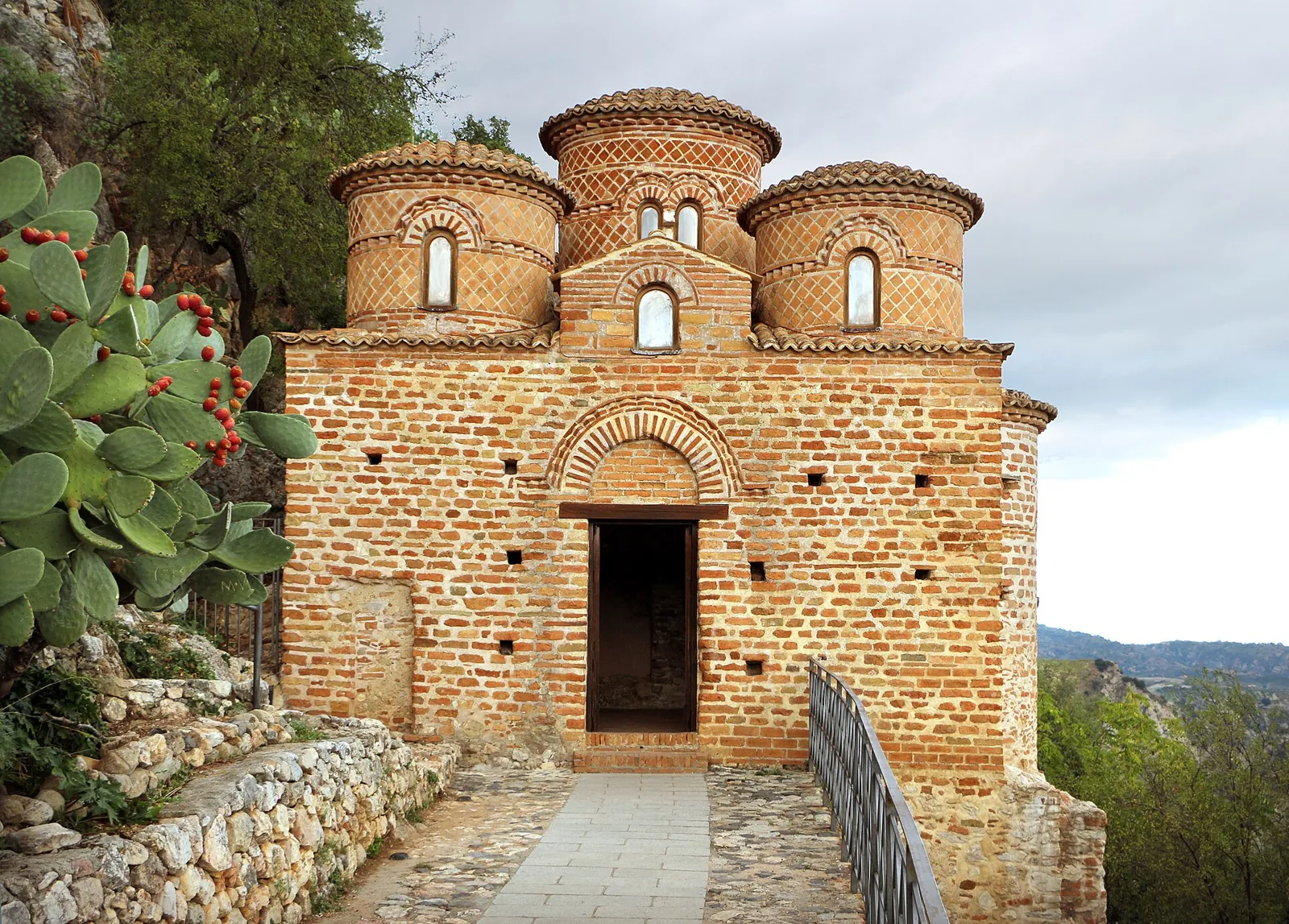
The exterior elevation draws attention with its austere form and masterful use of brick. The walls are almost bare of ornament, except for friezes of bricks set diagonally in a sawtooth pattern (Italian a dente di sega) along the line of the windows and around the arch above the entrance, and the drums and domes clad in square terracotta tiles laid in diamonds. The building also incorporates spolia – reused ancient elements, a common practice in the Middle Ages. Through the system of pendentives, the builders managed to transition smoothly from square forms to the round drums of the domes, which illuminate the interior through narrow bifora and monofora windows.
| Structural Element | Technical Characteristics |
|---|---|
| Temple plan | Greek cross inscribed in a square. |
| Domes | Five domes with terracotta tiles arranged in diamond patterns. |
| Interior columns | Four ancient columns (spolia) dividing the interior and supporting the vaults. |
| Building material | Brick and mortar, spolia from ancient ruins. |
The church interior is divided into nine square spaces by four ancient columns. The column bases incorporate ancient capitals turned upside down – including a Corinthian one at floor level – revealing the pragmatism of old master builders. In 1997 Arabic inscriptions with formulas of the Muslim profession of faith were discovered on the shaft of one column, a testimony to the turbulent history of the region. The three east-facing apses served the needs of the Eastern liturgy: the central one (bema) held the altar, the northern one (prothesis) was used to prepare the bread and wine, and the southern one (diakonikon) to keep the sacred vessels and vestments.
The Legacy of Cattolica di Stilo – from Byzantine Temple to Modern Monument
The key figure in saving the monument was the outstanding archaeologist Paolo Orsi, who between 1912 and 1927 carried out its first restoration in the modern sense – among other things removing a later pointed gable with a trefoil window above the portal. Orsi also drew scholars' attention to the significance of this small church in the landscape of medieval Calabria.
Today's appearance of the church is the result of successive conservation campaigns in the 20th and 21st centuries, including the restoration of the frescoes in 2004–2006. The latest works, funded by the PNRR (Italy's national recovery plan, backed by EU funds), secured the building after damage caused by violent storms, removed architectural barriers and added new visitor paths, trees and information points in the adjacent Clarisse park. After almost ten months of closure, the monument reopened to visitors on 29 July 2026.
Byzantine Decorations in the Cattolica di Stilo – a Dialogue between East and West
The church interior holds fragments of wall paintings from different periods. Although the decoration is incomplete and heavily damaged, all the walls preserve traces of frescoes painted between the late 10th and the 15th century.
It is precisely the fragmentary state of the interior that says most about its past today. Rather than a complete iconographic programme, what one sees here are traces of successive eras, each of which left behind new painted interventions. Among the surviving scenes one can recognise the Dormition of the Virgin (Dormitio Virginis), the Ascension of Christ, and the holy bishops Saint Nicholas, Saint Basil and Saint John Chrysostom. Thanks to this, the Cattolica di Stilo remains an important point of reference for the study of the interpenetration of Eastern and Western traditions in Calabria.
Watch on YouTube
Cattolica di Stilo – Spiritual Centre of Calabria
The Cattolica di Stilo is an important trace of the spiritual history of the region and one of the clearest signs of Byzantine Calabria. Stilo and the entire Stilaro valley are strongly connected to the Byzantine-Greek tradition, which developed here over centuries. The temple is therefore not an isolated monument but part of a broader religious landscape shaped by monasticism and the liturgy of the Greek rite.
Inseparable from this landscape is the figure of St John Theristus ("the Harvester", Italian San Giovanni Theristis), a monk venerated in both the Eastern and Western traditions. The main place of his cult is the Orthodox monastery (Monastero Greco-Ortodosso di San Giovanni Theristis) in nearby Bivongi – worth combining with a visit to Stilo to understand the Byzantine heritage of the Stilaro valley. According to the municipality of Bivongi, the monastery is generally open daily from 9:00–13:00 and 14:00–18:00, and admission is free.
Practical Information
Location: Slopes of Monte Consolino, Stilo (RC)
By car: From the Ionian coast, leave the SS106 (Jonica) at Monasterace Marina and follow the winding SS110 (also signed SP9) uphill to Stilo – about 13 km
By train: The nearest station on the Ionian line is Monasterace-Stilo; from the station to the historic centre of Stilo is about 10–12 km of winding road uphill (a climb of about 400 m) – not walking distance, so you need a car or a taxi
On site: From the centre of Stilo to the Cattolica is a short drive or walk; visiting the building itself usually takes 20–30 minutes, and with the approach and the views from the terrace about 45–60 minutes
Current opening hours according to the municipality of Stilo: Monday closed; Tuesday and Sunday 14:00–19:30; Wednesday–Saturday 8:30–19:30; the first Sunday of the month and 15 August 8:30–19:30. The ticket office closes 15 minutes before the monument closes.
Tickets cost €4 (full) and €2 (reduced). The site can be contacted by email at [email protected] or by phone on +39 320 6130878.
The approach from the town is short but steep. In summer, bring water, a hat and comfortable shoes with good grip. The best light for photographs is in the morning and late afternoon. Combine the visit with a walk through the historic centre of Stilo, a climb to the ruins of the Norman castle on the summit of Monte Consolino, and a trip to Bivongi and the Cascata del Marmarico waterfall.
Frequently Asked Questions
What period does the Cattolica di Stilo date from and why is it unique?
It is most commonly dated to the 10th century, often narrowed to the late 10th or early 11th century. Its uniqueness lies above all in its compact Byzantine form with five domes and the fact that it is one of the best-preserved examples of this type of architecture in Calabria and in Italy.
Is Cattolica di Stilo inscribed on the UNESCO list?
The monument has been on Italy's UNESCO Tentative List since 2006, as part of the candidacy "Cattolica Monastery in Stilo and Basilian-Byzantine complexes". This is not yet a full World Heritage inscription but an important step in the candidacy process.
What are the opening hours of Cattolica di Stilo and how much does a ticket cost?
From 29 July 2026, the monument is open to visitors again. The stated hours are: Monday closed; Tuesday and Sunday 14:00–19:30; Wednesday–Saturday 8:30–19:30; the first Sunday of the month and 15 August 8:30–19:30, with the ticket office closing 15 minutes earlier. The Direzione regionale Musei nazionali Calabria lists a full ticket at 4.00 euros and a reduced ticket at 2.00 euros.
Where do the Arabic inscriptions inside the church come from?
Arabic inscriptions on one of the columns, discovered in 1997, are confirmed; one corresponds to the profession of faith (shahada), while the other is translated as "Glory to God". There is no certainty, however, as to why they are in the church: explanations include the temporary use of the building as a Muslim oratory during the Arab raids, the involvement of Arab craftsmen, or the reuse of a column that had been inscribed earlier.
What is the best way to get to Cattolica di Stilo?
The most convenient way is by car: leave the SS106 (Jonica) at Monasterace Marina and take the SS110 (SP9) uphill to Stilo. The nearest railway station is Monasterace-Stilo on the coast, but from there to the town it is still about 10–12 km of winding road uphill – by car or taxi.
Sources
The information in this article was verified against the following sources:
- musei.calabria.beniculturali.it – musei.calabria.beniculturali.it
- La cattolica di stilo riapre al pubblico – comune.stilo.rc.it
- The Cattolica in Stilo reopens on July 29 following PNRR renovations – finestresullarte.info
- Catalogo Generale dei Beni Culturali – catalogo.cultura.gov.it
- Wikipedia – Cattolica di Stilo – it.wikipedia.org
- Stazione di MONASTERACE-STILO – iechub.rfi.it
- UNESCO Tentative List – Cattolica di Stilo – whc.unesco.org
- comunebivongi.it – comunebivongi.it
- Wikipedia – Paolo Orsi – en.wikipedia.org
Last updated: