Seven days is a good amount of time to see Calabria's most important faces – from the turquoise beaches of the Coast of the Gods to the wild peaks of Aspromonte and Greek-speaking villages reached by switchbacks carved into the rock. This itinerary starts at Lamezia Terme airport and heads south along the Tyrrhenian coast to the very toe of Italy's boot, then returns via the Ionian side and the region's mountainous interior. A rental car makes the whole loop much easier, especially in Aspromonte and for reaching Bova and Gerace. The best time to go is May–June or September–October, when beaches are less crowded and temperatures usually stay below 30°C.
Table of Contents
- Day 1 – Arrive in Lamezia, evening in Tropea
- Day 2 – Tropea and Capo Vaticano
- Day 3 – Pizzo and the Coast of the Gods
- Day 4 – Drive south to Scilla and Chianalea
- Day 5 – Reggio Calabria: Riace Bronzes and the Lungomare
- Day 6 – Aspromonte, Bova and Gerace
- Day 7 – Stilo, La Cattolica and departure
- Practical tips
Day 1 – Arrive in Lamezia, evening in Tropea
Fly into Lamezia Terme (SUF), the most convenient starting point for the western side of the region. Pick up your rental car at the airport – book ahead in summer, as fleets are small. The drive to Tropea (about 55 km) usually takes 1 hour to 1 hour 20 minutes. You don't need the A2: the shortest route follows the coastal SS18 to Pizzo and then the former SS522 (now SP95) via Vibo Marina and Briatico.
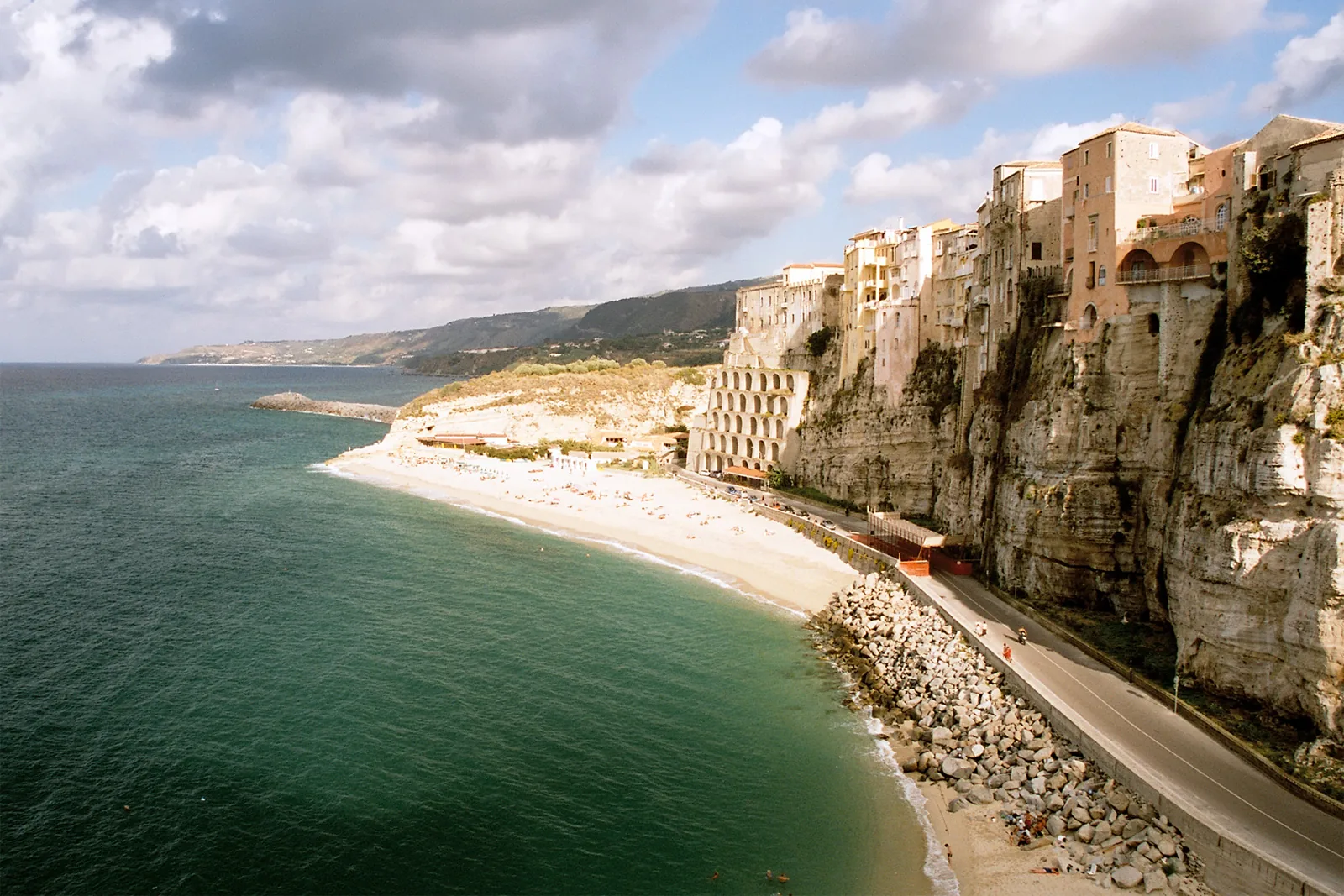
If you land before noon, stop in Pizzo on the way for your first taste of Calabrian cuisine – try tartufo di Pizzo – artisan hazelnut and chocolate gelato shaped into a ball, with a molten chocolate centre and a dusting of cocoa. If not, Pizzo gets its own day on Day 3.
Spend the evening in Tropea. Walk the centro storico, have dinner on one of the clifftop terraces, and watch the sunset from Belvedere del Cannone.
Overnight: Tropea (book a B&B or apartment in the centro storico – being close to the beaches and restaurants makes evening walks easy).
Watch on YouTube
Day 2 – Tropea and Capo Vaticano
Dedicate a full day to the two stars of the Coast of the Gods. In the morning, descend to the beach below the cliff – the water is crystal clear and the panorama with the sanctuary of Santa Maria dell'Isola in the background is one of Calabria's most recognisable views. Climb the rocky promontory of Santa Maria dell'Isola – steps lead through gardens to a panoramic viewpoint at the top.
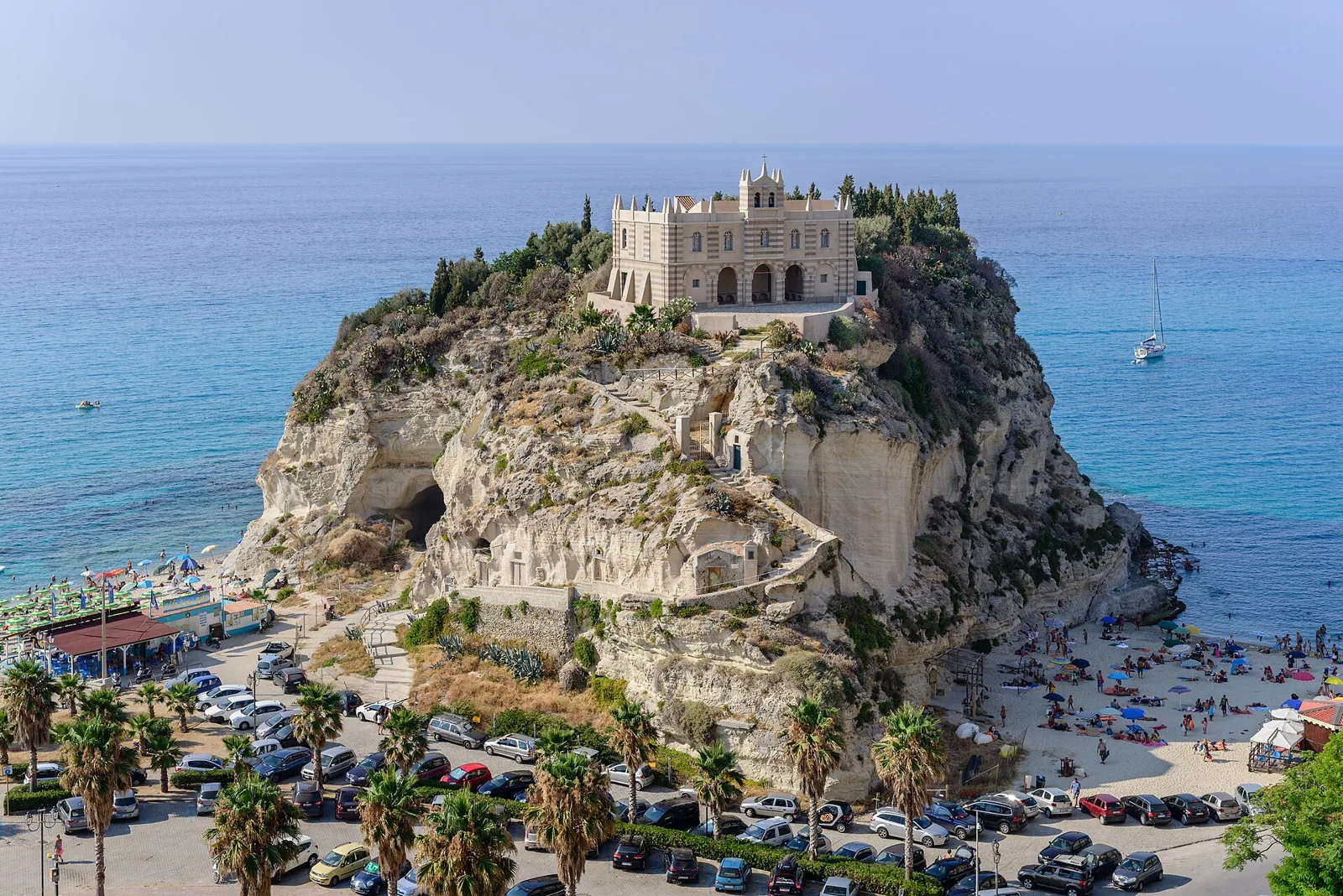
In the afternoon, drive to Capo Vaticano. The Belvedere del Capo lookout offers views of the Aeolian Islands and the smoking Stromboli volcano – on clear days Sicily looks close enough to touch. Descend to one of the hidden coves:
- Praia i Focu – a paradise bay of white sand, but access varies seasonally and it is often most conveniently reached by boat
- Grotticelle – three picturesque coves perfect for snorkelling, most easily reached by car and on foot
- Formicoli – a wider beach, more comfortable for families
The drive from Tropea to the Capo Vaticano belvedere usually takes 20–30 minutes, especially in season when traffic on local roads can slow things down. If you are set on Praia i Focu, treat it as a beach with access dependent on conditions rather than a guaranteed stop on the itinerary.
Overnight: Tropea (second night at the same base).
Day 3 – Pizzo and the Coast of the Gods
In the morning, drive north to Pizzo Calabro. The drive from Tropea usually takes 35–45 minutes depending on traffic. This compact cliff-top town packs several surprises:
- Chiesa di Piedigrotta – a church carved inside a sea cave, filled with sculptures associated primarily with the work of Angelo and Alfonso Barone. Standard admission to Chiesetta di Piedigrotta is 5 €; check current opening times and prices before visiting.
- Castello Murat – the Aragonese fortress where Joachim Murat, Napoleon's brother-in-law and King of Naples, was executed. Small exhibit, big history.
- Tartufo di Pizzo – an obligatory stop at one of the gelaterias on Piazza della Repubblica. Bar Ercole and Gelateria Dante compete for the title of best in town.
Pizzo itself can be explored in 2–4 hours. Piedigrotta usually takes 20–30 minutes, Castello Murat 30–45 minutes, and a stroll through the centro storico with a tartufo stop can easily fill another 1–2 hours.
Spend the afternoon on Piedigrotta beach or cruise back south along the Costa degli Dei, stopping at viewpoints and beaches. Take a look at Briatico and its seaside castle ruins.
Overnight: Tropea (final night) or relocate to Scilla in the evening to gain time the next day.
Day 4 – Drive south to Scilla and Chianalea
Today you head south – from Tropea to Scilla is about 85–90 km; allow around 1 hour 25–30 minutes by car, depending on your route and traffic. On the way, pass Palmi and its panoramic belvedere over the Strait of Messina.
Scilla is a town steeped in Greek myth – Homer placed the monster Scylla here, guarding the strait. Outside peak season, it is easy to explore on foot between Marina Grande, the castle and the Chianalea district.
Start with Castello Ruffo, which dominates the town from its high rock. From the castle you can see both Marina Grande beach and the hidden fishing quarter of Chianalea.
Chianalea is the soul of Scilla – a narrow strip of land with houses built directly on the rocks, where fishing boats rest beneath bedroom windows. In the evening, restaurants set tables literally over the water. Order grilled swordfish (pesce spada alla griglia) – the swordfish fishing tradition in the Strait of Messina goes back centuries and remains deeply tied to local cuisine.
In Scilla and on the other side of the strait, distinctive boats for catching swordfish, called feluca or passarella, were historically used, with a tall observation mast and a long bow platform. This is one of the most characteristic images of the Strait of Messina and an important element of the local fishing identity.
Overnight: Scilla (a B&B in Chianalea lets you stay right by the water).
Day 5 – Reggio Calabria: Riace Bronzes and the Lungomare
From Scilla to Reggio Calabria is a 20–25-minute drive. Park in the centre (underground car park at Piazza De Nava) and explore on foot.
The Museo Nazionale della Magna Grecia is the must-see – it houses the Riace Bronzes, two Greek statues from the 5th century BC pulled from the sea in 1972. They are among the finest surviving bronzes of antiquity. The museum building itself, designed by Marcello Piacentini, deserves attention.
The museum is open Tuesday to Sunday from 9:00 am to 8:00 pm, with last entry at 7:30 pm; it is closed on Mondays. Standard admission is 10 €, reduced admission for visitors aged 18–25 is 2 €, and admission is free for under-18s.
Allow 1.5–2 hours for a thorough museum visit. Just outside is Piazza De Nava, and further along Corso Garibaldi and the cathedral of Reggio Calabria; you can reach the lungomare from here on foot in about 10–15 minutes.
Next, stroll the Lungomare Falcomatà, nicknamed “the most beautiful kilometre in Italy”. The phrase is usually attributed to Gabriele D'Annunzio, but that is a legend – the poet apparently never visited Reggio, and the quote was popularised by radio commentator Nando Martellini in 1955. The views, however, are entirely real. On clear days, Etna and the Sicilian coast look like a painting on the horizon. Watch for the Fata Morgana phenomenon – an optical mirage that makes Messina appear to float above the water.
For lunch, try risotto with bergamot or penne alla ’nduja. Bergamot is associated primarily with the Ionian coast of the province of Reggio Calabria – it is one of the most local flavours of the region.
Overnight: Reggio Calabria or back to Scilla.
Day 6 – Aspromonte, Bova and Gerace
The most logistically demanding day of the trip. From Reggio, drive into the Aspromonte mountains – a national park where the route quickly changes from city streets to mountain switchbacks. Today you'll see two of Calabria's most fascinating towns.
First stop: Bova (about 53 km from Reggio Calabria; the drive usually takes around an hour, depending on traffic and the approach road). This is the symbolic centre of Calabria's Greek culture (Bovesìa). Walk through the historic centre, climb to the ruins of the Norman castle, and look for bilingual signs on the houses. At a local bar, order lestopitta – a traditional flatbread from the Greek-speaking tradition.
Bova is identified by the Calabria Region as the cultural capital of Calabria's Greeks. Its historic centre is home to the Museo della Lingua Greco-Calabra "Gerhard Rohlfs" and a palaeontological museum, both of which can be included in a walk around town.
The Grecanico area includes Bova, Bova Marina, Roghudi, Gallicianò and Condofuri, among others. Greko di Calabria, also called Grecanico, is today an endangered minority language spoken by a small number of inhabitants of the metropolitan area of Reggio Calabria, particularly in the Amendolea valley and surrounding villages.
Second stop: Gerace (about 75–80 km from Bova; allow around 1 hour 25–30 minutes, usually via Bova Marina and the SS 106). The town is famous for one of the most important and largest Norman churches in Calabria. Gerace has preserved its medieval street plan almost intact.
The town developed after the decline and depopulation of ancient Locri Epizephyrii on the Ionian coast. The cathedral dates from the Norman period, with construction begun after 1084; to this day, Gerace preserves numerous churches and a clear medieval urban layout.
Overnight: Gerace (an atmospheric B&B in the centro storico) or Locri on the Ionian coast.
Day 7 – Stilo, La Cattolica and departure
The final day leads through Byzantine Stilo and the region's mountainous interior. From Gerace, drive north to Stilo (about 60 km, around an hour).
Stilo is a small town spread across the slopes of Monte Consolino, but it hides a unique monument: La Cattolica, a small Byzantine church usually dated to the 10th century or the turn of the 10th and 11th centuries. It has a cross-in-square plan and five domes. It stands alone on the mountainside, with views over the valley and the sea.
Stilo was an important centre in the Byzantine era. The town is also associated with the philosopher Tommaso Campanella, born here in 1568.
After Stilo, head back to Lamezia Terme (about 100 km, around 1 hour 45 minutes). If you have time, stop at Serra San Bruno, where a Carthusian monastery has functioned since the 11th century, surrounded by dense fir forests of the Serre mountains.
The working Carthusian monastery is enclosed, so visitors can primarily access the Museo della Certosa. According to information from the municipality, the museum is open daily from 10:00 am to 1:00 pm and from 3:00 pm to 7:00 pm; admission requires a ticket, and guided visits are available by reservation.
Tip: if your flight is in the evening, you'll have time for both Stilo and Serra San Bruno. Bear in mind that the SS110 between the two is a winding mountain road that takes longer than the distance suggests – don't cut it close to check-in. If you fly in the morning, spend the last night in Lamezia.
Practical tips
Budget per person (7 days): In summer, expect around 700–1,000 € per person (excluding flights), including accommodation (50–90 €/night for a double room), car rental (25–40 €/day), fuel (about 80 € for the whole trip), food (20–40 €/day), and entrance fees. Calabria is one of Italy's cheapest regions – dinner with wine for 15–25 € per person is standard.
In Tropea, Scilla, Gerace and the historic centres of other towns, traffic restrictions and ZTL zones may apply, particularly in the evenings and in season. It is most convenient to park on the outskirts of the centro storico and walk the last 5–15 minutes.
Getting around: Rent a car – without one this itinerary is practically impossible, especially in the mountains and for reaching Bova and Gerace. Coastal roads are good; mountain roads (Aspromonte, the route to Bova, the Serre forests) can be narrow and winding. The A2 motorway is toll-free in Calabria. Fuel is cheaper away from the motorway. Use the self-service pumps (“self” or “fai da te”) – full service (“servito”) costs noticeably more per litre.
The entire loop described here covers approximately 500–600 km, depending on accommodation choices and beach detours. The driving itself across 7 days will take around 10–13 hours behind the wheel, not counting local diversions and searching for parking.
Best time to visit:
- May–June – warm (22–28°C), quiet, blooming oleanders
- September–October – sea still warm (24°C), food festivals
- July–August – hot (35°C+), crowds in Tropea, higher prices
| Day | Route | Key highlights | Overnight |
|---|---|---|---|
| 1 | Lamezia → Tropea | Centro storico, sunset | Tropea |
| 2 | Tropea + Capo Vaticano | Beaches, Santa Maria dell'Isola, Belvedere | Tropea |
| 3 | Pizzo + Costa degli Dei | Piedigrotta, Castello Murat, tartufo | Tropea / Scilla |
| 4 | Tropea → Scilla | Chianalea, Castello Ruffo, swordfish | Scilla |
| 5 | Scilla → Reggio Calabria | Riace Bronzes, Lungomare, bergamot | Reggio / Scilla |
| 6 | Reggio → Bova → Gerace | Aspromonte, Greek Calabria, cathedral | Gerace / Locri |
| 7 | Gerace → Stilo → Lamezia | La Cattolica, (Serra San Bruno), departure | – |
Frequently asked questions
Is 7 days enough for Calabria?
Yes – a week covers the essentials: the Tyrrhenian coast, Reggio Calabria, the Aspromonte mountains, and the Ionian coast. With more time you could add Sila National Park or Cosenza, but 7 days gives a complete picture of the region.
Do I need a car?
Yes – a car is practically essential for the whole loop. Trains run along the coast to places such as Ricadi-Capo Vaticano, Bova Marina, Locri and Monasterace-Stilo, but the historic centres of Bova, Gerace and Stilo sit high above the stations and depend on infrequent local buses, which would break a 7-day plan. Rent a car at Lamezia airport – it is the most convenient option.
When is the best time to visit Calabria?
May–June and September–October are the golden months – ideal weather, quieter beaches, and reasonable prices. July and August bring crowds and temperatures above 35°C, especially in Tropea.
How much does a week in Calabria cost?
Calabria is one of Italy's most affordable regions. Budget around 700–1,000 € per person for 7 days (excluding flights), covering accommodation, car rental, fuel, food, and entrance fees. Dinner with wine typically costs 15–25 €.
Are the roads in Calabria safe?
Yes, though they require attention. Coastal roads (SS18, A2 motorway) are comfortable. Mountain roads to Bova or Stilo are narrow and winding but well-maintained. Avoid driving in the mountains at night – limited lighting and sharp bends can catch you off guard.
Sources
The information in this article was verified against the following sources:
- Orari e informazioni – museoarcheologicoreggiocalabria.cultura.gov.it
- La Certosa di Serra San Bruno – Comune di Serra San Bruno – comune.serrasanbruno.vv.it
- Sentiero dell'Inglese - Regione Calabria – regione.calabria.it
- trenitalia.com (PDF) – trenitalia.com
Last updated: