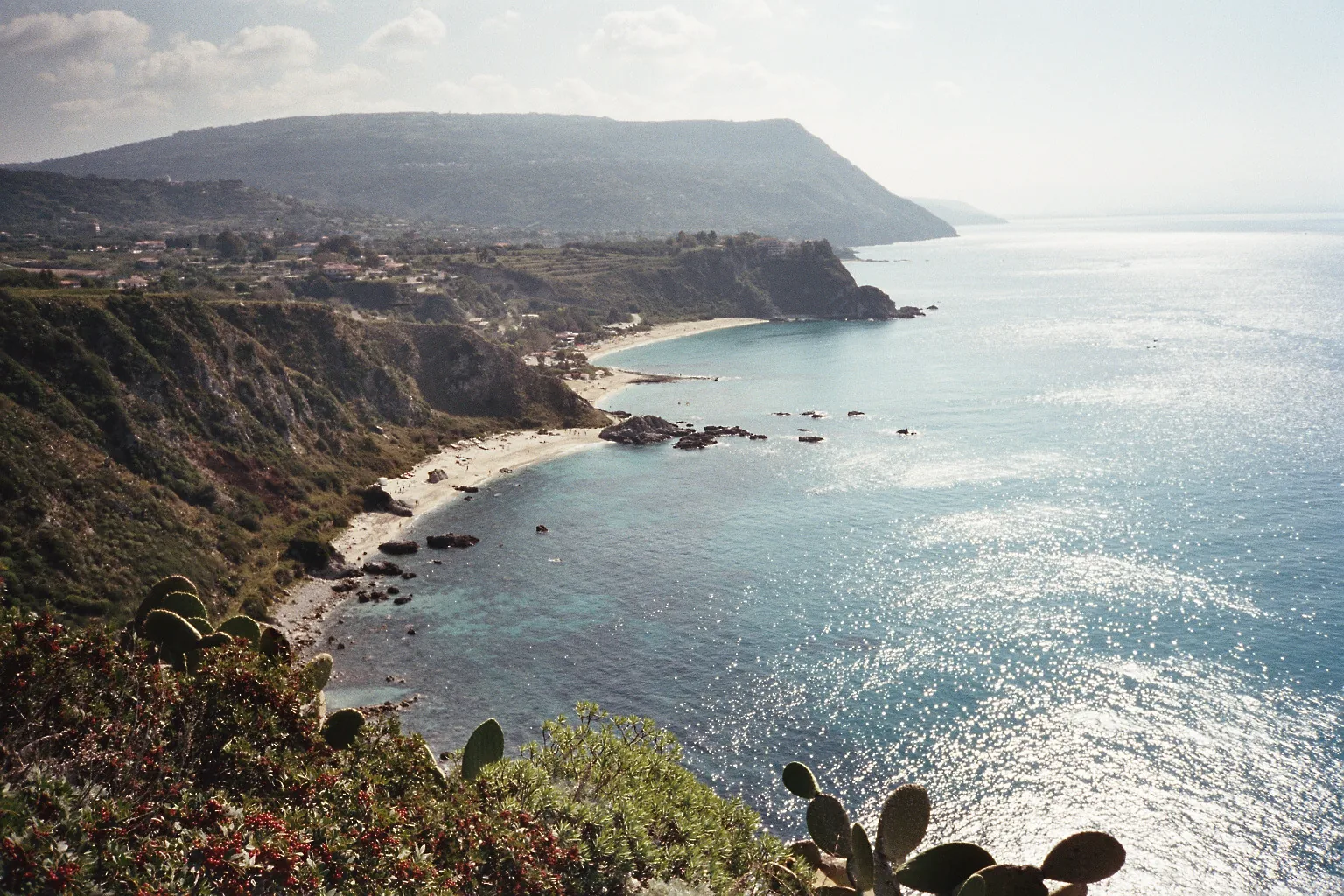
Capo Vaticano is a rocky cape in Calabria, located in the municipality of Ricadi in the province of Vibo Valentia, on the Costa degli Dei – the Coast of the Gods. Granite cliffs, coves at the foot of the rocks and exceptionally clear water make it one of the most recognisable places on this stretch of the Tyrrhenian Sea. Visitors come for the views from Belvedere del Faro, beaches such as Grotticelle and boat trips along the coast, where many coves are best seen from the sea. The character of the place is also shaped by Mediterranean maquis, local cuisine based on products from the Ricadi and Tropea area, and the proximity of towns and villages such as Tropea, Pizzo and the settlements of the Monte Poro plateau.
Table of Contents
- The Evolution of Tourism in Capo Vaticano – From Strategic Outpost to Holiday Destination
- Flora and Fauna of Capo Vaticano – Maquis and Seagrass Meadows
- Climate in Capo Vaticano – Seasonal Attractions for Visitors
- Water Sports and Recreation – Activities in Capo Vaticano
- Culture and Traditions of Capo Vaticano – Spiritual and Culinary Heritage of Calabria
- Capo Vaticano – Views, Beaches and Practical Information
The Evolution of Tourism in Capo Vaticano – From Strategic Outpost to Holiday Destination
The history of Capo Vaticano is far older than its development as a resort. For a long time, the significance of this place was linked primarily to coastal observation and agriculture, while the modern coastal defence system of Calabria was designed to protect this stretch of the Tyrrhenian Sea from seaborne raids. The granite character of the cape's rocks still largely shapes the local landscape and coastline.
Capo Vaticano belongs to the municipality of Ricadi, on the Costa degli Dei coast, in the province of Vibo Valentia. The development of the area as a resort is mainly a 20th-century phenomenon, especially the second half, when Tyrrhenian coastal tourism began to gain importance rapidly. Nearby are also traces of ancient settlement linked to the Formicoli area and Forum Herculis.
Local hypotheses and stories surround the name of the cape, but their origin is not certain. Likewise, the references invoked by Giuseppe Berto, a writer associated with this place, are best treated as literary interpretation and a local legend rather than confirmed historical fact. The current appearance of the San Ciriaco cave is the work of the local Barone family in the 19th century.
Tourism development gathered pace in modern times, when the charm of wild beaches and clear water began attracting visitors from across Italy and abroad. The cape reaches about 124 m above sea level, and the difference in height helps explain why some coves are harder to access from land. It is precisely this combination of high coastline, granite rocks and turquoise sea that has shaped the character of this place.
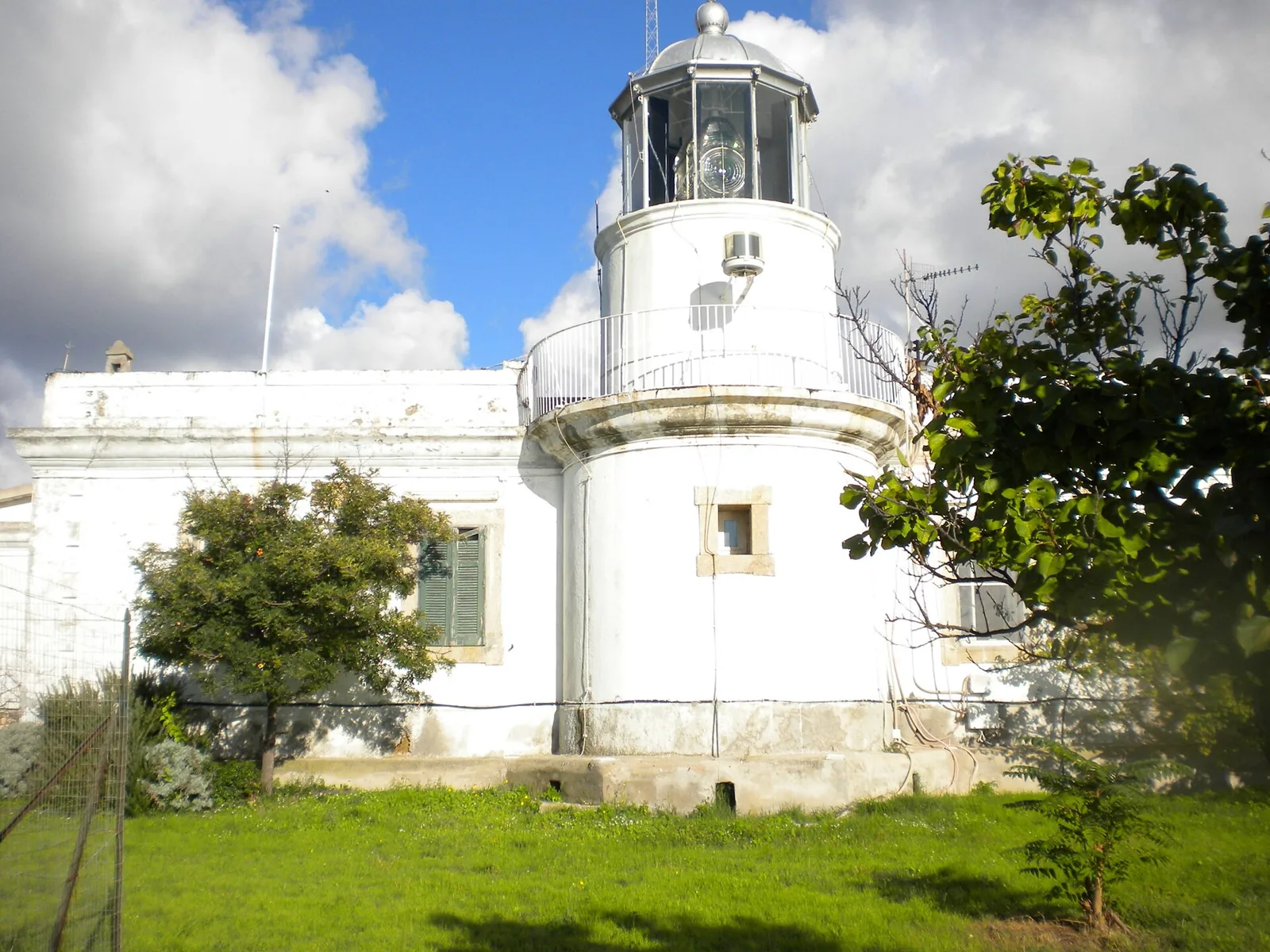
One of the most important landmarks is the Faro di Capo Vaticano in the municipality of Ricadi. The lighthouse was built in 1870 and activated in 1885; its tower is 8 m high, and the light stands at 108 m above sea level. Its light characteristic is Fl(4) W every 20 s, and the nominal range of the main light is 24 nautical miles. Today, the area around the lighthouse and Belvedere del Faro is the focus of most short visits centred on the coastal panorama.
| Geographical Parameter | Value/Description |
|---|---|
| Municipality | Ricadi |
| Province | Vibo Valentia |
| Maximum elevation | About 124 m above sea level |
| Main rock formation | White-grey granite |
| Coastal area | Costa degli Dei (Coast of the Gods) |
Flora and Fauna of Capo Vaticano – Maquis and Seagrass Meadows
Capo Vaticano is renowned not only for its steep granite cliffs but also for the diverse Mediterranean environment typical of the coast. The cape's vegetation is a classic example of Mediterranean maquis, well adapted to high temperatures, wind and salt spray. Species typical of this ecosystem include myrtle, juniper, rosemary, lentisk and, in places, the dwarf palm Chamaerops humilis.
In the sea, a key role is played by seagrass meadows of Posidonia oceanica, which are very important for biodiversity and water clarity. They provide shelter for many small organisms and support a healthy coastal ecosystem. The rocky seabed and network of small coves are ideal for snorkelling, especially where the water remains calm and exceptionally clear.
The seabed around Capo Vaticano also has formal protected status: Fondali di Capo Vaticano is the Natura 2000 SAC IT9340093, covering about 802 ha. The area includes seabed at depths of 5–50 m in the municipality of Ricadi. The listed habitats include, among others, 643 ha of sandbanks, 118 ha of Posidonia oceanica meadows, about 1 ha of reefs and 0.5 ha of submerged or semi-submerged sea caves.
The nature of Capo Vaticano is best experienced during a leisurely walk along the clifftops or from the sea. On one side, the scent of sun-warmed maquis fills the air; on the other, beneath the surface, you can see how closely the terrestrial and marine landscapes are connected here. This is why the area remains one of the most distinctive stretches of the Calabrian coast.
Climate in Capo Vaticano – Seasonal Attractions for Visitors
The climate of Capo Vaticano is clearly Mediterranean: summers are warm and dry, while winters are mild. Beach holidays are therefore concentrated in the summer season, but walks, viewpoints and short trips along the Costa degli Dei make sense for much of the year. The difference between the August peak and quieter June or September is considerable, especially in car parks and at beach access points.
Summer – Time for the Beach
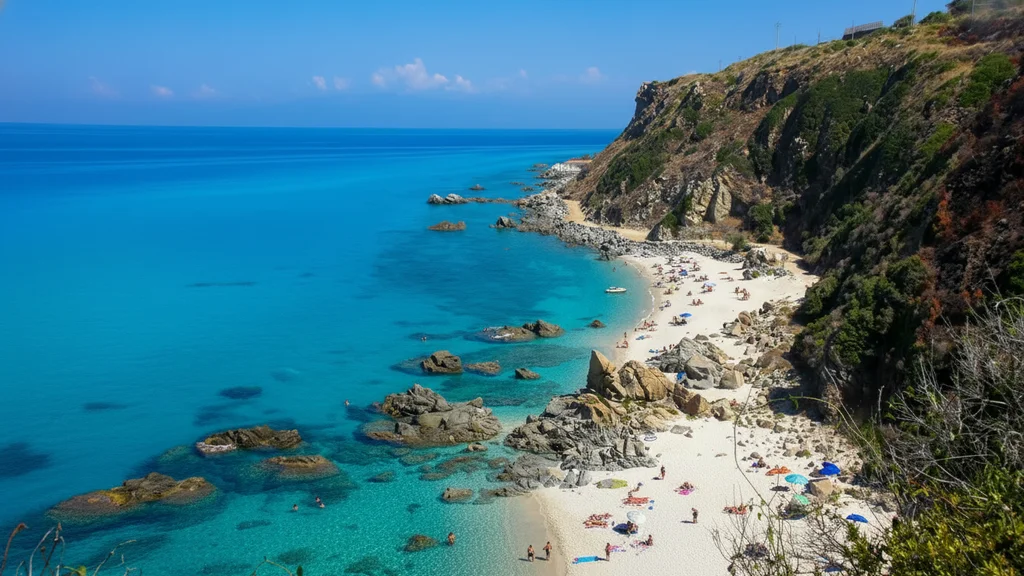
In summer, during July and August, temperatures frequently exceed 30°C, attracting beach and swimming enthusiasts. Capo Vaticano is known for its clear water and scenic beaches such as Spiaggia di Grotticelle. August is usually among the warmest months for sea temperature too, making it ideal for long swims and boat excursions. Due to the high popularity of the area at this time, finding a parking space after 9:00 am can be challenging, and the roads down to the coves are steep and narrow.
Spring and Autumn – Ideal for Sightseeing
Spring (April–June) and autumn (September–October) offer milder conditions with temperatures ranging from 20–28°C. This is a good time to explore the surrounding cliffs and the Belvedere del Faro viewpoint, from which, in good visibility, you can see the smoking Stromboli volcano and the other Aeolian Islands. The sea remains pleasantly warm, and the swimming season often lasts longer than in many other parts of Italy. September is particularly good for combining fine weather with smaller crowds on the beaches.
Winter – A Quiet Time on the Southern Coast
In winter, Capo Vaticano is characterised by mild temperatures of around 10–15°C. This is not the season for a classic beach holiday, but the conditions are well suited to visiting nearby towns and exploring local culture. Calabria's climate means Capo Vaticano remains attractive even off-season, especially for those who enjoy walks, views and a slower pace.
Water Sports and Recreation – Activities in Capo Vaticano
In the Capo Vaticano area, clear water and a high granite coastline create good conditions for a variety of water activities. The most popular are snorkelling, swimming, boat trips along the coast and short excursions by boat to less accessible coves. This is an area best explored not only from the beach, but also from the sea.
For those who prefer lighter activities, snorkelling at Spiaggia Formicoli offers a chance to see a stretch of coast linked to the area of the ancient Forum Herculis. Boats and local taxi boats play a key role in getting around, because Praia i Focu (Praia di Fuoco) is often easiest to reach by sea. In calm conditions, this is one of the best ways to see the granite rocks, small coves and sea caves.
Remember that the Capo Vaticano coastline is rocky and steep in places, so water shoes are useful at many beaches. The sea can be very clear, but in windy weather and with waves, boat access to some coves may be limited. Snorkelling is best planned when the sea is calm and outside the busiest boat-traffic hours, when visibility and comfort are usually at their best.
For active travellers, tennis courts or bicycle hire may also be available, but this depends mainly on the specific accommodation. Some resorts also organise evening entertainment and events for guests. In practice, however, the greatest attractions of Capo Vaticano remain the sea, the cliffs and the natural rhythm of the day set by the weather.
Watch on YouTube
Culture and Traditions of Capo Vaticano – Spiritual and Culinary Heritage of Calabria
Capo Vaticano is a place where culture and traditions are closely tied to the landscape and history of western Calabria. The region belongs to the Costa degli Dei – a name with a clearly promotional and cultural character, highlighting pale beaches, granite rocks, clear water and views of the Aeolian Islands and Stromboli. This coastal image is the one that stays in the memory most strongly, but the hinterland of Ricadi and Monte Poro adds an agricultural, local context.
The Ricadi area draws inspiration from ancient Mediterranean civilisations, as reflected in the MU.RI. project – Museo Civico di Ricadi. It is best seen as a dispersed museum network of the municipality of Ricadi, devoted to local history and economy, rather than as one large institution in the classical sense. This model reflects the character of a place where culture is spread between seaside settlements and the agricultural hinterland.
MU.RI. operates in five centres: Museo del Mare in Capo Vaticano, Museo della Cipolla Rossa in Capo Vaticano/San Nicolò, Museo delle Torri at Torre Marrana di Brivadi, Museo dell’Arte Contadina in Ricadi and Museo Antropologico e Paleontologico in Santa Domenica. Museo del Mare is housed in a former Navy watch station, used until the mid-20th century as a daytime lookout post (faro diurno). Its exhibition includes fishing and sailing equipment, shells and an educational garden of more than 2,000 m².
Religion as a Social Pillar
The Catholic faith plays a key role in the life of the Capo Vaticano community and surrounding villages. In Ricadi and the neighbouring villages, the year is marked by local patron saint festivals (feste patronali) that bring residents together. A wider, provincial symbol of devotion is the Piedigrotta church in Pizzo, about 40 km away, carved entirely into a seaside rock.
Local Cuisine – A Taste of Tradition
Calabrian cuisine is built on ingredients with distinctive flavours that are deeply rooted in the local landscape. The most important include the sweet red onion Cipolla Rossa di Tropea Calabria IGP, also grown in the municipalities around Capo Vaticano and Ricadi, and the traditional pecorino del Monte Poro cheese. Inland, about 10 km by road from Capo Vaticano, lies Spilinga – the home of the spicy spreadable salami ’nduja. It is not a product of Capo Vaticano itself, but it is one of the key flavours of the whole Monte Poro plateau.
Fileja and fusilli calabresi pasta, tuna and swordfish (pesce spada) dishes from the Tyrrhenian coast, peperoncino and extra virgin olive oil often appear on local tables. This is simple but deeply regional cooking – based more on the quality of ingredients than on elaborate recipes. As a result, even an ordinary lunch in the area can say a lot about this part of Calabria.
Historical Heritage
In the surroundings of Capo Vaticano, historical buildings recall the turbulent past of this part of the coast, once plagued by pirate raids. Torre Marrana in Brivadi belongs to the Museo delle Torri; according to the MU.RI. description, it was built in the Angevin period, in the 14th century. Next to the ruins is a stone open-air theatre for about 500 spectators, used in summer for festivals and performances. This mix of history and contemporary life shows that the municipality of Ricadi offers more than just beaches.
Capo Vaticano – Views, Beaches and Practical Information
Capo Vaticano is one of the most important viewpoints on the Costa degli Dei. The cliffs and coves create a landscape best seen from the area around the lighthouse and from a boat travelling along the coast. The main observation point is the Belvedere del Faro, from where, in good visibility, you can see the smoking Stromboli volcano and other islands of the Aeolian archipelago.
The best-known beach is Grotticelle – a group of small coves at the foot of granite rocks. Other frequently mentioned beaches and coves in the area include Praia i Focu (Praia di Fuoco) and Formicoli. Even visitors who are not planning a full beach day come here for the combination of the belvedere and one of the finest coastal views on the whole Costa degli Dei.
Attractions such as nearby Tropea – known for its charming clifftop old town – further enrich the region's offer. Capo Vaticano lies about 10 km from Tropea, and the nearest railway station is Ricadi-Capo Vaticano on the Lamezia Terme Centrale – Rosarno/Reggio Calabria route via Tropea, served mainly by Trenitalia regional trains. From Lamezia Terme airport, you first need to reach the railway station by shuttle, bus or taxi, and then continue by train.
In practice, getting around Capo Vaticano itself can be less straightforward than brochures suggest. From Ricadi-Capo Vaticano station to the viewpoints and beaches, you usually need a car, taxi or a walk, and some coves are reached by steps or mainly from the sea. In the high season, especially in July and August, beach car parks fill up quickly and access paths can be steep.
Frequently Asked Questions About Capo Vaticano
Where is Capo Vaticano?
Capo Vaticano is located in southern Italy, on the western coast of Calabria, in the municipality of Ricadi (province of Vibo Valentia). It lies on the Tyrrhenian Sea, on the Costa degli Dei (Coast of the Gods), approximately 10 km south of the famous Tropea.
What beaches are near Capo Vaticano?
The main beaches are Spiaggia di Grotticelle, Praia i Focu (Praia di Fuoco), and Formicoli. Some coves are easier to reach from the sea, while access from land can be steep or involve steps.
How do you get to Capo Vaticano?
The best option is to fly to Lamezia Terme airport (SUF), then take a shuttle bus or taxi to Lamezia Terme Centrale railway station and continue by Trenitalia regional train to Ricadi-Capo Vaticano station. You can also hire a car – the airport is about 65 km away, around 1 hour 15 minutes by car outside peak times.
What is worth seeing beyond the beaches at Capo Vaticano?
Worth visiting are the lighthouse and Belvedere del Faro viewpoint (with views of Stromboli), Torre Marrana, and the nearby towns of Tropea with its charming clifftop old town and Pizzo with its Castello Murat. Even a short visit just for the viewpoint makes sense, especially in good weather.
When is the best time to visit Capo Vaticano?
The ideal time is June or September – temperatures then often range between 25–30°C, the sea is warm, and crowds are smaller than in August. For the belvedere and a short walk, 30–60 minutes is usually enough; for half a day, combine the viewpoint with Grotticelle beach, and for a full day, add Tropea or a boat trip.
Top Attractions of Capo Vaticano
Belvedere del Faro
Viewpoint at the lighthouse with a panorama of the Aeolian Islands and the Stromboli volcano.
Spiaggia di Grotticelle
The cape's best-known beach – a group of small coves, pale sand and granite rocks creating a distinctive setting.
Baia di Riaci – Diving
One of the popular snorkelling and diving spots on the Calabrian coast, valued for its clear water and rocky seabed.
Taxi Boat – Wild Beaches
Boats that make it easier to reach less accessible beaches, such as Praia i Focu (Praia di Fuoco), and to view the coast from the sea.
Museo del Mare
Part of MU.RI. in Capo Vaticano, with an exhibition of fishing and sailing equipment, shells and an educational garden.
Tropea
A charming clifftop old town with sea views, just 10 km from Capo Vaticano – one of the most beautiful towns in Calabria.
Getting there
The nearest airport is Lamezia Terme (SUF), about 65 km and around 1 hr 15 min by car; the nearest station is Ricadi-Capo Vaticano.
Lamezia Terme airport (SUF)
- By car via A2About 65 km and 1 hr 15 min: take the A2, exit at Pizzo Calabro, then continue via Tropea to Ricadi. Parking is available by Belvedere del Faro.
- Airlink + regional trainTake Lamezia Airlink to Lamezia Terme Centrale every 30 minutes or so (€1.80 added to the rail ticket), then a regional train to Ricadi-Capo Vaticano: about 1 hr.
- Summer L1 serviceIn summer, Ferrovie della Calabria’s L1 service runs via Tropea and Ricadi; the trip to Contrada Capo Vaticano takes about 1 hr 30 min.
Reggio Calabria airport (REG)
- By car via A2About 90 km and around 1 hr 40 min: take the A2 to Rosarno, then continue via Nicotera to Ricadi and Capo Vaticano.
- Airport station + regionalTake a regional train from Reggio Calabria Aeroporto to Centrale, then continue towards Ricadi-Capo Vaticano. Allow roughly 2 hrs in total.
- Taxi from the airportThe most convenient option for late arrivals or heavy luggage; travel directly to your accommodation or chosen beach.
From Poland – direct flights
- Choose SUF airportSUF is closer: about 65 km away. In summer 2026, Ryanair flies from KRK, WRO, WMI and KTW, and Wizz Air from KTW and WAW.
- Flight days from PolandKTW–SUF: Ryanair and Wizz Air Tue/Thu/Sat; WAW–SUF with Wizz Air Mon/Wed/Fri. In winter, a connection is usually required.
- Then as from SUFThe fastest option is a rental car: A2, exit at Pizzo Calabro, then via Tropea; around 1 hr 15 min.
From Rome or Naples
- Train to LameziaFrecciarossa or Italo to Lamezia Terme Centrale: about 4–4.5 hours from Rome and 3–3.5 hours from Naples. Intercity trains are slower: about 5.5–6.5 hours from Rome.
- Regional train via TropeaFrom Lamezia Terme Centrale, take a regional train via Tropea to Ricadi-Capo Vaticano, around 1 hr. Continue by transfer or taxi.
From Tropea
- Local road southboundAbout 10 km and around 20 min on local roads via Santa Domenica and Ricadi; enter your specific beach or accommodation in the navigation.
- Regional train to RicadiA Trenitalia regional train from Tropea to Ricadi-Capo Vaticano takes roughly 10 min. A transfer is needed for beaches and the lighthouse.
From Pizzo
- Via Vibo and TropeaAbout 40 km and around 1 hr on local roads via Vibo Marina and Tropea, then continue to Ricadi and Capo Vaticano.
- Regional train via TropeaFrom Pizzo station, take a Trenitalia regional train via Tropea to Ricadi-Capo Vaticano, roughly 1 hr. A transfer is needed for the final stretch.
From Vibo Valentia
- Via TropeaAbout 30 km and around 45 min via Vibo Marina and Tropea, then continue through Ricadi to Capo Vaticano.
- Vibo Valentia-Pizzo + regionalFrom Vibo Valentia-Pizzo station, take a regional train via Tropea to Ricadi-Capo Vaticano, around 40 min; reach the station first from central Vibo.
From Costa Viola
- A2 via RosarnoAbout 60 km and around 1 hr 15 min: take the A2 towards Rosarno, then continue via Nicotera to Ricadi and Capo Vaticano.
- Train from Scilla or BagnaraFrom Scilla or Bagnara, take a regional train towards Ricadi-Capo Vaticano, roughly 1 hr. A transfer is needed for the beaches.
From Reggio Calabria
- A2 via RosarnoAbout 90 km and around 1 hr 40 min: take the A2 to Rosarno, then continue via Nicotera to Ricadi and Capo Vaticano.
- Regional train to RicadiFrom Reggio Calabria Centrale, take a regional train towards Ricadi-Capo Vaticano; the journey takes roughly 1 hr 30 min.
From the Aeolian Islands
- Ferry to TropeaThe supplied material does not include verified timetables or an operator for ferries from the Aeolian Islands to Tropea.
- From Tropea via RicadiCapo Vaticano is about 10 km from Tropea harbour; local roads via Ricadi usually take around 20 min.
Journey times are approximate. Timetables: Trenitalia, Ferrovie della Calabria, local operators.
Near Capo Vaticano
Sources
The information in this article was verified against the following sources:
- Capo Vaticano e la Costa degli Dei in Calabria - Italia.it – italia.it
- Stazione di RICADI-CAPO VATICANO – iechub.rfi.it
- Fondali Capo Vaticano – Arpacal – sic.arpacal.it
- CAPO VATICANO - Marina Militare – marina.difesa.it
- Museo del Mare – Comune di Ricadi – museiricadi.it
- Museo delle Torri e Torre Marrana – Comune di Ricadi – museiricadi.it
- Trenitalia – trenitalia.com
- regione.calabria.it – regione.calabria.it
- regione.calabria.it – regione.calabria.it
- Trenitalia – trenitalia.com
- baiadelsole.com – baiadelsole.com
- Comune di Ricadi – servizi.comune.ricadi.vv.it
- Wikipedia – Capo Vaticano – en.wikipedia.org
Last updated: