Calabria has nearly 790 km of coastline along the Tyrrhenian and Ionian Seas and the Strait of Messina. This region, commonly referred to as the toe of the Italian boot, is one of the most geomorphologically varied areas of the Mediterranean basin. It offers both the rocky coves and cliffs of the Tyrrhenian coast and the wide, sandy stretches of the Ionian coast. Comparing Tropea in the west with Soverato in the east shows how distinctly the landscape changes between the two sides of the region.
Table of Contents
- Tyrrhenian Coast – cliffs and turquoise water
- Characteristics of the Tyrrhenian Coast
- Sandy exceptions on the Tyrrhenian Coast
- Costa degli Dei – from Pizzo to Nicotera
- Tropea – a town on a cliff
- Ionian Coast – wide beaches and gentle entry
- Guide to Calabria's beaches – practical tips for tourists
- Flavours of Calabria – local produce and coastal cooking
- Landmarks and natural wonders along the Calabrian coast
Tyrrhenian Coast – cliffs and turquoise water
Characteristics of the Tyrrhenian Coast
The Tyrrhenian Coast, stretching along the western part of the region, has a varied coastline and clear, turquoise water. Although pebbly and rocky beaches dominate, there are also quiet coves and short stretches of light sand. The Tyrrhenian seabed drops steeply in places; the deepest part of the basin, the Fossa del Tirreno, reaches around 3,785 metres. The cliffs and rock formations, combined with the clear water, create a striking landscape.
Sandy exceptions on the Tyrrhenian Coast
Despite the predominantly rocky shores, the Tyrrhenian coast does have sandy stretches. The beaches at Tropea are covered in light sand, which in places mixes with fine gravel, providing good underwater visibility. Besides its historic architecture, this small town offers panoramic views of the volcanic island of Stromboli.
Costa degli Dei – from Pizzo to Nicotera
Costa degli Dei, or the Coast of the Gods, is a 55-kilometre stretch in the province of Vibo Valentia, extending from Pizzo to Nicotera. Granite cliffs dominate, but small beaches with soft sand lie between them. Spiaggia di Michelino in Parghelia is one of the least developed spots on this coast, reached by more than 210 steps carved into the rock.
Capo Vaticano also lies along this stretch, one of the most characteristic points of Calabria's Tyrrhenian coast. Light-coloured rocks, clear water and small coves mean the headland regularly appears in rankings of the region's best beaches. Marinella di Zambrone, known as Paradiso del Sub (the Diver's Paradise), attracts snorkelling enthusiasts.
Tropea – a town on a cliff
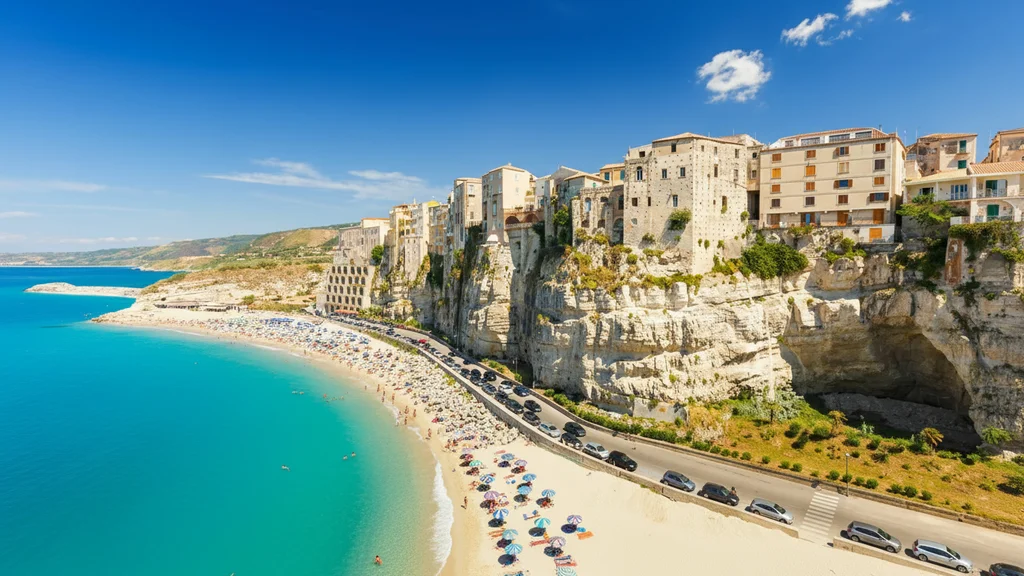
Tropea, a town perched on a monumental sandstone cliff, is the best-known resort on the Calabrian coast. Its historic centre sits on the rock, several dozen metres above the sea. Among the key landmarks are the Santa Maria dell’Isola sanctuary and a Norman cathedral from the 12th century, rebuilt repeatedly after earthquakes.
Tropea was an important centre as early as the Middle Ages and developed under Byzantine and Norman rule. Santa Maria dell’Isola, the symbol of the town, stands on a rock once separated from the mainland, and its current appearance is the result of successive reconstructions, particularly after earthquakes. The architecture of the centre itself also bears traces of these changes, as the town has experienced powerful tremors on multiple occasions.
The sweet red onion – cipolla rossa – plays an important part in Tropea's local cooking. Together with fiery peperoncino peppers it forms the basis of many traditional dishes. In local trattorias it is worth trying ’nduja from Spilinga, the spicy, spreadable sausage the area is known for.
The beaches are reached by stairs from the centre of town. The most famous, Marina dell'Isola, lies at the foot of the rock with the Santa Maria dell'Isola sanctuary and creates Tropea's characteristic panorama. Rotonda Beach has good underwater visibility, while the smaller Spiaggia del Cannone is a quieter spot away from the main descents.
Tropea has a railway station on the Tyrrhenian line with regional connections to Lamezia Terme Centrale, Pizzo, Vibo Valentia-Pizzo, Rosarno and Reggio Calabria, among others. The nearest airport is Lamezia Terme (SUF), approximately 60 km away. From the station to the historic centre is a 10–15 minute walk.
For the centre and viewpoints alone, allow a minimum of 2–3 hours, and a full day if you also plan to spend time on the beach. Tropea makes a good base for exploring Costa degli Dei. The proximity of the Capo Vaticano headland and towns such as Pizzo and Nicotera makes it worth staying longer.
Ionian Coast – wide beaches and gentle entry
The Ionian coast differs from the Tyrrhenian in its relief. The eastern shores feature wide, sandy beaches with gentle entry into the water, popular with families. Although the Ionian Sea is the deepest part of the Mediterranean – the Calypso Deep exceeds 5,000 metres – the Calabrian coastal zone along this stretch is characterised by extensive shallows.
Parameter |
Tyrrhenian Coast (West) |
Ionian Coast (East) |
|---|---|---|
Dominant terrain |
Cliffs, caves, steep mountains |
Wide beaches, low hills |
Seabed gradient |
Steep (rapid drop-off) |
Gentle (wide shallows) |
Water temperature (August) |
approx. 25-26°C |
approx. 26-27°C |
Sediment character |
Coarse sand, gravel, rocks |
Fine sand, occasionally pebbles |
The Ionian coast of Calabria includes areas in the provinces of Crotone, Catanzaro and Reggio Calabria. Popular beach towns include Soverato, Caminia, Copanello, Badolato Marina, Monasterace, Roccella Ionica and Siderno. The coastline here is sandier and flatter than the Tyrrhenian side, though rocky sections also occur, particularly around the bay of Caminia and Copanello.
The main resort on this stretch is Soverato, with a long sandy beach on the Baia dell’Ippocampo. The bay is protected as part of the Regional Marine Park “Baia di Soverato”, established in 2009, because it is a habitat for two species of seahorse: Hippocampus hippocampus and Hippocampus guttulatus. Along the coast you can also see the ruins of medieval watchtowers (torri costiere), which once gave warning of pirate raids.
Smaller coves sheltered by rocks lie near Caminia. Also worth seeing are the Vasche di Cassiodoro – coastal pools cut into the rock at Copanello, traditionally associated with fish farming at the Vivarium, the monastery founded by Cassiodorus in the 6th century, though their precise function and dating remain uncertain. Soverato lies in the province of Catanzaro, while Roccella Ionica and Siderno are in the province of Reggio Calabria.
The southern part of the Ionian coast is close to Aspromonte National Park, with its dense forests and hiking trails. Getting to the Ionian resorts can be time-consuming because of the distances and a sparser rail network than in the west. To avoid the peak heat and crowds, it is best to plan your visit in September, when the sea has warmed up over the summer.
Watch on YouTube
Guide to Calabria's beaches – practical tips for tourists
Planning a beach holiday in Calabria means taking local logistics into account. The beach season typically runs from June to September, with full services at the lidi (singular: lido) operating mostly from mid-June to the first half of September. Spiaggia libera means a free, public section of beach, while a lido is a paid section with parasols, loungers, a bar and toilets.
At the height of the season (July–August), hiring a set – one parasol and two loungers – usually costs between 20 and 35 EUR per day, and more in the most popular resorts such as Tropea. Parking at the beach typically costs around 5–10 EUR per day.
- Water shoes – useful on many Tyrrhenian coast beaches, where the seabed can be stony or gravelly.
- Green Flag (Bandiera Verde) – an award given by paediatricians to child-friendly beaches: gentle entry into the water and clean sand. In Calabria, Soverato and Nicotera hold it.
- Car rental – makes it easier to reach smaller coves not served by public transport.
- Ferragosto – around 15 August, during the Italian holiday, beaches and car parks are at their most crowded and prices at their highest.
At Cirella, part of the municipality of Diamante, a day on the beach can be combined with a walk up to the ruins of the old town, Cirella Vecchia. Grotticelle at Capo Vaticano is a good spot for snorkelling, and nearby viewpoints look out over three adjacent bays. In season it is worth arriving early in the morning at popular spots to find a parking space.
Flavours of Calabria – local produce and coastal cooking
Calabrian cooking is built on bold flavours. One of the region's emblems is ’nduja, a spicy, spreadable pork sausage traditionally produced around the town of Spilinga. Its fiery flavour comes from generous amounts of peperoncino. It is usually served on toasted bread or stirred into pasta.
The Tyrrhenian coast is where cipolla rossa di Tropea Calabria IGP is grown – the sweet red onion cultivated in the coastal strip between Amantea and Capo Vaticano. A staple in local trattorias is fileja, a traditional pasta rolled by hand around a rod and often served with tomato sauce and ’nduja. In Pizzo, try tartufo di Pizzo, an artisanal ice cream dessert with a molten chocolate centre.
Swordfish (pesce spada) is a mainstay of the cooking on Costa Viola, especially in Scilla, where traditional fishing methods survive to this day. The province of Reggio Calabria is known for its bergamot groves, and the northern Tyrrhenian coast – the Riviera dei Cedri – for citron.
Local dishes go well with Calabrian wine, for example Cirò DOC, produced on the Ionian coast around Cirò Marina, whose winemaking tradition goes back to the days of Magna Graecia.
Landmarks and natural wonders along the Calabrian coast
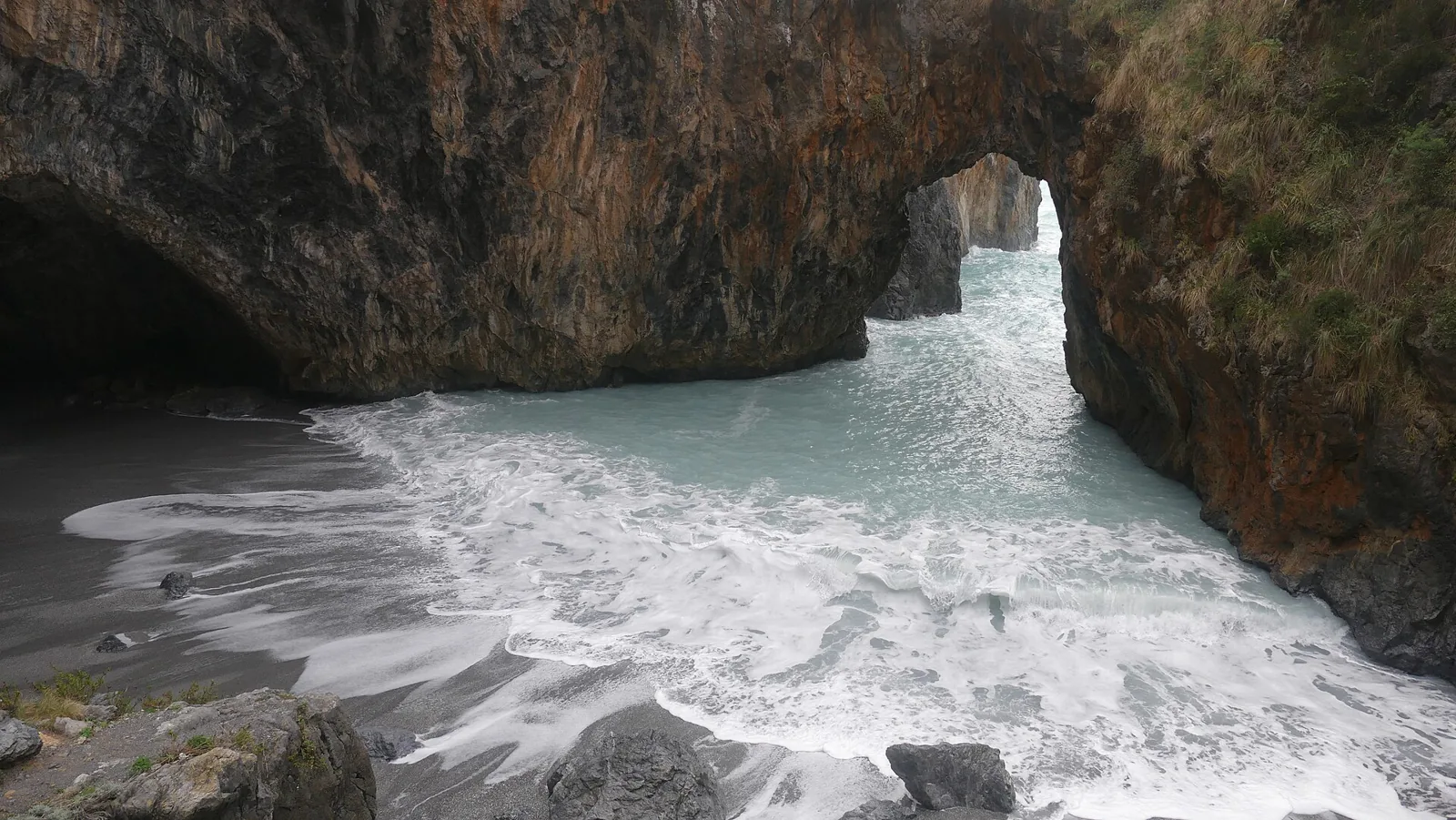
Along the Calabrian coast, nature often sits alongside historic sites. In the north, on the Riviera dei Cedri, lies Arcomagno – a natural rock arch in the town of San Nicola Arcella. The small beach hidden beneath the arch is one of the best-known spots in the region, though access to it is regulated on safety grounds.
Arcomagno is reached on foot via a steep path from Marinella beach. In summer, visitor numbers are limited and entry is ticketed – the rules are set by the municipality of San Nicola Arcella, so check its latest notice before visiting. The path is also closed from time to time because of landslides and safety works. To avoid the crowds, go early in the morning or late in the afternoon.
Nearby at Praia a Mare lies Dino Island, which can be circled by boat to see its sea caves, among them the Grotta Azzurra and the Grotta del Leone. Further south, on Costa Viola, it is worth visiting Scilla and its fishing quarter of Chianalea, where old houses stand directly on rocks washed by the sea.
The Ionian coast preserves the traces of Magna Graecia: the archaeological park of Locri Epizephyrii, the ruins of Kaulonia at Monasterace, Scolacium at Roccelletta di Borgia and the remains of ancient Kroton in today's Crotone. Many modern resorts lie near former Greek colonies of the 8th–7th centuries BC, so a day at the beach is easily combined with sightseeing.
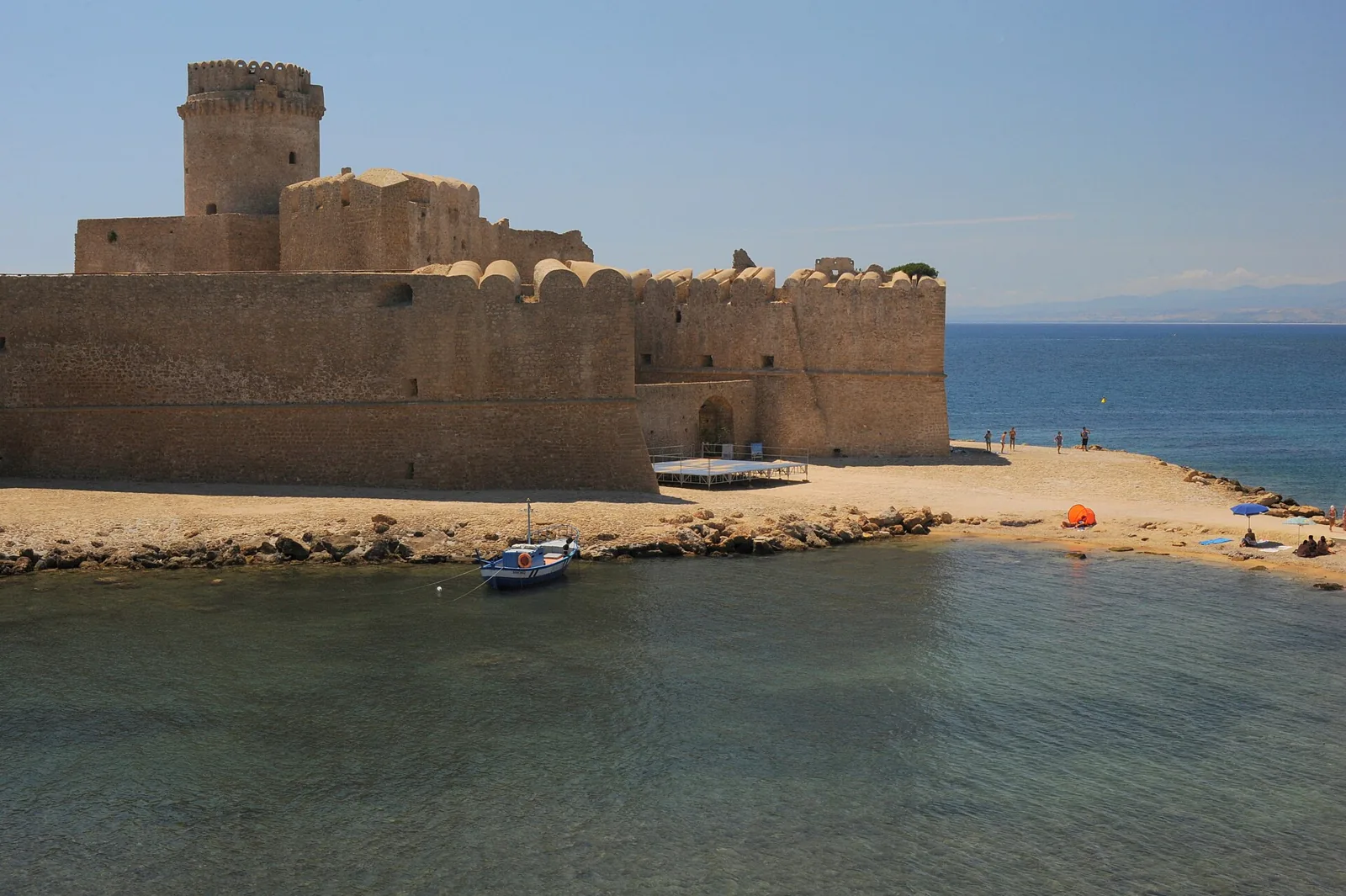
One notable landmark is the Le Castella fortress in the municipality of Isola di Capo Rizzuto, built on a small islet joined to the shore by a narrow causeway. The structure has medieval roots, and its current form is largely the result of Aragonese rebuilding. Le Castella lies within the Capo Rizzuto Marine Protected Area, established in 1991, which covers nearly 15,000 hectares and is the largest reserve of its kind in Italy. It extends between Capo Colonna and Le Castella and offers good conditions for diving. Inland, in the south of the region, lies Aspromonte National Park, whose forests and mountain trails are a cooler alternative to the hot coast.
Best beaches in Calabria – frequently asked questions
What are the most beautiful beaches in Calabria?
The best known are Spiaggia della Rotonda in Tropea and Grotticelle beach on the Capo Vaticano headland. A striking rock formation with a beach hidden beneath it is Arcomagno in San Nicola Arcella.
Which beach in Calabria is best for families with children?
Good choices are the beaches at Soverato on the Ionian coast and Nicotera on the Tyrrhenian coast. They have fine sand and gentle entry into the water, and hold the Green Flag (Bandiera Verde) certification awarded by paediatricians.
When is the best time to visit Calabria's beaches?
The best time is June or September. The sea is warm by then, and the beaches are free of the crowds typical of August, the Italian holiday month.
Are Calabria's beaches free or paid?
Most beaches have publicly accessible free areas (spiaggia libera). There are also paid sections (lidi), where a parasol and two loungers in peak season usually cost between 20 and 35 EUR. Parking at the beach costs around 5–10 EUR per day.
What sea is in Calabria – Tyrrhenian or Ionian?
Calabria lies on two seas: the Tyrrhenian to the west, with a varied coastline, cliffs and steep entry into the water, and the Ionian to the east, with wide sandy beaches and gentle entry.
Sources
The information in this article was verified against the following sources:
- Vulcani sottomarini – rischi.protezionecivile.gov.it
- comune.isoladicaporizzuto.kr.it (PDF) – comune.isoladicaporizzuto.kr.it
- comune.praiaamare.cs.it (PDF) – comune.praiaamare.cs.it
- Ordinanza n.12/2026: ingresso gratuito all’Arcomagno per i residenti accompagnatori /… – comune.sannicolaarcella.cs.it
- comune.tropea.vv.it – comune.tropea.vv.it
- Il mare della Calabria. | Calabria .travel – calabria.travel
- Cammino di Cassiodoro - Istituto di studi su Cassiodoro e sul medioevo in Calabria – cassiodoro.it
- Wikipedia – 'Nduja – en.wikipedia.org
Last updated: