For nearly five centuries – from the 6th to the 11th century – Calabria was one of the most important Byzantine provinces in the western part of the empire. Here, eastern civilisation left a mark that survived the Norman conquest, Angevin domination and the unification of Italy. Byzantine churches, monasteries of Basilian monks, priceless manuscripts and Greek-speaking villages are now among the most valuable cultural monuments of southern Italy.
Understanding Calabria's Byzantine heritage lets you see the region as a historical borderland between East and West. This can be seen in its architecture, language, cult of saints and religious traditions, which in several places remain alive rather than being mere textbook history.
Table of Contents
Byzantine Calabria – historical context
After the fall of the Western Roman Empire in 476 AD, Calabria passed through a brief period of Ostrogothic rule before being reconquered by the armies of Belisarius, general of Emperor Justinian I, in 536 AD. From that moment, Byzantine influence and overlordship dominated here for about five centuries, with the final end of Byzantine rule in southern Italy linked to the Norman conquests of the 11th century and the fall of Bari in 1071.
In antiquity, the name Calabria referred primarily to the Salentine Peninsula, i.e. present-day Apulia. In the early Middle Ages, after Byzantium lost some of its former territories and as a result of administrative reorganisation, the name gradually shifted to the area of modern Calabria. This is important when reading 8th–11th century sources, because the word “Calabria” does not always denote exactly the same area as today.
In the 7th century, as Arab and Persian invasions devastated the eastern provinces of Byzantium, Calabria became a refuge for monks fleeing Syria, Egypt, and Asia Minor. They initiated a process of orientalisation of religious life that gradually encompassed liturgy, the cult of saints, and the entire church organisation. Greek became not merely the language of administration but also the everyday speech of the inhabitants.
Administratively, the region was linked successively to Byzantine structures in Italy, first to the Exarchate of Ravenna, and later to units such as the theme or duchy of Calabria and the Catepanate of Italy, headquartered in Bari. Rossano was one of the most important Byzantine centres in Calabria. The city earned the epithet Rossano la Bizantina and served as a theological, artistic, and administrative hub.
The Byzantines brought not only religion and art to Calabria but also craft techniques of major economic importance. Their presence is linked to the development of silkworm cultivation, thanks to which Calabria – and especially Catanzaro – became an important centre of silk production in later centuries. This tradition survived until Italian unification in the 19th century, and Catanzaro earned the title Città delle tre V (City of the Three Vs) after Vento (wind), Velluto (velvet) and Vitaliano (the city’s patron saint).
| Period | Event | Significance for Calabria |
|---|---|---|
| 536 AD | Belisarius's conquests | Calabria returns to Byzantine rule |
| 7th c. | Influx of monks from the East | Orientalisation of religious life begins |
| 8th–9th c. | Iconoclasm in Byzantium | Further wave of monastic emigration westward |
| 10th c. | Establishment of the Catepanate of Italy | New administrative organisation of the south |
| 1059–1071 | Norman conquests | End of Byzantine rule in Italy |
From the 9th century, Calabria's coasts were exposed to Arab raids; in 902, the Arabs captured Reggio. The pressure of these attacks encouraged the development of defensive settlements inland and on hard-to-reach hilltops, such as Rossano, Stilo, Bova and Gerace. This is why many of the region's most important Byzantine centres are located far from the coastline today.
Byzantine churches and monuments – eastern architecture on Italian soil
Calabria's Byzantine sacred architecture is among the best preserved in western Europe. Churches built by eastern monks and craftsmen are distinguished by the characteristic plan of a cross inscribed within a square, domes on drums, and brick construction adorned with geometric patterns.
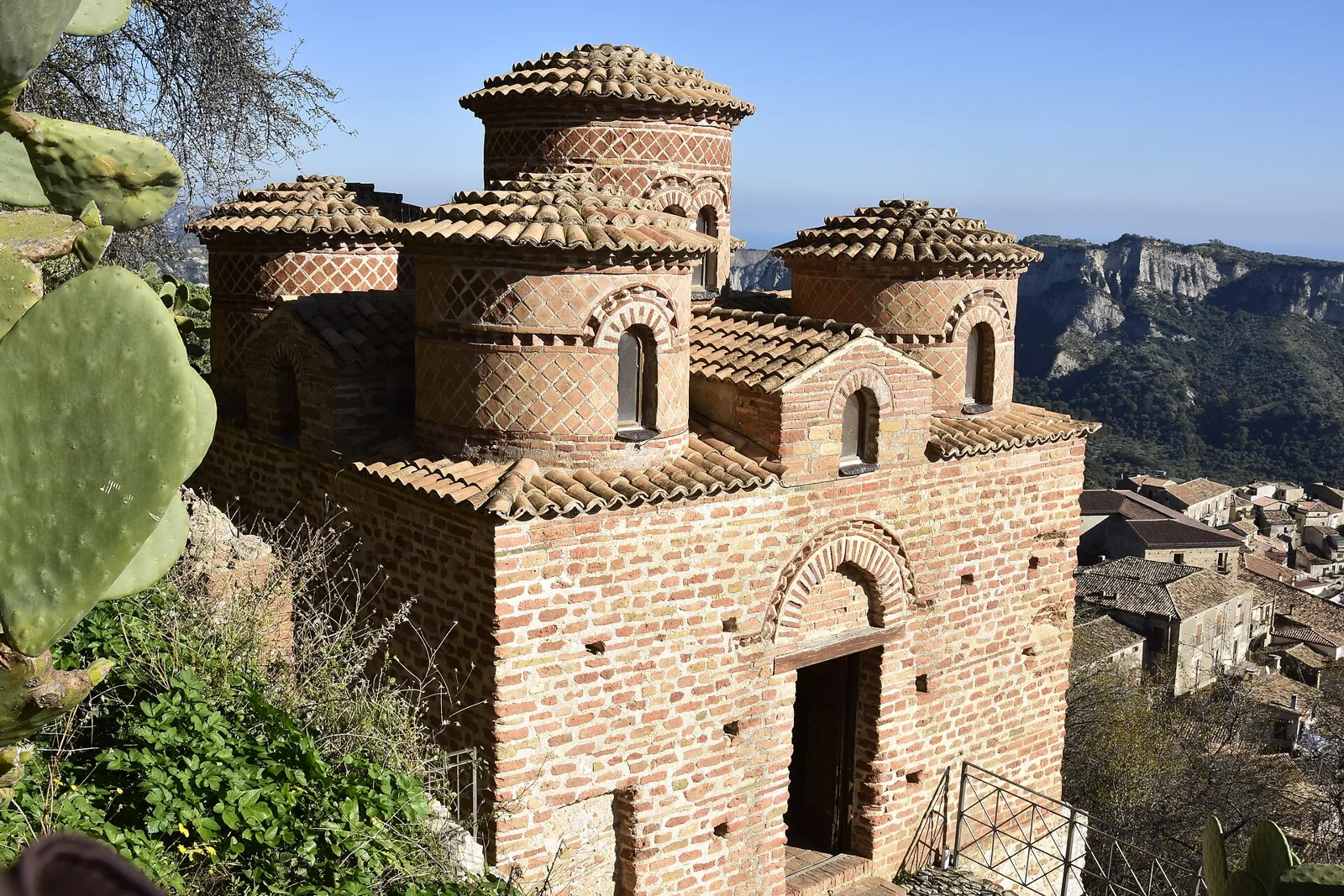
In small Calabrian churches, several features recur: three apses on the eastern side, a central dome supported by four piers, and a presbytery facing east. From the outside, these buildings can be austere, with a simple brick facade, but inside a rich painted programme was originally what mattered most. This makes it easier to understand why the Cattolica di Stilo and San Marco in Rossano are so significant for the history of architecture.
Cattolica di Stilo – icon of Byzantine Calabria
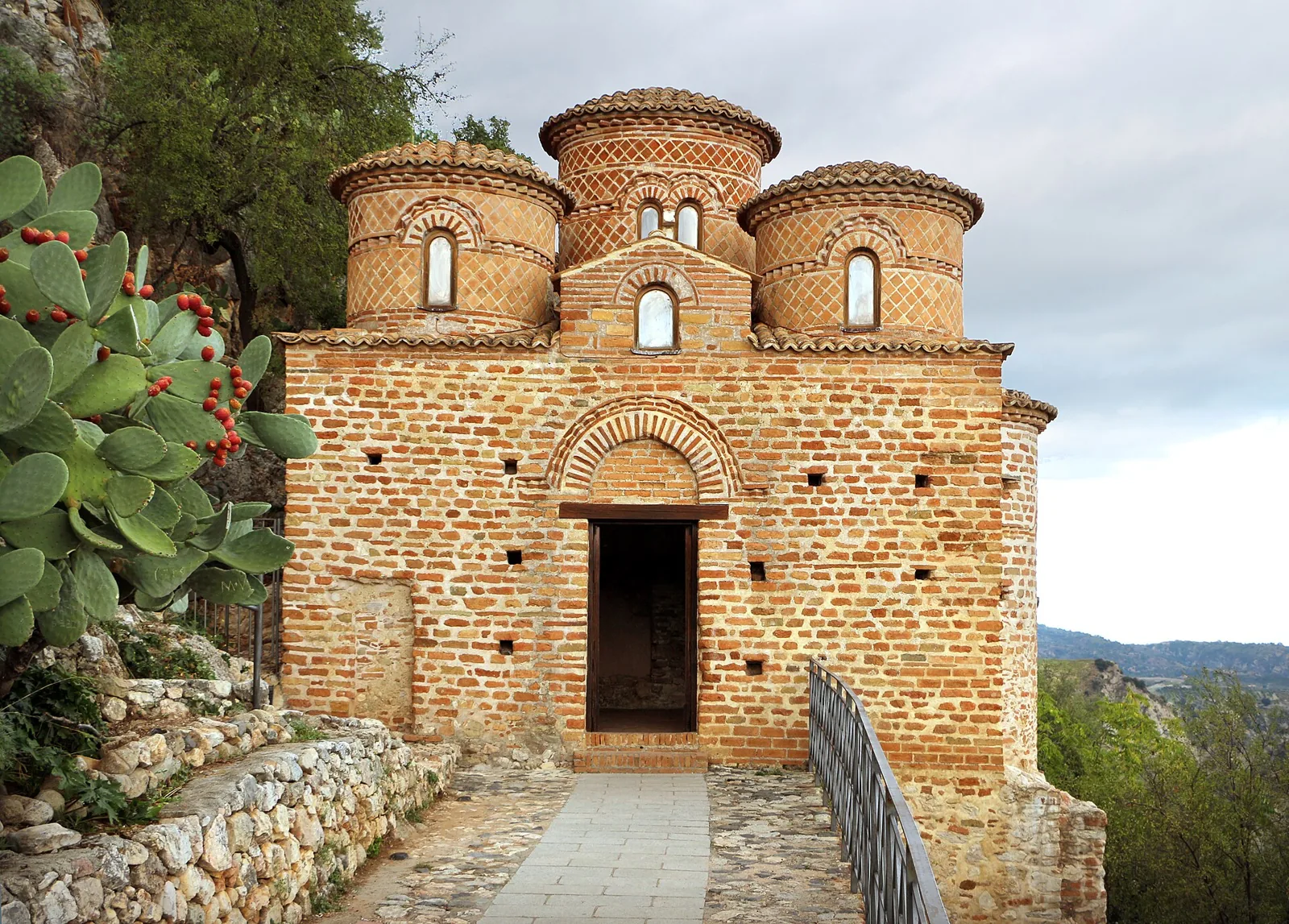
The Cattolica di Stilo is the most recognisable Byzantine monument in Calabria. Usually dated to the 10th century, this small brick church is a masterpiece of middle Byzantine architecture. Its plan follows the typical scheme of a cross inscribed within a square, with the interior divided by four columns into five spaces topped by domes – the central one slightly taller and wider than the corner ones.
The name Cattolica derives from the Greek katholikí or katholikon, a term referring to the main or “universal” church. The interior preserves remnants of frescoes painted between the 10th and 15th centuries. Mentions of an Arabic inscription associated with the monument appear in scholarly literature, but they do not provide grounds for considering the church a former Muslim oratory. The Cattolica is a national monument and part of the nomination for UNESCO World Heritage status as “Evidence of Italo-Greek Culture between the Early and Late Middle Ages.”
Oratory of San Marco in Rossano
Dated to the 10th century and traditionally associated with the milieu of St Nilus the Younger, the Oratory of San Marco is, alongside the Cattolica, the most precious monument of Byzantine architecture in Calabria. Perched on a rocky escarpment, it features a Greek cross plan inscribed within a square with three identical apses. Five domes – the central one on a taller drum, flanked by four smaller corner domes – evoke miniature versions of the great churches of Constantinople. During restoration in 1928–1934, fragments of a fresco depicting the Virgin Hodegetria (She Who Points the Way) were uncovered, one of the most precious examples of Byzantine wall painting in Italy.
Cathedral of the Madonna Achiropita in Rossano
Rossano's cathedral houses the priceless image of the Madonna Achiropita – an image “not made by human hands,” linked to the Byzantine period and among the most important objects of worship in the city. The entire edifice stands as testimony to the religious continuity between eastern and western Christianity.
The term acheiropoietos or achiropita means precisely “not made by human hands.” In Rossano, this image is the focal point of local religious identity, and tradition links its miraculous appearance to the Byzantine era. Even if the exact dating of the image itself is sometimes debated, its cult has centuries-long continuity.
- Cattolica di Stilo – 10th c., inscribed cross plan, five domes, Byzantine frescoes, national monument
- Oratory of San Marco, Rossano – 10th c., traditionally associated with the milieu of St Nilus the Younger, Virgin Hodegetria fresco
- Cathedral Achiropita, Rossano – image “not made by human hands,” important centre of Marian worship
- San Giovanni Theristis, Bivongi – the surviving church and complex usually dated to the 11th–12th c., one of the few monasteries in Calabria where the Eastern rite liturgy is still celebrated
- Santa Severina – baptistery – 8th–9th c., circular domed structure, one of the oldest baptisteries in southern Italy
Monastic heritage – the Basilian monks and their legacy
The phenomenon of Basilian monasticism in Calabria has no equivalent in western Europe. From the 7th century, monks of the Greek and Byzantine tradition, customarily called Basilians, established hermitages, eremitic settlements and monasteries in the mountains of Aspromonte, in the valleys of Stilaro and Amendolea, and along the Ionian and Tyrrhenian coasts. At their peak, between the 9th and 11th centuries, Calabria counted dozens of Basilian monasteries that served as centres of prayer, learning, and manuscript copying.
Basilian monks did not live in isolation from the world – their monasteries were hubs of culture, education, and care for the needy. In the monastic scriptoria, copies of ancient works and writings of the Church Fathers were produced, while monastic libraries amassed collections of immense significance for the history of European scholarship.
The most important figure of this tradition remains St Nilus the Younger of Rossano, born around 910 and died in 1004. He was one of the most distinguished Greek monks of southern Italy, and his biography well illustrates the standing of Rossano as a centre of Greek culture in the 10th century. It was he who in 1004 founded the Abbey of Grottaferrata near Rome, which preserves the Byzantine tradition to this day.
Abbey of Santa Maria del Patire (Patirion)
One of the most renowned Basilian monasteries in Calabria is the Abbey of Santa Maria del Patire, also known as the Patirion, founded around 1095 by the monk Bartholomew of Simeri on earlier Byzantine foundations. Situated in the hills above Rossano, the abbey quickly became one of the wealthiest and most important monasteries in southern Italy.
During the Norman period, the Patirion possessed a rich library and scriptorium where copyist monks worked on transcribing ancient codices. The monastic church, with its basilica plan and three east-facing apses, is an outstanding example of Romanesque-Byzantine architecture. The abbey flourished until the 15th century, and its final end came during the Napoleonic period in the early 19th century. Today, the church and the ruins of the monastery survive.
Monastery of San Giovanni Theristis in Bivongi
The monastery at Bivongi, built on the site of an older eremitic tradition associated with St John Theristis, is one of the few places in Calabria where the Eastern rite liturgy is still celebrated today (since 2008 it has been in the care of monks of the Romanian Orthodox Church, and before that – from 1994 – of monks who came from Mount Athos). The surviving building is later than the tradition of the place itself and is usually dated to the 11th–12th century. It stands as a living bridge between the region's Byzantine past and its present – proof that the eastern religious tradition here is not merely a museum exhibit.
According to information from the municipality of Bivongi, the Monastero Greco-Ortodosso di San Giovanni Theristis is usually open daily from 09:00–13:00 and 14:00–18:00. Admission is free. The address is Contrada San Giovanni, SNC, 89040 Bivongi RC, which makes it easy to set as a navigation destination when driving through the Stilaro valley.
Codex Purpureus Rossanensis – masterpiece of Byzantine manuscript art
Calabria's greatest treasure of Byzantine manuscript art is the Codex Purpureus Rossanensis – a 6th-century illuminated manuscript of the Gospels of Matthew and Mark, written primarily in silver ink on purple-dyed parchment, with gold used in selected parts. It is one of the most precious surviving early Christian codices and one of the symbols of Rossano.
In 2015, the Codex Purpureus was inscribed on the UNESCO Memory of the World Register. This is a different type of distinction from inclusion on the UNESCO World Heritage List, but its significance for the manuscript remains exceptional. The codex is associated with the Museo Diocesano e del Codex (Diocesan Museum and Codex) in the historic centre of Rossano, on Piazza Duomo.
The museum operates in two seasons. From 8 September to 30 June it is open from 9:30–12:30 and 15:00–18:00, on holidays from 10:00–12:00 and 16:00–18:00, and is closed on Mondays as well as on 1 January, Easter and 25 December. From 1 July to 7 September the opening hours are 9:30–13:00 and 16:00–20:00; Monday is the closing day except in August.
A standard ticket costs €7, a reduced ticket €5, children aged 7–17 pay €4, and school groups €3. The ticket includes a guided visit to the Codex section. Before visiting, check the current availability on the official website of the Museo Diocesano e del Codex, because the display of the manuscript depends on conservation rules and museum organisation.
Watch on YouTube
Greek-speaking communities – a living trace of Byzantium
One of the most extraordinary manifestations of Byzantine heritage is the survival of Greek-speaking communities in Calabria. The area known as Bovesia (or Grecìa Calabrese), located in the mountainous terrain of Aspromonte in the Province of Reggio Calabria, is home to the last speakers of Grecanico (Calabrian Greek).
Calabrian Greek is a continuation of the Greek language that has survived in this region since the era of Magna Graecia, enriched by Byzantine influences. Written in the Latin alphabet, it differs from modern Greek but preserves many archaic forms. Greek-speaking communities are found primarily in:
- Bova Superiore – the historic capital of Bovesia, with the Cathedral of Santa Maria Isodia and preserved Greek inscriptions
- Gallicianò – a picturesque village above the Amendolea valley, called the “fortress of Grecanico”
- Roghudi – an abandoned mountain village, a symbol of the emigration that threatened the language's survival
- Bova Marina – a coastal town with an important centre documenting the Greek minority culture
- Condofuri and Roccaforte del Greco – villages where elderly residents still converse in Grecanico
In Bova itself, a concrete place to learn about this culture is the Aspromonte National Park Visitor Centre dedicated to the linguistic minority of the Greeks of Calabria. It is housed in Palazzo Tuscano and includes an exhibition route over three floors. The centre also contains the Mosino Library, with around 5,000 volumes on the culture of the Greeks of Calabria; the stated opening hours are weekdays 08:00–13:00.
Calabrian Greek is recognised as a severely endangered language, but it is not a widely spoken tongue in the region. Today it is used by a very small number of people, mainly of the older generation, primarily in the area of Bova, Gallicianò, Roghudi or new Roghudi, Condofuri and surroundings. Following Law 482/1999 on the protection of historic linguistic minorities, its survival is supported by associations, schools and cultural events.
The Paleariza Festival, held in summer across several towns of the Grecanico area, is the most important event dedicated to preserving Calabrian Greek culture. It is an ethnomusical and cultural festival associated with Grecìa Calabrese, rather than an event tied to one fixed location. The programme typically includes concerts of traditional and world music, language events and promotion of Greco-Calabrian culture.
What to visit – the Byzantine Calabria trail
Calabria's Byzantine heritage is scattered across the entire region, but it can be explored through several well-planned routes. The key sites are Rossano, Stilo, Bivongi, Bova, Santa Severina, Gerace and Patirion above Rossano.
In practice, this is a trail best planned by car. The main artery linking these places is the coastal SS106 Jonica road, but reaching most of the historic towns means turning inland onto steep, winding roads; public transport between these points can be limited and time-consuming. For Rossano alone, it is worth allowing half a day to a full day, and a north–south tour of all the key sites (Rossano to Bova is over 250 km) requires at least 4–5 days.
When planning Stilo, check the current visiting rules for the Cattolica di Stilo. The site reopened to visitors on 29 July 2026. The stated hours are: Monday closed, Tuesday and Sunday 14:00–19:30, Wednesday–Saturday 8:30–19:30. The ticket office closes 15 minutes before the site closes.
Rossano and surroundings (Province of Cosenza)
Rossano – today part of the municipality of Corigliano-Rossano – is the capital of Byzantine Calabria. In a single day, you can visit the Codex Museum with the Codex Purpureus, the Oratory of San Marco with fragments of medieval frescoes, the Cathedral with its Achiropita icon, and the ruins of the Abbey of Santa Maria del Patire on a nearby hill. For history enthusiasts, it is an essential destination.
Stilo and the Stilaro valley (Province of Reggio Calabria)
The Cattolica di Stilo is the most recognisable stop on the trail. It is worth combining with a visit to the medieval town of Stilo – birthplace of the philosopher Tommaso Campanella – and nearby Bivongi with the Monastery of San Giovanni Theristis. The Stilaro valley was one of the most densely settled monastic centres in Calabria.
Gerace (Province of Reggio Calabria)
Medieval Gerace, set on a massive rocky plateau, is one of the most beautiful villages in Italy (borghi più belli d'Italia). Although it is famous for its mighty Norman cathedral, the interior holds clear Byzantine traces – the crypt and ancient reused columns brought from the nearby abandoned Greek city of Lokroi Epizephyrioi.
Bovesia and Aspromonte (Province of Reggio Calabria)
Bova and the villages of Bovesia offer the experience of living Byzantine heritage – from Greek inscriptions on buildings to the memory of the region's former language. Mountain roads in the Aspromonte massif demand concentration behind the wheel and time to spare, but they reward visitors with spectacular landscapes and an authenticity that has rarely survived in the coastal resorts.
Santa Severina (Province of Crotone)
This picturesque hilltop town conceals a Byzantine baptistery from the 8th–9th century – a circular domed structure that ranks among the oldest of its kind in southern Italy. Combined with its Norman castle and cathedral, Santa Severina offers a fascinating cross-section of Calabria's multi-layered history.
Santa Severina is also important because it illustrates well the layering of successive periods in the region's history. Significant traces of Byzantine settlement and culture have been preserved here, and the baptistery itself is among the most precious early medieval sacred monuments in Calabria. The juxtaposition of this site with the later Norman castle and cathedral allows you to see how Byzantium, the Norman conquest and Latin reorganisation coexisted in one landscape.
| Site | Province | Key attraction | Visit time |
|---|---|---|---|
| Rossano | Cosenza | Codex Purpureus (Codex Museum) | 3–4 hrs |
| Stilo | Reggio Calabria | Cattolica di Stilo | 1–2 hrs |
| Bivongi | Reggio Calabria | Monastery of San Giovanni Theristis | 1–2 hrs |
| Bova | Reggio Calabria | Cathedral, Greek-speaking community | 2–3 hrs |
| Gerace | Reggio Calabria | Byzantine-Norman cathedral with reused columns | 2–3 hrs |
| Santa Severina | Crotone | Byzantine baptistery | 1–2 hrs |
| Patirion (Rossano) | Cosenza | Basilian abbey ruins | 1–2 hrs |
Byzantine Heritage of Calabria – frequently asked questions
How long did Byzantine rule in Calabria last?
Byzantine influence and overlordship dominated in Calabria for about five centuries – from the reconquest by Belisarius's armies in 536 AD to the Norman conquests of the 11th century. Their final end in southern Italy is linked to the fall of Bari in 1071.
What is the Codex Purpureus Rossanensis and where can it be seen?
The Codex Purpureus Rossanensis is a 6th-century illuminated Gospel manuscript written primarily in silver ink on purple parchment, with gold used in selected parts. In 2015 it was inscribed on the UNESCO Memory of the World Register. It is associated with the Museo Diocesano e del Codex in Rossano, but before your visit you should check the current availability of the exhibit on the museum's official website.
Is Greek still spoken in Calabria?
Yes, but Calabrian Greek (Grecanico) is today the language of a very small, endangered community. It is used mainly by older residents in the area of Bova, Gallicianò, Roghudi, Condofuri and surroundings in Aspromonte. Italy has officially protected this historic linguistic minority since 1999.
What makes the Cattolica di Stilo different from other Byzantine churches in Calabria?
The Cattolica di Stilo is the best-preserved and most recognisable example of middle Byzantine architecture in Calabria. Its inscribed cross plan with five domes illustrates the features of this style well. Other churches, such as San Marco in Rossano, share a similar scheme, but the Cattolica stands out for its exceptionally compact and legible form.
Who were the Basilian monks and why were they important for Calabria?
They were monks of the Greek and Byzantine tradition, customarily called Basilians. From the 7th century, they established hermitages and monasteries in Calabria that became centres of prayer, learning and manuscript copying. Their legacy includes churches, monasteries and the enduring presence of the Eastern liturgical rite, which in some places survives to this day.
Sources
The information in this article was verified against the following sources:
- Comune di Gerace - Basilica Minore Concattedrale Santa Maria Assunta – comune.gerace.rc.it
- La cattolica di stilo riapre al pubblico – comune.stilo.rc.it
- Informazioni - Museo Diocesano e del Codex - Arcidiocesi di Rossano-Cariati – museocodexrossano.it
- Centro Visita di Bova | Parco Nazionale dell'Aspromonte – parconazionaleaspromonte.it
- comunebivongi.it – comunebivongi.it
- CHIESA DI SAN MARCO A ROSSANO CALABRO | Storia dell'Arte – progettostoriadellarte.it
- Wikipedia – Byzantine Empire – en.wikipedia.org
Last updated: