Calabria is a region where tradition is not a museum piece – it pulses through processions, tarantella circles and summer sagre. From the blood-soaked rites of Holy Week in Nocera Terinese, through the 20-ton UNESCO-listed Varia di Palmi, to thousands of pilgrims sleeping under the stars at the Polsi sanctuary – Calabrian festivals fuse raw devotion with exuberant celebration. When planning a trip, the best approach is to synchronise it with a local feast: a procession, a sagra or a patron saint celebration.
Table of Contents
Major religious festivals
The Calabrian year revolves around patron saint feasts and Marian celebrations. These are the most important ones:
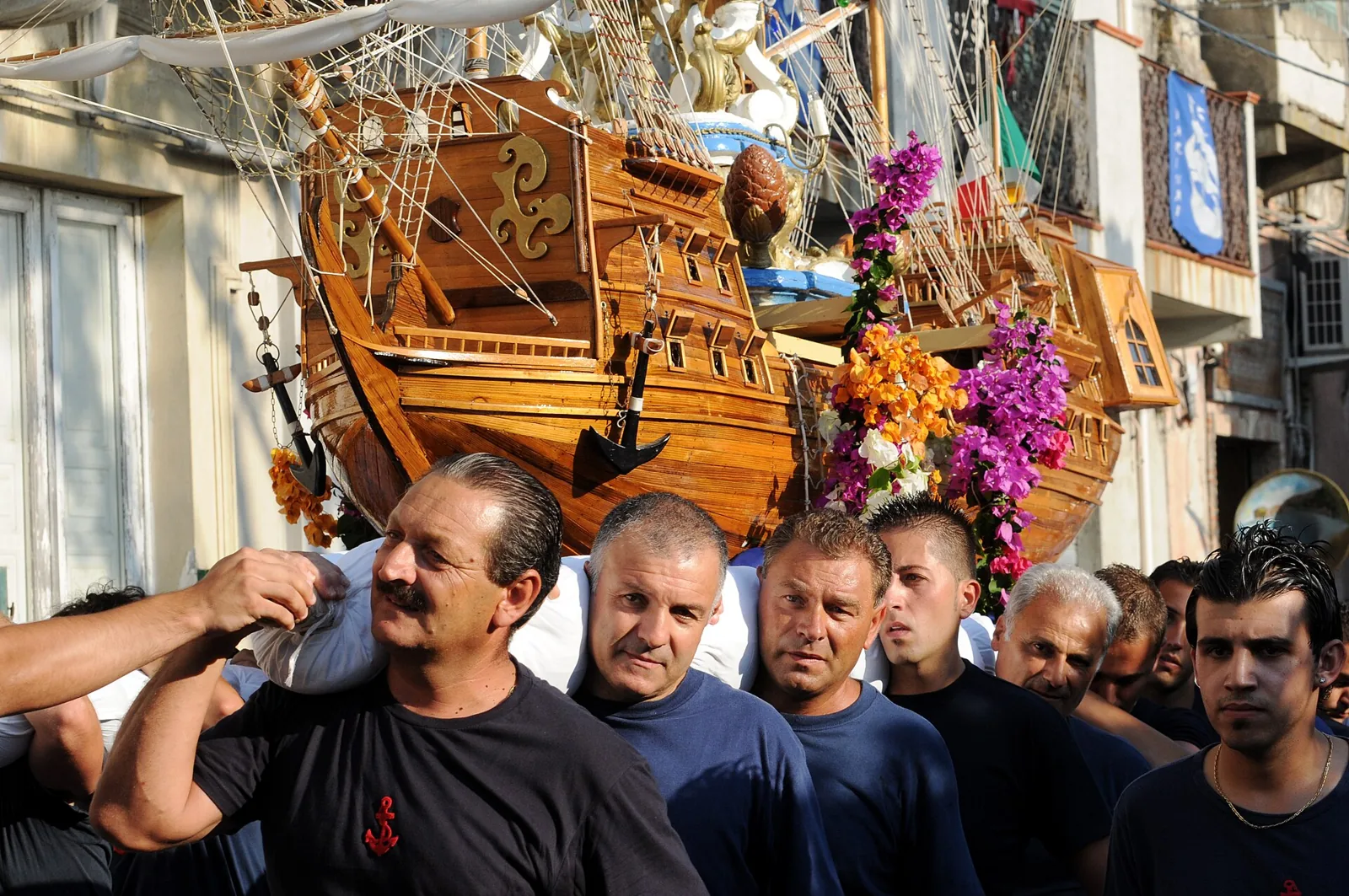
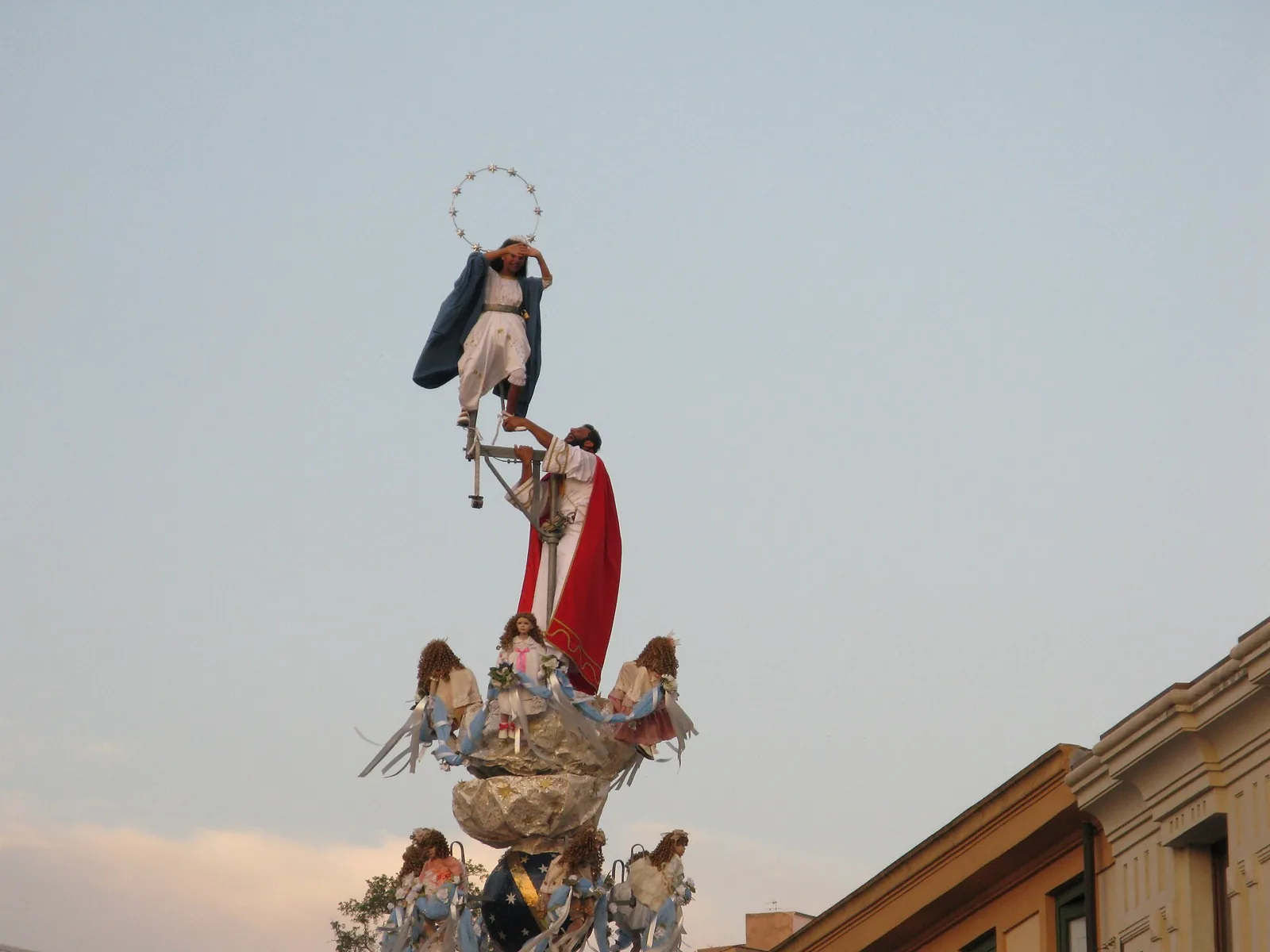
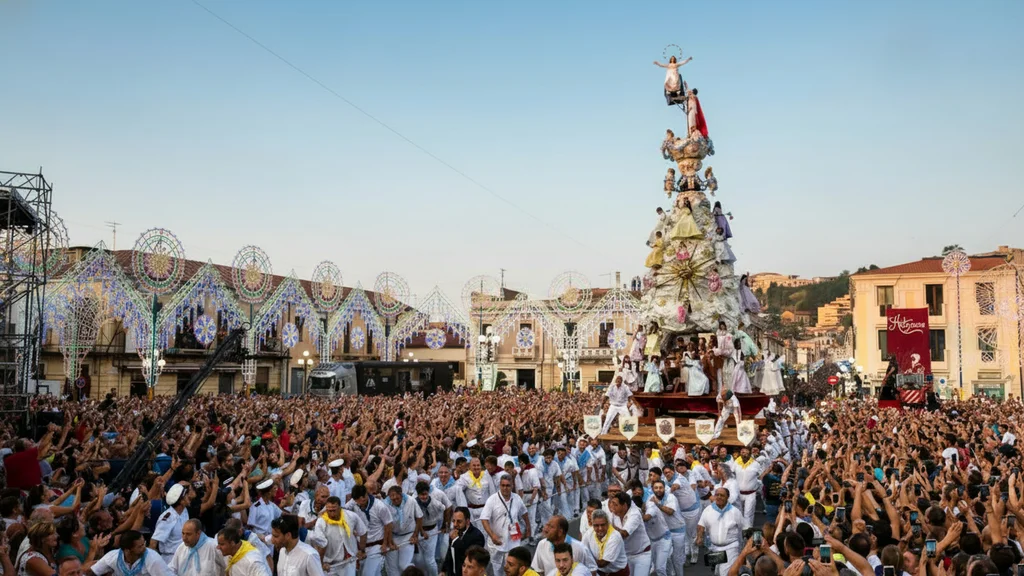
Varia di Palmi (last Sunday of August, in the years when the Varia is held) – the date of a specific edition must be checked in advance, because the Varia procession takes place only every few years. This is the most spectacular religious event in Calabria, inscribed in 2013 on the UNESCO Representative List of the Intangible Cultural Heritage of Humanity. Around 200 mbuttaturi set in motion a 16-metre structure weighing about 20 tons, representing the Assumption of the Virgin Mary; the modern Varia moves across granite paving on steel runners. A living girl – the Animella – is placed at the top, symbolising the Madonna. The origins of the feast are linked to the historic Marian cult in Palmi and the tradition of contacts with Messina, though local accounts present the beginnings differently.
The UNESCO inscription does not concern the Varia di Palmi alone. In 2013 the list received the joint entry “Celebrations of big shoulder-borne processional structures”, encompassing four Italian traditions: the Varia di Palmi, the Macchina di Santa Rosa in Viterbo, the Faradda dei Candelieri in Sassari and the Gigli di Nola. This shows that Palmi is part of a broader Mediterranean culture of great processions.
Festa della Madonna della Consolazione (Reggio Calabria, from the second Saturday of September) – a four-day celebration that brings the entire city to a standstill. A 1547 painting of the Madonna, mounted on a 5-metre vara weighing 1.2 tonnes, is carried on the shoulders of devoted porters from the hilltop Hermitage down to the cathedral in the city centre. The procession begins on the morning of the second Saturday in September; the route from the Basilica dell’Eremo to the cathedral is about 3.5 km long, and the final moment is the volata – the porters running with the vara towards Piazza Duomo. Although Saint George is the patron saint of the city, locals regard the Madonna della Consolazione as the true protectress of Reggio. The feast ends on Tuesday evening with a fireworks display over the Strait of Messina.
Madonna della Montagna di Polsi (31 August – 2 September) – the largest pilgrimage in Calabria. Over 50,000 faithful make their way to a sanctuary hidden deep in the Aspromonte mountains, many on foot through rugged terrain. The climax is an all-night vigil from 1 to 2 September – prayers, litanies and ancient songs accompanied by the organetto (diatonic accordion).
Feast of Saint Francis of Paola (Paola (CS), 2–4 May) – patron saint of Calabria since 1962, born in Paola in 1416, Saint Francis is honoured with three days of celebrations: the lighting of the votive lamp (2 May), the blessing of the sea (3 May) and a procession of the silver bust through the streets (4 May). Fairs, concerts and fireworks accompany the religious programme.
During the Varia di Palmi and the feast in Reggio Calabria, the city centre is often closed to traffic, so it is best to arrive at least 2–3 hours before the main procession. Polsi lies in the mountainous part of the municipality of San Luca, accessed via winding roads through Aspromonte – during the pilgrimage, traffic and parking are severely restricted and accommodation in the area must be booked well in advance.
Tarantella calabrese – dancing in the circle
The Calabrian tarantella is not the cheerful Neapolitan postcard tune. It is an archaic couple dance performed inside a circle of people called the rota (wheel), with a dance master (u mastru ’i ballu) who decides the order in which pairs may enter. It lives on today in the dancers' bearing, rhythm and improvisation.
In the traditional rota, entry into the circle may be signalled by a gesture, a glance or an invitation from the person leading. The dance can be a form of courtship, rivalry, affirmation of community or simply a display of character and skill. In many places, improvisation matters more than staged choreography.
The traditional tarantella is a couple dance (man-woman, but also man-man or woman-woman) that takes on distinct regional forms:
- Sonu a ballu – the oldest form from Aspromonte, accompanied by the Calabrian lyre and tambourine
- Viddanèdda – the variant from the Reggio Calabria province, with a lively, bouncing rhythm
The instruments accompanying the tarantella are primarily the tamburello (frame drum), organetto (small diatonic accordion) and lira calabrese – a three-stringed bowed instrument played upright. In some areas, the zampogna (bagpipe) is also used. You will hear tarantella at patron saint feasts, weddings and sagre – it is a living part of Calabrian culture, not folklore confined to a stage.
Seasonal traditions – Easter and beyond
Holy Week in Calabria is one of the most profound religious experiences in Italy. Every town has its own rituals, but a few stand out for their exceptional staging:
The Vattienti of Nocera Terinese (Holy Saturday) – the most severe penitential rite in the region. Flagellants called vattienti walk through the streets, cutting their thighs and calves with the cardo – a cork disc set in wax with 13 shards of glass (for Christ and the twelve apostles) – as part of a penitential practice linked to Passion processions and local Marian devotion. Blood literally marks the route of the Procession of Our Lady of Sorrows, and the tradition has been documented since the 17th century.
Badolato (Holy Saturday and Easter Sunday) – a full-day Passion re-enactment with hundreds of participants dressed as Roman soldiers. The procession winds through the alleys of the town from morning until evening, visiting churches along the way. Sunday ends with the traditional Cumprunta – a symbolic meeting between the figure of the Risen Christ and the Blessed Virgin.
Vallje in Arbëreshë villages (during the Easter period, usually Easter Sunday or Monday – depending on the village) – Calabria’s Albanian communities celebrate Easter with traditional vallje dances in ceremonial costumes, often after the liturgy. The dance commemorates the resistance of Skanderbeg and underscores Arbëreshë identity, and the best-known celebrations can be seen in Civita, Frascineto, San Demetrio Corone, Lungro and Acquaformosa in the province of Cosenza.
Watch on YouTube
Traditional crafts and folk costume
Calabrian craftsmanship has survived not through tourism but through generational continuity. The most important artisan traditions of the region:
- Ceramics of Seminara – in the town of Seminara, in the Costa Viola area of the province of Reggio Calabria, artisans produce apotropaic ceramic masks with grotesque faces, originally meant to ward off evil spirits. According to local accounts, Pablo Picasso admired the work of the Seminara ceramicist Paolo Condurso
- Lute-making in Bisignano – known as “The Town of Luthiers” since the 17th century, when the De Bonis family began crafting the chitarra battente and Calabrian lyre. Lutherie workshops also operate in Scilla, Acri and Lamezia Terme
- Silk from Catanzaro – from the late Middle Ages one of the most important silk-producing centres in Italy, renowned for silk weaving as early as the 15th century. The tradition lives on through the “Nido di Seta” cooperative in nearby San Floro
- Textiles from Longobucco and Tiriolo – hand-woven tapestries, carpets and vancàli (traditional stoles/shawls), prized for their quality and traditional patterns
- Artistic blacksmithing – màstri furgiàri (master blacksmiths) in Serra San Bruno and Stilo forge ornamental gates, candlesticks and crosses
- Goldsmithing – masters Gerardo Sacco and Michele Affidato from the Crotone area create jewellery inspired by Magna Graecia designs
Seminara is home to the Museo delle Ceramiche di Calabria, a good place to see local ceramics beyond the souvenir shop. According to the Reggio Calabria tourism portal, the collection includes around 500 objects from 20 production centres, including Seminara, Squillace, Mileto, Tropea and Vibo Valentia. This makes it possible to compare the masks and vessels of Seminara with ceramics from other Calabrian workshops.
There was no single universal folk costume for all of Calabria. The pacchiana is the general name for the traditional women's costume, found in many local variants – among the best known are those of Tiriolo (province of Catanzaro) and Castrovillari (province of Cosenza). They differ in cut, colours, headwear and jewellery, but typically consist of a long colourful skirt, a black velvet bodice (corpetto), a white shirt with wide sleeves, an apron and a head covering. Family jewels called brillòcchi – necklaces, brooches and earrings – completed the ensemble. Today the costumes appear mainly during festivals and processions.
Festival calendar – when to go
The festival season in Calabria runs from Easter to late autumn, peaking in August and September. Here are the key events:
| Date | Festival | Location |
|---|---|---|
| Holy Week (March/April) | Vattienti – flagellant procession | Nocera Terinese (CZ) |
| Easter period | Vallje – Arbëreshë dances | Arbëreshë villages (CS) |
| 2–4 May | Feast of San Francesco di Paola | Paola (CS) |
| Last Sunday of August, in the years when the Varia is held | Varia di Palmi (UNESCO) | Palmi (RC) |
| 8 August | Sagra della ’Nduja | Spilinga (VV) |
| 31 August – 2 September | Pilgrimage to Polsi | San Luca (RC) |
| From the second Saturday of September | Madonna della Consolazione | Reggio Calabria |
| 13 August | Sagra della Cipolla Rossa di Tropea | Ricadi (VV) |
| September | Festival del Peperoncino | Diamante (CS) |
| October | Festa del Cioccolato | Cosenza |
Bear in mind that the dates of Holy Week, Easter Sunday and related processions are moveable. Easter in the Catholic calendar can fall between 22 March and 25 April, so events such as the Vattienti and Vallje must be checked separately each year. In the case of the Varia di Palmi, you also need to confirm whether the full edition with the procession of the structure is taking place in that year.
Among the culinary events, the Peperoncino Festival in Diamante stands out as the most recognisable event of its kind in Calabria, usually held in September, with producers, tastings, stalls and cultural events. The Diamante Peperoncino Festival 2026 is announced for 9–13 September 2026; the official programme describes five days of tastings, exhibitions, meetings and the final of the Campionato Italiano Mangiatori di Peperoncino. The Sagra della ’Nduja is most closely associated with Spilinga, regarded as the heartland of this product in the province of Vibo Valentia. It is traditionally held on 8 August every year, and the 2026 edition is announced as the jubilee 50th edition. The red onion from the Tropea area holds the IGP designation “Cipolla Rossa di Tropea Calabria IGP”, so similar festivals can be found not only in Tropea itself (where the summer Sagra del Pesce Azzurro e della Cipolla Rossa is held) but across the entire production area – the best-known onion sagra, running since 1978, takes place on 13 August in Ricadi.
Practical tip: Most festivals are local affairs without official websites. The best source for current dates is the calabriastraordinaria.it portal or asking at the nearest Pro Loco (local tourist information office). Book accommodation well in advance – during major feasts, rooms at agriturismi and B&Bs sell out fast.
Calabrian festivals are living community rituals in which entire families participate, from grandparents to infants. Visitors are welcome, but respect the local character: do not film flagellants at close range, do not interrupt processions and do not refuse when someone offers you a glass of homemade wine. These are the moments when you best understand the Calabrian mindset. For more on the Calabrian cuisine you will discover at sagre, see our dedicated guide.
Calabrian Traditions and Festivals – frequently asked questions
What is the most important festival in Calabria?
The Varia di Palmi, inscribed in 2013 on the UNESCO Representative List of the Intangible Cultural Heritage of Humanity, is the most recognisable festival in the region. It is a spectacular procession featuring a 16-metre, 20-ton structure set in motion by around 200 mbuttaturi. It takes place on the last Sunday of August in the years when an edition of the Varia is organised; the date must be checked in the current Palmi calendar.
When is the best time for festivals in Calabria?
The festival season runs from Easter to October, with the highest concentration of events in August and September. Holy Week offers the most intense religious rituals, while summer and early autumn bring sagre (food festivals) and patron saint feasts.
What is the Calabrian tarantella and where can I see it?
The Calabrian tarantella is a traditional couple dance performed inside a circle (rota) to the accompaniment of the tambourine, organetto and Calabrian lyre. You do not need a special festival – tarantella is danced spontaneously at patron saint feasts, weddings and sagre across the region. Music and dance often accompany the great religious feasts as well, especially during the summer months.
Are the vattienti (flagellants) of Nocera Terinese a real ritual?
Yes. It is an authentic penitential tradition documented since the 17th century, practised on Holy Saturday. Participants genuinely wound themselves as part of a ritual linked to Passion processions and local Marian devotion. Watching is permitted, but maintain a respectful distance.
How can I buy authentic Calabrian handicrafts?
Visit artisan workshops directly: ceramics in Seminara (Costa Viola), instruments in Bisignano (Cosenza province), textiles in Longobucco. Avoid mass-produced souvenirs from tourist shops – look for the artigianato locale label or ask at the local Pro Loco for workshop addresses.
Sources
The information in this article was verified against the following sources:
- ich.unesco.org (PDF) – ich.unesco.org
- Museo delle Ceramiche di Calabria | Turismo Reggio Calabria – turismo.reggiocal.it
- La festa della Madonna della Consolazione | Turismo Reggio Calabria – turismo.reggiocal.it
- Artigianato in Calabria: botteghe, mestieri e tradizioni - Italia.it – italia.it
- 'Nduja Festival Spilinga | 8 August | Sagr.it – sagr.it
- Sagra della Cipolla Rossa di Tropea IGP, Ricadi | Sagr.it – sagr.it
- Consiglio regionale della Calabria – consrc.it
- Peperoncino Festival di Diamante | Sito Ufficiale dell'Evento – peperoncinofestival.org
- San Francesco di Paola: santo da 500 anni con un messaggio sempre attuale - Vatican News – vaticannews.va
- Wikipedia – Tarantella – en.wikipedia.org
Last updated: