Calabria has nearly 790 kilometres of coastline – washed by the Tyrrhenian Sea to the west and the Ionian Sea to the east. That coastline gives you a wide choice: the cliffs of Tropea and Capo Vaticano, long Ionian beaches, small coves reached on foot, and seaside towns you can get to by train. The official 2026 Bandiera Blu list includes, among others, Praia a Mare – Camping Internazionale/Punta Fiuzzi, San Nicola Arcella – Arcomagno/Canale Grande Marinella, Soverato – Baia dell’Ippocampo, and Tropea – Marina del Convento, Marina dell’Isola, Rocca Nettuno. I explored them from Praia a Mare in the north to Riace Marina in the south – here are my top ten.
Table of Contents
- 1. Tropea – The Region's Showpiece
- 2. Capo Vaticano – Granite Cliffs and Caribbean Colours
- 3. Soverato – A Resort on the Ionian Sea
- 4. Scilla – Marina Grande
- 5. Pizzo – A Beach with a Bay View
- 6. Caminia – A Cove Between Cliffs
- 7. Zambrone – For Snorkelling Fans
- 8. Praia a Mare – In the Shadow of Isola di Dino
- 9. San Nicola Arcella – The Arcomagno
- 10. Riace Marina – Ionian Silence
- When to Go and What to Bring
1. Tropea – The Region's Showpiece
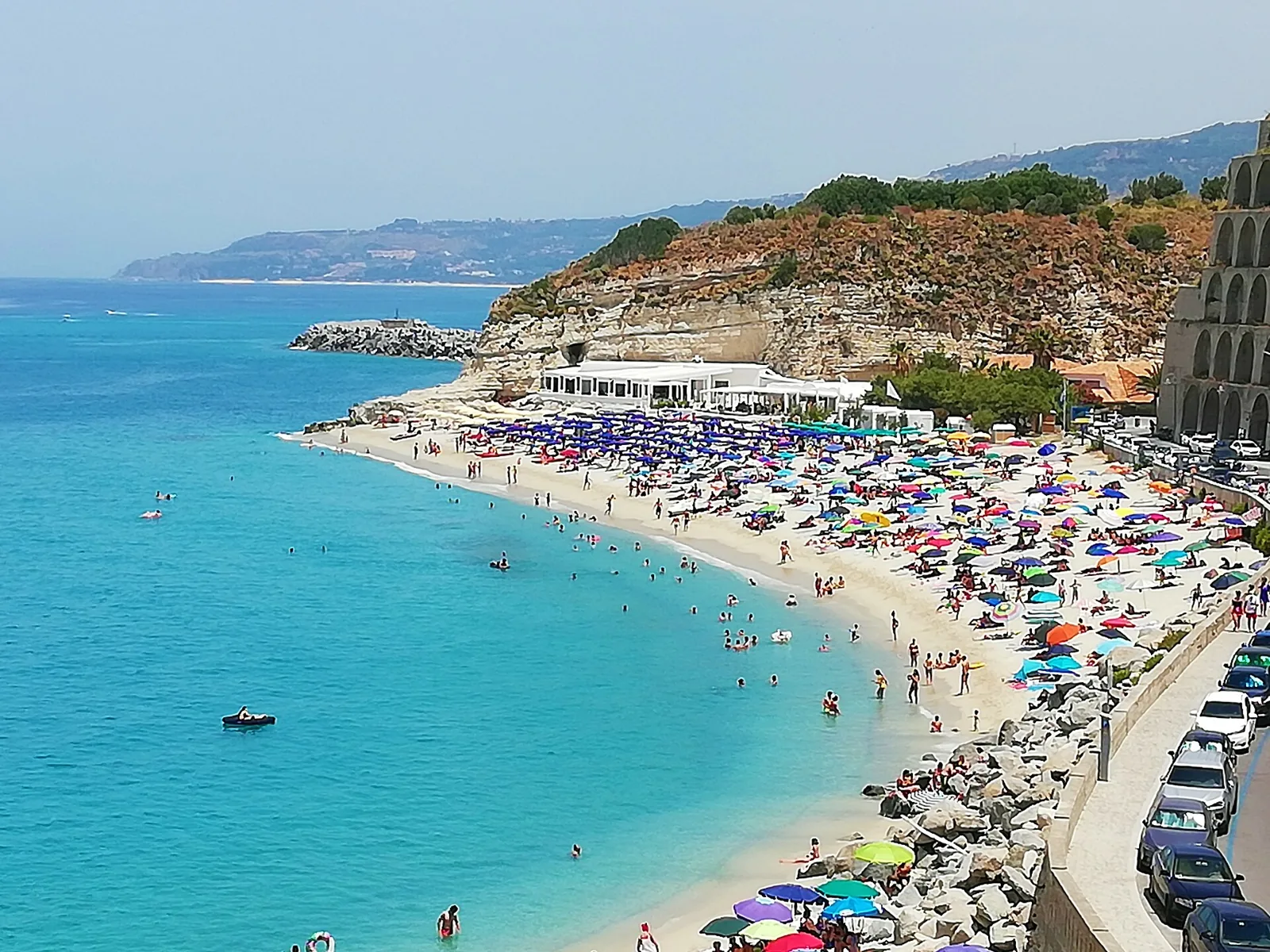
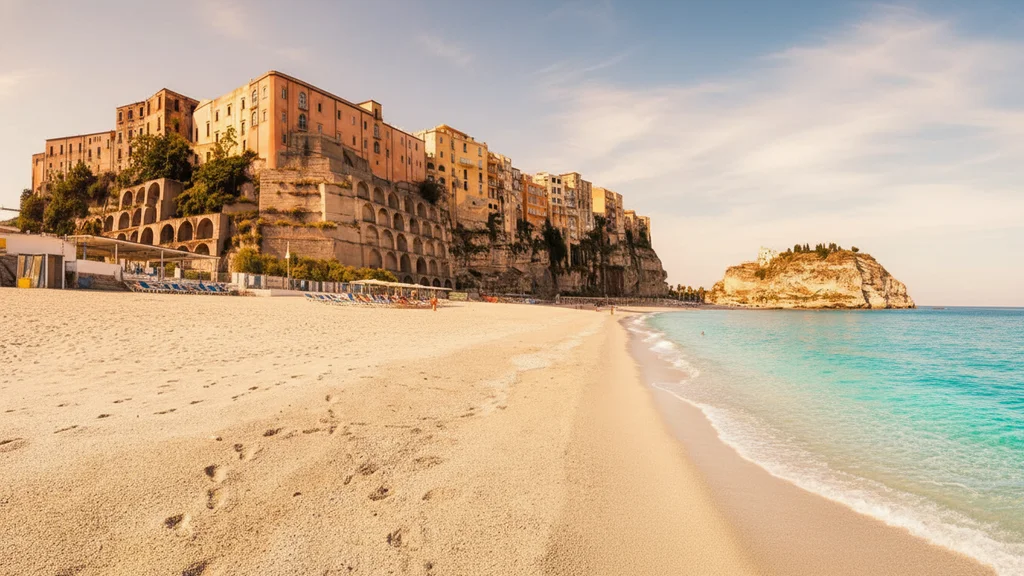
Let us start with the beach everyone finds when they type "Calabria" into a search engine. Tropea is a cliff-top town with wide crescents of white sand below and water so clear you can see the bottom several metres down. In the background, perched on a rocky promontory connected to the beach, stands the church of Santa Maria dell'Isola – one of the most photographed views in southern Italy.
The beaches below Tropea lie right at the foot of the cliff, with stairways leading down from the centro storico. The best-known stretches are Spiaggia della Rotonda, the beach below Santa Maria dell'Isola and the area around Marina dell'Isola. In peak season the stairways can get crowded from around 10:00, and walking from the Tropea train station to the main beach accesses takes roughly 10–15 minutes.
The main beach, Spiaggia della Rotonda, is easily reached by steps from the town centre. In summer it gets busy, so if you want peace, head to Spiaggia del Cannone on the western side or the lesser-known Spiaggia a Linguata. Lido prices depend on the season, row and individual stabilimento; outside peak season you can find cheaper sets, but in July and August expect higher rates and check current price lists.
2. Capo Vaticano – Granite Cliffs and Caribbean Colours
Capo Vaticano lies a short drive from Tropea and is where the Calabrian coastline shows its wildest face. Granite cliffs drop vertically into the sea, creating dozens of small bays often reachable only on foot or by boat. The water here is a colour you do not expect in Europe – intense turquoise fading to deep navy.
The most stunning beach is Grotticelle – three small coves at the foot of the lighthouse, with views of the Aeolian Islands on a clear day. Getting there requires a steep staircase, but the effort pays off. Snorkelling here is fantastic – underwater rock formations create a natural aquarium.
Capo Vaticano lies in the municipality of Ricadi, roughly 10–12 km south of Tropea. Grotticelle is easiest to reach by car, as getting there from the Ricadi train station area is impractical without one. Some of the coves are accessible only from the sea or via steep paths – important to keep in mind for families with small children and visitors with limited mobility.
3. Soverato – A Resort on the Ionian Sea
We cross to the eastern coast. Soverato is a wide beach with light gravel, fine pebbles and patches of coarser sand, plus calm, crystal-clear water. It is the favourite bathing spot for residents of Catanzaro province – less touristy than Tropea but equally beautiful. The beach is well equipped with sunbeds, beach bars, and rentals for windsurfing and diving gear.
Soverato includes the Parco Marino Regionale “Baia di Soverato”, established by regional law L.R. n. 10/2008. The bay is regularly home to Hippocampus hippocampus and Hippocampus guttulatus, the two seahorse species that give Baia dell’Ippocampo its name. That is a good reason to treat the shallow water here with extra care, especially when snorkelling or swimming close to the seabed.
In the evening, Soverato's promenade comes alive. The local gelaterias serve some of the best ice cream on the coast – I recommend the fichi e mandorle (fig and almond) flavour.
4. Scilla – Marina Grande
Marina Grande in Scilla is a beach where you swim and gaze in equal measure. On one side, the Ruffo Castle on its rock; on the other, the pastel houses of Chianalea; behind you, the Strait of Messina with Sicily on the horizon. The beach is mostly pebbly and gravelly, with patches of coarser sand in places, and the walk from the train station takes about 10 minutes.
Scilla also has a rich cultural backdrop – many identify it with the myth of Scylla from the Odyssey. Castello Ruffo di Scilla stands on a headland commanding the Strait of Messina, while Chianalea is a historic fishing quarter, whose houses stand right above the water.
This is the perfect half-day beach – a swim in the morning, a panino con pesce spada for lunch, a stroll through Chianalea in the afternoon. The train station is close by, so you can reach it from Reggio Calabria in 20 minutes.
5. Pizzo – A Beach with a Bay View
Pizzo is known above all for its tartufo di Pizzo (the legendary gelato in a chocolate shell), but the beaches here are special too. Spiaggia di Pizzo stretches at the foot of the cliff on which the town stands, offering views across the Gulf of Sant'Eufemia. The beaches here vary in character – you will find stretches of sand, gravel and pebbles, and the entry into the water is not equally gentle everywhere.
After swimming, walk up to town for a tartufo at one of the historic gelaterias. The dessert is usually credited to Giuseppe De Maria, known as Don Pippo, who is said to have created it in 1952, and various establishments keep their own versions of the tradition alive. A beach plus one of the most famous Calabrian desserts? Hard to beat.
If you want to add one distinctive attraction to your beach day, drive a few kilometres from the centre to the Chiesa di Piedigrotta. This is a seaside chapel-grotto carved into tufa, filled with statues, whose present appearance developed from the late 19th into the 20th century. Many visitors combine it with a beach trip to Pizzo.
6. Caminia – A Cove Between Cliffs
Caminia is a small beach tucked between steep cliffs and lush vegetation, about 15 minutes' drive from Soverato. It is a place that still lives to a local rhythm – you are more likely to hear the Calabrian dialect here than English. The water is exceptionally clear, and the surrounding rocks and greenery create a sense of intimacy, especially outside weekends and peak season.
The infrastructure is not over the top, but there is certainly more than just a single bar and a few sunbeds. In season, lidos, bars and restaurants operate here, so you can easily spend half a day or the whole day. Caminia retains a more local than resort-like feel.
7. Zambrone – For Snorkelling Fans
Zambrone sits on the Tyrrhenian coast between Tropea and Capo Vaticano, offering beaches that look like travel brochure material – minus the crowds. The most famous is Spiaggia Paradiso del Sub (Diver's Paradise) – the name says it all. Reaching it requires a short walk along a scenic rocky path, but the reward is crystal waters, rock formations and excellent conditions for snorkelling.
Even if you do not dive, the sight of cliffs dropping into the sea is worth the visit alone. The beach is partly pebble, partly sandy, and gentle waves make it safe for swimming.
8. Praia a Mare – In the Shadow of Isola di Dino
At the northern tip of Calabria's coastline, right on the border with Basilicata, lies Praia a Mare. The star attraction is Isola di Dino – the largest island of Calabria, a rocky mass rising to a maximum height of around 100 metres above sea level, just a few hundred metres from the beach. According to local geological interpretations, it may once have been connected to the mainland.
Boats depart from Praia a Mare beach for tours around the island – you will see the Grotta Azzurra (Blue Grotto) with its extraordinarily vivid water, the Grotta delle Cascate, and several other sea caves. By kayak or pedalo you can at most circle the area around the island in line with local rules; landing on Isola Dino and moving around the island requires authorisation or participation in an organised visit with an authorised guide. The beach itself stretches 5 km and offers a mix of free stretches and lido sections with sunbeds.
9. San Nicola Arcella – The Arcomagno
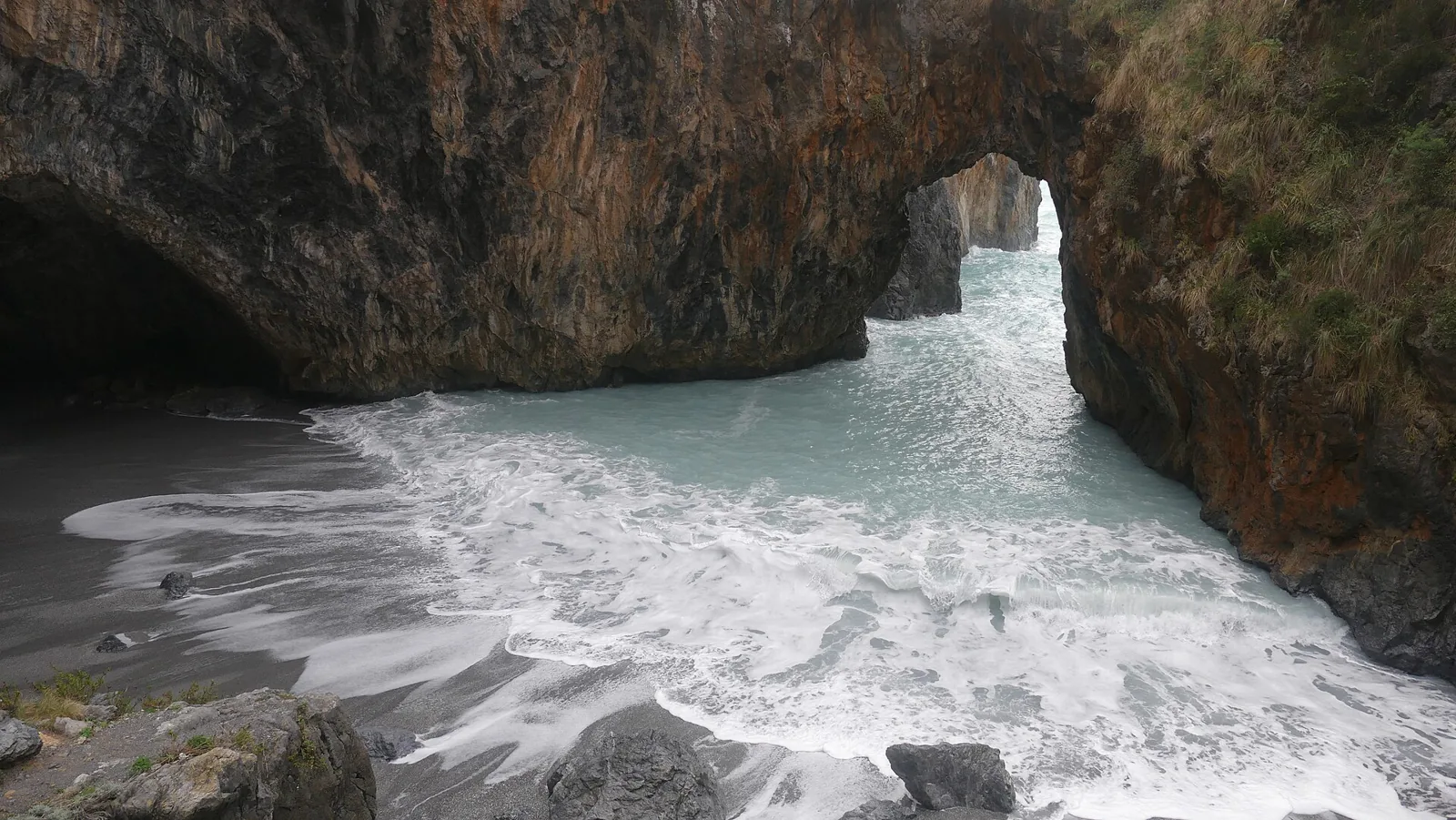
A few minutes south of Praia a Mare, San Nicola Arcella hides one of the most photogenic beaches in the region – Arcomagno. It is a tiny cove framed by a natural stone arch (arco) through which the sea flows in. It looks like a gateway to paradise. Access is possible on foot: either via the more difficult northern approach from the Fiuzzi/Arcomagno side or the easier southern approach from Spiaggia Marinella. Access from the sea and swimming under the arch are prohibited.
Arcomagno, also known as Grotta del Saraceno, lies in a protected area. The walk from the car park usually takes 20–30 minutes along a path with stairs and a coastal stretch. In 2026, visits to Arcomagno are regulated: time on the beach is limited to 30 minutes, the site and trails are open from 8:30 to 19:30, first entry is at 9:00 and last entry at 18:30. Adult tickets start from 4 €, while children up to 12 years old pay 2 €.
A word of warning: in summer, Arcomagno can be overcrowded – it is a popular Instagram spot. Food and drinks other than water are banned, as are smoking, umbrellas, sunbeds and cool boxes, and swimming under the arch is prohibited. Arrive early in the morning or visit in September, when the beach reclaims its tranquillity.
Watch on YouTube
10. Riace Marina – Ionian Silence
Finally, something for those who truly want to escape tourism. Riace Marina is a long, wide beach on the Ionian coast – off the shores of Riace Marina, in the sea not far from the beach, the famous Riace Bronzes were discovered in 1972. The sand is golden, the sea calm, and within sight there is often no one but you and a handful of local families.
The Bronzi di Riace were found on 16 August 1972, about 220 metres from shore at a depth of just a few metres. They are two Greek bronzes from the 5th century BC. The originals are now displayed in the Museo Archeologico Nazionale in Reggio Calabria, not in Riace.
This is not a beach with a huge entertainment offer; infrastructure is limited, but in season lidos and beach bars operate here, so check current service availability before you go. There is still plenty of silence, warm water, and the feeling that you have found a calmer corner of Ionian Calabria. After your swim, drive up to nearby Riace Superiore – the village that gained fame as a symbol of hospitality toward immigrants.
When to Go and What to Bring
Best time: May usually brings 22–25°C during the day, with the sea at around 18–20°C. In June it becomes properly beach weather – 26–30°C and water around 22–24°C. July and August are full summer at 30–34°C with the sea warmed to 25–27°C, and in September conditions are still excellent: 26–29°C with water at 24–26°C. October can surprise you too, with daytime temperatures of 22–25°C, and on the Ionian coast autumn often lasts longer and is warmer than on the Tyrrhenian side.
Getting around: A car is very useful but not always essential. The Tyrrhenian railway line serves Praia a Mare, Scalea, Paola, Pizzo, Vibo Valentia-Pizzo, Tropea and Scilla among others, so several of the best beaches can be linked without a car. The Ionian line reaches Soverato and Riace Marina among others, though services are usually fewer and slower. The nearest airport for Tropea, Pizzo, Zambrone and Capo Vaticano is Lamezia Terme (SUF); for Scilla and Riace it is Reggio Calabria (REG); Crotone (CRV) is less useful for this list. From Lamezia airport to Tropea, the quickest way is the bus to Lamezia Terme Centrale station and then a direct regional train – usually 1 h 10 min–1 h 20 min in total (the train alone from Centrale takes about 50–60 minutes). From 4 July 2026, a seasonal servizio navetta runs San Nicola Arcella – Lidi Arcomagno – Fiuzzi, with stops at San Nicola Arcella, Lido La Rotonda/Lido Roccia del Sub, Parco Poggio del Sole and Parco Arcomagno. Timetables are posted at the stops.
What to bring: Water shoes (many beaches have pebbly or gravelly entries), a snorkelling mask, and high-factor sunscreen. Patience for stairs and climbs will also come in handy, especially in Tropea, Capo Vaticano and near Arcomagno.
790 km of coastline is a lot – too much for one trip. The best approach is to choose one stretch of coast and avoid trying to jump from the Tyrrhenian to the Ionian every day. Calabria works best at a slower pace: one beach in the morning, one town in the afternoon, and time for the next cove the following day.
Sources
The information in this article was verified against the following sources:
- Programma Bandiera Blu – bandierablu.org
- Isola Dino – Comune di Praia a Mare – comune.praiaamare.cs.it
- Attivazione del Servizio Navetta San Nicola Arcella - Lidi Arcomagno Fiuzzi / Avvisi /… – comune.sannicolaarcella.cs.it
- Acquista i Biglietti per visitare l'Arcomagno di San Nicola Arcella – arcomagnocalabria.it
- Ombrellone mio, quanto mi costi! I prezzi a luglio e agosto nel Vibonese: a Tropea fino a… – lacnews24.it
- DIVIETO DI ACCESSO NON AUTORIZZATO E REGOLAMENTAZIONE DEI FLUSSI TURISTICI/ESCURSIONISTICI… – parchimarinicalabria.it
- Baia di Soverato – parchimarinicalabria.it
- Wikipedia – Calabria – en.wikipedia.org