The ruins of Kaulon in Monasterace are one of the most important testimonies to the Greek presence on Calabria's Ionian coast. The former polis belonged to the world of Magna Graecia and developed as a centre of trade, religion and contacts between Greeks and the peoples of Italy. For modern visitors, Kaulon is a readable archaeological park where the development of the city, its monumental ambitions and the effects of its violent fall can still be seen.
Kaulon, also known as Kaulonia, lay on the Ionian coast of Calabria, in the area of present-day Monasterace Marina, near Punta Stilo. The polis functioned from the archaic era, and its essential end came in 389/388 BC, when the city was conquered and destroyed by Dionysius I of Syracuse. After this event, part of the population was resettled in Sicily, and although later phases of settlement existed, the glory of Kaulon was already a thing of the past.
Table of Contents
Kaulon and Its Role in the Colonisation of Magna Graecia – Achaean Foundations
The Development of Kaulon Against the Backdrop of Magna Graecia Colonisation
Kaulon, situated on the Punta Stilo promontory in present-day Calabria, is an important example of Greek expansion within Magna Graecia. The city's foundation is usually dated to the late 8th or early 7th century BC. The choice of this location resulted from the need to control maritime routes on the Ionian coast.
An intriguing aspect of the city's identity is the myth of the Amazon Clete, who according to legend founded the settlement after her ship was wrecked on the way from Troy. While archaeologists focus on historical facts, such legends built the colony's prestige in the eyes of the ancients. The chronology of early colonisation indicates that Kaulon was founded very early, within the same broad horizon as the most important Achaean centres in the region.
| City (Colony) | Approximate Foundation Date (BC) | Origin of Settlers |
|---|---|---|
| Sybaris | 720–710 | Achaeans |
| Kroton | 710–700 | Achaeans |
| Kaulon | late 8th / early 7th c. | Traditionally linked to Kroton and the Achaean world |
| Locri Epizephyrii | 690–680 | Locrians |
Ancient sources and modern archaeology do not allow us to identify a single indisputable foundation date. It is therefore safest to speak of a colony most likely Achaean in origin, traditionally linked to Kroton. Such a cautious description better reflects the state of research than overly precise dating.
Foundation and Economic Significance
The city is traditionally linked to settlers from the circle of Kroton and served as an advanced centre on the border of spheres of influence with Locri Epizephyrii. Fertile land favoured the cultivation of grain, vines and olives, and the location on the Ionian Sea strengthened the trading significance of the settlement. The economy of Kaulon was based on exploiting the resources of both the coast and the hinterland, which allowed the city to enter a network of exchange encompassing southern Italy and Sicily.
Thanks to its position on the Ionian maritime route, Kaulon developed contacts with other centres of Magna Graecia. The wealth of the city can be seen later in its sacred and civic architecture. The material traces – especially the temple, walls and finds from the necropolises – best show the scale of the polis's former importance.
Cultural Influences and Infrastructure Development
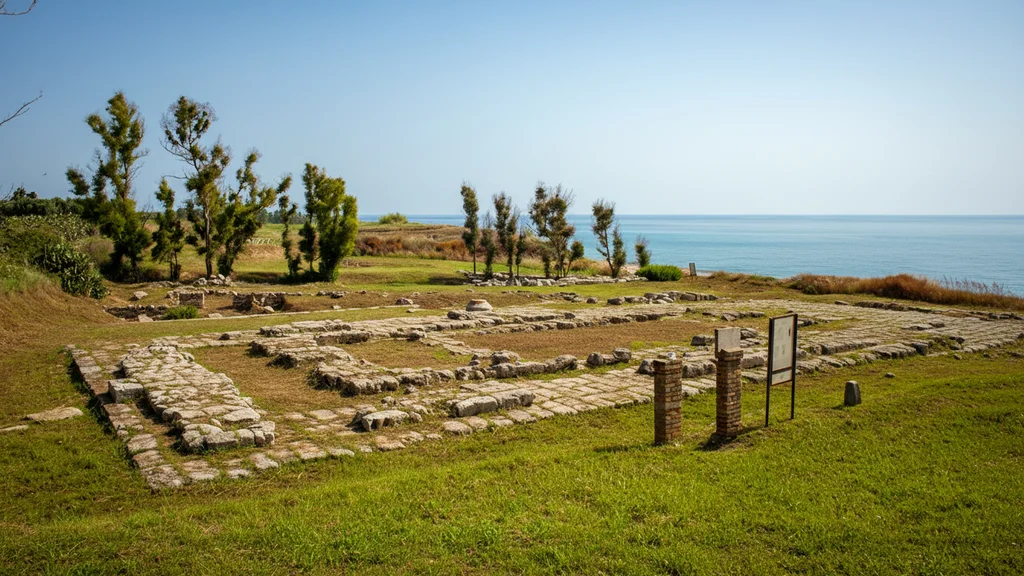
The city layout had a regular, well-planned character, visible in the course of streets and the organisation of buildings. This type of spatial order facilitated the functioning of the colony and shows that Kaulon developed according to clear urban-planning principles. The city also possessed defensive walls that protected its most important parts.
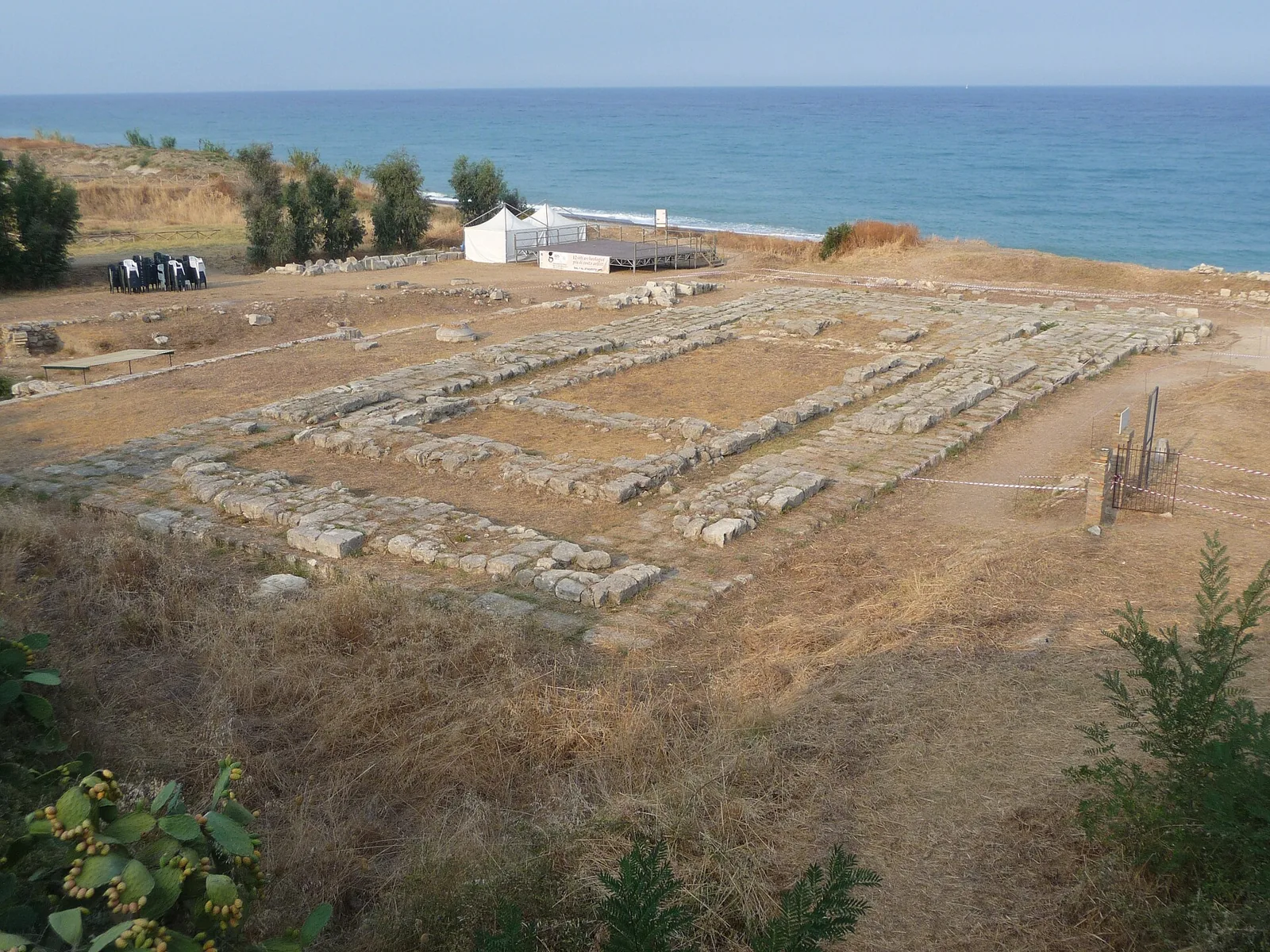
Cultural influences flowing from contacts with the metropolis and neighbouring colonies resulted in the creation of important buildings. The focal point was a monumental peripteral Doric temple, dated by the MiC to around 470–460 BC. Architectural descriptions give a column layout of 6 × 14, a crepidoma with 3–4 steps and a surviving column drum with 20 flutings. Research has also revealed details such as terracotta lion-head waterspouts, testifying to the high level of local craftsmanship.
Strategic Position and Conflicts
The history of Kaulon was marked by rivalry among the poleis of southern Italy. Tradition links the city's environs with the Battle of the Sagra River, but sources are ambiguous here and the account is partly legendary. It is better to treat this story as an element of ancient memory than a reliable description of events.
The most important well-attested military moment was the destruction of Kaulon by Dionysius I of Syracuse in 389/388 BC, in the context of his expansion in southern Italy. It is precisely this event that marks the turning point in the history of the polis and explains why the city so abruptly disappears from the region's main stage. Later phases of settlement existed but did not restore the centre's former standing.
Archaeological Discoveries at Kaulon – Traces of the Greek Past
The Parco Archeologico Kaulon in Monasterace Marina is the result of over a hundred years of scientific research, initiated by the distinguished archaeologist Paolo Orsi at the end of the 19th century. Modern research has used, among other methods, close-range photogrammetry, aerial and ground documentation and 3D models, which have helped update the site's planimetry. As a result, the site offers an increasingly complete insight into the evolution of a Greek city from its archaic foundations to later building phases.
Defensive Walls and Acropolis
Archaeologists have uncovered at Kaulon the remains of defensive walls of stone blocks, which show the scale of investment undertaken by the polis's inhabitants. Finds on the acropolis, including a temple with an altar and other elements of cult equipment, point to the central role of religion in the life of the city. In the area of the sanctuary and the walls, votive materials and traces of craft activity were discovered, showing the connection between defensive, sacred and productive spaces.
Necropolises and Finds
Necropolises discovered in the Bavolungi and Franchi di Stilo areas remain an important source of knowledge about the community of the ancient city. The local museum (Museo Archeologico dell’antica Kaulon, MAK) displays, among other objects, grave assemblages, a cremation burial from Bavolungi di Stilo, a grave group from Franchi di Stilo, Ithaca-type kantharoi and Euboean and Achaean material. Such grave goods show that Kaulon maintained contacts with the wider Mediterranean world.
Urban Infrastructure and Underwater Discoveries
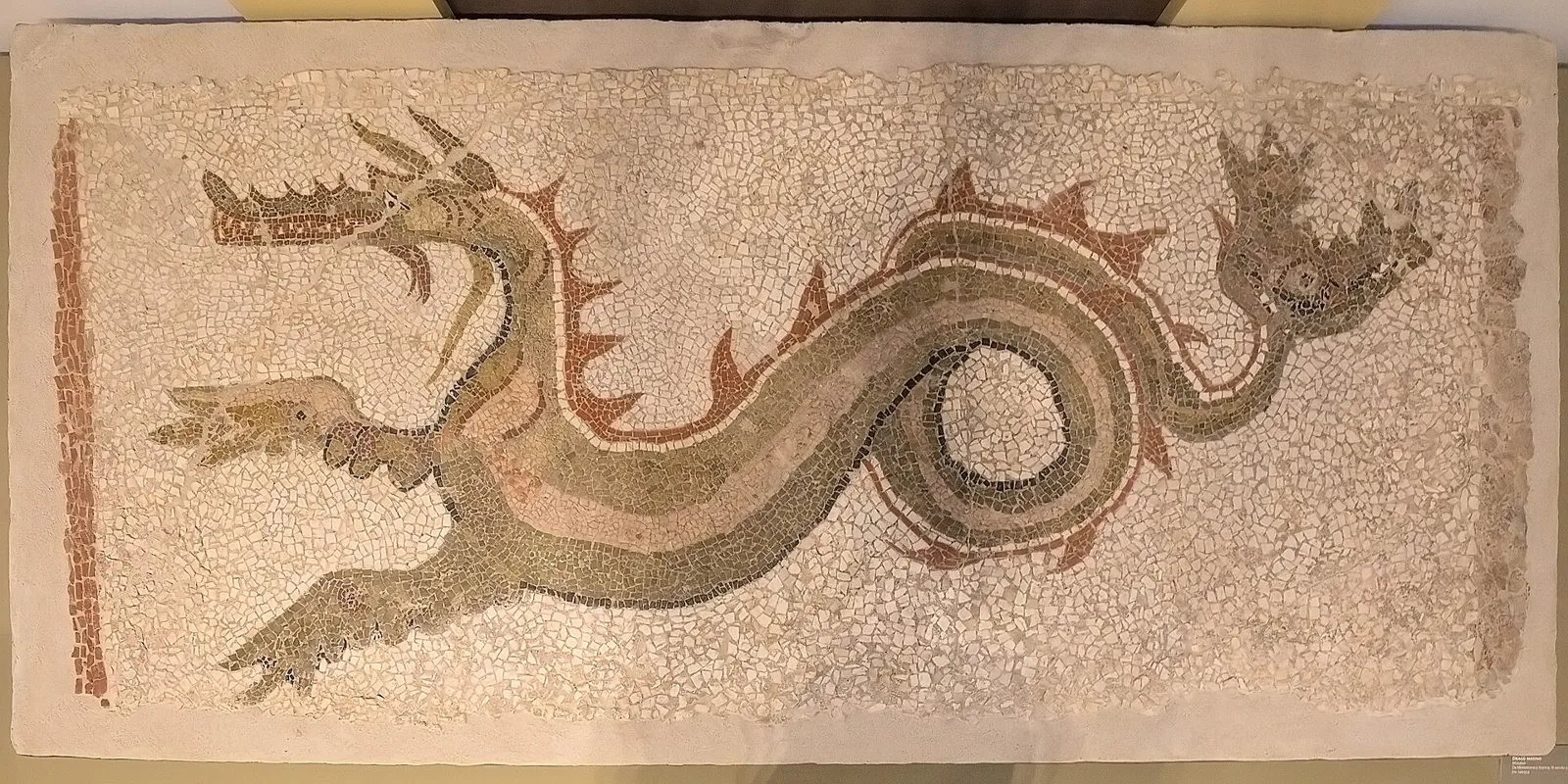
Underwater archaeology holds particular significance in the research, as tectonic processes and changes in the coastline have caused parts of the ancient buildings to end up beneath the sea. Underwater surveys help to better understand the city's relationship with the sea and the scale of losses caused by nature. On land, the greatest interest was aroused by the discovery of a large mosaic with a motif of a sea dragon and dolphins.
This most famous find from Kaulon was discovered in 2012 in a bath building or thermal complex. The mosaic covers approximately 30 m², making it one of the largest Hellenistic mosaics found in southern Italy. The discovery generated wide coverage in the Italian media and the archaeological community.
Hellenistic Splendour and the Tabula Cauloniensis
The Hellenistic period left traces of high material culture in Kaulon, the best examples being the mosaics and the buildings associated with the thermal complex. An important discovery at the site is also the Tabula Cauloniensis, a bronze tablet with a metrical inscription in the Achaean alphabet, dated to the 5th century BC. SAET/SNS describes it as the longest inscription in the Achaean alphabet known today, while other studies connect it with a dedication to Zeus.
For visitors, the practical rule is simple: some of the most valuable elements are seen on site and some only in the museum. That is precisely why a visit is best planned as a combination of a walk through the ruins and viewing the collections from Monasterace.
Watch on YouTube
Religion and Spirituality in Ancient Kaulon – The Foundation of Social Life
In ancient Kaulon, religion was an important part of public life and one of the pillars of the polis's identity. The best attested cult here is that of Zeus, especially in the form of Zeus Homarios/Homagyrios. A monumental Doric temple dated to the 5th century BC is associated with the city.
Much about the local character of worship is also told by the coins of Kaulon. They feature Apollo with a branch, alongside a small running figure and a deer – one of the most recognisable coin types of the city. Thanks to such depictions, religion here is not an abstract backdrop but something tangible and well attested.
The remains of sanctuaries, inscriptions and numismatic material show how strongly the sacred sphere permeated the daily life of inhabitants. At Kaulon it is worth looking at the ruins not merely as a layout of walls but as a space in which religion ordered the life of the community. This dimension clearly explains the city's standing in the world of Magna Graecia.
Invasions and Cataclysms – Causes of Ancient Kaulon's Decline
The Impact of Invasions and Roman Domination
The decisive blow to Greek Kaulon was dealt not by the transformations of the Roman era but by earlier military events. In 389/388 BC the city was conquered and destroyed by Dionysius I of Syracuse, which ended its period of greatest splendour. After this destruction, part of the population was resettled in Sicily.
Later phases of settlement existed but did not reverse the effects of this turning point. The official MiC description indicates that after 389 BC Kaulonia recovered in the Hellenistic period, especially from the second half of the 4th to the 2nd century BC. The definitive decline of the polis is linked to the episode of Pyrrhus's expedition against the Romans, while the gradual abandonment of the site took place in the 4th–5th century AD.
Natural Cataclysms – Environmental Threats
Apart from wars, Kaulon had to contend with the destructive force of nature. The Punta Stilo area is known for seismic activity, and earthquakes, erosion and shifts in the coastline have affected the condition of monuments and the waterfront buildings. Part of the site has also suffered from tectonic processes and marine abrasion, which is why some relics are today underwater or very close to the shore.
Today, the greatest challenge is progressive coastal erosion, which in 2013–2014 threatened the foundations of the Doric temple. In 2014, after storms threatened the temple and the mosaic, extraordinary measures for urgent protection were announced. A separate MiC project worth 1.5 million euros, launched later, focused primarily on enhancing, securing and improving visits to the park. The present-day ruins in Monasterace remain one of those places in Calabria where history and landscape literally meet at the water's edge.
The site is located in Monasterace Marina, on the SS106 Jonica, about 15 km from Stilo. The park is crossed by the SS106 road and the railway line. Official and specialist sources give the address as C.da Runci / SS106 Ionica, 89040 Monasterace (RC). The nearest railway station is Monasterace-Stilo on the Ionian line, and access by car is straightforward from Reggio Calabria as well as from Catanzaro Lido or Soverato. Allow 1.5–2 hours for an unhurried visit to the park and museum.
Opening hours are updated seasonally, so check them before visiting on the official channels of the Calabrian museum system or the Ministry of Culture. The listed contact details are telephone +39 0964 735154 and email [email protected]. A standard ticket costs €4.00 and a reduced ticket €2.00. From Reggio Calabria to Monasterace-Stilo it is about 123–131 km by road, from Catanzaro Lido about 46–48 km, and from Soverato about 31 km.
Frequently Asked Questions
What was ancient Kaulon and what remains of it?
Ancient Kaulon was a Greek colony on the Ionian coast of Calabria, active from the archaic era. The foundations of a Doric temple, wall remains, site buildings and some finds displayed in the Museo Archeologico dell'antica Kaulon (MAK) in Monasterace survive to this day.
What is the dragon of Kaulon – the famous mosaic?
It is a large Hellenistic mosaic with a motif of a sea dragon and dolphins, discovered in 2012 in a bath building or thermal complex. It covers approximately 30 m² and is one of the largest Hellenistic mosaics found in southern Italy.
What are the opening hours of the Kaulon archaeological park?
Opening hours and ticket prices are best checked on the official channels of the Calabrian museum system or the Ministry of Culture, as they change seasonally. It is most convenient to plan a combined visit to the park and museum on the same day.
Where can you see the most important finds from Kaulon?
Some finds remain in situ in the archaeological park, while others are displayed in the museum in Monasterace, known as the Museo Archeologico dell'antica Kaulon (MAK). To properly understand the site, it is best to combine a walk through the ruins with a museum visit.
Are the Kaulon ruins accessible for people with disabilities?
Route accessibility and facilities are best checked directly before visiting on the official channels of the park or museum. Infrastructure information may change depending on the season and current works on the site.
Sources
The information in this article was verified against the following sources:
- calabria.cultura.gov.it – calabria.cultura.gov.it
- Museo e parco archeologico dellantica kaulonia – cultura.gov.it
- CEG 396a – Dedica di Pythokritos figlio di Euxenos (Tabula Cauloniensis) | CEG supplementum – ceg-supplementum.uniroma2.it
- ISPRS-Archives - The sanctuary of Punta Stilo at Kaulonia-Monasterace (Rc, Italy):… – isprs-archives.copernicus.org
- Parco Archeologico Kaulon Monasterace Marina (RC) - Itinerari Archeo Calabria – itinerariarcheocalabria.it
- itinerariarcheocalabria.it (PDF) – itinerariarcheocalabria.it
- Epigraphic research in Sicily and Magna Graecia – SAET – saet.sns.it
- Calabria, il mare si mangia il tempio greco - Rai News – rainews.it
- Kaulon o Kaulonia Area Archeologica – turismoincalabria.it
- Monasterace: Museo e Parco Archeologico dell’Antica Kaulon (MAK) – URPinRETE – urpinrete.it
- Wikipedia – Magna Graecia – en.wikipedia.org
Last updated: