Marina Grande in Scilla is the town's best-known beach, appealing not only for its scenic setting but also for its cultural richness. It lies on Costa Viola (the "Violet Coast") and is a wide, urban beach with a gravelly-pebbly surface, in places mixed with coarser sand. Nearby stand Ruffo Castle and the charming fishing district of Chianalea, which recall the centuries-old history of the region. This is the natural centre of Scilla's summer life, good both for relaxation and as a base for discovering Calabria's heritage.
Table of Contents
Scilla and Surroundings – Cultural Gems Around Marina Grande
The natural beauty of Marina Grande beach in Scilla is just the beginning of discovering the local attractions. The coastal landscape of this town, situated at the junction of the Tyrrhenian Sea and the Strait of Messina, clearly shows the meeting of mythical past and everyday life by the sea. The beach itself has an urban character, and just a few steps away begin some of the most recognisable views in this part of Calabria.
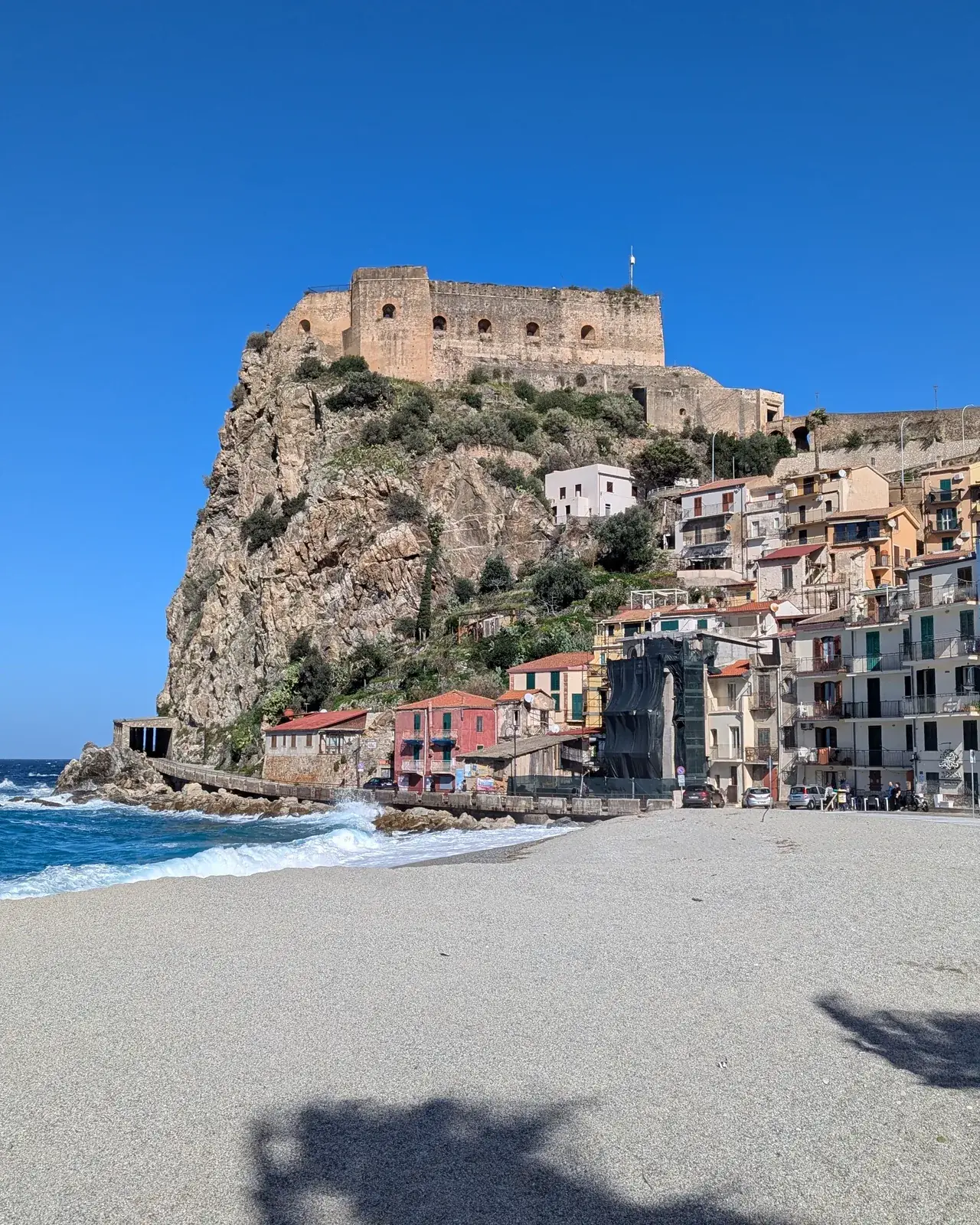
The Comune di Scilla lists several names for the same stretch of coast: Marina Grande, Scilla Marina, Marina di Scilla, Lido di Scilla, Spiaggia delle Sirene, and Spiaggia di Scilla. The beach runs between two rocks for about 1 km and includes Lungomare Cristoforo Colombo and a strip of very fine gravel. This makes it a convenient starting point both for beach time and for a short walk to the castle, Chianalea, or Piazza San Rocco.
Scilla is traditionally identified with the mythical Scylla from Homer's "Odyssey," while Charybdis was located on the Sicilian side of the strait. This myth is linked to the dangerous currents of the Strait of Messina, which have commanded the respect of sailors since antiquity. This is an important context for the town itself, as it explains its name and the strong presence of maritime motifs in local identity.
Ruffo Castle and the Mythical Scylla
Rising on a cliff above the beach, Ruffo Castle is a historic fortress and an excellent viewpoint. The rock it stands on is identified with the mythical Scylla, so a tour of its walls becomes a journey through layers of history and legend. The castle offers views of Marina Grande beach, the Strait of Messina and the Sicilian coast. The fortress once served as a lookout point against threats from the sea, and today it remains one of the most important symbols of Scilla.
The walk from Marina Grande takes about 10 minutes uphill, so it is best to combine beach time with a walk up to the castle rock. Allow 30–60 minutes for a leisurely visit. According to information from the Comune di Scilla dated 29 June 2026, Castello Ruffo is closed on Mondays and open Tuesday to Sunday from 09:00–13:40 and 15:00–20:00. The standard ticket costs €3.00; children up to 6 years old and people with certified disabilities with a companion enter free of charge. Entrance is from Piazza Matrice.
The Charming Chianalea District
Just beyond the castle lies the Chianalea district, known as the Little Venice of the South (Piccola Venezia del Sud). It is characterised by traditional fishermen's houses literally rising from the sea, creating a unique atmosphere. A stroll through this area is a chance to see the local building layout, where the sea washes building foundations and boats are moored almost at the doorstep. Scilla is one of the important centres of the swordfish fishing tradition using felucca boats, which to this day remains strongly linked to the identity of this stretch of coast.
Chianalea is the historic fishing district of Scilla, developed along a narrow strip of rocks at the foot of the castle promontory. Its most recognisable feature is houses set right above the water and small descents and slipways for boats. Chianalea has been mentioned in guides as one of Calabria's most beautiful borghi, but before publication its current status in the official I Borghi più belli d'Italia list should be checked.
Unforgettable Views from Piazza San Rocco
A fine viewpoint is Piazza San Rocco, located in the upper part of Scilla's historic centre at an elevation of over 70 metres. From here visitors can admire sunsets over Costa Viola and the panorama of Sicily. In the warm season, it is best to come early in the morning or in the late afternoon, when the light is at its best and the heat less oppressive. Piazza San Rocco is an important meeting point for residents and local events.
San Rocco is the patron saint of Scilla, and the feast dedicated to him takes place on the Friday, Saturday, and Sunday after 16 August. The procession passes through San Giorgio, Chianalea, and Marina Grande, so it covers the town's most important areas. On Sunday evening, the "trionfino" with fireworks takes place near Piazza San Rocco, making the square one of the main centres of town life at that time.
Coastal Cruises
One of the greatest assets of the area are boat cruises along the Costa Viola coastline, usually departing from the port and marina area of Scilla. They most commonly last roughly between 1 and 3 hours and offer the chance to see Chianalea and the castle from the sea, sometimes also stopping for a short swim in calm conditions. This is a simple way to see Scilla from a different perspective and appreciate how tightly the town is bound to rock and water.
The availability of such cruises is clearly seasonal – the most options usually fall between June and September. In practice, much depends on conditions in the strait and the wind, so it is best to ask about current departures on the spot. This makes it easier to fit the plan to the weather and avoid disappointment.
The area around Marina Grande gives you a simple car-free sightseeing plan: a roughly one-kilometre beach along Lungomare Cristoforo Colombo, the climb to Ruffo Castle, the descent into Chianalea, and the viewpoint at Piazza San Rocco. This layout means that in Scilla you can combine swimming, a walk through historic districts, and views of the Strait of Messina in a single day. The most convenient plan is to start with the beach in the morning, then go up to the castle and the upper part of town in the late afternoon.
Ruffo Castle – Medieval Watchtower Above Marina Grande
Ruffo Castle (Castello Ruffo) is one of the most recognisable symbols of Scilla, rising above Marina Grande beach. This is a fortress of medieval form, built on a site with much older, ancient defensive origins. The structure serves as a clear boundary between Marina Grande and the fishing quarter of Chianalea, having served defensive, residential, and military functions for centuries.
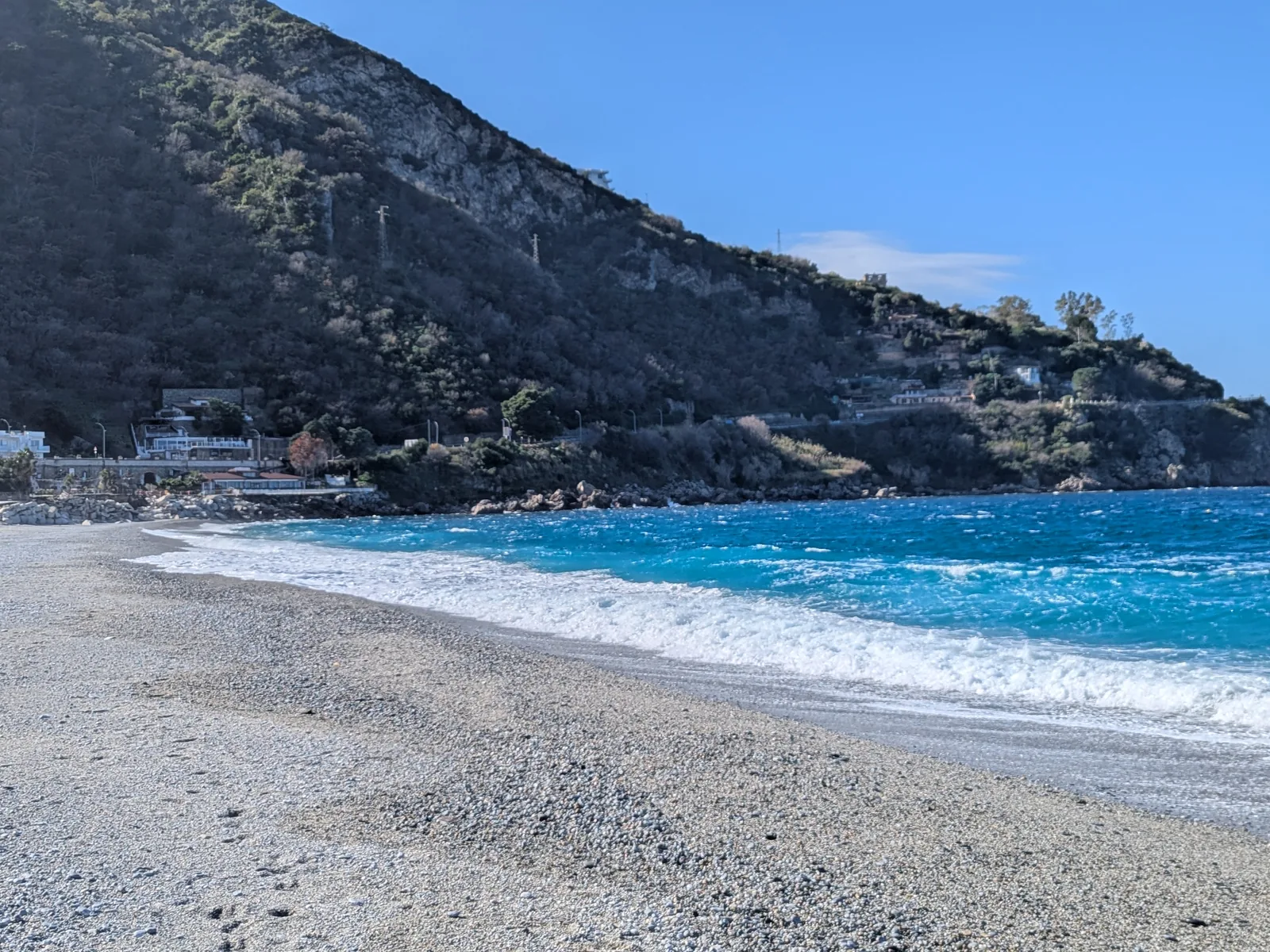
The castle rock was used for defence as far back as antiquity, while the present castle has an essentially medieval form, with significant rebuilds in the Angevin, Aragonese, and modern eras. The name "Ruffo" is associated with the Ruffo di Calabria family, who held the castle for centuries. In 1533, the fortifications were strengthened as part of the coastal defence system of the Kingdom of Naples against Ottoman and corsair attacks; after the earthquake of 1783, the building was damaged, and in the 19th and 20th centuries it also served military and signalling functions.
History and Architectural Merits
Ruffo Castle played an important role as a fortress guarding this stretch of coast and the approach to the Strait of Messina. Its history is long and multi-layered – from the ancient beginnings of the defensive rock, through medieval rebuilds, to modern adaptations against threats from the sea. It is a good place to understand how strategically important Scilla was over the centuries. Architecturally, the castle impresses above all with its location on a rocky spur that dominates the coastline. Walking along the walls and terraces allows one to grasp the relationship between the rock, the buildings of Scilla, and the open expanse of the strait. The castle's contemporary function as an events and exhibition venue gives it additional life, but even without exhibitions it is worth entering for the view alone. The panorama of Marina Grande, Chianalea, and the Sicilian shore is among the strongest images in this part of Calabria.
Watch on YouTube
Chianalea – Scilla's Magical Fishing District
Chianalea is Scilla's historic fishing district, known as Venezia del sud, with houses set directly on the rocks above the sea. Its historic character attracts tourists seeking a calmer, more rugged side of the coast. Houses built directly on the rocks create an unrepeatable panorama, where the sea is literally part of residents' daily life. The district's name has been linked to various etymological hypotheses, but there is no full certainty, so it is best to treat them with caution.
District Characteristics
Chianalea is above all an old settlement whose heart is a picturesque, narrow street running along the seashore. It is here that fishermen's daily life unfolds, and the traditional practice of mooring boats right by the houses remains one of the most characteristic images of Scilla. The district's architecture makes some buildings appear to almost hang above the rocks, only intensifying the unique atmosphere of this place. Narrow passages lead straight to the water, offering a glimpse of Scilla from a side that cannot be replicated.
Location and Surroundings
The district is situated at the foot of Ruffo Castle, which serves as a natural boundary and landmark for the entire area. The location itself well illustrates the ancient roots of the settlement and its close connection with the sea and the defensive rock. Chianalea has deservedly earned a reputation as one of the most beautiful corners of the south, and is also a great place to try fresh swordfish and see Scilla from a more intimate perspective.
Calabria's Beach Showdown – Marina Grande vs Spiaggia di Michelino
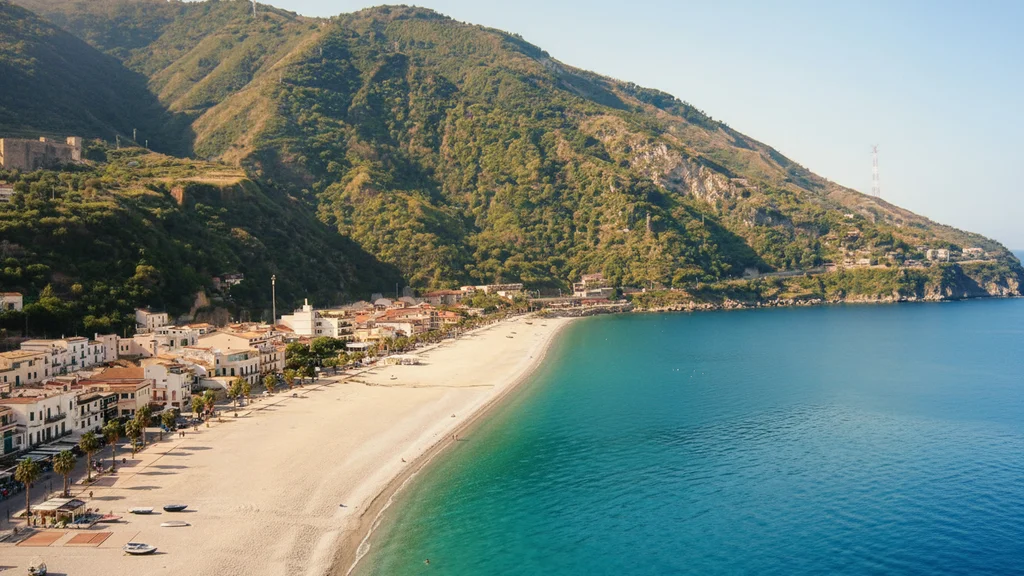
Calabria is famous for its picturesque coastlines, home to beaches of entirely different character. Marina Grande beach in Scilla and Spiaggia di Michelino in Parghelia are two different worlds, though both offer clean water and striking views. In the official list of the 2026 Bandiera Blu programme, Parghelia appears with the beaches of Costa dei Monaci/Bordila, La Grazia/Vardano, Michelino, and La Tonnara. This is a concrete quality argument in Michelino's favour, while Marina Grande wins on ease of access and direct contact with historic Scilla.
| Parameter | Marina Grande (Scilla) | Spiaggia di Michelino (Parghelia) |
|---|---|---|
| Surface type | Fine gravel and pebbles | Sandy-gravelly surface |
| Accessibility | Very easy (town centre) | Demanding (over 200 steps) |
| Infrastructure | Full (lido, bars, showers) | Wild, limited |
| Atmosphere | Urban resort with history | Intimate oasis of calm (outside August) |
Location and Accessibility
Marina Grande lies practically in the centre of Scilla, making it convenient for those arriving by car or by train. The railway station is about 500–700 metres from the beach, and the walk usually takes 7–10 minutes, partly via steps and a road descending toward the sea. Meanwhile, reaching Michelino involves descending stairs (over 200) from a viewpoint in Parghelia, so the descent, and especially the return in the heat, is demanding – an important difference for families with pushchairs and those with limited mobility.
Beach Type and Surface
Marina Grande features a surface of fine gravel and pebbles, in places mixed with coarser sand, which results in good water clarity. Protective footwear is recommended due to the stony entry into the water, which is typical for this stretch of Costa Viola. Spiaggia di Michelino has a more mixed, sandy-gravelly surface.
Ideal Visitors
The location and infrastructure make Marina Grande a very good choice for those who value convenience and the chance to combine the beach with a stroll through the town. The beach has an urban character – some stretches are free-access, while others are occupied by lido. Allow 2–4 hours for time by the water itself, and if you plan to add Chianalea and the castle, 4–6 hours makes sense; at the height of the season, it is best to arrive in the morning as parking near the beach is limited.
Frequently Asked Questions
What does Marina Grande beach in Scilla look like and is it sandy?
Marina Grande beach has a mixed surface, but fine gravel, pebbles, and in places coarser sand predominate. This is not a classic wide beach with soft sand, so protective footwear is useful when entering the water.
When is the best time to visit Marina Grande beach in Scilla?
The best time to visit is from May to September, with peak season falling in August. Those seeking peace should consider June or September, when the weather still favours swimming and the beaches are less crowded.
Are there sun loungers and umbrellas for hire on Marina Grande beach?
Yes, the beach has an urban character and combines free-access stretches with organised lido, where you can hire sun loungers and umbrellas. Bars and basic beach services also operate on site, so it is easy to spend several hours here without much logistical effort.
What is the easiest way to reach Scilla?
For many people, the train is the most convenient option, as the station in Scilla is about 500–700 metres from Marina Grande. The walk usually takes 7–10 minutes, partly via steps and a road descending toward the sea; if you are driving, in season it is worth arriving early as parking near the beach is limited.
What is the local cuisine in Scilla famous for?
Scilla is renowned for its swordfish fishing tradition, linked to the entire Strait of Messina area. The most characteristic dishes feature pesce spada, especially involtini di pesce spada, pesce spada alla griglia, and panino con pesce spada; tuna and simple seafood dishes are also well worth trying.
Nearby
Sources
The information in this article was verified against the following sources:
- Calabria – I Borghi più Belli d'Italia – borghipiubelliditalia.it
- Turismo - Comune di Scilla – comune.scilla.rc.it
- Marina Grande - Comune di Scilla – comune.scilla.rc.it
- Culto di San Rocco nella Costa Viola | Turismo Reggio Calabria – turismo.reggiocal.it
- Programma Bandiera Blu – bandierablu.org
- Castello Ruffo - Comune di Scilla – comune.scilla.rc.it
- Wikipedia – Scilla, Calabria – en.wikipedia.org
Last updated: