Piazza San Rocco in picturesque Scilla is an essential stop for anyone visiting Calabria. Situated above the Strait of Messina, the square offers views that take your breath away. It is here that you can admire extraordinary panoramas of the Calabrian and Sicilian coastlines, and on clear days even the Aeolian Islands. This is a place where history meets natural beauty, and every detail bears witness to the rich past of this region. Piazza San Rocco serves as the central point of the San Giorgio district, forming the administrative and social heart of the town suspended 70 metres above sea level.
| District of Scilla | Location | Main Function |
|---|---|---|
| San Giorgio | Upper part (~70m a.s.l.) | Administrative and residential (Piazza San Rocco) |
| Marina Grande | Southern coastline | Tourist and bathing (Spiaggia delle Sirene) |
| Chianalea | Northern coastline | Fishing and gastronomy (houses on rocks) |
History of Piazza San Rocco – From Myths to Modernity
Piazza San Rocco in Scilla, though currently known as one of the most important viewpoints over the Strait of Messina, conceals far more than just charming landscapes. The history of this place is permanently linked to the rich cultural and historical heritage of the Calabria region and the influences of various civilisations that passed through the area. The square is the result of impressive engineering works, constituting a monumental terracing built on a rocky slope that has survived numerous tests of time.
Medieval Roots and Urban Evolution
Scilla, whose name evokes the mythological tales of the monster Scylla, was a place of great strategic importance, controlling the vital shipping route between Italy and Sicily. Piazza San Rocco formed a natural extension of the ancient village of Bastìa, characterised by low-rise buildings and narrow streets with distinctive arches. The square's present appearance is the result of years of reconstruction following the devastating earthquakes of 1783 and 1908, which forced residents to continually rebuild their identity.
Architectural Relics and Seismic Resilience
Although precise documents describing the early development of Piazza San Rocco are lacking, it is easy to see how Scilla's past continues to influence this space to this day. The stone streets leading to the square bear witness to times when the town was an important trading centre. The square's strategic position enabled monitoring of ship traffic, which historically was of fundamental defensive importance against pirates and invading fleets.
Contemporary Significance and Revitalisation
Today, Scilla is a place that attracts tourists with its natural beauty and history stretching from mythology to modernity. In 2017, a thorough renovation of the square was completed, having begun in 2009 and including the construction of a modern lift connecting the upper town with Marina Grande beach. Piazza San Rocco serves as a magical viewpoint where residents and tourists can feel the spirit of bygone centuries, admiring the harmonious blend of nature and architecture.
Church of San Rocco – The Square's Spiritual Heart
The dominant feature of the square is the Church of San Rocco, dedicated to the town's patron saint, whose cult dates back to the 15th century and is linked to trade relations with Venice. The current neoclassical facade of the church dates from 1989 and resembles an ancient temple with massive columns. Noteworthy is the monumental bronze relief in the tympanum, created in 2003 by sculptor Mario Benedetto.
The church interior holds precious artefacts, including a marble statue of Saint Roch from the late 16th century and wooden doors from 1885 by Rocco Foca. A legend associated with the church tells of a mysterious pilgrim who reportedly carved a miraculous figure of the saint, then vanished without a trace. Every year in August, the square becomes the stage for exciting celebrations, culminating in a joyful run carrying the saint's statue under a cascade of fireworks, known as U Triunfinu.
The Strait of Messina – Key Hub of Mediterranean Navigation
The Strait of Messina is a narrow sea passage that plays a vital role in the geography of the central Mediterranean. It stretches from Sicily to mainland Italy, with its width ranging from 3 km to 16 km. It is here that the scenic views accessible from Piazza San Rocco are found, offering spectacular panoramas of Sicily and Calabria. Geographically, the strait separates the Tyrrhenian Sea from the Ionian Sea, creating a unique ecosystem with strong sea currents.
The strategic importance of the Strait of Messina cannot be overstated, as it controls movement between the basins of the Mediterranean Sea. Thanks to its position, similar to Gibraltar, it is a significant trade and military route. For tourists visiting Scilla, the view from Piazza San Rocco remains an unforgettable experience, allowing one to discern the lights of Sicily and the outline of Mount Etna in good visibility.
Ruffo Castle – Guardian of History and Cultural Heart of Scilla
Ruffo Castle in Scilla, also known as Castello Ruffo di Scilla, is one of the most important viewpoints over the Strait of Messina. Perched on a lofty rock, the castle enables visitors to admire the landscapes of Costa Viola and the picturesque Chianalea district. The first mentions of the fortress date from the 9th century, when it served as an essential defensive point against naval raids.
For centuries the stronghold belonged to the influential Ruffo family, and its history intertwines with the fate of Europe. In the 19th century, Joachim Murat, King of Naples and Napoleon's brother-in-law, passed through the castle, though he was ultimately captured and executed in Pizzo Calabro in 1815. Today the castle is a cultural centre, hosting numerous exhibitions and events that attract history enthusiasts from around the world.
The Aeolian Islands Seen from Piazza San Rocco – Calabria's Panorama
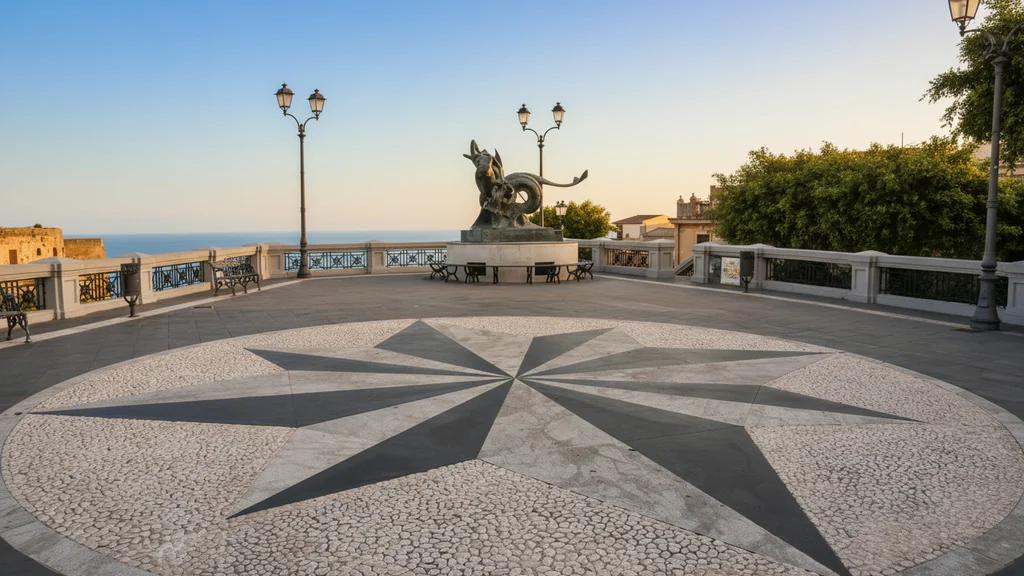
Piazza San Rocco offers one of the most captivating views of the Strait of Messina and the Aeolian Islands to the north. This remarkable viewpoint allows visitors to admire the beauty of volcanic archipelagos such as Stromboli and Vulcano. On the terrace itself stands a monument to Scylla, a bronze statue unveiled in 2013 by Francesco Triglia, depicting the metamorphosis of the mythical nymph into a monster.
From the terrace, one can admire the imposing cliffs of Costa Viola, which shimmer in violet hues at sunset. Piazza San Rocco is freely accessible to visitors, and since 2021 it can be reached by lift from the Marina Grande level (cost approx. 1 EUR). It is an excellent spot for a relaxing stroll, where you can sample local delicacies such as granita in nearby cafes, enjoying the unique atmosphere of Calabria.
Frequently Asked Questions
What can you see from Piazza San Rocco in Scilla?
The square offers a panoramic view of the Strait of Messina, the Sicilian coastline (including Punta Faro), Ruffo Castle, Marina Grande beach, and on clear days the Aeolian Islands such as Stromboli.
Where is the best viewpoint in Scilla?
Piazza San Rocco is considered the best publicly accessible viewpoint, alongside the terraces of Ruffo Castle. The square offers a wide perspective over the entire area from a height of approximately 70 metres.
Can you see Sicily from Piazza San Rocco?
Yes, Sicily is clearly visible from the square, as Scilla is located at one of the narrowest points of the Strait of Messina. At night, the lights of towns on the other side of the water can be distinctly seen.
How do you get to Piazza San Rocco from the beach?
You can use the modern mechanical lift connecting Marina Grande with the square, climb the picturesque steps through the San Giorgio district, or drive to the upper part of town.
When does the San Rocco festival take place in Scilla?
The main celebrations in honour of the patron saint take place in mid-August (usually the weekend after 16 August). The square fills with processions, brass band music and spectacular fireworks displays.