In the picturesque region of Calabria, surrounded by lush vegetation and ancient monuments, stands the Monastery of San Domenico in Stilo. It was here, in this medieval complex of exceptional architecture, that the Dominicans conducted their intellectual activities. Located on the slopes of Monte Consolino, this site represents a unique intersection of Byzantine spirituality, Dominican scholasticism, and revolutionary naturalism. It is inseparably linked to the figure of Tommaso Campanella, making it an extraordinary destination for lovers of Italian culture and history. What secrets does this remarkable centre hold, and why did it become the cradle of one of the boldest utopias in European history?
Monastery of San Domenico in Stilo – from Benedictine Abbey to Dominican Centre of Learning
Introduction to the Monastery of San Domenico in Stilo
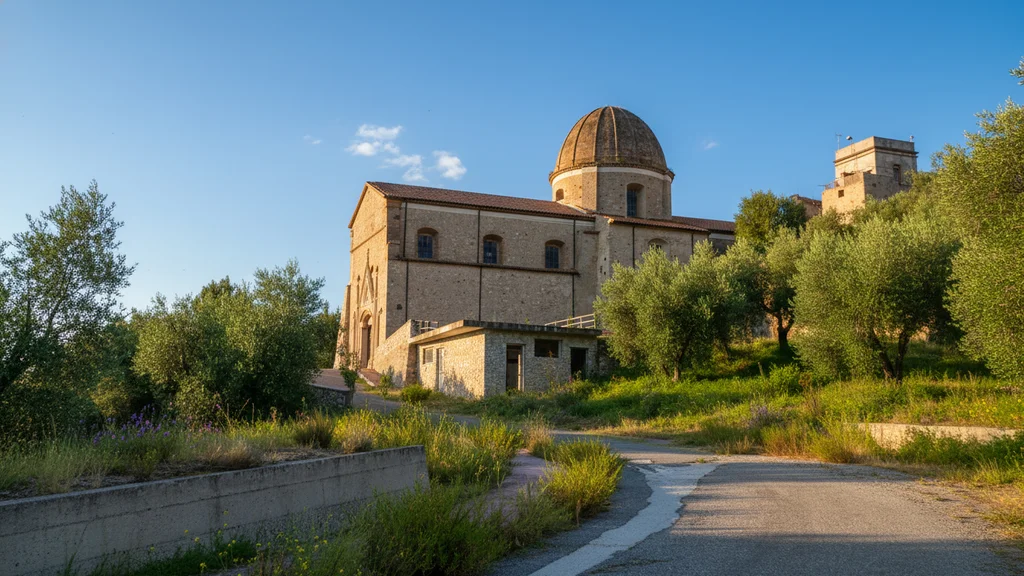
The Monastery of San Domenico Maggiore is located in Stilo, a picturesque town in the province of Reggio Calabria in southern Italy. It is a significant monument of medieval Norman architecture. Situated on a hilltop, surrounded by olive groves, the monastery combines elements of Romanesque style with Arab-Byzantine and Dominican influences. Its history reflects the turbulent past of Calabria under Norman, Sicilian, and knightly order rule, forming the cultural foundation in which the young Campanella grew up.
Foundation and Early History (11th–12th Century)
The monastery was founded by Count Roger I as part of a broader policy of colonisation and Christianisation of southern Italy following the conquest of Muslim emirates. Due to its strategic location, it served not only a spiritual but also a defensive role. Archaeological research has confirmed the existence of defensive walls and cisterns, suggesting a fortress function. Importantly, from as early as the 10th century, the Vallata dello Stilaro valley was a refuge for Eastern monks, giving the area a mystical character still perceptible today.
Flourishing in the Middle Ages (13th–15th Century)
In the 12th century, the monastery became a Benedictine abbey, but by the 13th century it had passed to the Dominican order, as evidenced by papal documents from the period. The Dominican friars transformed it into a thriving theological centre. The Church of San Domenico, built in the 15th century with funding from the Sanseverino family, became the intellectual hub of the region. It attracted scholars from various corners of Europe, offering access to rich libraries and fostering the development of philosophical thought.
Tommaso Campanella and His Connection to the Monastery
The Monastery of San Domenico in Stilo is known above all as a place associated with the Renaissance philosopher. It was here that his remarkable intellectual journey most likely began, culminating in the work Civitas Solis. Campanella's presence in Stilo makes this place not only a centre of learning but also ties it to the development of utopian social concepts. His “humble monastic cell” became a laboratory of ideas that would shake the political order of contemporary Europe.
Tommaso Campanella – a Philosopher within the Walls of San Domenico
Tommaso Campanella, born in 1568 in Stignano as Giovan Domenico, spent his formative years in the Dominican monastery of San Domenico in Stilo. It was here that his first inspirations and philosophical and theological interests took shape. As the son of an illiterate man, Campanella had to demonstrate superhuman determination to obtain the education that ultimately allowed him to challenge Aristotelian orthodoxy.
|
Date |
Place |
Event |
Significance |
|---|---|---|---|
|
1582 |
Placanica |
Entering the novitiate |
Taking the name Tommaso in honour of St Thomas Aquinas. |
|
1588 |
Cosenza |
Reading Bernardino Telesio |
Philosophical breakthrough and departure from syllogisms. |
|
1599 |
Stilo |
Discovery of the conspiracy |
Arrest for attempting to overthrow Spanish rule. |
|
1602 |
Naples (prison) |
Writing The City of the Sun |
Creation of one of the most important utopias in history. |
At the monastery in Stilo, Campanella began his education under the Dominican friars, which included the study of Latin and Greek. The rich library collections contributed to his versatile intellectual development. These early experiences had an enormous impact on his later work as a philosopher known for La città del Sole. Stilo, with its unique monuments, shaped his thought, becoming a constant point of reference in his literary work.
The true turning point came in 1599, when Campanella, residing in San Domenico, led a conspiracy against the Spanish viceroys. Using astrology, he convinced fellow friars such as Dionisio Ponzio and Fra Pietro di Stilo that a new era of the Holy Spirit was approaching. Is it any wonder that after the betrayal was discovered, the philosopher had to feign madness during a 40-hour torture called tormento della veglia to escape the death penalty?
Architecture of the Monastery of San Domenico – the Uniqueness of Medieval Structures
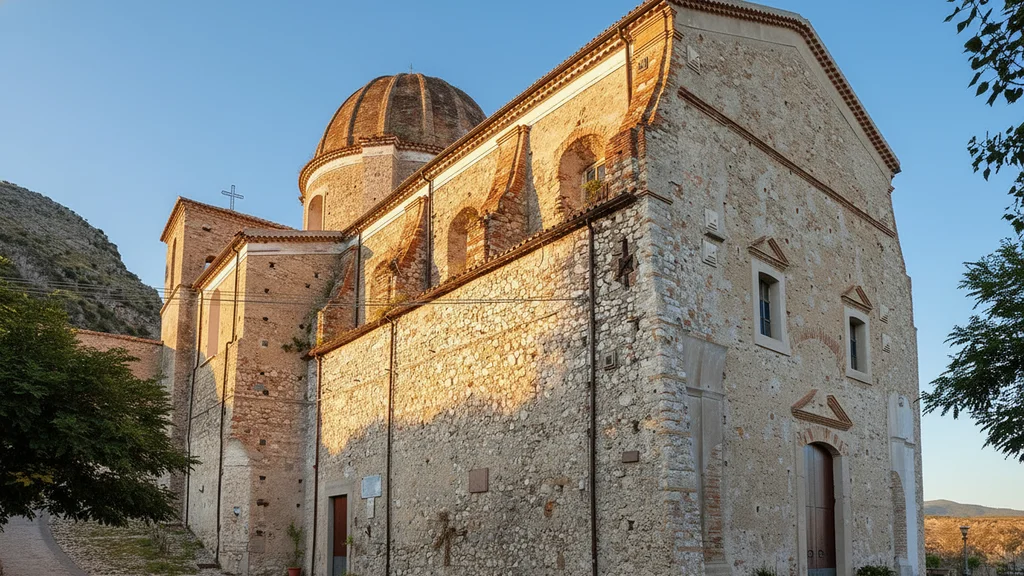
The Monastery of San Domenico in Stilo, known locally as Chiesa del Rosario, is an excellent example of architecture resilient through the centuries. Although the original structure was Gothic, numerous earthquakes, particularly that of 1783, necessitated a Baroque reconstruction. Set in the picturesque scenery of Calabria, it bears witness to an era when the Dominicans conducted intensive educational activities here.
Main Architectural Features
One of the distinctive elements of the building is the Gothic portal, which has survived historical cataclysms. The structure has retained its original foundation outline, making it an authentic representative of medieval heritage. The only 17th-century element to have survived entirely intact to this day is the monumental dome.
-
The Monastery Church
The church features a simple yet impressive facade dominated by symmetry and restraint in decoration. The interior conceals traces of Campanella's presence and precious frescoes that have recently been restored. Thanks to the use of unique magnetic systems, wall decorations were exhibited without damaging the wall structure, a novelty in monument conservation.
-
Cloisters and Monks' Cells
The cloisters surrounding the garden were where the Dominicans devoted themselves to reflection and contemplation each day. Although the monastic buildings fell into ruin after 1783, the memory of Campanella's cell remained alive. Contemporary restoration work, completed in 2024, restored the building's sacred and museum functions, allowing visitors to experience the atmosphere of the former convent.
Monastery of San Domenico – the Heart of Calabria's Spiritual and Educational Life
The Monastery of San Domenico in Stilo played a decisive role in shaping the region's culture, combining elements of religion and learning. Founded in the Middle Ages, it became an intellectual centre where an educational vocation was fulfilled. The Dominicans organised schools open to the local community, teaching not only theology but also literature and liberal arts, significantly raising the level of knowledge in society.
Architecture and Cultural Influence
The complex consists of a church, cloisters, and monks' cells, offering a rich insight into the region's historical architecture. The Renaissance-Baroque style with numerous frescoes attracts art enthusiasts, making it a site of regional importance. The local topography, dominated by Monte Consolino, directly influenced Campanella's spatial imagination when designing his ideal city.
Educational Legacy
Campanella's works, such as De praedestinatione, reflect the order's religious and intellectual engagement. Thanks to such personalities, the monastery became a centre influencing the development of philosophical thought across the entire Apennine Peninsula. The vision of an “encyclopaedia on the walls” from The City of the Sun is today interpreted as a foreshadowing of the era of universal access to information.
|
Site |
Opening Hours |
Access |
|---|---|---|
|
Chiesa di San Domenico |
Tuesday – Saturday: 09:00 – 13:00 |
Free entry / donation |
|
Cattolica di Stilo |
08:00 – 20:00 (summer) |
Ticketed (approx. €5) |
|
Monte Consolino |
Open access (trail) |
Free |
Thus, the Monastery of San Domenico is not only the spiritual centre of Stilo but also a place of enormous cultural achievement. Its influence is felt to this day, and the restoration of the building opens new perspectives for Renaissance scholars. Stilo remains a “City of the Sun” – not just the one from the pages of a book, but a real place tempered by history.
Frequently Asked Questions
Who was Tommaso Campanella and what was his connection to Stilo?
Tommaso Campanella was an outstanding Renaissance philosopher and Dominican friar who was born in nearby Stignano and received his intellectual formation at the Monastery of San Domenico in Stilo. It was here that he planned a conspiracy against the Spanish and developed his utopian social visions.
Is the Monastery of San Domenico in Stilo open to visitors?
Yes, after years of restoration, the building was reopened in April 2024. It can be visited during designated hours, with restored frescoes and the cell where Campanella stayed available for viewing.
What did Campanella write in his work The City of the Sun?
In The City of the Sun (La città del Sole), he described a vision of an ideal theocratic state in which private property does not exist, and social life is based on natural principles and universal visual education.
What are the most important architectural features of the monastery?
The most important architectural features include the 15th-century Gothic portal, the monumental 17th-century dome, and the Baroque interior with precious frescoes discovered during recent archaeological work.
What was Campanella's conspiracy of 1599?
The conspiracy aimed to overthrow Spanish rule in Calabria and establish a republic based on religious and social reforms. The movement united local nobility, friars, and peasants, counting on support from the Ottoman fleet.