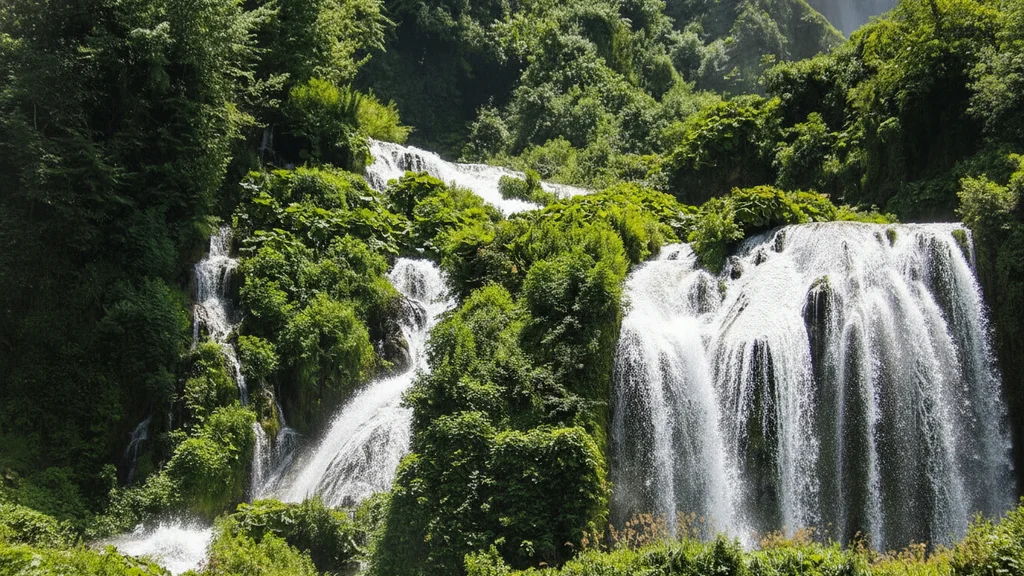
In the heart of the Serre Calabresi massif, where the rugged nature of Calabria reveals its most stunning face, lies the Marmarico Waterfall (Cascata del Marmarico) – the tallest hydrological monument in the entire Southern Apennines. Though often mistakenly associated with Pollino National Park, this imposing 114-metre cascade is located within the municipal boundaries of Bivongi, in the province of Reggio Calabria. Visiting this site is particularly breathtaking in spring, when the torrents fed by the Folea stream are at their peak and the surrounding flora bursts into life. A place of exceptional significance, it was officially inscribed on the prestigious “Italian Wonders” (Meraviglie Italiane) list in 2011.
The Impact of Marmarico Waterfalls on Tourism Development in Calabria
The Marmarico Waterfalls play a fundamental role in the development of sustainable tourism in the region, serving as an icon of ecology in the Mediterranean basin. As the tallest waterfall in Calabria, located in the scenic Stilaro river valley, it attracts a growing number of travellers fascinated by its spectacular three-tiered cascades. The rising interest in this area has directly stimulated the development of tourism infrastructure, and since 2015, when Marmarico was granted the status of “Site of Tourist Significance,” visitor numbers have been steadily increasing.
Data from 2024 indicates that Calabria recorded a rise to 5.8 million overnight stays, with a significant share attributed to the mountainous areas of the Serre Regional Park. This growth has brought tangible benefits to the local economy in towns such as Bivongi, Stilo, and Pazzano. The establishment of over 20 new agritourism lodges and B&Bs since 2015 has created seasonal employment for more than 500 people, supporting regional businesses through tourist spending of 150–200 euros per day.
Promotion of the waterfalls, bolstered by campaigns on Instagram and TripAdvisor, strengthens Calabria's image as a destination full of undiscovered natural attractions. A significant role is also played by the Fondo per l'Ambiente Italiano, which promotes the cascade as part of its “Places of the Heart” project. Thanks to this, Marmarico not only stimulates the economy but also builds ecological awareness, teaching the value of preserving biodiversity for future generations.
Geology and Hydrology – The Crystalline Heart of the Serre Massif
The morphogenesis of the area where the Marmarico Waterfall formed is closely linked to the geological evolution of the Serre Calabresi massif. Unlike the limestone karst formations typical of other parts of the region, the bedrock here consists of resistant crystalline rocks, primarily granites and syenites. This specific geological structure determines the torrential character of the river network, leading to the formation of vertical faults and deep erosional incisions in the Folea stream valley.
| Physical Parameter | Value/Characteristic |
|---|---|
| Total height | 114 metres |
| Number of main tiers | 3 cascades |
| Feeding watercourse | Folea stream (tributary of the Stilaro) |
| Location | Bivongi (Reggio Calabria) |
Structural analysis shows that the total drop of 114 metres comprises three main tiers, creating a dynamic hydrological system that terminates in a crystalline lake at the base. The name “Marmarico” derives from the local dialect and means “slow”, referring to the optical illusion in which water falling from such a great height appears almost motionless. Water flow exhibits considerable seasonal variability, peaking in spring during snowmelt in the upper reaches of the Serre massif.
The Ecosystem Around Marmarico Waterfall – A Botanical Sanctuary
The surroundings of the Marmarico Waterfall constitute one of Europe's most important refugia for relict flora, resembling a prehistoric jungle. The most precious element of the local vegetation is Woodwardia radicans, a giant chain fern whose lineage dates back to the Tertiary period. The constant humidity generated by the spray from the cascade and protection from frost have allowed this species to survive in the Stilaro valley for millions of years.
The Folea valley is also rich in chestnut, oak, and beech forests, which shelter rare fauna. The clean waters of the stream are home to the brown trout (Salmo trutta fario), while peregrine falcons and hoopoes can be observed in the skies above. Unfortunately, monitoring of the Woodwardia radicans population shows regressive trends – the number of specimens declined from 1,300 in 2003 to approximately 840 in 2008, underscoring the urgent need to protect this unique ecosystem.
Byzantine Heritage and the Cultural Landscape of Bivongi
The Marmarico Waterfall is an integral part of the “Byzantine Valley,” a region that has served as a centre of Eastern monasticism since the 9th century. The most important monument in the vicinity is the Monastery of St John the Harvester (San Giovanni Theristis) in Bivongi, representing a unique style blending Byzantine and Norman influences. The monastery is currently administered by the Romanian Orthodox Church, making it a living centre of worship that attracts pilgrims from across Europe.
The town of Bivongi itself has gained international fame as the “Village of Longevity” due to its remarkably high number of centenarians. This phenomenon is attributed to the crystalline water from the Stilaro basin, a specific diet, and the local Bivongi DOC wine. The combination of Byzantine spirituality, winemaking traditions, and the wild nature of the waterfall creates a unique tourism product where the sacred blends with the raw beauty of the landscape.
Discovery of the Marmarico Waterfalls – From Legends to Science
The history of Marmarico's discovery is full of fascinating twists and terminological misunderstandings. Although local communities considered the site sacred, calling it the “hidden thunders,” official scientific documentation did not appear until the late 19th century. For a long time, Marmarico remained a secret known only to local shepherds, and its scientific documentation is owed to Italian researchers and cartographers who, while mapping the mountainous terrain of Calabria, brought this impressive waterfall to wider public attention.
Expedition Logistics and Practical Tips
Reaching the highest waterfall in Calabria requires proper preparation, as the trekking routes are of an excursionist nature. The main trail from Bivongi is approximately 6 kilometres long and passes the ruins of old mills and industrial installations. For those seeking a less demanding option, a 4x4 off-road vehicle transport service is available, bringing tourists to within a 20-minute walk of the cascade itself.
- Footwear – high trekking boots are essential, as the granite rocks can be extremely slippery.
- Water temperature – the lagoon beneath the waterfall invites swimming, but the water rarely exceeds 15°C, which can risk thermal shock.
- Monastery etiquette – when visiting the Monastero di San Giovanni Theristis, remember to dress modestly and respect service hours.
Frequently Asked Questions
How tall is the Marmarico Waterfall?
The Marmarico Waterfall stands at 114 metres, making it the tallest waterfall in Calabria and in the entire Southern Apennines.
How do you get to Marmarico Waterfall and how long does the trail take?
The main hiking trail from Bivongi is approximately 6 km one way, and takes an average of 3 hours to complete. Alternatively, you can use a Jeep transport service that shortens the walk to 20 minutes.
When is the best time to visit the Marmarico Waterfall?
The best time to visit is spring, when melting snow ensures maximum water flow, and early summer, when the surrounding nature is in full bloom.
Where exactly is the waterfall located?
The waterfall is located in the municipality of Bivongi (province of Reggio Calabria), within the Serre Regional Park, in the Stilaro river valley.
Is it safe to swim beneath the waterfall?
Swimming in the lagoon is possible, but caution should be exercised due to the very low water temperature (approx. 15°C) and the slippery lake bed.