Hidden in the picturesque hills of Calabria, the Cattolica di Stilo is one of the most precious examples of Byzantine architecture to have survived to our times. This church represents a unique combination of Eastern and Western influences, delighting visitors with both its exterior form and an interior full of frescoes and icons. Since 2006, the monument has been on the UNESCO Tentative List, underscoring its universal value that extends beyond Italy's borders.
The building rises on the slopes of Monte Consolino, strategically dominating the Stilaro river valley. Between the 9th and 11th centuries, Calabria was the heart of the Byzantine "Thema di Calabria," serving as a centre radiating the culture and spirituality of the Eastern Empire. The Cattolica probably served as the main church (euktírion) of a monastic complex, acting as a point of reference for hermits living in the surrounding grottoes.
Architectural Mastery and the Style of Cattolica di Stilo
The Cattolica di Stilo is an outstanding example of Byzantine architecture in the Calabria region, built on a Greek cross plan inscribed within a square. This precise layout, measuring approximately 7.80 by 7.30 metres, symbolises in Byzantine theology the union of the earthly square with the heavenly sphere of the domes. The central dome is supported by four pillars, and the entire structure is crowned with five domes in a quincunx arrangement, resembling the pattern of dots on a die.
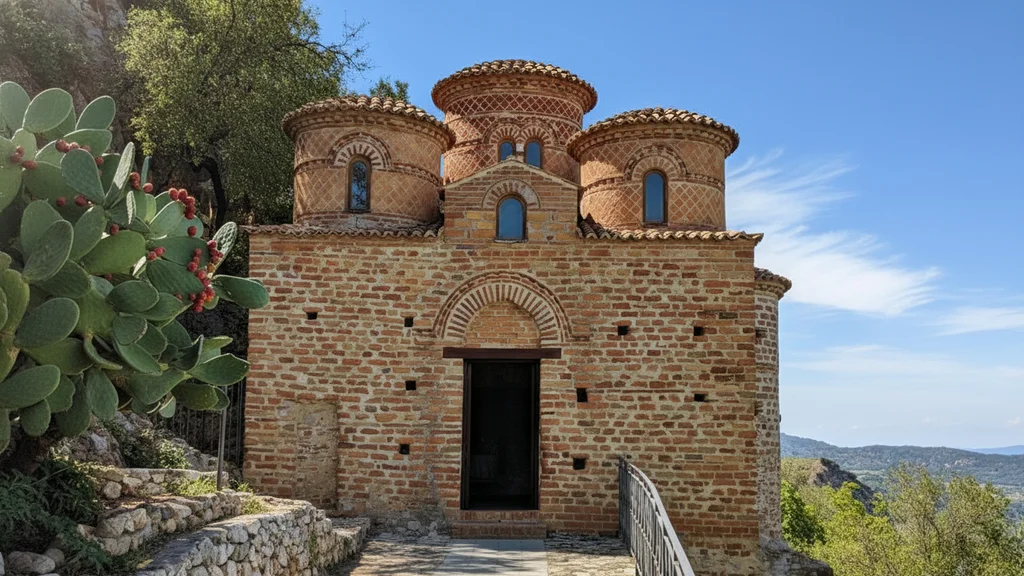
The exterior elevation delights with its austerity and masterful use of brick, often laid in the characteristic spina di pesce (herringbone) pattern. The use of reclaimed materials (spolia) from the ancient cities of Kaulonia and Scolacium testifies to medieval builders' desire to maintain historical continuity. Through the system of pendentives, architects managed to transition smoothly from square forms to the round drums of the domes, which illuminate the interior through narrow bifora and monofora windows.
| Structural Element | Technical Characteristics |
|---|---|
| Temple plan | Greek cross inscribed in a square (Macedonian model). |
| Domes | Five domes with tiles arranged in diamond patterns. |
| Interior columns | Four monolithic columns, each in a different style. |
| Building material | Brick and mortar, spolia from ancient ruins. |
The church interior is divided into nine square spaces by four ancient columns. One of the columns is placed upside down, with a Corinthian capital at floor level, revealing the pragmatism of ancient master builders. Three apses facing east serve liturgical functions: the central one (Bema) and the lateral ones (Prothesis and Diakonikon), typical of the Eastern rite.
The Legacy of Cattolica di Stilo – from Byzantine Temple to Modern Monument
The temple's name derives from the Greek word Katholikì, meaning a "universal" or mother church, possessing the right to baptise. The first certain documentary mention of the site dates from 1094, when the Hauteville family (Normans) confirmed the existence of the complex. Despite later Latin domination, in Stilo the rito greco (Greek rite) officially survived until the end of the 15th century, making it a unique cultural enclave.
Modern knowledge of the monument is largely thanks to the outstanding archaeologist Paolo Orsi. It was he who between 1912 and 1927 conducted the first scientific conservation works, saving the building from progressive degradation. Orsi identified as many as five different layers of painted decoration, which overlapped from the 10th to the 15th century, creating a fascinating artistic palimpsest.
Over the centuries, the role of the Cattolica di Stilo in the social life of the region was incalculable. The building survived numerous earthquakes and landslides that afflicted the area, remaining a silent witness to the fall of empires. Today the monument is under the care of the Italian Ministry of Culture, and admission is ticketed, allowing for the financing of ongoing conservation and interior microclimate monitoring.
Byzantine Decorations in the Cattolica di Stilo – a Dialogue between East and West
The interiors of this Byzantine church constitute a research field for analysing the interpenetration of Eastern and Western Christian traditions. The oldest frescoes present an austere monastic style, focused on theological depth and mystical experience of faith. In the central apse, the figure of Christ Pantocrator dominates, surrounded by Church Fathers such as St. Basil the Great and St. Nicholas of Myra.
Western Christianity left its mark in later decorative phases, introducing more narrative biblical depictions. An example is the 16th-century scene of the Dormitio Virginis (Dormition of the Virgin), which features a rare iconographic detail – an angel cutting off the hands of a heretic attempting to desecrate the coffin of the Mother of God.
A remarkable mystery is the Arabic inscriptions discovered in 1997 on one of the columns. These inscriptions contain the Muslim declaration of faith (Shahada), suggesting that the building may have been temporarily used by Arabs or built using materials from Islamic structures. This multiculturalism makes the Cattolica di Stilo a true melting pot of Mediterranean civilisations.
Cattolica di Stilo – Spiritual Centre of Calabria
The Cattolica di Stilo is undoubtedly not only an architectural gem but also an important spiritual centre of the region, inseparably linked with the figure of John Theristus. The Basilian monks to whom he belonged made the Stilaro valley a "new Thebaid," a place full of prayer and asceticism. This spirituality has survived within the temple walls for centuries, attracting pilgrims seeking silence and contact with the sacred in the austere mountain landscape.
Today the church is part of the Ecomuseo delle Ferriere e delle Fonderie di Calabria, combining the sacred with the industrial history of the region. The Stilaro valley was famous for iron mining, and care of the mines often rested in the hands of religious communities. For visitors, the temple remains a magical place, especially at sunset, when light enters through the dome drums, illuminating the remains of golden polychrome paintings.
Practical Information
Location: Slopes of Monte Consolino, Stilo (RC)
Hours (summer): Daily 08:00–20:00
Hours (winter): Reduced – check before visiting
Tickets: €4.00 full, €2.00 reduced (ages 18–25)
Getting there: By car from the Ionian coast, exit at Monasterace, inland roads to Stilo
Frequently Asked Questions
What period does the Cattolica di Stilo date from and why is it unique?
The temple dates from between the 9th and 10th centuries. Its uniqueness lies in its quincunx architecture (five domes) and the fact that it is one of the best-preserved examples of Byzantine sacred building in southern Italy.
Is Cattolica di Stilo inscribed on the UNESCO list?
Currently, the Cattolica di Stilo has been on the UNESCO Tentative List since 2006. This means it is a candidate for inscription on the World Heritage List as part of the Byzantine-Basilian monuments of Calabria.
What are the opening hours and how much does admission cost?
The church is usually open to visitors daily, in summer from 08:00 to 20:00, and somewhat shorter in winter. Admission costs €4 (€2 for visitors aged 18–25).
Where do the Arabic inscriptions inside the church come from?
The Kufic script inscriptions on the columns are the subject of scholarly debate. They may date from the period of short-lived Arab dominance in the region or result from the reuse of building materials from other, Muslim structures.
What is the best way to get to Cattolica di Stilo?
The monument is located in the town of Stilo in the province of Reggio Calabria. The best way to reach it is by car, following scenic roads inland from the Ionian coast (exit at the town of Monasterace).