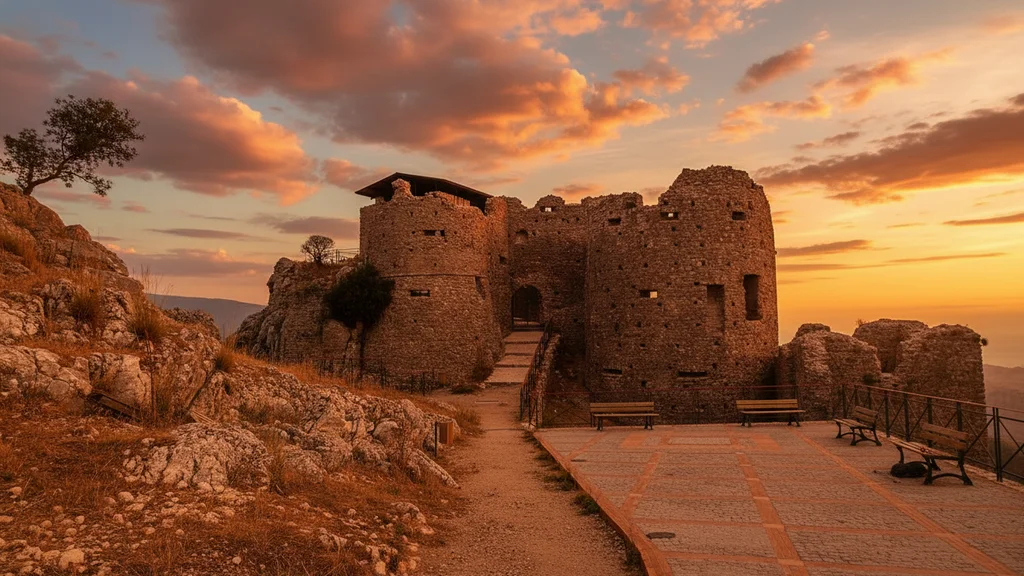
The castle on Monte Consolino, set amid the mountainous scenery of Calabria, is one of the most valuable examples of Norman architecture in Italy. This monumental fortress, rising to 701 metres above sea level, is not merely a relic of former defensive might, but a multi-layered testament to civilisational changes from the Bronze Age through to modern times. The picturesque castle ruins, erected atop the mountain in the 11th century, attract tourists and scholars alike with their monumentality and rich history, standing as a symbol of the region's multicultural past.
Strategic Significance of the Castle on Monte Consolino in Medieval Political Realities
The castle on Monte Consolino, also known as Castello Normanno di Stilo, played a vital strategic role in the Middle Ages, crucial for dominance over southern Italy. Perched on a mountain summit, it offered not only impressive views of the Ionian Sea but, above all, strategically controlled important trade routes. Its location at the very peak allowed observation of a vast stretch of coastline, from Cape Capo Spartivento to Crotone, making it a point nearly impossible to surprise by invaders.
| Geographical-Technical Parameter | Specification |
|---|---|
| Summit elevation | 701 m a.s.l. |
| Location | Eastern slope of Monte Consolino, Stilo (RC) |
| Rock formation | Limestone (roccia calcarea) |
| Elevation gain from town | Approximately 301 metres |
Control of Communication Routes
Monte Consolino, with its view over the Calabrian coast, was ideally positioned for monitoring ship traffic between the Tyrrhenian and Ionian Seas. Its location enabled effective control of trade, boosting both security and the region's financial revenues. The fortress served as a key control point over the Stilaro valley, protecting the town of Stilo and strategic natural resources, including local iron mines.
Defence Against Threats
The Norman fortress also served a defensive role against external attacks, protecting inhabitants from Barbary pirate and Saracen raids. The settlement of Stilo in the 7th–8th centuries AD was a direct response to these threats, as coastal populations sought refuge inland. Together with other fortifications, the castle formed an integral part of southern Italy's defence, contributing to the political stability of the Kingdom of Sicily.
Political and Administrative Significance
On the political plane, Monte Consolino was a place of symbolic dominion over Calabria, serving as an important centre of governance and feudal authority. In the 13th century, under the rule of Charles I of Anjou, the castle in Stilo was one of seven principal manors in Calabria administered directly by the Reale Curia. Documents from 1281 describe in detail the conservation works to which local barons were obligated, testifying to the Crown's prioritisation of this stronghold.
Role in the Defence System
The castle on Monte Consolino was part of a network of medieval fortifications, providing excellent visibility and an early warning system. The builders fully exploited the irregular orography of the terrain, raising walls directly on the living limestone rock quarried from the massif. The castle remains to this day a symbol of Norman strategic genius, who were able to integrate military architecture with the natural geological barrier.
Norman Essence in the Ruins of Stilo Castle – A Testament to Medieval Might
The castle on Monte Consolino is an impressive example of Norman architecture that perfectly illustrates the adaptation of a military unit to rugged terrain. Built in the 11th century, it combines elements typical of Norman defensive constructions, such as massive walls and towers of varying cross-sections. The central defensive element was the donjon – a massive tower of a residential-defensive character, typical of construction from this period.
Architectural Characteristics of the Castle
The castle in Stilo is distinguished by its simplicity of form, underscored by solid stone structures devoid of external ornamentation. The original structure featured triangular towers that minimised dead zones of fire, and round towers equipped with arrow slits (feritoie). During the Aragonese period, the castle underwent modernisation, resulting in the addition of two mighty semicircular towers designed to increase resistance to the emerging fire artillery.
| Architectural Element | Characteristics and Functions |
|---|---|
| Donjon (Mastio) | Main Norman tower in the northern part of the fort. |
| Triangular towers | Unique defensive forms from the Norman period. |
| Water management | Terracotta pipe system channelling rainwater to cisterns. |
| Castle chapel | Sacred structure with a main altar and four side altars. |
Comparison with Other Norman Constructions
Compared to the richly decorated cathedrals of Sicily, the castle in Stilo is an example of a more functional style adaptation, oriented towards military efficiency. While Sicilian monuments evolved into hybrid forms with Arab influences, the Calabrian castle remains true to the austerity of medieval fortification. An exceptionally rare element was the presence of an elaborate chapel at the centre of the complex, suggesting the castle's role in the process of introducing the Latin rite in Byzantine territories.
The Normans and Their Legacy in Calabria – An Analysis Through Stilo Castle
The Normans in Calabria: Historical Context
The Normans played a key role in shaping the culture and architecture of Calabria, particularly in the 11th century. These warriors, led by figures such as Robert Guiscard, extended their influence across southern Italy, creating a dynamic state. Calabria, situated between the Tyrrhenian and Ionian Seas, was an arena of action for many powers, and the Normans introduced a new feudal and urban system.
Construction of the Castle on Monte Consolino
The castle's construction dates to the 11th century and is attributed to either Roger II or Roger I. The first official documentary mention of the fortress's existence dates to 7 May 1093, when Count Roger I issued a concession act in favour of St Bruno of Cologne. The name of one of the towers – Altavilla – is a direct reference to the royal Hauteville dynasty, underscoring the prestige of the structure.
Architectural and Cultural Heritage
The castle in Stilo reflects the unique synthesis of styles that the Normans brought with them, combining Romanesque elements with solutions observed in the Near East. The landscape dominated by the castle became an inspiration for Tommaso Campanella, who in Stilo conceived the vision of his ideal “City of the Sun.” The relationship between the austere castle and the Byzantine Cattolica at its foot illustrates the transition from Greek mysticism to Norman feudalism.
A Dark Chapter of History – The Angevin Prison
In the 13th century, the castle gained grim fame as one of the kingdom's most rigorous prisons. Cells were located on a vertical rock face 500 metres high, accessible only from above by ropes, making escape physically impossible. According to local legends, political prisoners there had a choice only between enduring inhumane captivity or leaping into the abyss.
Earthquakes as Catalysts of Destruction at the Castle on Monte Consolino
The castle on Monte Consolino is not only a witness to history but also a victim of nature's destructive force in this seismically active region. Its geographical location means that the limestone structure is susceptible to erosion and landslides triggered by tremors. Although the castle served as a formidable defensive point, its walls cracked repeatedly due to tectonic movements of the African and Eurasian plates.
One of the most catastrophic tremors was the earthquake of 1694, which caused the collapse of the main outer walls and towers. Further major damage occurred during the catastrophic Calabrian earthquake of 1783. Modern restoration carried out between 2009 and 2016 enabled the consolidation of towers and the securing of the donjon, saving the monument from total degradation.
Frequently Asked Questions
How long does it take to climb Monte Consolino to the castle in Stilo?
The ascent to the summit typically takes 45 to 60 minutes, depending on the chosen route. The most popular Via Crucis trail is steep but offers the best views, while the route from the cemetery side is somewhat gentler.
What can you see from the castle ruins on Monte Consolino?
The ruins offer a spectacular panorama of the Stilaro valley and the Ionian Sea, and on a clear day you can spot Cape Capo Spartivento. You can also see the rooftops of Stilo and the neighbouring towns of Pazzano and Bivongi.
What is the history of the Norman castle in Stilo?
The castle was built in the 11th century by the Normans, probably during the time of Roger I, as a key defensive point. Over the centuries it served as an administrative fortress and Angevin prison, and after numerous earthquakes fell into ruin before being restored in the 21st century.
Is the castle in Stilo accessible to climbers?
Yes, the limestone walls of Monte Consolino offer over 75 climbing routes ranging in difficulty from 4a to 9a. Sectors such as “Città del Sole” allow you to combine sporting passion with admiring historic architecture from a vertical perspective.
What is the Palio di Ribusa held in the shadow of the castle?
It is an annual historical festival held in August that evokes the Renaissance splendour of Stilo. The programme includes jousting tournaments, period costume processions, and fairs where replicas of ancient coins – Ribuso – are used.