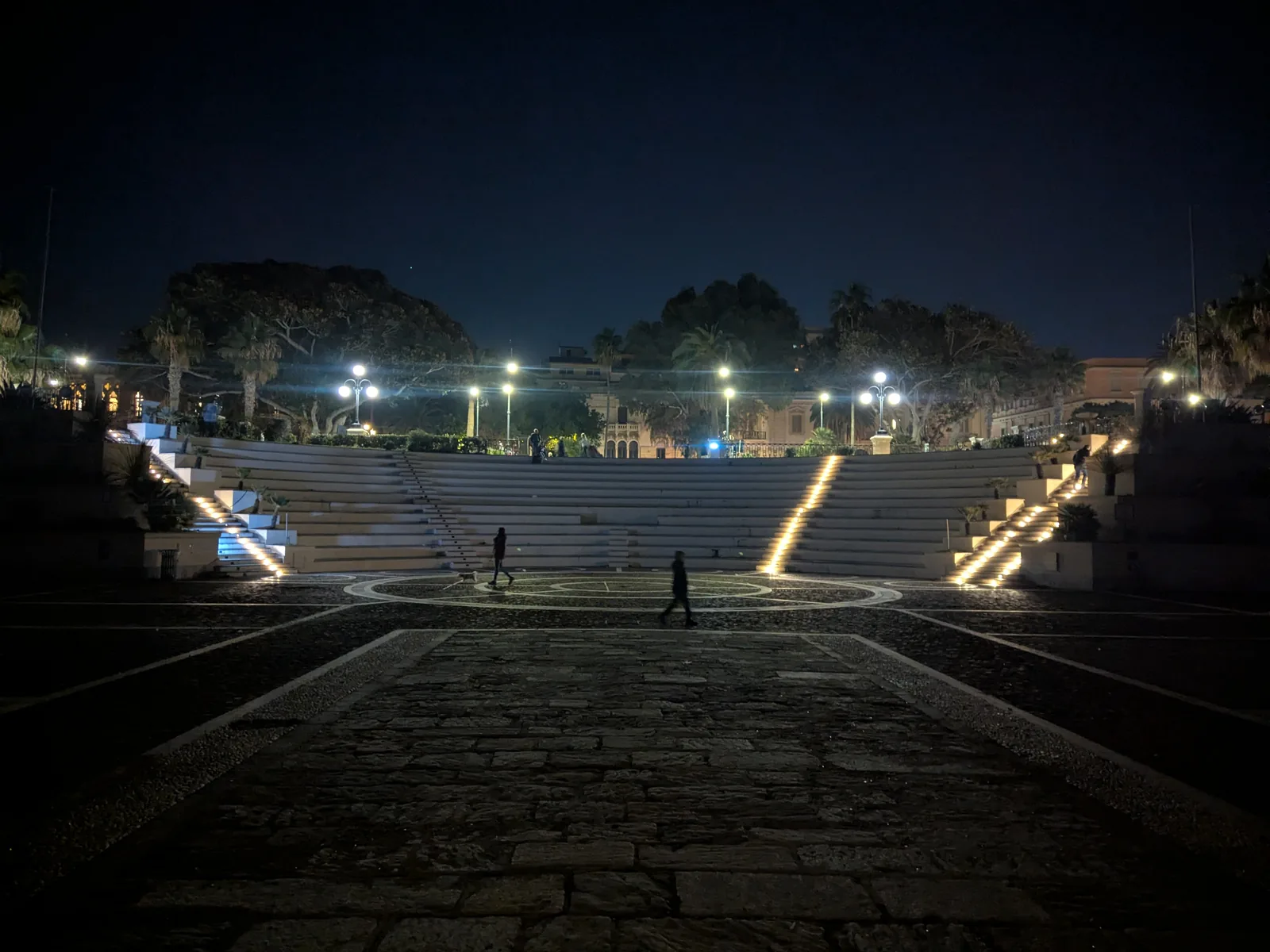
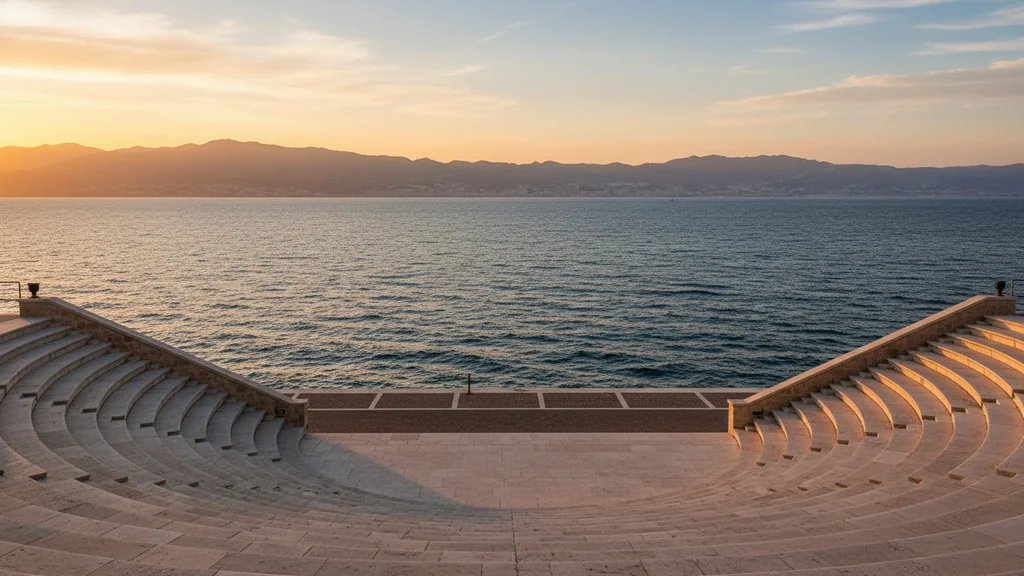
The Arena dello Stretto is a modern open-air amphitheatre perched on the very edge of the Strait of Messina in Reggio Calabria. Its semicircular form evokes ancient theatres, but today it serves above all as a contemporary cultural venue. In the evening, when the lights come on across the strait in Sicily and music fills the stage – it is hard to imagine a more striking setting for an open-air event.
The official name of the venue is Anfiteatro Ciccio Franco – since 2006 the arena has been named after local senator Francesco "Ciccio" Franco. For the people of Reggio, however, it remains simply "the Arena," one of the main centres of the city's summer cultural life.
Table of Contents
History
Before the amphitheatre existed, this site was occupied by the Molo di Porto Salvo – the main harbour pier of Reggio Calabria. The earthquake of 28 December 1908, one of the most powerful in European history, completely destroyed both the pier and much of the city. According to the most widely accepted modern estimates, the disaster claimed around 80,000 lives; some popular accounts also give a figure of around 100,000.
Reconstruction of Reggio took decades. In place of the former port, the authorities decided to create a monument with an entirely new purpose. The design of the marble monument, crowned with a bronze statue of Athena Promachos, was entrusted to architect Camillo Autore. The inauguration took place in May 1932. The central marble obelisk, known as the Monumento a Vittorio Emanuele III or Cippo di Porto Salvo, commemorates King Victor Emmanuel III stepping ashore here on 31 July 1900. The young king was returning from a cruise in the eastern Mediterranean after learning that his father, Umberto I, had been assassinated in Monza two days earlier – Reggio was where he first set foot on Italian soil as monarch.
Two stages in the history of this place should be kept separate. The 1932 monument is the marble obelisk with the statue of Athena Promachos by Antonio Bonfiglio, while today's Arena dello Stretto is a later arrangement of the space around the monument. The official city guide states that the Arena dello Stretto, also known as Teatro Anassilaos, was created at the end of the 20th century as part of the redevelopment of the seafront, after the coastal railway line running here was moved underground. In 2001, after the modernisation of the promenade was completed, the monument with Athena was placed on a raised platform at the centre of the amphitheatre and turned toward the city.
The bronze Athena Promachos – the warrior goddess defending the city – was sculpted by Messinese artist Antonio Bonfiglio. Originally facing the sea, as if guarding the city against invaders, today the statue looks toward Reggio. It was turned on the orders of the then mayor Italo Falcomatà, who reportedly believed that Reggio's real enemies would not come from the sea but were within the city itself. The gesture is often linked to the period of civic renewal known as the Reggio Spring (Primavera di Reggio), though the term refers more broadly to the transformations the city went through from the 1990s onward.
The amphitheatre's current form, with its semicircular stepped seating, was developed in the second half of the 20th century, stylistically echoing the theatrical traditions of Magna Graecia. The venue has been modernised and has long served as Reggio Calabria's main outdoor performance space.
The name Anfiteatro Ciccio Franco also has a clear political and commemorative dimension. Francesco "Ciccio" Franco (1930–1991) was a CISNAL trade unionist and MSI senator, and one of the most recognisable faces of the protests in Reggio Calabria in 1970–1971 following the decision to choose Catanzaro as the regional capital. The motto associated with the Reggio revolt was "Boia chi molla," which is why the naming of the arena after him in 2006 was and remains controversial.
Watch on YouTube
What to See
The arena takes the form of semicircular tiers descending toward the sea and serves as a large open-air auditorium during city events. Its orientation is unique – the audience faces directly onto the Strait of Messina, with Sicily as a natural backdrop. From the arena, the coast around Messina is clearly visible across the water, and at its narrowest point the strait is about 3.1 km wide. Mount Etna is visible only when atmospheric clarity is very good, and the Fata Morgana phenomenon appears rarely, usually in the morning and only under specific thermal conditions.
At the centre of the amphitheatre stands the marble monument with the statue of Athena Promachos. The goddess, depicted striding forward with spear and shield, is one of the most recognisable symbols of Reggio Calabria. Take a closer look at the details of the sculpture – its classical form fits well with the monumental character of the whole ensemble.
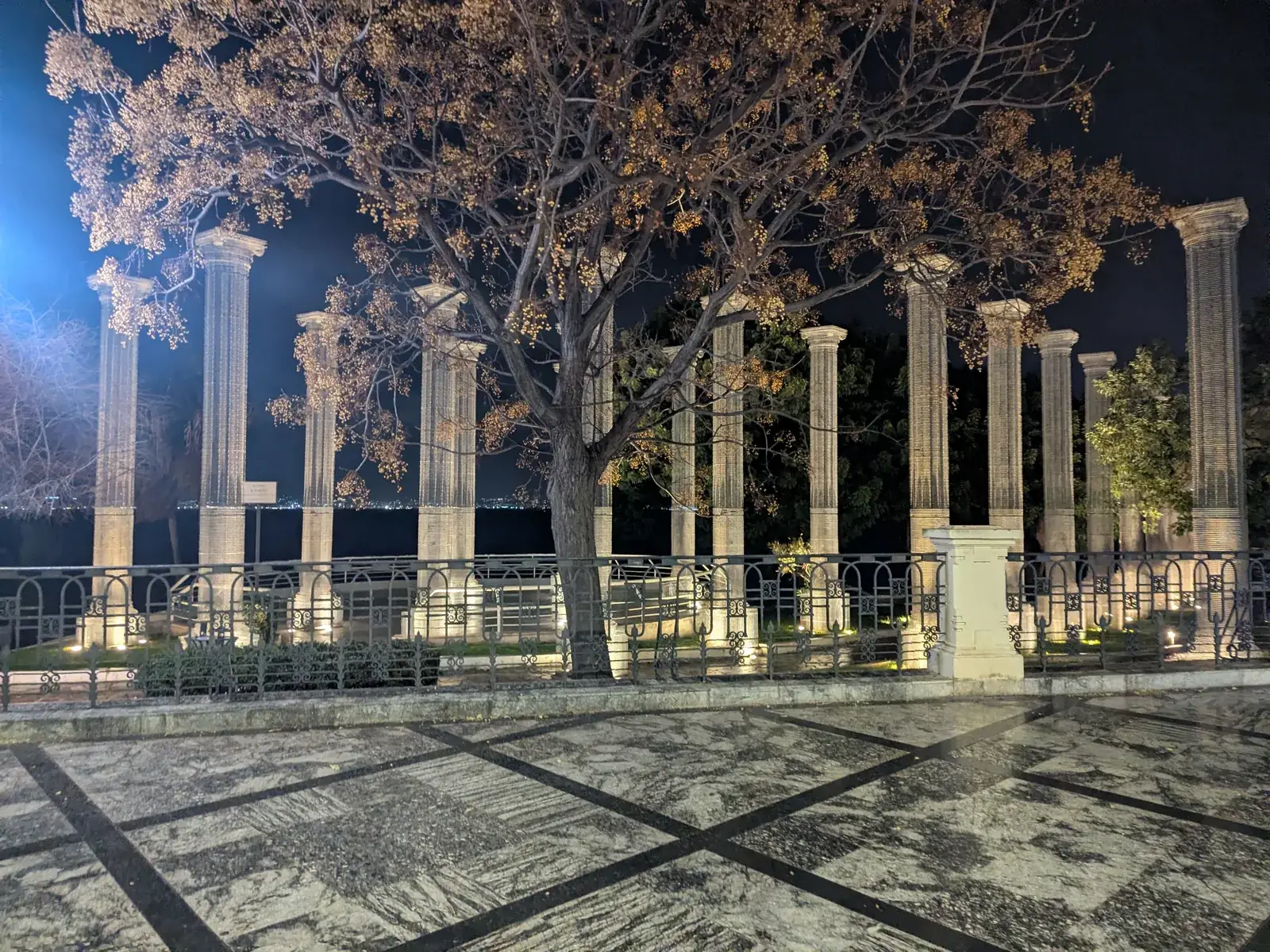
The Arena is an integral part of the Lungomare Falcomatà – the celebrated seafront boulevard known as "the most beautiful kilometre in Italy" (a phrase attributed to D'Annunzio). Walking along the promenade, you can move seamlessly from the amphitheatre to the Art Nouveau palazzi and other elements of the city's exhibition space and sculptures placed along the lungomare.
In summer the arena comes alive with concerts, theatrical performances, film screenings and festival events, as well as occasions such as Tesori del Mediterraneo. RTL 102.5 broadcasts and the Miss Italia nel Mondo pageant have also been held here. It is the evening events that best show how deeply this part of the lungomare is woven into the daily life of the city.
Practical Information
Location: Lungomare Falcomatà, Reggio Calabria – the amphitheatre sits on the seafront promenade, a 10–15 minute walk from the National Archaeological Museum
Admission: The arena is publicly accessible and free to visit; during events, tickets are sold by individual organisers
Best time: Summer evenings (June–September) – both for the cultural programme and the spectacular sunsets
Getting there: On foot from central Reggio – about 15 minutes from Reggio Calabria Centrale station or about 10 minutes from Reggio Lido station on the promenade
The arena lies on Lungomare Italo Falcomatà, in the central part of the promenade, near Piazza Italia and Corso Vittorio Emanuele III. The official Turismo Reggio Calabria portal gives the address as Lungomare Falcomatà, 89123 Reggio Calabria, and the coordinates as 38.111186, 15.644896. From the National Archaeological Museum of Reggio Calabria, it is about 10–15 minutes on foot. From Reggio Lido station, about 10 minutes on foot (approx. 650 m), and from Reggio Calabria Centrale about 15 minutes' walk (approx. 1.2 km) or a few minutes by taxi.
On a day-to-day basis, the space is open as part of the promenade and can be viewed without a ticket. According to information from the Comune di Reggio Calabria, access to the Arena is permitted for everyone, including people with disabilities. Two side ramps lead to the lower part of the arena, making it easier to enter without using the steps. During concerts and events, access to the seating area may be controlled, and prices depend on the organiser and programme – there is no single fixed price list for the arena. The most active events season usually falls in the summer months, particularly July and August.
Frequently Asked Questions
Is the Arena dello Stretto open all year?
Yes, the amphitheatre itself is a public space accessible year-round. However, cultural events – concerts, festivals, film screenings – take place mainly during the summer months, from June to September.
How many people does the Arena dello Stretto hold?
The amphitheatre has a semicircular auditorium used during large open-air events; the exact number of available seats depends on the organiser and the event configuration.
Why is the arena named after Ciccio Franco?
In 2006 the amphitheatre was renamed Anfiteatro Ciccio Franco in honour of Senator Francesco "Ciccio" Franco. He was a figure strongly associated with the Reggio revolt of 1970–1971 and the motto "Boia chi molla," which is why his commemoration remains controversial in the city to this day.
How can I combine a visit to the Arena with other Reggio attractions?
The Arena sits directly on the Lungomare Falcomatà, a 10–15 minute walk from the National Archaeological Museum. An ideal itinerary: museum in the morning, a stroll along the boulevard, then an evening event at the arena with sunset views over the Strait of Messina.
Sources
The information in this article was verified against the following sources:
- comune.reggio-calabria.it – comune.reggio-calabria.it
- Arena dello Stretto | Turismo Reggio Calabria – turismo.reggiocal.it
- The Arena of the Strait | Turismo Reggio Calabria – turismo.reggiocal.it
- 429 Too Many Requests – ingvterremoti.com
- Arene e Giardini | Scoprire Reggio Calabria - La guida della Città – scoprirereggiocalabria.it
- Anfiteatro Ciccio Franco – Wikipedia (IT) – it.wikipedia.org
- Wikipedia – Arena dello Stretto – en.wikipedia.org
Last updated: