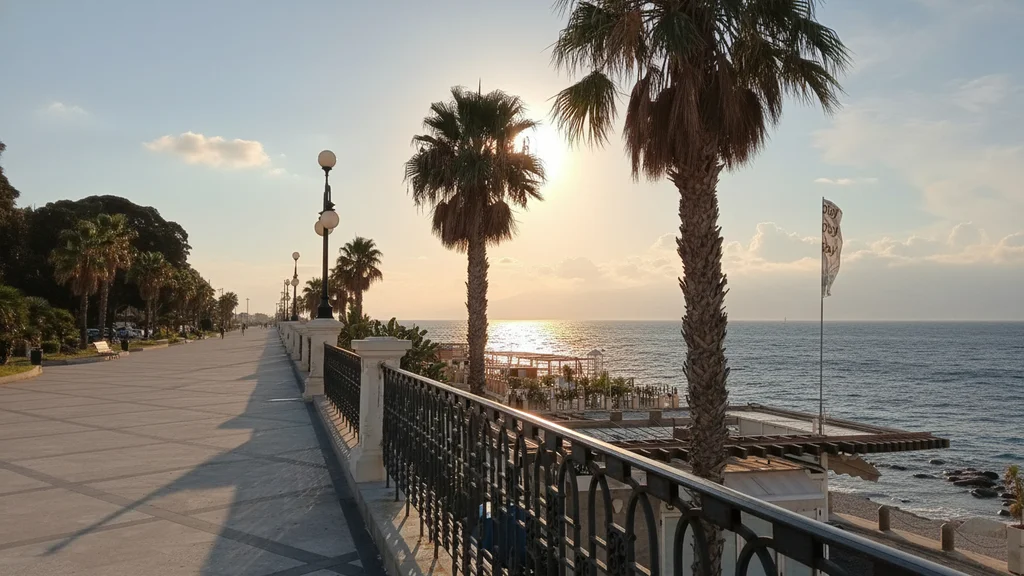
The Lungomare Falcomatà is the seafront boulevard of Reggio Calabria, stretching roughly 1.7 kilometres along the Strait of Messina – from the area of Piazza Garibaldi to Piazza Indipendenza. It is traditionally hailed as "the most beautiful kilometer in Italy," a phrase attributed to the poet Gabriele D'Annunzio, though historians dispute the authenticity of the quote. Regardless of attribution, the promenade is one of the most striking seaside walks on the Italian peninsula – with views of Sicily, Mount Etna and the Fata Morgana mirage.
The promenade runs along the representative waterfront of the city, taking in the lower avenue of Lungomare Italo Falcomatà and the parallel, higher-level Corso Vittorio Emanuele III (the so-called via Marina alta, lined with Liberty-style buildings), with a northern extension towards Viale Genoese Zerbi. The current name – Lungomare Italo Falcomatà – commemorates Mayor Italo Falcomatà, associated with the "Reggio Spring" (Primavera di Reggio) – the cultural and civic revival of the city in the 1990s.
Table of Contents
History
The present form of the Lungomare is the product of dramatic events. The catastrophic earthquake of 28 December 1908 destroyed virtually the entire historic centre of Reggio Calabria. In the aftermath, Giuseppe Valentino – then the city councillor for public works (assessore ai lavori pubblici) and later mayor – tasked engineer Pietro De Nava with drafting a new urban plan. De Nava designed wide streets, a rational grid, and elegant buildings to line the seafront promenade.
The earthquake was accompanied by a tsunami in the Strait of Messina, and the scale of destruction meant that much of the city had to be rebuilt practically from scratch. De Nava’s plan was based on a grid of wide, straight streets and low-rise construction better adapted to seismic risk. Today’s representative character of the waterfront is a direct result of this rebuilding in the first decades of the 20th century.
The rebuilding took decades. Palazzo Zani and Palazzo Spinelli belong to the construction phase after the 1908 earthquake; the present Villa Genoese Zerbi was also built after the earthquake, on the site of an earlier villa of the Genoese Zerbi family, and was later restored. Together they form a striking architectural sequence that gives the Lungomare the character of an open-air urban salon.
Today's Lungomare is the result of later modernisation and landscaping – with viewing terraces, benches and planting that emphasise the city's relationship with the sea. Modern infrastructure has been woven into the historic context of rebuilt Reggio.
Watch on YouTube
What to See
Fata Morgana. This rare optical phenomenon makes the coast of Sicily appear to float above the water, its buildings stretched into unreal, elongated shapes. The name derives from the Arthurian sorceress Morgan le Fay, said to lure sailors with visions of phantom lands. It is most often observed in the early morning on hot, windless days, when air layers of different temperatures form above the strait.
The Fata Morgana over the Strait of Messina is a classic superior mirage caused by temperature inversion: cooler, denser air near the surface and warmer air above bend light rays. This is why the Sicilian coast can appear raised, multiplied or unnaturally elongated. The phenomenon is most strongly associated with the stretch between Reggio Calabria and Messina, although the narrowest point of the strait – about 3.1 km between Torre Faro and Villa San Giovanni – is not directly adjacent to the centre of Reggio.
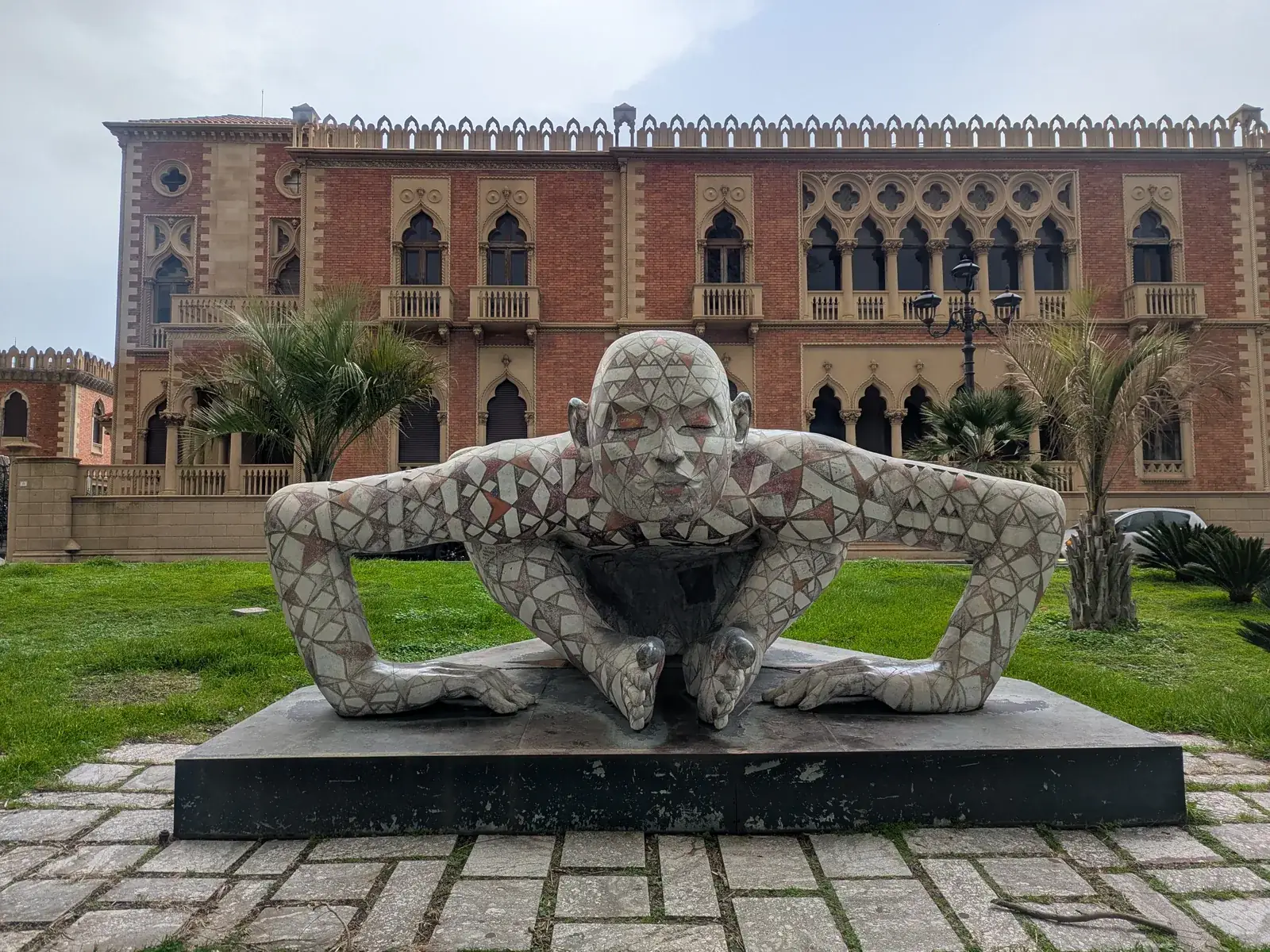
Historic palazzi. Walking from Piazza Indipendenza you pass early-20th-century palazzi: Palazzo Zani with ornate wrought-iron balconies, Palazzo Spinelli with its stone facade, and Villa Genoese Zerbi – an example of neo-Gothic modelled on Venetian architecture. This architecture clearly shows how the rebuilding after the 1908 earthquake gave the waterfront its representative, orderly character.
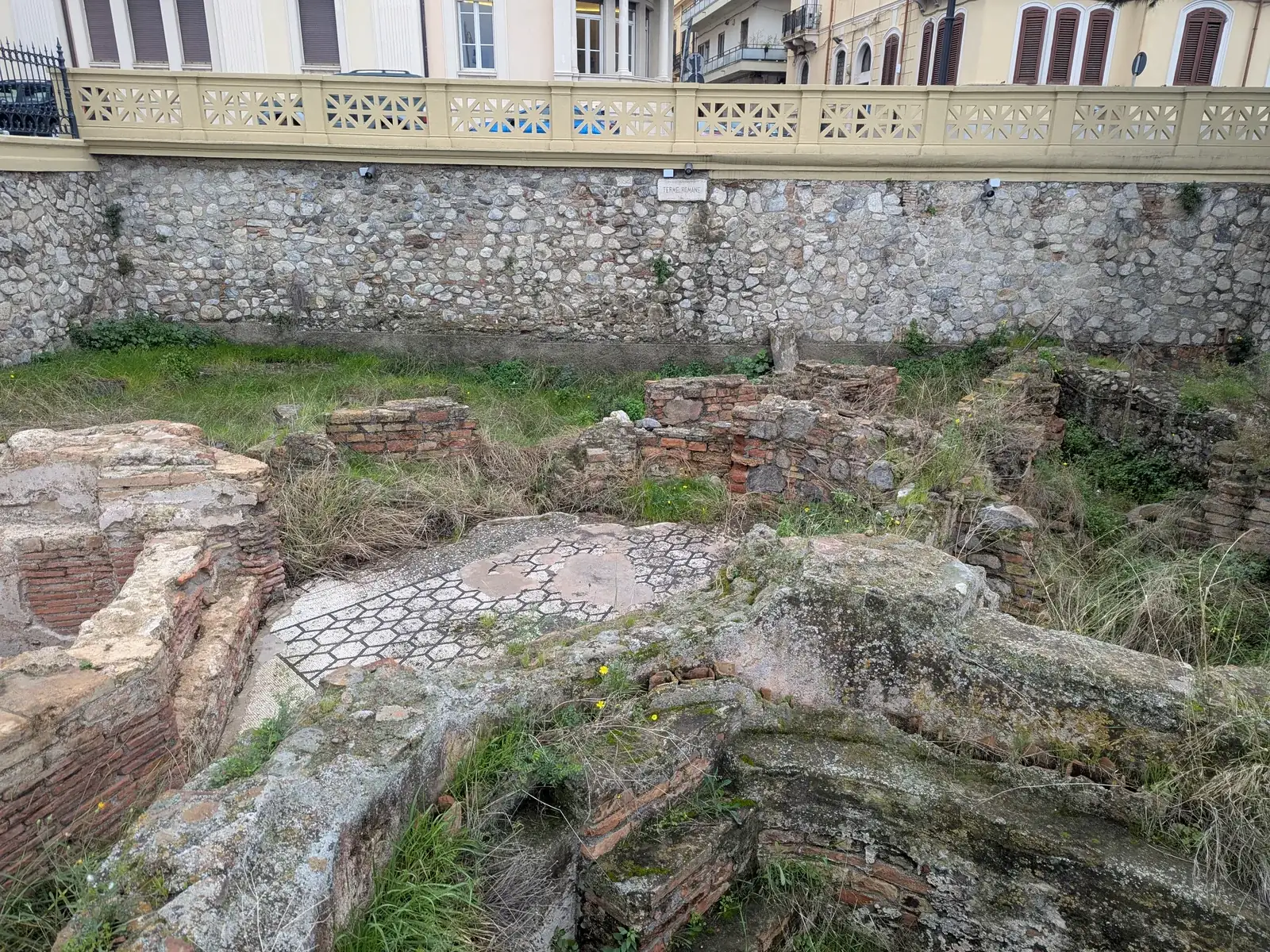
The Lungomare also preserves older traces of the city: remains of Greek walls from the 4th century BC and Roman baths connected with an imperial-era domus. The baths were uncovered during the rebuilding works after the 1908 earthquake. You can still see traces of a portico, heated rooms and a fragment of flooring made of white and black tesserae. It is a good reminder that a walk along the promenade is not only a passage through a modern waterfront, but also through a place layered with ancient history.
Along the route, a few handy landmarks are worth noting. At Piazza De Nava stands the Museo Archeologico Nazionale di Reggio Calabria, best known for the original Riace Bronzes from the 5th century BC. In the central section of the waterfront lies the Arena dello Stretto, and on the southern side of the centre is the Villa Comunale, a municipal garden with subtropical vegetation.
Arena dello Stretto. The open-air amphitheatre with its monument of Athena is an integral part of the Lungomare. In summer it hosts concerts, film festivals and cultural events with the Strait of Messina as a natural backdrop. Beside the Arena stands the Cippo Marmoreo dedicated to Vittorio Emanuele III, unveiled in May 1932 – the monument was designed by Camillo Autore, and the bronze figure was made by the Messina sculptor Antonio Bonfiglio. The figure represents Athena Promachos defending Reggio, and the monument commemorates the landing of Vittorio Emanuele III at Molo di Porto Salvo on 31 July 1900.
The Lungomare is also home to Opera by Edoardo Tresoldi, inaugurated on 12–13 September 2020. The installation consists of 46 columns made of metal mesh, up to 8 metres high, arranged in a 2,500 m² park. Practical note: on 17 February 2026, the city authorities issued a ban on entering and passing by the installation for public safety reasons.
Exotic gardens. Reggio's mild climate supports subtropical vegetation. Palms, ficus trees, dracaenas and magnolias line the promenade, creating a green corridor between the buildings and the sea. In the evening it is one of the best places to witness the local passeggiata – a relaxed social stroll that in the warmer months typically takes place between 6:30 and 9:00 pm, often with artisan gelato or a granita – bergamot is the local flavour to try.
The Lungomare serves as the city’s main social salon: families, joggers, couples and groups of friends gather here, and in summer open-air events add to the rhythm of the waterfront. The best way to experience the route is without rushing, linking viewpoints, ancient remains, the Arena dello Stretto and the municipal garden into one walk along the strait.
Practical Information
Location: Reggio Calabria waterfront, from the area of Piazza Garibaldi in the south to Piazza Indipendenza in the north, approx. 1.7 km
Admission: The boulevard is publicly accessible and free, 24 hours a day
Best time: Sunset (spring–autumn) for the finest views; early morning for the chance to witness the Fata Morgana
Getting there: For those visiting the museum and the north-central section of the promenade, the most convenient station is Reggio Calabria Lido; from Reggio Calabria Centrale station, the southern end of the Lungomare near Piazza Garibaldi is closest; allow about 1 km on foot to the Arena dello Stretto and about 1.7 km to Piazza Indipendenza.
Walking time: A straightforward walk along the main section usually takes 20–30 minutes without stops; with the Arena dello Stretto, photographs and a coffee or aperitivo, allow 1–2 hours
Nearby: Museo Archeologico Nazionale di Reggio Calabria (at Piazza De Nava), Arena dello Stretto
The Museo Archeologico Nazionale di Reggio Calabria is open Tuesday to Sunday from 9:00 am to 8:00 pm, with last entry at 7:30 pm; it is closed on Mondays. Ticket prices in force from 1 July 2024: standard ticket €10, reduced ticket for visitors aged 18–25 €2, and free admission for visitors under 18. A MArRC Slim ticket is also available for €5, valid from 6:00 pm until closing.
Frequently Asked Questions
Is the D'Annunzio quote about "the most beautiful kilometer" authentic?
The authenticity of the quote is disputed by historians. According to researcher Agazio Trombetta, D'Annunzio never visited Reggio Calabria, and there is no mention of the city in the poet's library archives. The phrase gained currency after a 1955 RAI radio broadcast in which commentator Nando Martellini attributed it to D'Annunzio, repeating what enthusiastic locals had told him. Regardless of its origin, the promenade fully deserves the compliment.
When can you see the Fata Morgana?
The Fata Morgana is a rare optical mirage most commonly observed in the early morning on hot, windless days, when layers of air at different temperatures form above the Strait of Messina. The best chances fall in summer (July–August), though the phenomenon can also appear in spring and autumn.
How much time should I allow for the Lungomare?
Walking from one end to the other takes about 20–30 minutes, but with stops at viewpoints, the Arena dello Stretto, coffee or aperitivo, it is better to set aside 1–2 hours, especially around sunset.
Is the Lungomare safe in the evening?
The promenade is popular in the evening and lit, but as in any city, use standard caution, especially late at night and away from the busiest stretches.
Sources
The information in this article was verified against the following sources:
- comune.reggio-calabria.it – comune.reggio-calabria.it
- comune.reggio-calabria.it – comune.reggio-calabria.it
- comune.reggio-calabria.it – comune.reggio-calabria.it
- Orari e informazioni – museoarcheologicoreggiocalabria.cultura.gov.it
- Arena dello Stretto | Turismo Reggio Calabria – turismo.reggiocal.it
- Lungomare Falcomatà - Italia.it – italia.it
- Comune di Reggio Calabria - Documenti - Ord. Sind. n. 31 del 17-02-2026 - misure a tutela… – reggiocal.it
- Wikipedia – Villa Genoese Zerbi – it.wikipedia.org
- Wikipedia – Reggio Calabria – en.wikipedia.org
Last updated: