The MARCA Museum in Catanzaro is a cultural gem of Calabria, focusing on the presentation of the region's contemporary art. Located in the heart of Catanzaro, the museum serves as a bridge between traditional and modern Calabrian art, showcasing unique works by local artists and discovering new talents. MARCA plays a key role in promoting the region's cultural heritage, attracting art lovers and tourists from around the world.
The Leading Role of MARCA Museum in Catanzaro in Promoting Contemporary Art
MARCA Museum, or Museo delle Arti di Catanzaro, plays an extremely important role in Calabria's cultural landscape, striving to promote contemporary art and local artists. The establishment of the institution in March 2008 marked a turning point for the region's cultural policy, creating a modern centre capable of promoting local heritage in an international context. With its strategic location in Catanzaro, a citadel of art in southern Italy, the museum is not only a venue for presenting works but also a catalyst for the region's artistic development.
The institution quickly gained a reputation as a place of artistic collaboration at an international level, including with such prestigious organisations as the Triennale di Milano. Management by the Fondazione Rocco Guglielmo has given the museum the dynamism typical of modern art foundations, allowing local creators to present their work in a broader context. This collaboration enables valuable exchange of experiences with artists from other parts of the world, building the city's prestige on the European stage.
Beyond organising regular exhibitions, the museum also engages in various artistic projects, such as murals in nearby Diamante, which attract international attention. Through these initiatives, MARCA enriches the cultural offering of Catanzaro, becoming one of the key attractions for art-interested tourists. The city's candidacy for the title of Italian Capital of Contemporary Art is the best evidence of the effectiveness of the actions undertaken by this institution.
| Key Facts about MARCA | Details |
|---|---|
| Date of establishment | March 2008 |
| Location | Via Alessandro Turco 63, Catanzaro |
| Structure | Three exhibition levels, garden and terrace |
| Management | Fondazione Rocco Guglielmo |
Architecture and Revitalisation – A Dialogue Between Modernism and Tradition
The museum building at Via Alessandro Turco 63 is a fascinating example of adapting public utility architecture for exhibition purposes. Before its thorough renovation, the building served as an institute for the hearing impaired and a printing house, making its current form a metaphor for the transition to a knowledge-based society. The restoration process, carried out under the supervision of engineer Agostino Apa in 2004–2005, emphasised white cube functionality.
The interiors gained a unique character thanks to the involvement of distinguished designers who gave the museum spaces the hallmarks of a total work of art. The museum bookshop was designed by Alessandro Mendini, one of the most important theorists of Italian design, while the bar is the work of Flavio Favelli. This approach means that the boundary between architecture and pure artistic form is completely blurred at MARCA.
The museum's architectural context is inseparably linked to the figure of Saulo Greco, who gave a modern face to all of Catanzaro in the mid-20th century. From the museum terrace, there is a view of the Ponte Bisantis, one of the tallest arch bridges in Europe, a symbol of the city's engineering boldness. The design of the space in front of the building by Ignazio Maria Greco allowed for a seamless connection of the institution with the urban fabric.
Mimmo Rotella – Prophet of Décollage and His Place in the Museum
It is impossible to speak of MARCA without an in-depth analysis of the figure of Mimmo Rotella, an artist born in Catanzaro who revolutionised post-war art. The first floor of the museum, where the permanent Rotella collection is housed, is the heart of the institution and a place of pilgrimage for researchers of pop art and Nouveau Réalisme. The décollage technique, developed by the artist in 1953, involved tearing posters from city walls and their subsequent reconfiguration in the studio.
The collection contains works representing various periods of the master's career, from early fascinations with abstraction to pop culture icons such as Marilyn Monroe and Elvis Presley. The work L'ultimo re dei re from 1961 is an excellent example of rebellion against easel painting and an attempt to capture the dynamics of urban life. Rotella, as the only Italian invited to join the Nouveaux Réalistes group, became a bridge between European tradition and American pop art.
The museum serves as the guardian of the artist's heritage, coordinating research into his archives and organising prestigious jubilee exhibitions. In 2026, the Autorotella exhibition was organised, focusing on the creator's self-portraits, encompassing bronze sculptures and the famous sovrapitture on metal. Thanks to these activities, the protest against banality that Rotella advocated remains alive in the consciousness of successive generations of visitors.
Greek Influences in Calabrian Art – MARCA Museum as a Bridge Between Cultures
Calabria, known for its rich cultural heritage and historical influences, owes its artistic climate to a significant degree to Greek influences. In antiquity, this region was part of the so-called Magna Graecia, which left a lasting mark on its culture and art. MARCA Museum introduces visitors to a fascinating world of contemporary art, while not forgetting its ancient roots.
The history of Greek colonisation in Calabria dates back to the 8th century BC, when settlers founded the first cities here, such as Sybaris. These ancient centres became hubs of culture where new forms of artistic expression were developed, discernible even in today's MARCA collections. Through its exhibitions, the institution connects traditional motifs with innovative approaches, allowing for the preservation of regional identity in an era of globalisation.
In the MARCA Museum collections, we can find works by artists who frequently draw inspiration from Greek iconography and mythology, creatively reinterpreting them in a modern context. The artistic expression of the region is also influenced by architectural and aesthetic elements left by the Greeks, such as characteristic decorative patterns. MARCA thus serves as a bridge connecting history with modernity, attracting travellers seeking depth in southern Italy.
Historical Collection – Foundations of Calabrian Art from the 16th to 19th Century
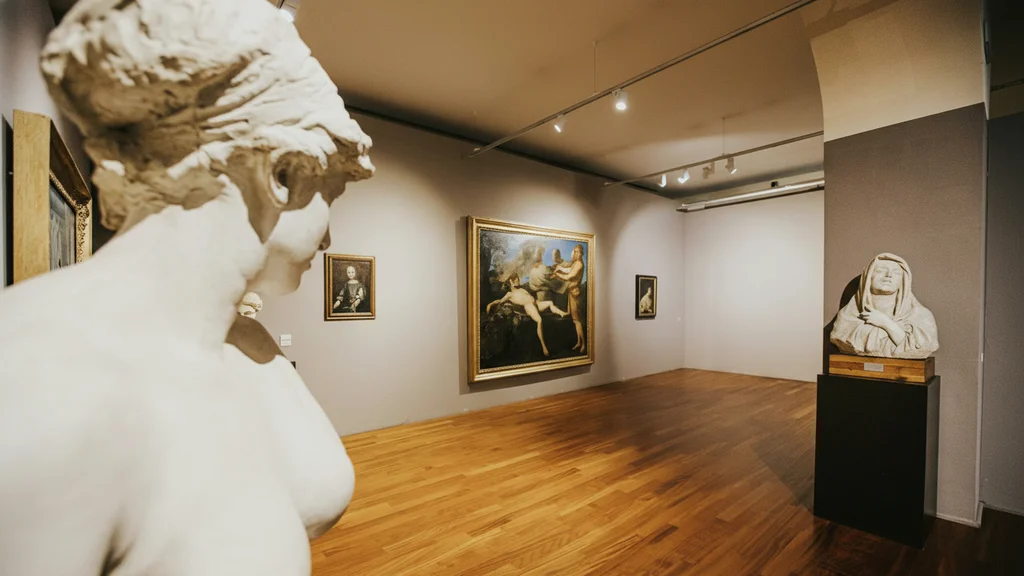
Although MARCA is mainly associated with contemporaneity, its ground floor conceals the Provincial Pinacoteca and Gipsoteca, comprising approximately 120 valuable works. A key place is occupied by the circle of Mattia Preti, known as the Cavaliere Calabrese, whose influence on Baroque art in the region was colossal. Baroque canvases full of dramatic chiaroscuro provide an aesthetic contrast to the minimalist halls of the museum's upper floors.
The 19th century is represented above all by the figure of Andrea Cefaly, a painter and patriot combining verismo with the political passion of the Risorgimento period. The monumental canvas Indipendenza Albanese documents the spirit of the era and the artist's workshop proficiency, being one of the most important points of the historical collection. The Gipsoteca, in turn, allows visitors to acquaint themselves with the work of sculptor Francesco Jerace, a master of the psychological portrait in plaster and marble.
The presence of these works in the modern building is no coincidence, as curators build a narrative of the continuity of the avant-garde. It is suggested that the uncompromising realism of the old masters is the ideological ancestor of Rotella's gestures and contemporary installations. This diachronic model means that contemporary art in Catanzaro grows from deep, historical roots, rather than being merely an imported trend.
Artistic Events at MARCA Museum – Modern Calabria on the International Stage
MARCA Museum in Catanzaro plays a significant role in promoting Calabria on the world cultural map through its intensive exhibition activity. The year 2026 brought the exceptional exhibition Luci Residue: Tracce d'Eternità, curated by Tea Mancuso, which posed questions about the permanence of beauty in an ephemeral world. The event brought together eight masters working in diverse media, from Fiber Art to light sculpture.
MARCA constantly strives to attract the attention of not only local but also foreign creators, organising projects that go beyond the traditional framework of exhibitions. Thanks to cooperation with the Triennale di Milano, the museum has gained a reputation as a centre open to experimental artistic approaches. An important element of the programme was the exhibition Oblatio Mundi, presenting works by 40 creators engaging in dialogue with the sacred and spiritual sphere.
One of the tools promoting regional art is the diverse range of performance exhibitions and multimedia projects, such as Il Volo di Icaro. Such undertakings reflect the dynamic development of Calabria's art scene and draw attention to the multicultural roots of the region. The selection of artists for such projects is often inspired by local heritage, allowing for the construction of a modern identity while respecting the past.
Murals in Diamante – Connecting Contemporaneity with Calabrian Tradition
The murals in Diamante represent a unique connection of contemporary art with the traditional heritage of Calabria. In June 2017, this project attracted over 80 artists who created an impressive collection of more than 300 murals on the historic walls of the town. Each of them depicts elements of the region's history, culture and legends, turning the town into an open gallery accessible to everyone.
The protection of this artistic heritage is a task carried out by local creators, such as Antonino Perrotta. In 2011, the famous mural commemorating the 88th edition of the Giro d'Italia was restored, harmoniously combining sporting history with local legends of Cirelli. Such activities strengthen the position of Diamante as a place where art is an essential element of cultural identity and everyday life.
Mural art significantly contributes to attracting tourists who, during their visits to Calabria, can discover both the MARCA Museum in Catanzaro and the colourful streets of Diamante. The town's community is actively involved in the Associazione Italiana Paesi Dipinti, which promotes local traditions on a broader scale. This project catalyses interest in modern forms of expression, which become a natural extension of the town's historic fabric.
MARCA Open – International Sculpture Park as a Space for Dialogue
One of the most innovative projects associated with the museum is MARCA Open, the International Sculpture Park in the nearby Parco della Biodiversità Mediterranea. The collection comprises 23 works created by leading artists of the global scene, such as Antony Gormley and Michelangelo Pistoletto. This initiative proves that contemporary art can function outside elite salons, becoming part of everyday life.
Gormley's installation Seven Times explores the relationship of the human body with gravity, while Pistoletto's Third Paradise is a manifesto for harmony between nature and technology. The inauguration of works by such masters as Daniel Buren and Wim Delvoye placed Catanzaro alongside the most important sculpture parks in Europe. The synergy between the museum building and the sculpture park creates a unique cultural ecosystem attracting thousands of tourists.
Education and Formation – MARCA as a Laboratory of the Future
From the outset, MARCA Museum has placed emphasis on education, cooperating closely with the Academy of Fine Arts in Catanzaro. The Ceilings project aims to provide advanced training for students through their direct participation in curatorial processes, allowing for the practical education of future cultural professionals. Students participate in developing virtual tours and educational paths, combining traditional museology with modern technologies.
The institution also offers a rich programme for schools, using the learning by doing method. Laboratoria didattiche engage children in experiments with form and material, often drawing on techniques used by Mimmo Rotella. The use of virtual reality allows the youngest visitors to enter the world of images, making art history education an immersive and highly engaging process.
Frequently Asked Questions
What can you see at the MARCA Museum in Catanzaro?
At the museum, you can admire the permanent collection of works by Mimmo Rotella, the Pinacoteca with works from the 16th to 19th centuries (including Mattia Preti and Andrea Cefaly) and the Gipsoteca. Additionally, the museum organises numerous temporary exhibitions by world-renowned contemporary artists.
How much does a ticket to the MARCA Museum cost?
The standard ticket price is usually between EUR 3.00 and EUR 6.00, depending on current temporary exhibitions. Reduced tickets are also available at approximately EUR 2.00 for students and groups.
What exhibitions does the MARCA Museum offer?
The museum offers permanent exhibitions dedicated to regional heritage and Mimmo Rotella, as well as a dynamic programme of temporary exhibitions such as Luci Residue and Autorotella. The institution also promotes contemporary photography and sculpture through the MARCA Open project.
What are the museum's opening hours?
The museum is usually open from Tuesday to Sunday, 09:30–13:00 and 15:30–20:00. The institution is closed to visitors on Mondays.
Is the museum accessible for people with disabilities?
Yes, the historic building has undergone thorough revitalisation and is fully adapted to the needs of people with disabilities, offering modern lifts and appropriately designed exhibition spaces.