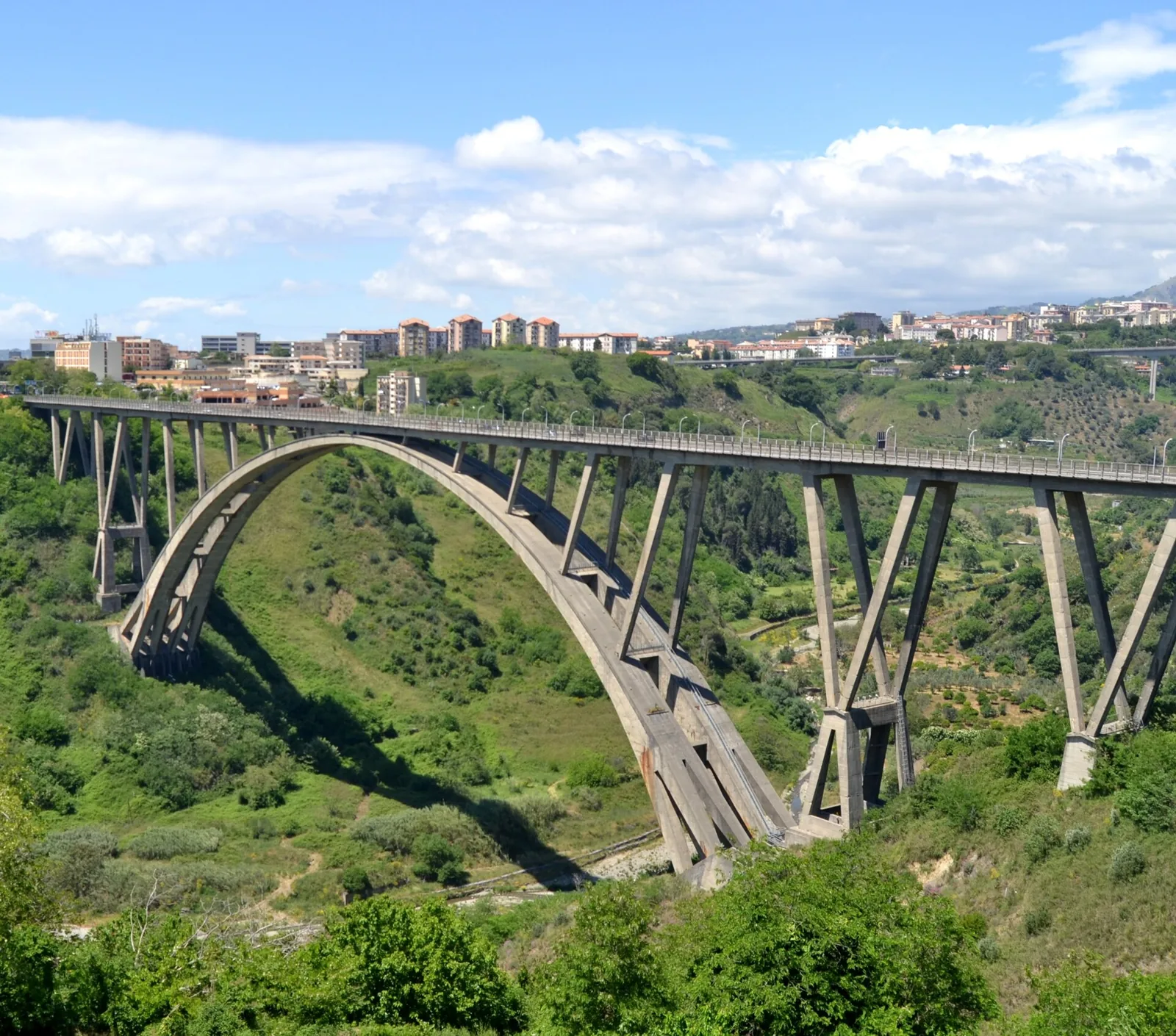
The Bisantis Bridge, also known as Viadotto Bisantis, is one of the most distinctive structures in southern Italy. It rises above Catanzaro, Calabria, spanning the Fiumarella stream valley. It serves not only as a vital element of road infrastructure but also as a striking feature in the city's panorama. The opening of the structure in 1962 was an important moment in the history of Catanzaro's infrastructure.
The bridge was designed by Riccardo Morandi, and its construction was a response to a very specific urban problem: the need to connect the historic centre with newer districts on the other side of the deep valley. The name "Viadotto Fausto Bisantis" commemorates Fausto Bisantis, an important politician from Catanzaro and a champion of the investment. This is precisely why the bridge is more than an impressive structure here – it became an instrument of real change in the city's layout.
Table of Contents
Viadotto Bisantis – A Key Link in Calabria's Urban Transport
Viadotto Bisantis plays an important role in Catanzaro's transport system because it makes it possible to cross the deep Fiumarella valley without a long detour. It lies on the SS 109 bis/dir and connects central Catanzaro with the Strada dei Due Mari and the northern and north-western parts of the city, including the Mater Domini and Gagliano areas. It has a single carriageway divided into three lanes, so it is first and foremost an active element of the urban road network. The concept of connecting different parts of the city over the Fiumarella valley was born in the post-war period, aiming to break the geographical isolation of the historic centre.
Bus Connection Network
Buses of the AMC Catanzaro municipal network stop near Viadotto Bisantis, providing convenient access from various parts of the city. The extensive public transport network makes it easier for both residents and tourists to get around this hilly terrain.
Regional Transport Connections
The main railway stations served by Trenitalia are Catanzaro (in the Germaneto district) and Catanzaro Lido, on the Ionian coast, but both lie some distance from the historic centre and the viaduct. Closer to the centre, in the San Leonardo district, is the Catanzaro Città station on the narrow-gauge Ferrovie della Calabria line, from where the historic heart of the city can also be reached by the local funicular railway, which links the lower town with Piazza Roma.
Impact on Tourism and the Local Community
The location of Viadotto Bisantis and its role in the city's layout make it not only an important part of daily life for residents but also a natural landmark for visitors. Thanks to it, Catanzaro is easier to navigate on the ground, and the Fiumarella valley is no longer the barrier that once divided the city's development. This is infrastructure that truly changed local everyday life: it shortened journeys between parts of the city and added one of the most recognisable features to Catanzaro's skyline.
Watch on YouTube
Architecture and Engineering Precision – The Remarkable Construction of Viadotto Bisantis
The Bisantis Bridge in Catanzaro is an example of bridge architecture combining 1950s aesthetics with advanced engineering. Created by the distinguished Italian engineer Riccardo Morandi, it combines elements of minimalism with the raw expression of structure. Viadotto Bisantis is one of Morandi's most important works in Calabria, and at the same time a structure where form derives directly from function.
Style and Form
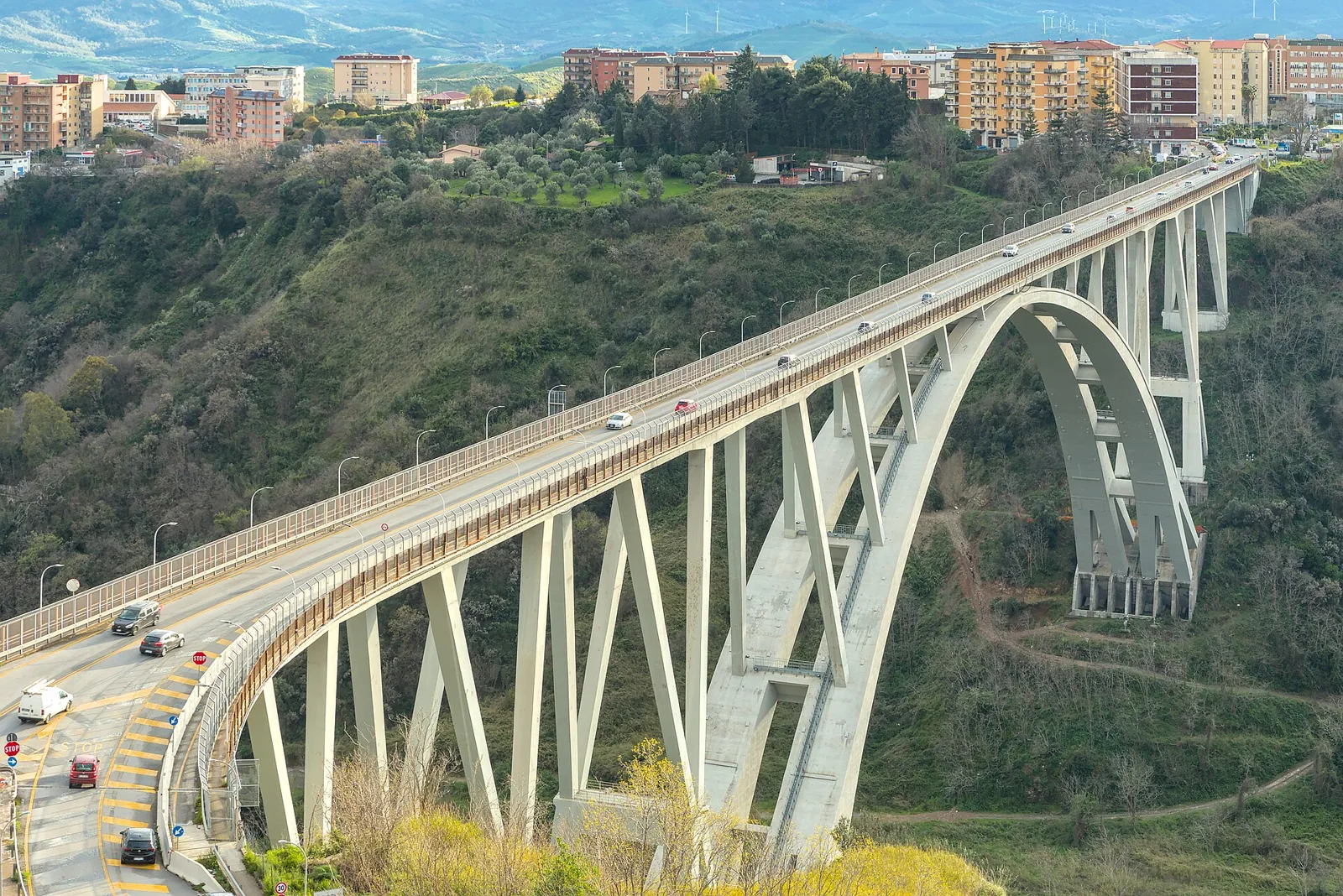
Viadotto Bisantis belongs to the modernist tradition of engineering architecture, where the main emphasis was placed on the clarity of the load-bearing system. The bridge is distinguished by its slender and dynamic line, well suited to the landscape of the Fiumarella valley. Concrete, left in its natural form, emphasises the restrained, decisive character of this structure.
Engineering Structure and Parameters
Viadotto Bisantis is a mighty arch bridge built in reinforced concrete. The main arch with a span of 231 metres is the most important element of the entire structural composition. When it opened in 1962, it was the second single-span reinforced concrete arch bridge of this size in the world and in Europe, after Sweden's Sandö Bridge. The scale of the structure reveals itself best when viewed from the opposite side of the valley. Below are the key technical specifications.
| Technical Parameter | Value |
|---|---|
| Total length | 468.25 m |
| Deck height above valley floor | 112 m |
| Arch span | 231.00 m |
| Deck width | 12.50 m |
Construction and the Record-Breaking Centering
The construction of the viaduct was a major technical challenge due to the difficult topography and the scale of the valley. Riccardo Morandi (1902–1989) was one of Italy's most renowned 20th-century engineers, specialising in reinforced and prestressed concrete structures, which is why Viadotto Bisantis remains among his important southern Italian realisations. It is also one of Morandi's most recognisable works in all of Calabria.
The construction used centering around 120 m high, which in 1962 was the largest structure of its kind in the world. It had to withstand gusts of wind exceeding 140 km/h, which gives a clear sense of the scale of the work carried out above the Fiumarella valley. Around 450 km of steel tubes and 245,000 joints were used to build it, so the temporary support system was almost as impressive as the viaduct's arch itself.
The Role of Viadotto Bisantis in Calabria's Culture and Tourism
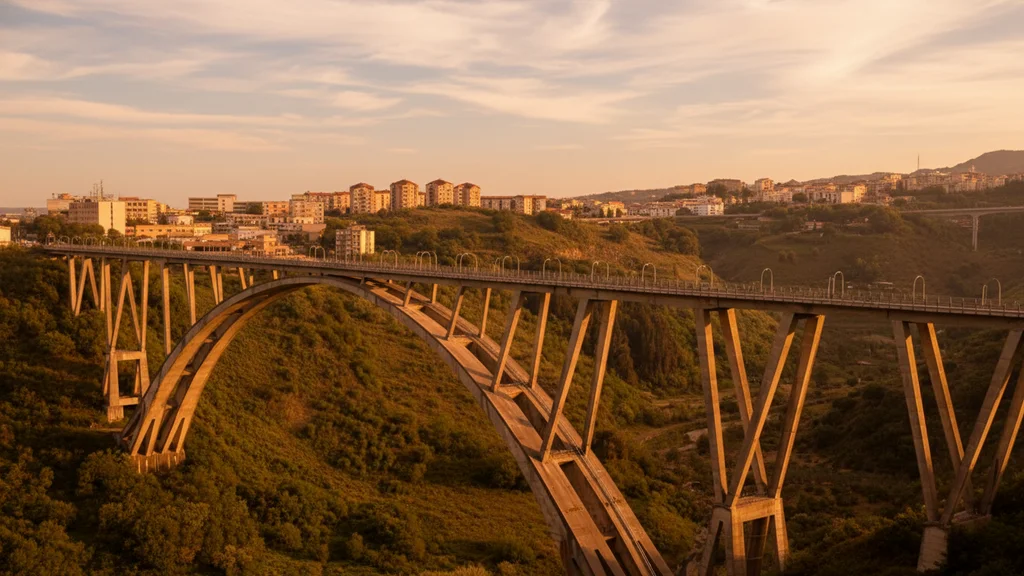
Viadotto Bisantis is not only an important element of road infrastructure but also an architectural icon of Catanzaro. Thanks to its structure and its position above the Fiumarella valley, it attracts the attention of residents and visitors because it clearly shows how demanding the city's topography is. The structure's name commemorates Fausto Bisantis, an important politician from Catanzaro and a champion of the investment.
The dedication to Fausto Bisantis came only years after the viaduct opened. The illumination of the arch was inaugurated on 12 October 2001, and in 2002, on the 40th anniversary of the construction, the bridge was dedicated to the memory of Fausto Bisantis, former president of the province and senator. This is an important detail because it shows that today's name is part of the city's later memory of the project.
Viadotto Bisantis is one of the most recognisable features of Catanzaro's panorama and ranks among the most important works of 20th-century engineering in Calabria. Its significance stems not only from its technical parameters but also from the fact that it physically overcame the barrier of the Fiumarella valley, which for decades hindered the development of a coherent urban fabric. This is precisely why for the locals it is not just a bridge but one of the city's symbols.
From a tourist's perspective, it is worth remembering that this is a road structure, not a classic attraction with a ticket office – there are no admission tickets or elaborate visitor facilities. The best way to experience it is from viewpoints around Catanzaro, or simply by driving or walking through the area, focusing on the panorama of the Fiumarella valley and the silhouette of the structure. A good observation point is the terrace by the Complesso Monumentale San Giovanni in central Catanzaro, where you can see the city panorama and frame the viaduct in its urban context. A brief viewpoint stop typically takes 15–30 minutes; with the journey and a stroll around central Catanzaro, allow 1–2 hours.
Thanks to Viadotto Bisantis, the city of Catanzaro has become more legible and accessible even for those visiting only briefly. The viaduct nicely combines an urban experience with a landscape one – on the one hand it is part of everyday traffic, on the other it offers one of those views that best explain the city's topography. This is a place worth seeing not for its "interior" but for its scale, light, and the relationship between the bridge and the valley.
The Architecture of Viadotto Bisantis Among European Viaducts
Viadotto Bisantis, located in the heart of Italian Calabria, is an interesting reference point when discussing 20th-century European bridges. Rather than relying on uncertain rankings, it is better to view it through the lens of construction type and the solution Morandi employed. It is a reinforced concrete arch bridge with a single large arch spanning approximately 231 m, which makes it stand out not only for its scale but also for the clarity of its form.
Comparison with Innovative Structures in Europe
From a comparative perspective, the Millau Viaduct in France remains one of the most important points of reference, but it represents a completely different type of structure. Millau is a cable-stayed bridge from 2004, and the often-cited 343 m refers to the height of the pylon, not the height of the roadway above the terrain. By contrast, Calabria's own Viadotto Italia, on the A2 motorway, is famous for its record height above the valley floor (259 m), while Bisantis is best understood as an outstanding example of a Morandi reinforced-concrete arch bridge.
- Construction type – Bisantis is a reinforced concrete arch bridge with a very clear, unified form.
- Arch scale – a single arch spanning approximately 231 m gives the structure exceptional visual impact.
- European context – compared with structures such as Millau or Viadotto Italia, it stands out not through rankings but through a different structural logic.
Conclusions from Comparisons
Analysing various European viaducts, Viadotto Bisantis stands out above all for the coherence between its engineering solution and the city's landscape. It does not need to compete through superlatives to remain one of Calabria's most characteristic bridges. This is a structure best remembered not from a record table but from the view suspended above the Fiumarella valley.
Frequently Asked Questions
What is the height and length of the Bisantis Bridge in Catanzaro?
The bridge has a total length of 468.25 metres, and its deck rises to a height of 112 metres above the floor of the Fiumarella stream valley.
Is the Bisantis Bridge the tallest viaduct in Europe?
No. Italy's tallest viaduct is the Viadotto Italia (259 m) on the A2 motorway, also in Calabria. Viadotto Bisantis (112 m) is instead one of the most important and largest reinforced-concrete arch bridges in Europe, opened in 1962.
Who designed the Bisantis Bridge in Catanzaro?
The principal designer was the distinguished Italian engineer Riccardo Morandi, known for his work in reinforced and prestressed concrete construction.
How can I reach the vicinity of the viaduct by public transport?
The historic centre of Catanzaro is best reached by local Ferrovie della Calabria trains (Catanzaro Città station) or by the municipal funicular railway from the lower town. AMC Catanzaro city buses serve the city itself, including the area around Viadotto Bisantis.
Is the bridge structure safe after the Genoa disaster?
Yes. The structure is under constant structural monitoring (including a radar system for remote displacement measurement) and undergoes regular inspections and load tests carried out by the road authority ANAS, as well as a cycle of technical acceptance certifications following renovation work. For tourists, the key point is that the bridge remains an active element of Catanzaro's urban road network.
Nearby
Sources
The information in this article was verified against the following sources:
- censimentoarchitetturecontemporanee.cultura.gov.it – censimentoarchitetturecontemporanee.cultura.gov.it
- Intermodalità Catanzaro Città | Trenitalia – trenitalia.com
- La storia del Ponte Morandi di Catanzaro – rainews.it
- Wikipedia – Ponte Bisantis – it.wikipedia.org
- Wikipedia – Riccardo Morandi – en.wikipedia.org
- Wikipedia – Stazione di Catanzaro Città – it.wikipedia.org
- Wikipedia – Funicolare di Catanzaro – it.wikipedia.org
- Wikipedia – Viadotto Italia – it.wikipedia.org
Last updated: