Catanzaro Cathedral, known as Duomo Santa Maria Assunta, is one of the most important sacred sites in Calabria. Although less well known than some other Italian cathedrals, it plays a crucial cultural and religious role in the region. Its dedication to the Assumption of Mary and to Saints Peter and Paul is part of the widespread Marian devotion in this part of Italy. In this article, we take a closer look at the fascinating history of this site, its architecture and its enormous significance for the local community and tourists visiting Calabria.
Catanzaro Cathedral – A Testament to Medieval Architecture and Spirituality
Known as Duomo Santa Maria Assunta, Catanzaro Cathedral is not only the main point of reference for the Catholic community in the Calabria region, but also one of the most important places of Marian worship in Italy. Its roots date back to the 11th century, when it was originally erected during Norman times, around 1100. A pivotal moment for the church was the visit of Pope Callixtus II in 1121, who solemnly inaugurated the cathedral, sanctioning its role as the spiritual centre of the territory.
Over the centuries, the cathedral served as a guardian of memory, witnessing many historical events and cultural transformations. In 1309, a chapel was built in honour of St Vitaliano, which was associated with the building's transition to a Latin cross plan. Today, the cathedral is the resting place not only of St Vitaliano, but also of Saints Fortunatus and Irenaeus, creating a unique bridge between Byzantine and Latin heritage.
It survived numerous destructions, including the devastating earthquake of 1783, which ruined much of its original structure. The reconstruction, completed between 1837 and 1847 under the direction of architect August Schwarz, restored the cathedral's splendour in a Baroque style with neoclassical elements. Today, the cathedral's interior impresses with its wealth of detail, such as frescoes and historic altars, which are precious testimonies of past eras, despite the traumatic events of the 20th century.
The cathedral's significance for the Archdiocese of Catanzaro-Squillace cannot be overstated. It is regarded as a symbol of the diocese's spiritual unity, being the venue for major liturgical events and pilgrimages. The cathedral is the central place of worship for the miraculous image of the Madonna di Mezzogiorno, which has been canonically crowned since 1797, testifying to the living Marian devotion among local faithful.
| Year / Period | Key Historical and Architectural Event |
|---|---|
| c. 1100 | Foundation of the original cathedral in the Romanesque (Norman) style. |
| 1121 | Solemn inauguration by Pope Callixtus II. |
| 1309 | Construction of the Chapel of St Vitaliano and change to Latin cross plan. |
| 1511 | Creation of the Renaissance facade (destroyed in 1638). |
| 1783 | Catastrophic earthquake and the "Baracche" period (temporary worship). |
| 1943 | Allied bombing destroying a significant part of the structure. |
| 1960 | Completion of post-war reconstruction designed by Vincenzo Fasolo. |
Architectural Features of Duomo Santa Maria Assunta in Catanzaro
Architectural Characteristics of the Cathedral
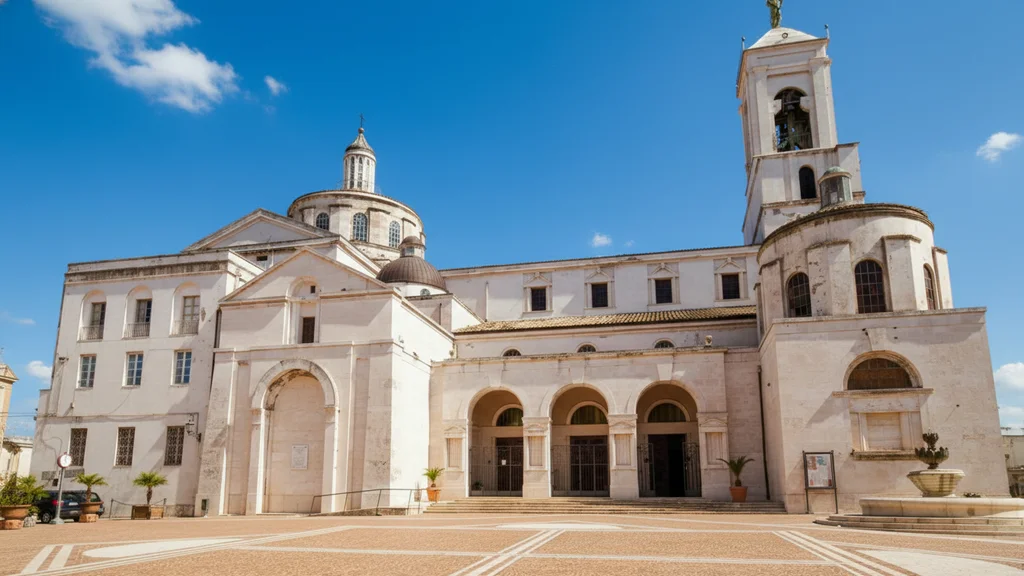
Duomo Santa Maria Assunta in Catanzaro is an architectural palimpsest, in which layers of history overlap in an extraordinarily complex manner. The current structure is the result of the post-war reconstruction of 1954–1960, entrusted to architects Vincenzo Fasolo and Franco Domestico. Fasolo, drawing on Roman and Michelangelesque traditions, created a building of austere, white surfaces, which some critics regard as anachronistic rationalism.
The current layout preserves the orientation and tri-apsidal plan of the original, but the central placement of the bell tower on the facade significantly altered the former proportions. The cathedral's interior is divided into three naves by massive square pillars, creating a monumental space, though cooler in feel than the former Baroque ornamentation. The use of reinforced concrete in the 1950s unfortunately became the cause of structural problems that led to the church's closure in 2018.
History and Cultural Context
Italian churches were often designed with liturgical practices and local traditions in mind, which contributes to their unique character. In the case of Catanzaro, each reconstruction was a response to trauma – from earthquakes to the carpet bombing of 27 August 1943. The current renovation project (2024–2026), valued at over 9 million euros, envisages "slimming down" the construction by replacing heavy concrete with steel and modern metal fabrics.
Cultural and Spiritual Value
Catanzaro Cathedral, as the principal church of the archdiocese, holds enormous significance for the local community. Even after radical architectural changes, this building remains one of the key monuments, essential for understanding the region's heritage. Tourists visiting the city can admire the Renaissance sculpture of the Madonna and Child by Antonello Gagini, which is one of the most precious works of art in all of Calabria.
Madonna di Mezzogiorno – The Cult of Our Lady at the Centre of Catanzaro's Spiritual Life
At the heart of Catanzaro lies a unique object of Marian devotion – the Madonna di Mezzogiorno. This venerated image of Our Lady has its roots reaching back to the Middle Ages and was canonically crowned by Pope Pius VI around 1797. This cult is inseparably linked with the city's identity, and the figure itself serves as a point of reference for thousands of faithful throughout the archdiocese.
Origin and Legend
According to local tradition, the church's history is connected with a remarkable legend of a young woman appearing at noon in the cathedral square. This figure, identified with Mary, was said to distribute bread and figs to the poorest, which became the foundation of the name "Madonna of the South". This tale became woven into the spiritual landscape of the city, becoming part of Catanzaro's local religious identity and traditions.
Religious and Cultural Significance
Catanzaro's Duomo, as the centre of the cult of the Madonna di Mezzogiorno, has served for centuries as a spiritual refuge for residents. Contemporary renovation works aim to restore the splendour of this site, including the unique dome, which through a new zenithal lighting system is intended to symbolically connect the sacred sphere with the faithful gathered in the presbytery. This investment reflects the community's ongoing commitment to maintaining this historic site as a living centre of worship.
The Most Important Santa Maria Assunta Cathedrals in Italy – Treasures of Architecture and Art
Cathedrals dedicated to Santa Maria Assunta in Italy constitute significant points on the country's cultural map. Among them, the cathedral in Siena stands out as a stunning architectural masterpiece. The interior of the Siena cathedral contains the famous marble floor inlays, on which the most distinguished Tuscan artists worked over several centuries.
Siena Cathedral – The Marble Pride of Tuscany
Located on the Piazza del Duomo in Siena, this cathedral captivates with its Romanesque-Gothic style. The Piccolomini Library, decorated with frescoes by Pinturicchio, is particularly noteworthy. Like in Catanzaro, Siena's cathedral is the heart of the city's identity, though its scale and richness of decoration place it among the world's most important monuments.
An Architectural Marvel in Pisa – The Cathedral and the Leaning Tower
In Pisa, on the famous Piazza dei Miracoli, stands another impressive cathedral, Santa Maria Assunta. Built in the Romanesque style as early as the 11th century, it sits alongside the legendary Leaning Tower. The architecture of this church influenced numerous sacred buildings across the Mediterranean basin, including indirectly the early Romanesque forms once present in Calabria.
Lesser Known but Equally Important Cathedrals
Away from the main tourist routes, one can discover smaller cathedrals, such as the one in Tropea, dedicated to Santa Maria Assunta in Cielo. The Duomo in Catanzaro's belonging to this group testifies to the deep Marian devotion throughout Italy. Although Catanzaro's cathedral underwent a painful modernisation, its spiritual rank remains equal to the most renowned basilicas of the north.
Frequently Asked Questions
What is worth seeing in Catanzaro Cathedral?
The most important treasures include the Renaissance statue of the Madonna and Child by Antonello Gagini, the Stations of the Cross cycle by Alessandro Monteleone and the miraculous image of the Madonna di Mezzogiorno. The monumental Ruffatti organ from 1959 is also noteworthy.
What is the history of Santa Maria Assunta Cathedral in Catanzaro?
The cathedral's history dates back to around 1100 (Norman times). The church was repeatedly destroyed by earthquakes (including in 1638 and 1783) and bombing in 1943, after which it was almost entirely rebuilt in a modern style in 1960.
What are the opening hours of Catanzaro Cathedral?
The cathedral is currently undergoing a thorough process of restructuring and seismic reinforcement (works planned for 2024–2026). Before visiting, check the latest communications from the Archdiocese of Catanzaro-Squillace regarding interior accessibility for visitors.
Who was St Vitaliano to Catanzaro Cathedral?
St Vitaliano is the patron saint of the city of Catanzaro. His relics were transferred to the cathedral in the Middle Ages, and in 1309 a special chapel was dedicated to him, which became the centre of local patronal worship.
Why was the cathedral closed from 2018?
The closure was necessitated by serious structural stability problems with the reinforced concrete used during the post-war reconstruction. The modern renovation project envisages replacing these elements with lighter steel constructions to ensure seismic safety.