The Bisantis Bridge, also known as Viadotto Bisantis, is one of the most distinctive structures in southern Italy. Located in the Calabria region, it serves not only as a vital element of road infrastructure connecting key parts of the region, but also as an attractive tourist destination. The ceremonial opening of the structure in 1962 redefined the boundaries of construction possibilities, making it an essential stop on any trip to Catanzaro.
Viadotto Bisantis – A Key Link in Calabria's Urban Transport
Viadotto Bisantis plays a fundamental role in Catanzaro's transport system, integrating various forms of communication in the Calabria region. As a central transport hub, it connects the most important urban and regional arteries, making it a strategic element of road infrastructure. The concept of connecting the western part of the city with the Due Mari trunk road was born in the post-war period, aiming to break the geographical isolation of the historic centre.
Bus Connection Network
In close proximity to Viadotto Bisantis, there are many bus stops, greatly facilitating the use of public transport for residents and tourists alike. Main stops include Benny Hotel, Via De Filippis and Viale Barlaam Da Seminara. The viaduct is served by numerous bus lines, including the popular lines 1, 2, 3, 4, 5, 6, 28, 44 and 54, which offer connections to the Kennedy, Giovino and Magna Grecia terminals. This ensures convenient access to the most important points in Catanzaro, such as Unical (University of Calabria), and further afield, including destinations like Mangone and Camigliatello Silano.
Regional Transport Cooperation
Beyond local buses, Viadotto Bisantis supports a comprehensive regional transport system, cooperating with operators such as AMACO, AMC, Autolinee Romano and Trenitalia. This enables passengers to easily reach larger centres like Reggio Calabria and Locri, as well as other attractive destinations in Calabria. This is particularly important for travellers who wish to explore the charms of the region and take advantage of its diverse tourist attractions.
Impact on Tourism and the Local Community
The location of Viadotto Bisantis near well-known tourist sites and its role as a major transport hub make it not only an indispensable element of residents' daily life but also an excellent starting point for exploring the surroundings. Thanks to it, Catanzaro and all of Calabria are more accessible to visitors, fostering the development of tourism and the local economy. In 1963, the viaduct became the backdrop for scenes in the film La ballata dei mariti, permanently inscribing it in Italian popular culture.
Architecture and Engineering Precision – The Remarkable Construction of Viadotto Bisantis
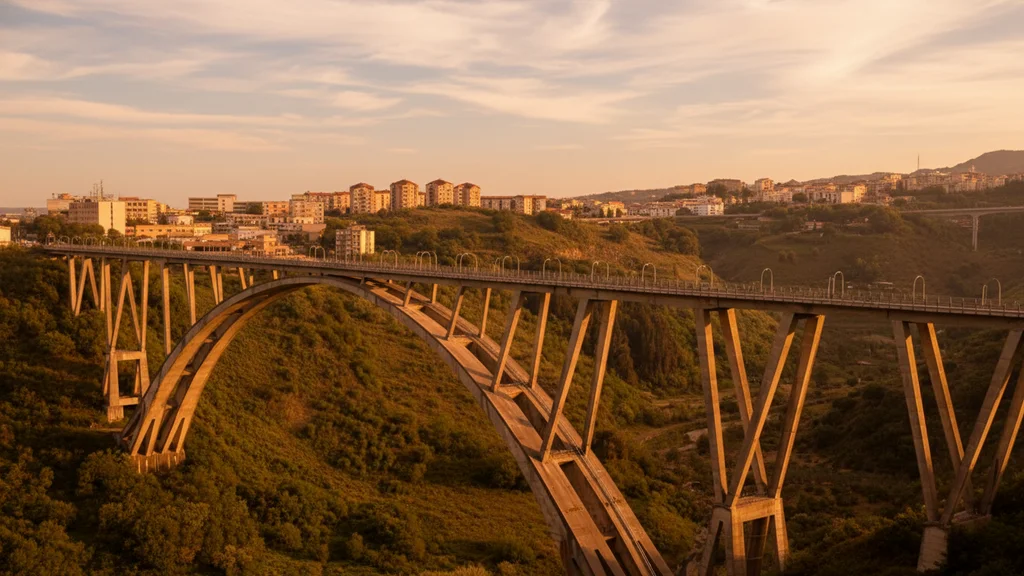
The Bisantis Bridge in Catanzaro is an example of bridge architecture mastery combining 1950s aesthetics with advanced engineering. Created by the distinguished Italian engineer Riccardo Morandi, it combines elements of minimalism with the raw expression of structure. Viadotto Bisantis is considered Morandi's crowning achievement in the field of arch bridges, where every element serves a precise structural function.
Style and Form
Viadotto Bisantis belongs to the modernist tradition of engineering architecture, where the main emphasis was placed on visible load-bearing structures. The bridge is distinguished by its slender and dynamic line, seamlessly harmonising with the mountainous landscape of Calabria. The characteristic "oblique pillars" (ritti obliqui), inclined at an angle of approximately 15 degrees, became the designer's recognisable signature. Concrete, left in its natural form, emphasises the minimalist character of this monumental structure.
Engineering Structure and Parameters
Viadotto Bisantis is a mighty arch bridge utilising concrete and high-carbon steel. The main arch with a span of 231 metres was designed to work almost exclusively in compression, minimising the risk of cracking. Below are the key technical specifications of this structure.
| Technical Parameter | Value |
|---|---|
| Total length | 468.25 m |
| Deck height above valley floor | 112.00 m |
| Arch span | 231.00 m |
| Deck width | 12.50 m |
| Inclination of oblique supports | 15° |
Construction and the Record-Breaking Centering
The construction process, carried out between 1959 and 1961 by the firm Sogene, was a technological challenge due to the difficult topography. The metal centering used to support the arch reached a height of over 120 metres, which was a world record at the time for temporary structures. When settling after the removal of supports, the arch keystone dropped by only 75 mm, confirming the brilliant precision of the engineering calculations.
The Role of Viadotto Bisantis in Calabria's Culture and Tourism
Viadotto Bisantis is not only an important element of road infrastructure but also an architectural icon that plays a significant role in the culture and tourism of the Calabria region. Thanks to its impressive construction and strategic location, it attracts the attention of both residents and visitors. In 2002, the viaduct was officially named after Fausto Bisantis, the then president of the province and promoter of the investment.
The viaduct, also known as ponte Bisantis Catanzaro, is an inseparable element of the city's panorama. Located in close proximity to numerous attractions, it enables tourists convenient access to various parts of Calabria. Its architecture provides an excellent backdrop for many photographs that promote the beauty of the local landscape. The structure has been listed in the Italian architecture registry from 1945 to the present day, confirming its status as a national cultural asset.
The Bisantis Bridge is also part of the region's cultural heritage. Its construction posed a challenge for engineers, making it one of the most interesting examples of modern technical thought in 20th-century Europe. It has permanently inscribed itself in the history of Catanzaro as a symbol of technological progress and the determination of the local community in overcoming difficulties related to terrain. In December 2025, a new LED artistic illumination was planned to highlight the monumental lines of the bridge after dark.
Thanks to Viadotto Bisantis, the city of Catanzaro has become more attractive to tourists seeking not only views but also experiences connected with local culture. The viaduct is part of numerous tourist routes, connecting towns and villages of Calabria, making it an excellent base for excursions. From the vicinity of Viadotto Bisantis, one can admire not only the panorama of Catanzaro but also the picturesque hills and valleys that make this area exceptional.
The Architecture of Viadotto Bisantis Among European Viaducts
Viadotto Bisantis, located in the heart of Italian Calabria, is not only a symbol of engineering but also a significant point of comparison with other European viaducts. Although considered a masterpiece, its height and length raise questions in the context of rankings of the tallest and longest viaducts on our continent. In 1962, Bisantis was the tallest concrete arch bridge in the world, which continues to impress specialists to this day.
Comparison with Innovative Structures in Europe
From a comparative perspective, the Millau Viaduct in France remains one of the most important points of reference. This steel cable-stayed bridge from 2004, with a height of 343 metres, surpasses Bisantis in terms of parameters. Nevertheless, Bisantis remains the third-tallest arch bridge in Europe, yielding only to structures such as the Pont du Gueuroz.
- Monolithic construction – unlike prefabricated bridges, Bisantis was built using the continuous in-situ concreting method.
- Seismic safety – the three-hinged arch system provides excellent static characteristics in the challenging conditions of the Apennines.
- Modern monitoring – the installed Structural Health Monitoring system analyses the bridge's dynamic response in real time.
Conclusions from Comparisons
Analysing various European viaducts, Viadotto Bisantis stands out above all for its adaptability and durability. Although taller structures such as Viadotto Italia (259 m) exist, Bisantis plays a special role as a unique example of a pure concrete arch. A modernisation programme worth 3.4 million euros carried out in recent years provided the structure with cathodic protection and structural reinforcement, ensuring its safety for decades to come.
Frequently Asked Questions
What is the height and length of the Bisantis Bridge in Catanzaro?
The bridge has a total length of 468.25 metres, and its deck rises to a height of 112 metres above the floor of the Fiumarella stream valley.
Is the Bisantis Bridge really the tallest viaduct in Europe?
At the time of its opening in 1962, it was the tallest concrete arch bridge in the world. It currently ranks third in Europe in its structural category (arch bridges).
Who designed the Bisantis Bridge in Catanzaro?
The principal designer was the distinguished Italian engineer Riccardo Morandi, known for his innovative approach to prestressed concrete construction.
Which bus lines serve the vicinity of the viaduct?
The viaduct is served by numerous city lines, including 1, 2, 3, 4, 5, 6, 28, 44 and 54, connecting the centre with transport terminals.
Is the bridge structure safe after the Genoa disaster?
Yes, rigorous inspections were carried out after 2018. Unlike the Genoa bridge, Bisantis is a stable concrete arch that has undergone thorough modernisation and has a permanent monitoring system.