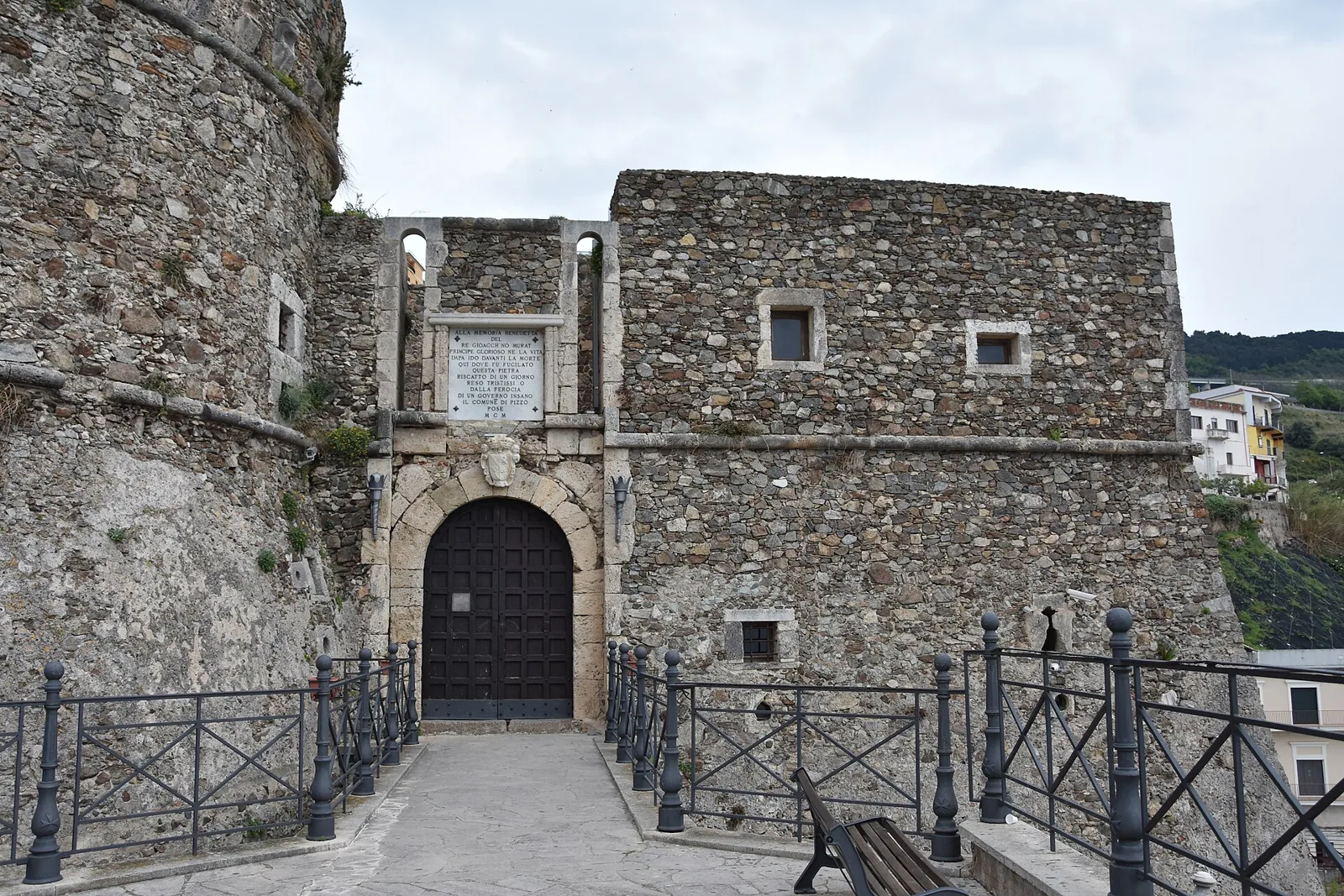
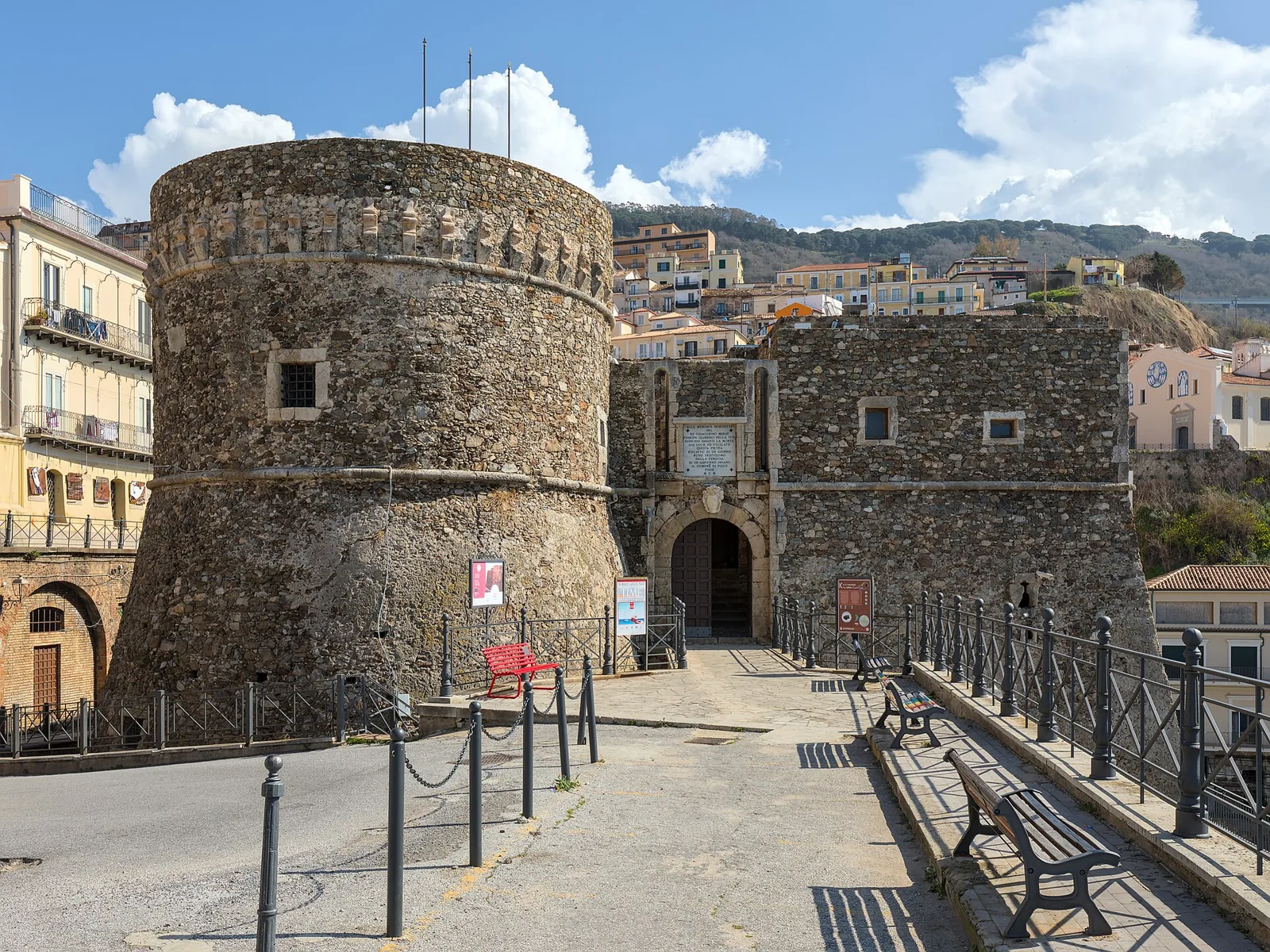
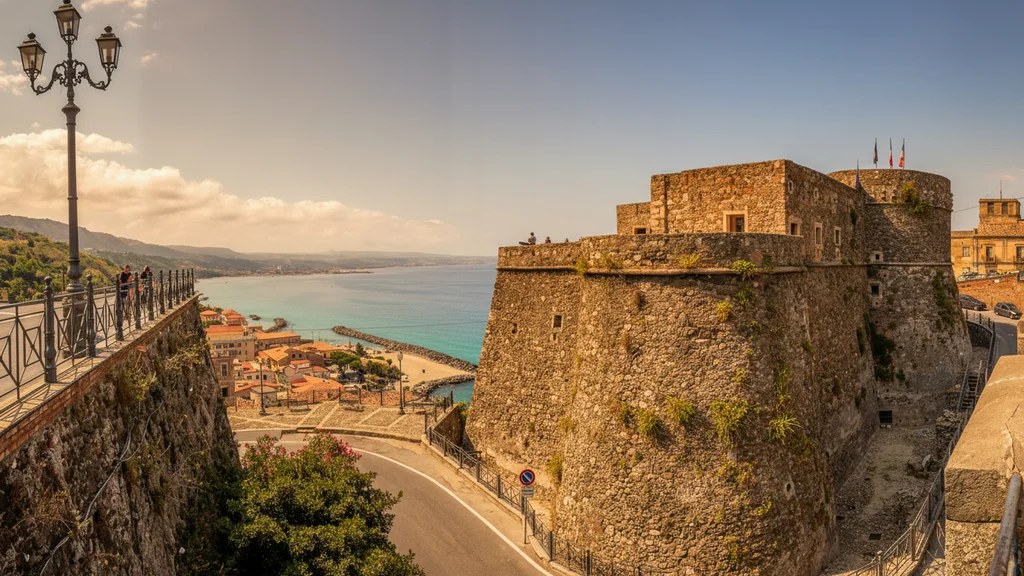
Castello Murat is a 15th-century Aragonese fortress known as the site of the imprisonment, trial and execution of Joachim Murat – Marshal of France, Napoleon’s brother-in-law and King of Naples. The castle overlooks the sea in the heart of Pizzo, and its walls house a museum dedicated to the king’s final days.
Table of Contents
History of the castle – from fortress to execution site
The building goes back to the Middle Ages: its oldest part is a watchtower (Torre Mastia) from the late 14th century, part of a chain of coastal towers built against Saracen pirate raids. As the raids continued under the Aragonese, King Ferdinand I of Naples (Ferrante), of the Aragonese dynasty, ordered the fortress to be strengthened by a decree of 12 November 1480 – walls, a central block and a small guard tower were added. The castle was never a noble residence, but a fortification and prison guarding the Tyrrhenian coast in this part of Calabria.
Joachim Murat was King of Naples from 1808 to 1815. After Napoleon’s fall he tried to hold on to power, and in March 1815 issued the so-called Proclamation of Rimini, calling on Italians to fight against Austria. After his Neapolitan forces were defeated at Tolentino on 2–3 May 1815, he fled and in the autumn made one more, already desperate, attempt to reclaim his throne.
For centuries the castle served military and prison functions, but the events of October 1815 etched it permanently into European history. His expedition from Corsica was meant to land near Salerno, but a storm drove the ships to Calabria, and on 8 October 1815 Murat and a handful of supporters came ashore in the harbour of Pizzo, hoping for popular support. Instead, he was arrested by the Bourbon gendarmerie under Captain Trentacapilli and locked in the castle prison.
A military tribunal convened almost immediately. The trial was summary in nature, and the death sentence was passed very quickly. On 13 October 1815, Murat faced the firing squad in the castle courtyard. According to accounts, he refused a blindfold and gave the order to fire himself; his last words are most often quoted as “Spare the face, aim for the heart. Fire!” (Mirate al petto, non al viso). He was 48 years old.
The name Castello Murat became attached to the fortress much later. Murat did not build the castle – the structure had already been a coastal defensive fortress for centuries. It was his imprisonment, trial and execution that made this former watchtower known across Europe.
Watch on YouTube
The Murat Museum – what to see inside
The castle houses the Museo Murattiano, a small history museum. The exhibition focuses on Murat’s stay in Pizzo in October 1815, his trial, the final letter to Caroline Bonaparte and the execution. Mannequins in period costume recreate Murat’s last days. It is not a large military museum but a place of memory that fits well into a walk through the old town.
Semi-underground cells – a long, narrow corridor leads to the cells where Murat and soldiers of his expedition were held. The stone interiors and thick walls are a reminder that the building was above all a fortress and prison.
Trial room and Murat’s cell – on the first floor you can see the reconstructed room of the summary trial and the cell where Murat spent his last moments: he made his confession to Canon Masdea and wrote, in French, a farewell letter to his wife Caroline Bonaparte and their four children.
Execution courtyard – where the shots were fired. A plaque marks the spot, and the walls look out over the Gulf of Sant’Eufemia.
Exhibition hall – trial documents, copies of correspondence and period memorabilia. The highlight is a marble helmet – the only surviving fragment of a statue of King Ferdinand IV of Bourbon, about 5 m tall and dressed as a Roman commander, by Antonio Canova. It stood in Pizzo until 1860, when a Garibaldian unit stationed in the town destroyed it.
Practical information
Detail |
Information |
|---|---|
Address |
Via P. Marincola, Pizzo (VV) |
Access |
Historic centre of Pizzo, a few minutes' walk from Piazza della Repubblica |
By train |
Pizzo station (regional trains only, on the line via Tropea) is about 2 km south of the centre – about 1.6 km and 20 minutes on foot, uphill; from Vibo Valentia-Pizzo station (Intercity, Frecciarossa, Italo) it is about 3.5 km on foot – take a taxi |
From Lamezia Terme Airport |
Approx. 30 km, by car usually 25–35 minutes |
By car |
A2 motorway, Pizzo exit, then follow signs to the historic centre; in summer, parking in the centre can be difficult |
Visit duration |
Usually 30–60 minutes |
Before visiting, it is best to check current opening hours and prices directly with the site operator, as these are details that can change. In October, the castle is sometimes also the setting for a rievocazione storica, a historical re-enactment with costumed extras connected with the anniversary of Murat’s landing and execution. According to ENIT, the event is organised every 4 years, so if you are planning an autumn stay in Pizzo, check whether an edition falls during your visit.
The fortress itself is a historic building with thick walls and stairs, so full barrier-free access may be limited. If travelling with a pushchair or requiring accessibility, it is best to confirm conditions with the site operator before arrival. The castle stands in the old part of town – expect slopes, stairs and uneven surfaces typical of Pizzo’s historic centre.
It is worth combining the visit with the Church of San Giorgio Martire in central Pizzo, where Murat’s body was laid in a common grave in the crypt; a slab in the floor in the middle of the nave marks the burial. After your visit, the perfect ending is a tartufo di Pizzo on Piazza della Repubblica.
Castello Murat – frequently asked questions
Who was Joachim Murat and why was he executed in Pizzo?
Joachim Murat was a Marshal of France, Napoleon Bonaparte’s brother-in-law and King of Naples from 1808 to 1815. After Napoleon’s fall he tried to hold on to power, issued the Proclamation of Rimini, and after his defeat at Tolentino made one more attempt to reclaim his throne. He reached Pizzo on 8 October 1815, was captured, tried by a military court and executed by firing squad on 13 October 1815.
How much does it cost to visit Castello Murat?
Ticket prices may change, so before visiting it is best to check the current pricing directly with the site operator. A visit usually takes 30 to 60 minutes.
Is the castle open year-round?
Opening hours may change by season, so before arriving it is worth checking the latest information directly with the site operator. This is the safest approach, especially if planning a visit outside peak season.
Where is Murat’s burial site?
Murat’s body was buried in a common grave in the crypt of the Church of San Giorgio Martire in central Pizzo, a few minutes from the castle. A slab in the floor in the middle of the nave marks the burial.
Sources
The information in this article was verified against the following sources:
- Catalogo Generale dei Beni Culturali – catalogo.beniculturali.it
- Castelli di Calabria | Enit S.p.A. (Italiano) – enit.it
- Wikipedia – Gioacchino Murat – it.wikipedia.org
- Wikipedia – Castello di Pizzo – it.wikipedia.org
- Il castello di Murat a Pizzo Calabro | Storia dell'Arte – progettostoriadellarte.it
- Wikipedia – Joachim Murat – en.wikipedia.org
Last updated: