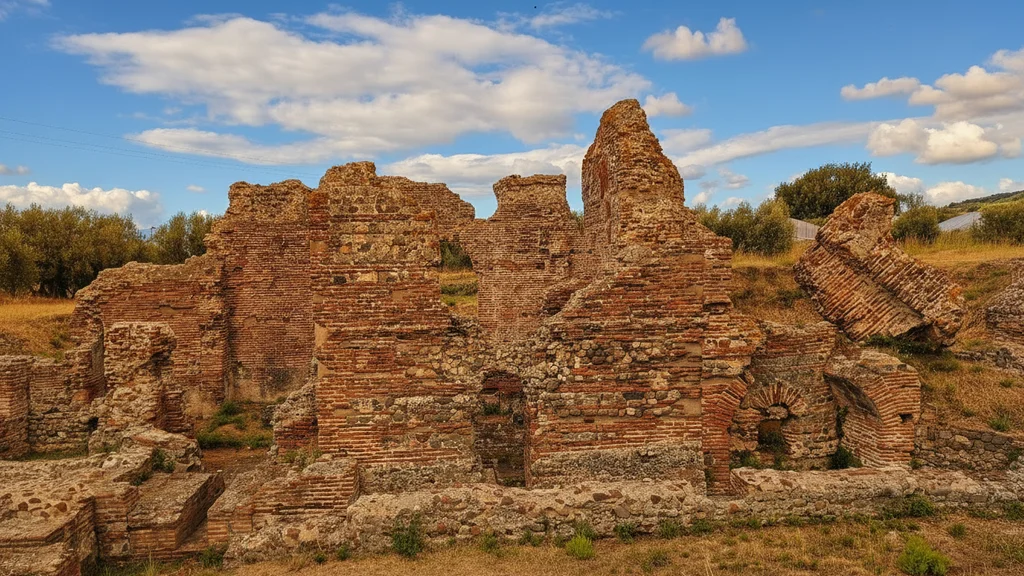
Calabria can surprise you with places where history and landscape come together very closely. Acconia di Curinga, located approximately 20–25 km from Pizzo depending on the starting point, is known primarily for the ruins of a Roman thermal complex – an archaeological site. If you are looking for active thermal bathing, you should head mainly to Terme di Caronte in the municipality of Lamezia Terme.
In practice, it is worth remembering this distinction at the trip-planning stage. Acconia di Curinga is a frazione of the municipality of Curinga in the province of Catanzaro and a destination for those interested in Roman ruins, while immersion in warm thermal water is primarily associated with a visit to Terme di Caronte. Curinga itself lies on the Catanzaro Isthmus, between the Tyrrhenian and Ionian Seas, which explains the importance of this area from antiquity to the present day.
Table of Contents
- Evolution of the Acconia di Curinga Baths – From Antiquity to the Present
- Architecture and Engineering of the Roman Thermal Complex
- Invaluable Health Benefits of the Curinga Thermal Waters
- Diversity of Calabria's Thermal Baths – Comparison with Acconia di Curinga
- The Monumental Plane Tree of Curinga – A Natural Heritage
- Tourism in Curinga – The Impact of Hot Springs on Local Development
Evolution of the Acconia di Curinga Baths – From Antiquity to the Present
The baths at Acconia di Curinga form part of the Roman history of the Catanzaro Isthmus. The strategic importance of the area grew during the Roman era thanks to the proximity of the Via Popilia, a road connecting Capua with Rhegium (today's Reggio Calabria), traditionally associated with the consul Publius Popillius Laenas and built in the 2nd century BC. It is precisely this communication corridor – in the narrowest part of the Apennine Peninsula, where the distance between coasts is approximately 30–35 km as the crow flies – that explains the presence of Roman infrastructure in the Curinga and Lamezia area.
Today the ruins are referred to primarily as the Roman thermal complex at Acconia. The preserved remains indicate an important thermal complex, probably private and connected with a large monumental villa and the former settlement and communications network of the region. The site is viewed today primarily as an archaeological site rather than a contemporary thermal bathing facility.
| Chronological Phase | Period | Activity Characteristics |
|---|---|---|
| Phase I | 1st – 2nd century AD | Construction of the original complex using opus latericium technique. |
| Phase II | 3rd – 4th century AD | Expansion and restoration; introduction of opus vittatum technique. |
Today, Acconia di Curinga is developing as a point on the map of quieter excursions around the Tyrrhenian part of Calabria. The archaeological site itself no longer serves as a bathing facility, but its preserved fragments, including elements of the hypocaustum system, continue to impress. It is best treated as a stop for those who want to combine the region's history with discovering less obvious places off the main trail.
Watch on YouTube
Architecture and Engineering of the Roman Thermal Complex
The complex covers an area of approximately 700 square metres, although scientists suggest the structures may extend considerably further. The layout of the ruins indicates a Roman bath complex with rooms of different functions and temperatures. The reconstructed plan includes an atrium-gymnasion, frigidarium, small tepidarium-apodyterium (changing room), two large calidaria, a laconicum and service rooms.
The entrance led from the east side through a portal more than 2 metres wide into an atrium of approximately 70 square metres. The frigidarium was the largest room in the complex, clearly showing the scale of the structure and its carefully planned division of space. It is precisely in such details that one best sees how the daily operation of Roman baths was organised.
An extremely important engineering element is the underfloor heating system, where fragments of suspensurae are still visible today. Hot air generated by furnaces circulated between small pillars, while exhaust fumes were discharged through ceramic pipes built into the walls. Such precision of execution testifies to the high level of technical knowledge of the Romans, who were able to design advanced heating systems in large thermal complexes.
Today the greatest value of this site lies in the opportunity to see up close how Roman utilitarian architecture worked. One does not come here for a bath but for contact with the material traces of antiquity on the Calabrian isthmus. That is precisely the charm of Acconia – it is a quiet, austere place, more archaeological than spa-like.
Invaluable Health Benefits of the Curinga Thermal Waters
At this point one needs to speak precisely: the ruins at Acconia are a monument, while the active thermal bathing of the region is primarily associated with Terme di Caronte in the municipality of Lamezia Terme. The Caronte thermo-mineral water emerges at a temperature of approximately 38–39°C and is classified as sulphurous-sulphate, alkaline-earth, iodic water with a high hydrogen sulphide content. On site there is both a historic spa and a popular natural spring with a small pool visited by locals and tourists.
From Pizzo to Terme di Caronte usually takes about 30 minutes by car, depending on the route. That is where to go if the aim of the day is immersion in warm water rather than viewing ruins. This makes it easier to plan a trip without confusing two different places into one.
The paid thermal pool at Terme Caronte is open Monday to Saturday from 9:00 to 13:00. A single entry costs 25 euros, and a swimming cap is required in the pool. You must shower before entering, and rubber flip-flops are required in barefoot areas.
Key Health Properties
Strengthening the Circulatory System and Improving General Wellbeing
Bathing in thermal water helps relax the muscles and brings relief from tension. If you have chronic conditions, it is still worth consulting a doctor before using thermal baths. With water at a temperature of approximately 38–39°C, it is wiser to opt for shorter sessions and remember to stay hydrated.
Alleviating Dermatological Problems
The sulphurous waters of Caronte have long attracted people seeking support for their skin and respiratory tract. It is worth remembering, however, that a visit to the baths is primarily an element of relaxation and spa tradition, not a guaranteed medical therapy.
Specialist Applications and Minerals
Before entering sulphurous water, it is worth removing silver jewellery as it quickly tarnishes. There are also contraindications including certain heart conditions, acute circulatory failure, active infections and high-risk pregnancy. Such caution is particularly important with hot water and longer bathing sessions.
Diversity of Calabria's Thermal Baths – Comparison with Acconia di Curinga
Calabria offers thermal experiences often compared with well-known Tuscan spas such as Saturnia or Bagni San Filippo. Compared with Tuscany's very recognisable thermal sites, some Calabrian springs have a more local and less commercial character. When comparing the Curinga area with Terme di Spezzano Albanese in the province of Cosenza, it should be noted that this is a separate thermal centre with waters used, among other things, for inhalation treatments and balneotherapy.
| Location | Temperature | Main Properties | Characteristics |
|---|---|---|---|
| Terme di Caronte | approx. 38–39°C | Sulphurous-sulphate, alkaline-earth, iodic | Official spa and paid thermal pool; there is also popular access to free springs in the area. |
| Saturnia (Tuscany) | 37.5°C | Sulphurous, rich in plankton | Travertine cascades, very large crowds. |
| Bagni San Filippo | up to 52°C | Limestone deposits | Rock formations resembling glaciers. |
Enjoying the bounty of nature in this region is facilitated by the proximity of Pizzo, Curinga and Lamezia Terme. The properties of the waters in this part of Calabria attract people seeking a quieter alternative to the busy spas of northern Italy. The combination of the ruins at Acconia, the operating Caronte thermal baths and the smaller coastal towns means that Calabria is well suited to a trip combining bathing, history and short drives between attractions.
The Monumental Plane Tree of Curinga – A Natural Heritage
While in the Acconia area, it is also worth planning an encounter with the oriental plane (Platanus orientalis) of Curinga. This tree grows near the hermitage of Sant'Elia Vecchio in the municipality of Curinga and is most commonly dated to approximately 1,000 years old. It is one of the most well-known monumental plane trees in Italy, which in 2021 took a distinguished second place in the prestigious European Tree of the Year competition.
The tree's official dimensions are 31.5 metres in height and 14.75 metres in trunk circumference. The trunk is completely hollow inside, creating a natural cave, which only adds to the character of the place. In good weather, the view from the area encompasses the Tyrrhenian Sea, and sometimes Stromboli on the horizon.
The plane tree and the thermal ruins are not in the same location. The ruins at Acconia are in the lowland part of the municipality, while the plane tree near Sant'Elia Vecchio lies higher up, in the hills of Curinga. It is best to plan them as two separate stops during one excursion, driving by car with a short walk up to the hermitage.
The Sant'Elia Vecchio complex lies in the località of Corda. The oldest mention is sometimes linked to a disputed document from 1062, while the first certain record of the Basilian monastery comes from a bull of Pope Alexander VI from 1493. In 1991, excavations revealed a plan with 13 rooms, including the prior's cell, a corridor, a storeroom and the chapel of Sant'Elia.
Tourism in Curinga – The Impact of Hot Springs on Local Development
Visits to Pizzo, Curinga and the surrounding thermal sites form an important element of tourism in this part of the Tyrrhenian coast. Natural hot springs attract those seeking relaxation, while the ruins at Acconia and the plane tree in Curinga add a historical and natural dimension to the trip. As a result, the region does not rely on a single attraction but on a well-complementary set of sites.
For tourists based in Pizzo, an excursion to Acconia is logistically straightforward – it is usually about 20–25 km by road, depending on the starting point and destination. Curinga belongs to the province of Catanzaro, and Pizzo to the province of Vibo Valentia, while the most important transport hub for the whole area remains Lamezia Terme with Lamezia Terme Centrale station and Lamezia Terme International Airport. From the airport to Curinga is approximately 15–20 km, and to Pizzo about 30 km.
It is precisely the proximity of Lamezia Terme that effectively supports tourism in this part of Calabria. The growing popularity of the surrounding attractions supports local gastronomy and services, while at the same time preserving the region's authentic, uncommercialised character. In practice, the combination of short drives, tranquil landscapes and attractions scattered between the lowlands and hills works well here.
Frequently Asked Questions
Where are the hot springs near Pizzo?
For active thermal bathing, the most important site is Terme di Caronte in the municipality of Lamezia Terme. Acconia di Curinga, approximately 20–25 km from Pizzo, is known primarily for the ruins of a Roman thermal complex.
Are the Acconia di Curinga thermal baths free to access?
Acconia is primarily an archaeological site, so it should not be equated with a free natural bathing spot. Free or semi-wild access may apply to some active springs in the region, especially around Terme di Caronte.
What is the water temperature at the Acconia baths?
At Acconia itself we are speaking primarily of the ruins of former baths, not a contemporary bathing facility. The temperature of approximately 38–39°C refers to the active springs of Terme di Caronte in the municipality of Lamezia Terme.
How do you get from Pizzo to the Curinga baths?
The most convenient way to reach the ruins at Acconia di Curinga is by car – it is usually about 20–25 km. If you want to use active thermal baths, your destination should be Terme di Caronte near Lamezia Terme, about 30 minutes' drive from Pizzo.
What should you remember before bathing in sulphur baths?
You should remove silver jewellery, as the sulphur in the water causes rapid tarnishing. With water at approximately 38–39°C, it is better not to prolong bathing unnecessarily, to stay hydrated and to exercise caution regarding health contraindications. During pregnancy, the official Terme Caronte recommendations advise avoiding the thermal baths in the first trimester, avoiding thermal mud treatments and limiting immersion and hydromassage to a maximum of 15 minutes after consulting a doctor or gynaecologist.
Sources
The information in this article was verified against the following sources:
- Monastero • Museo del Territorio di Curinga – museodelterritoriodicuringa.it
- curinga-in.it (PDF) – curinga-in.it
- ACQUA | TermeCaronte – termecaronte.it
- DOMANDE FREQUENTI | TermeCaronte – termecaronte.it
- ASP Cosenza – Dipartimento Tutela della Salute e Politiche Sanitarie – asp.cosenza.it
- PISCINA | TermeCaronte – termecaronte.it
- Wikipedia – Calabria – en.wikipedia.org
Last updated: