Calabria has more than beaches and seaside towns: it also has small spa resorts hidden inland. One of them is Terme di Antonimina, natural hot springs located near Locri, at the foot of Aspromonte National Park. It is a good address for travellers who want to combine thermal treatments with exploring Locride: the ancient heritage of Locri Epizephyrii, medieval Gerace and the Jasmine Coast. Below you will find the history of the site, a description of the waters and practical information for planning a visit.
Table of Contents
The History of Terme di Antonimina – Ancient Roots and Traditions
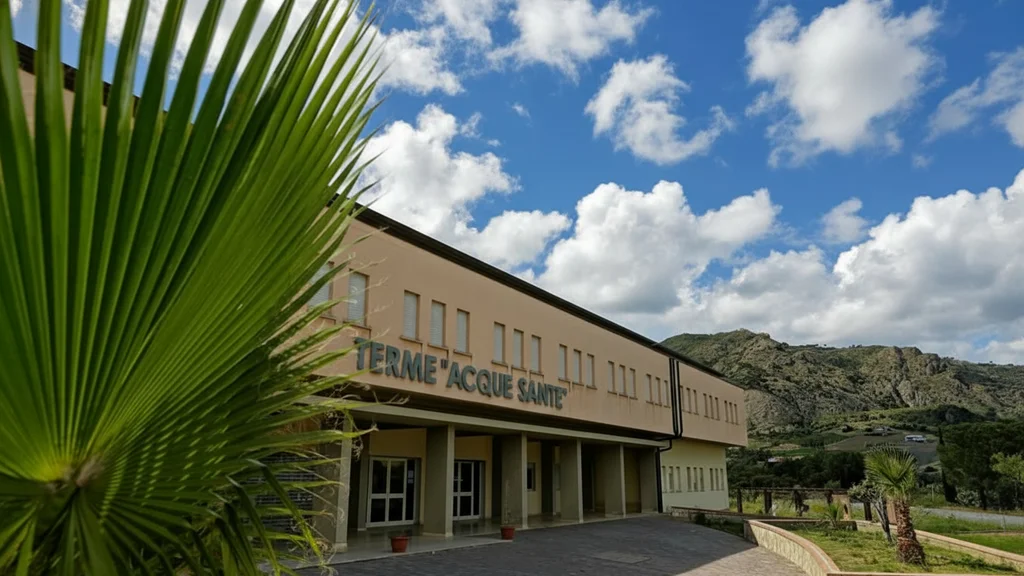
Terme di Antonimina, known by the name Acque Sante, meaning Holy Waters, is one of the most important thermal sites in this part of Calabria. Antonimina lies inland from the Ionian coast, which is why many travellers associate this spa with Locri – the nearest larger town and natural point of access. The historical background of the region is key here: ancient Locri Epizephyrii was one of the most powerful cities of Magna Graecia.
Local tradition readily links the Acque Sante with ancient Locri Epizephyrii. According to tradition, the ancient Greeks channelled these waters into the city, valuing them, among other things, as a remedy for female infertility. Firm evidence of modern, medical use of the springs, however, dates from the 19th century. The facility's official documentation cites studies by Dr Domenico Accorinti from 1830. The modern thermal establishment, in turn, took shape in 1870. Antonimina itself is a settlement of agricultural and pastoral origin, whose beginnings are dated to the 15th century.
Cultural and Medical Significance
The significance of Terme di Antonimina comes not only from the properties of the water itself but also from its picturesque location at the foot of the Aspromonte massif, near the distinctive Tre Pizzi peak. In the practical rhythm of a trip through Calabria, this place fits perfectly into the region's unhurried pace: a morning walk through a historic town, an afternoon of relaxation at the baths, and an evening dinner by the sea. In balneological tradition, this facility specialises in treatments supporting the respiratory tract, the musculoskeletal system and dermatological conditions.
Era |
Status and Significance |
Historical Context |
|---|---|---|
Antiquity (Magna Graecia) |
Use of the waters by the inhabitants of Locri Epizephyrii |
Local legends and tradition regarding healing properties |
19th century |
Scientific study of the waters (1830) and construction of the first facilities (1870) |
The beginnings of modern spa medicine in the region |
20th–21st century |
Development of Consorzio Termale Antonimina-Locri |
Integration of the facility into the Italian national health system (SSN) |
Healing Properties of Calabria's Hot Springs
The foundation of Terme di Antonimina's reputation is the stable water temperature and its rich mineral composition. The water emerges from the spring at approximately 35–36°C, allowing treatments to be carried out without artificially heating it. The Acque Sante waters are classified as thermomineral, isotonic, mildly sulphurous, saline-sulphate-alkaline, with traces of iodine. They are regularly tested for bacteriological and physico-chemical properties by the Institute of Hygiene of the University of Messina.
Parameter / Component |
Characteristics |
Therapeutic Effect |
|---|---|---|
Temperature at source |
Approx. 35–36°C |
Natural muscle relaxation and thermal comfort |
Mineral composition |
Thermomineral, mildly sulphurous, saline-sulphate-alkaline waters, with trace amounts of iodine |
Anti-inflammatory, stimulating and cleansing effects |
Water type |
Isotonic waters |
Gentle on mucous membranes and skin |
Practical application |
Baths, inhalations, mud therapy, irrigations |
Support for treating the respiratory tract, joints and skin |
Calabrian Spa – Natural Therapy
What distinguishes a stay at the baths from an ordinary spa? In Antonimina, the emphasis is on traditional balneotherapy. Sulphurous inhalations and baths are here an element of spa-based treatment. It is worth remembering, however, that a visit to the baths supports the body rather than replacing specialist medical treatment. It is most sensible to treat them as part of a broader regeneration programme, tailored after consultation with a doctor.
Watch on YouTube
Relaxation and Regeneration at the Highest Level – Spa Treatments in Calabria
In Antonimina it is best to expect classic balneological procedures rather than the luxury wellness packages found in modern hotels. At Terme di Antonimina-Locri, treatments are largely covered by the Italian national health service (SSN). They include, among others, packages of 12 baths, 12 thermal mud treatments (mud therapy), cycles of aerosol therapy and inhalation, and gynaecological irrigations.
The facility is accredited with the SSN. Patients without an exemption pay a flat-rate co-payment (the so-called ticket) of €55, patients with a partial exemption pay €3.10, and those fully exempt receive treatments free of charge. Foreign visitors using the baths privately should check current prices for individual treatments directly in the facility's price list. In the autumn season (from late August to the end of November 2026), the baths are open Monday to Friday from 08:00 to 12:00 and 16:00 to 19:00, and Saturdays from 08:00 to 12:00 (closed on Sundays).
It is worth planning the trip so that the baths are just one stop in the day. Antonimina is only a short drive from Gerace, one of Calabria's most beautiful medieval towns, famous for its imposing Norman cathedral. The Costa dei Gelsomini (Jasmine Coast) on the Ionian Sea is just as close.
Journey to Terme di Antonimina: How to Reach This Calabrian Spa
The most convenient option for tourists remains renting a car, especially if you want to move freely around the hilly hinterland of Locride. The route from central Locri to Antonimina is only about 8–10 km, and the drive takes around 15 minutes on a relatively straightforward road inland.
Those who prefer public transport can use the rail connections along the Ionian coast. The nearest station is Locri. Regional trains from Reggio Calabria cover this route in around 1 hour 15 minutes to 1 hour 30 minutes. From Locri's own station to the baths, it is best to take a taxi, as local buses run infrequently and their timetables depend heavily on the season and school days.
The National Archaeological Museum and Park of Locri (Museo e Parco Archeologico Nazionale di Locri), on the SS106 Jonica state road, fits perfectly into the day's plan. There you can see, among other things, the remains of a Greek-Roman theatre, Doric temples and ancient walls. This makes for a very practical day: archaeology in Locri in the morning, relaxation in the waters of Antonimina at midday, and dinner in medieval Gerace to finish.
Terme di Antonimina – Frequently Asked Questions
What healing properties do the thermal waters of Antonimina have?
The Acque Sante waters are thermomineral, isotonic, mildly sulphurous and saline-sulphate-alkaline, with traces of iodine. They are traditionally used, among other things, in baths, mud therapy and inhalations to support treatment of the respiratory tract, joints and skin conditions.
How much does a visit to Terme Antonimina cost?
Prices for private treatments are best checked directly in the facility's official price list. For treatments under the Italian national health service (SSN), patients without an exemption pay a flat-rate co-payment (the so-called ticket) of €55 for a full cycle (e.g. 12 baths and 12 mud treatments).
How do I get to Terme Antonimina from Locri?
It is a very short route – only about 8–10 km, taking around 15 minutes by car. If you are travelling by train, get off at Locri station, and from there it is best to take a taxi, as local buses run infrequently.
Can I use the spa treatments without a medical referral?
Yes, at Italian thermal baths treatments can be booked privately, but a short consultation with the on-site spa doctor is usually required before starting a cycle (such as inhalations or mud therapy).
When is the best time to visit Terme di Antonimina?
It is most convenient to plan a visit from spring to autumn. It is worth combining a stay at the baths with a trip to nearby Gerace, a visit to the Locri Epizephyrii archaeological park, and time on the Jasmine Coast.
Sources
The information in this article was verified against the following sources:
- musei.calabria.beniculturali.it – musei.calabria.beniculturali.it
- Acque Sante – Acque Sante | Centro Termale di Antonimina e Locri – acquesante.it
- Accesso alla terme – acquesante.it
- 401 - Unauthorized: Access is denied due to invalid credentials. – consrc.it
- Antonimina – Acque Sante | Centro Termale di Antonimina e Locri – acquesante.it
- Wikipedia – Locri – en.wikipedia.org
Last updated: