At the southern tip of Italy, in Calabria, the Locri Epizefiri Archaeological Park covers the extensive remains of the Greek colony of Lokroi Epizephyrioi. It bears witness to ancient Greek colonisation, preserving within its boundaries traces of the social, religious and economic life of one of the oldest Greek colonies in Italy. The current National Archaeological Park (Parco Archeologico Nazionale di Locri Epizefiri) encompasses approximately more than 230 hectares of extensive archaeological terrain, making it possible to read the plan of an ancient polis on a scale rarely found in the Mediterranean basin.
Table of Contents
The Rise of Locri Epizefiri – a Greek Colony in the Heart of Italy
Locri Epizefiri dates back to the period between 680 and 670 BC, placing it within the second wave of the great Greek colonisation. It formed an integral part of Magna Graecia, influencing the cultural and economic development of the entire region for hundreds of years. The settlers originated from Locris in mainland Greece, although a tradition passed down by Aristotle suggests the founders were runaway slaves and women from aristocratic families.
The city was founded at the end of the 8th or the beginning of the 7th century BC and by the 6th–5th centuries BC was already one of the important centres of Magna Graecia. In 477/476 BC, during the conflict with Anaxilas of Rhegion, Locri asked Hieron I of Syracuse for help. In the 4th century BC the city was tied to the politics of Dionysius I, who married an aristocratic woman from Locri, and around 356/357 BC Dionysius II, exiled from Syracuse, took refuge here. After the war with Pyrrhus and with Roman expansion, the city entered the Roman orbit; after the Second Punic War it gradually lost importance, and final abandonment of the site came only in the early Middle Ages.
This distinctive origin is reflected in the tradition emphasising a particularly strong position of women in the symbolic and religious life of the city. The original settlement is associated with the area of Cape Zephyrium, from which the name Locri Epizephyrii derives, meaning the Locrians settled by Zephyrion, a cape whose name is linked to Zephyrus, the west wind. According to ancient tradition the settlement was subsequently moved from the vicinity of Capo Zefirio to the proper site of Locri.
Period (BC) |
Event |
Strategic Significance |
|---|---|---|
c. 680–670 |
According to tradition: short-lived, archaeologically unconfirmed settlement at Capo Zefirio, today’s Capo Bruzzano |
Establishing a foothold on the Ionian coast |
c. 670–660 |
Relocation of the city to the Epopis hill |
Better defence and access to fertile lowlands |
c. 660 |
Traditionally linked to the activity of Zaleucus |
Among the earliest written laws of the western Greek world |
650–600 |
Foundation of sub-colonies Medma and Hipponion |
Control of trade routes to the Tyrrhenian Sea |
Archaeology and Discoveries
Contemporary archaeological research at the Locri Archaeological Park provides valuable insights into the social structure and urban planning of the ancient city. The city plan was based on a regular street grid with a clear functional division into an upper section linked to sanctuaries and a lower area of artisan character. An extensive defensive wall system has been uncovered, with origins dating back to the mid-6th century BC; at the end of the 4th and beginning of the 3rd century BC the walls were rebuilt and strengthened with towers.
In the Centocamere sector, meaning “One Hundred Rooms,” archaeologists discovered the monumental U-shaped stoa, which served as a banquet hall (hestiatorion). Ritual pits (bothroi) and votive vessels found there suggest intense religious life connected with this area. Ceramic and coin finds shed light on economic development, while preserved inscriptions help reconstruct the administrative and legal structures of the ancient metropolis.
Historical Significance and Legal Revolution
Locri Epizefiri earned its place in history above all as a city of the rule of law, thanks to the figure of Zaleucus. According to ancient tradition, it was here around 660 BC that one of the earliest written bodies of law in the western Greek world was created. The figure of Zaleucus himself, however, remains partly in the realm of tradition, so this element should be treated with caution.
The political structure of the polis is sometimes associated with oligarchic rule exercised by the so-called “Hundred Houses.” The political stability of Locri was legendary; the city rarely experienced tyranny, which allowed it to dominate the region, as confirmed by its victory over Croton at the Battle of the Sagra River. Its inhabitants contributed to the spread of Greek urban planning models, which had a lasting influence on the development of southern Italy.
The Role of Religious Beliefs in Daily Life at Locri Epizefiri
In the ancient colony, religion permeated every aspect of life, from politics to the private sphere. Houses, streets and public spaces were places where numerous altars were erected, making Locri an important sacred centre of Magna Graecia. One of the most significant deities was Persephone, whose cult had a unique character here – the goddess was worshipped as a patron of marriage and motherhood, rather than merely a queen of the underworld.
The most important cult complexes of Locri are the Sanctuary of Persephone at Mannella, the Marasà area with its monumental Ionic temple, and Centocamere, linked to cultic and representational functions. Pinakes from Locri are dated mainly to the 5th century BC and are most commonly associated with the cult of Persephone or Kore. The cults of Aphrodite and the Dioscuri are also attested in the city, and the famous sculptures from Marasà are usually dated to around 420 BC, that is, to the second half of the 5th century BC.
The most famous finds from the Mannella hill area are pinakes, small terracotta tablets decorated with relief carvings. Young women offered them to the goddess before marriage, and they were then deliberately broken during rituals to render the gift unfit for secular use. The iconography of these tablets constitutes an invaluable source of information about clothing, furniture and the complex theology of the transition from maidenhood to marriage.
The Locrian pinakes are among the most famous and numerous votive terracotta assemblages in all of Magna Graecia. They depict scenes connected with marriage, the abduction of Persephone and girls’ rites of passage to adulthood, which is why they are so important for the study of women’s religion in the western Greek world. Most were made from clay in moulds and then finished by hand. Although some are in the local museum, a very large group of pinakes is also displayed in the National Archaeological Museum in Reggio Calabria.
Pinakes Thematic Group |
Scene Description |
Symbolic Meaning |
|---|---|---|
Abduction |
Hades abducting Persephone |
Change in life status |
Enthronement |
Persephone and Hades enthroned |
Marital stability |
Preparations |
Women arranging garments |
Dowry rituals |
Watch on YouTube
Conservation Techniques and Challenges at Locri Epizefiri
The Locri Epizefiri Archaeological Park poses a challenge for modern conservators due to the specificity of the materials and Calabria’s climatic conditions. Preserving the ancient ruins requires a precise approach, particularly for architectural terracottas, ceramic elements and stone and brick walls, which are susceptible to erosion and structural weakening. Exposure of walls and foundations to rain, wind and salt air from the Ionian Sea remains a major problem.
In practice, vegetation overgrowth and the gradual degradation of exposed remains are also threats. At sites of this type, photogrammetric documentation, 3D scanning, protective shelters over selected fragments, and periodic weeding and drainage work are employed. This makes it easier to monitor the condition of walls, foundations and architectural decoration without resorting to hasty reconstruction.
Archaeological Discoveries at Locri Epizefiri – Evidence of Ancient Greek Life
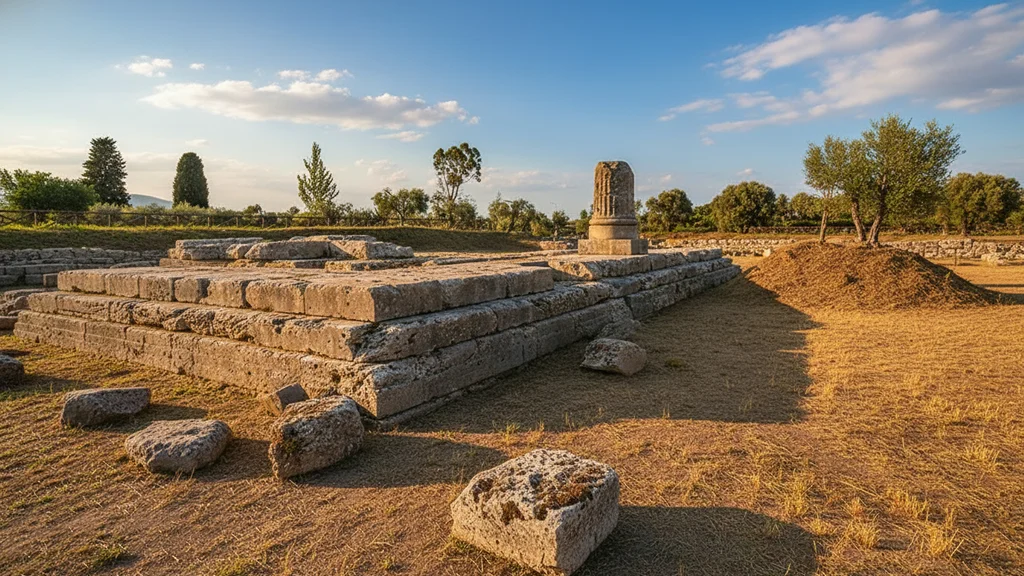
A key highlight of the park is the Sanctuary of Marasà with its monumental Ionic temple, regarded as one of the most important examples of Ionic architecture in Greek Italy. From this temple come the famous sculptural representations of the Dioscuri, usually dated to around 420 BC. Keep in mind, however, that the famous Dioscuri from the ruins of the Ionic temple at Marasà are kept in the Museo Archeologico Nazionale di Reggio Calabria, so in Locri you should not expect to see all the most important originals on site. Another important area of the site is Casa Marafioti, now interpreted more cautiously than in older descriptions, without definitively assigning it a specific cult dedication.
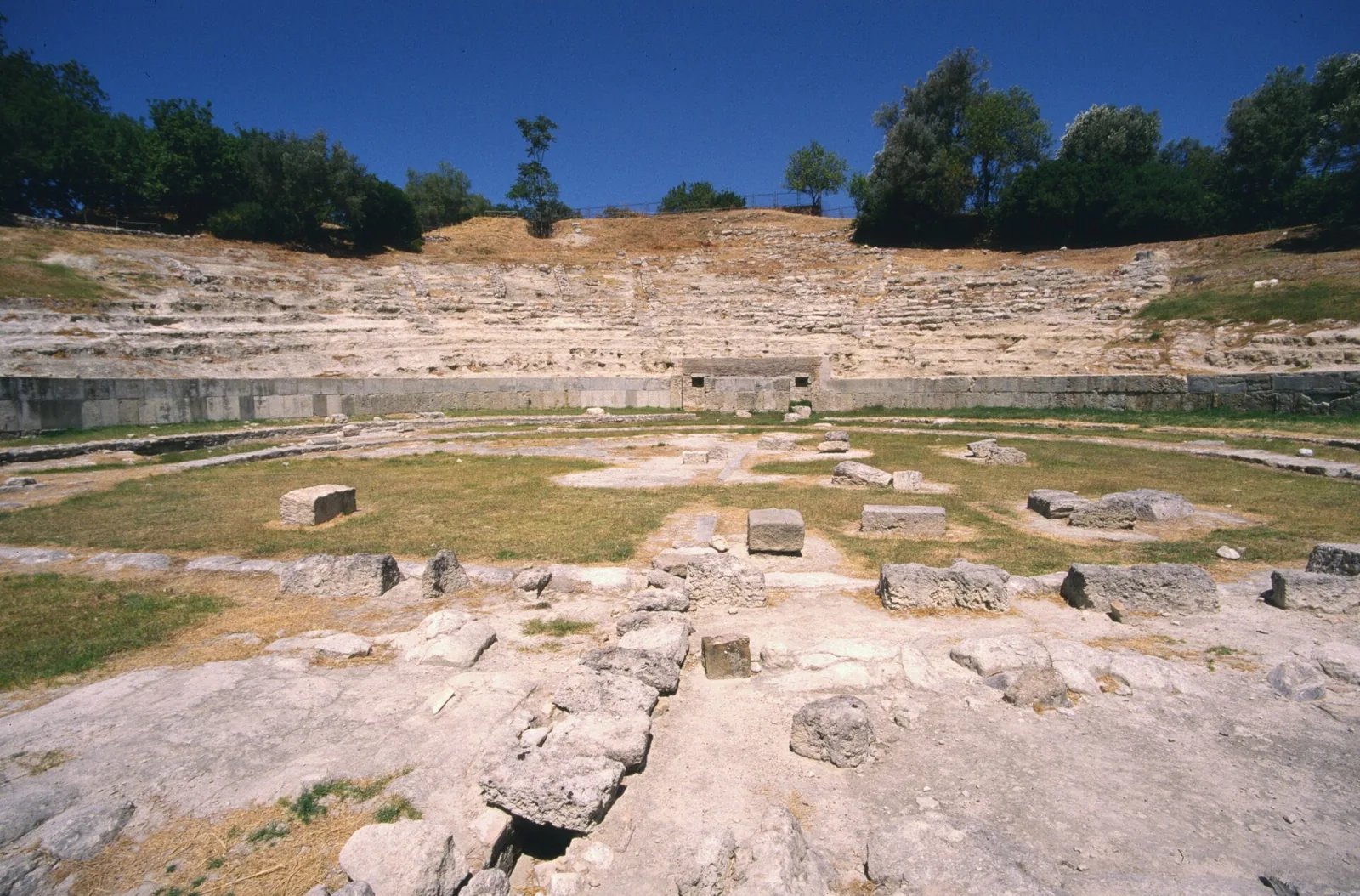
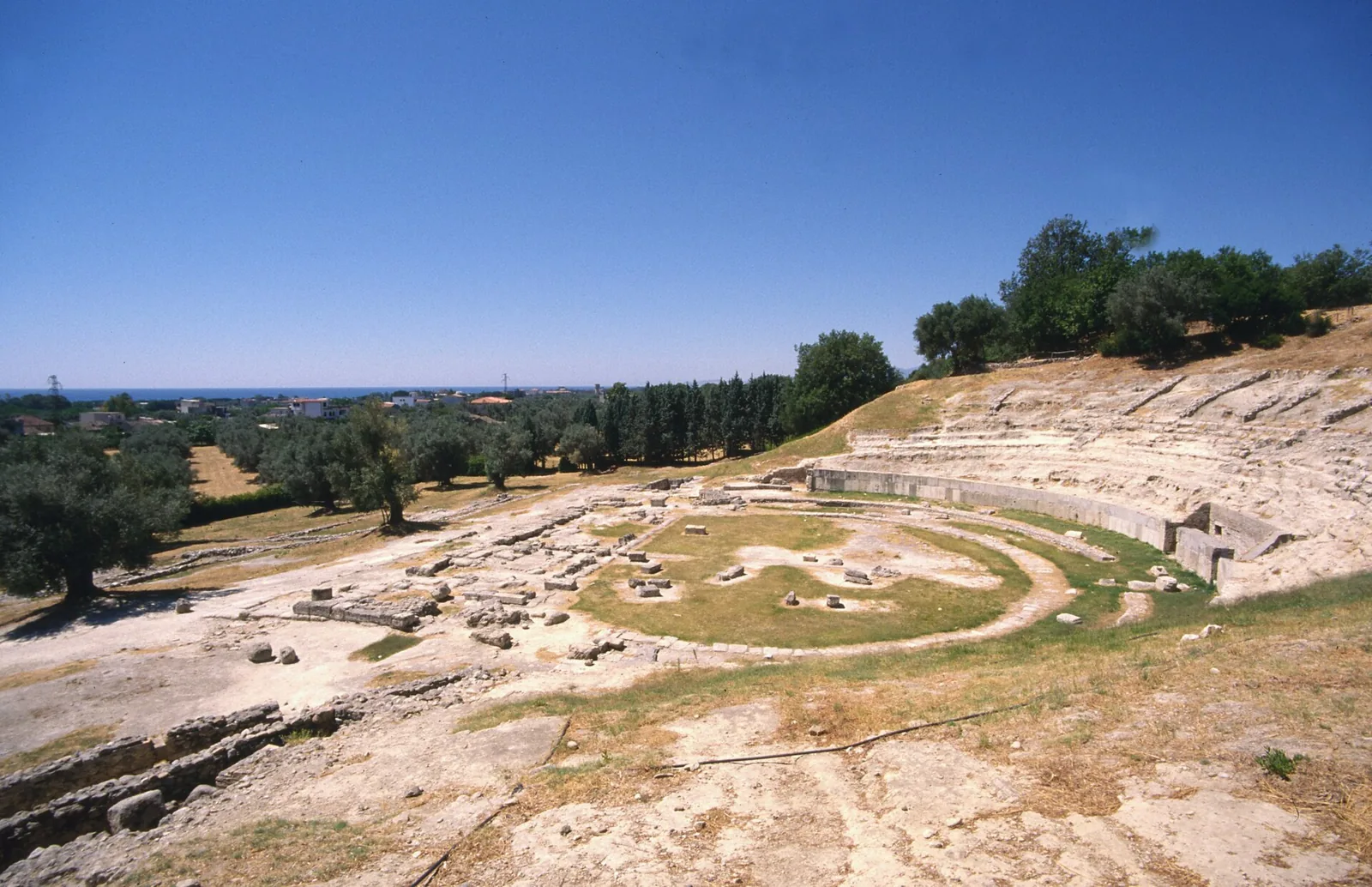
Another important find is the Greco-Roman theatre, one of the most legible elements of the former city. This place shows well how Locri also functioned during the Roman period, even as its importance gradually waned. Locri was also home to the poetess Nossis, who was most probably active in the 3rd century BC; a dozen or so of her epigrams survive in the Palatine Anthology, though her biography remains poorly documented.
This heritage is complemented by Casino Macrì, a 19th-century farmstead built on the foundations of Roman baths, where visitors can now admire mosaics and the statue of a man in a toga (Togato di Petrara). The modern park also offers the National Archaeological Museum, focused above all on the history of the colony and its territory and on the most important finds from the site. Officially described visitor routes lead, among other areas, from the Museo della polis greca through the eastern and northern sectors with walls, towers, a gate, the Thesmophorion and Marasà. A second major route covers the southern itinerary with the Zeus area, Porta Portuense, Casa dei Leoni, Sacello di Afrodite, Porta di Afrodite, Centocamere and the U-shaped stoa; further routes lead from Centocamere to Petrara, with the probable forum and baths, and to Dromo and Pirettina with the Greco-Roman theatre.
The archaeological park lies beside the modern town of Locri on the Ionian coast of Calabria, in the metropolitan city of Reggio Calabria. The official address is Strada Statale 106 Jonica, Contrada Marasà, 89044 Locri. The site is located along the SS106 Jonica, a few kilometres from the centre of Locri, so when planning your journey it is better to aim for Contrada Marasà rather than only the town centre. Allow roughly 1.5–3 hours for a leisurely visit to the site itself, and an additional 30–60 minutes for the museum. It is best to arrive in the morning or late afternoon, as much of the route is exposed – bring water, a hat and comfortable shoes.
The nearest major airports are Reggio Calabria and Lamezia Terme. Regional trains reach Locri along the Ionian line Reggio Calabria–Catanzaro/Lamezia, though connections may require changes; by car the most convenient approach is along the SS106 Jonica. From Locri railway station a short local trip or walk is usually needed to reach the site, depending on your chosen entrance. The official website of the Regional Directorate of National Museums of Calabria gives opening hours from Tuesday to Sunday 09:00–20:00, with closure on Monday, and tickets: full price 5,00 €, reduced 2,00 €. Before visiting, however, check the current hours and prices on the official website of the Italian Ministry of Culture or the museum, as such information can change administratively.
Discover the Treasures of Locri Epizefiri Archaeological Park – Frequently Asked Questions
What was ancient Locri Epizefiri in Magna Graecia?
Locri Epizefiri was one of the important Greek colonies in Italy, founded at the end of the 8th or the beginning of the 7th century BC. It became known for its strong position in Magna Graecia, important sanctuaries and the tradition linked to the laws of Zaleucus, counted among the earliest written laws of the western Greek world.
What can you see at the Locri archaeological park?
The park features defensive walls stretching approximately 6–7 km, ruins of the Ionic temple of Marasà, a Greco-Roman theatre, the Centocamere quarter and the National Archaeological Museum with a collection of Locrian pinakes. It is one of those places where the ruins are best viewed together with the museum exhibition.
What are the opening hours of the Locri archaeological park?
The official website of the Regional Directorate of National Museums of Calabria gives opening hours from Tuesday to Sunday 09:00–20:00 and closure on Monday. Before visiting, it is best to check the current hours on the official website of the Italian Ministry of Culture or the museum.
How much does admission to Locri Epizefiri cost?
The officially listed price is 5,00 € for a full ticket and 2,00 € for a reduced ticket. Prices may change, so before setting out it is best to check the current price list on the official website of the Italian Ministry of Culture or the museum.
How do I get to Locri from Lamezia Terme airport?
It is best to check current rail or road connections to Locri, as timetables vary by season. Regional trains reach the town on the Ionian line, sometimes with a change, and by car the route runs along the SS106 Jonica.
Sources
The information in this article was verified against the following sources:
- Parco Archeologico di Locri - Segretariato Regionale del MiBACT Calabria – beniculturalicalabria.it
- musei.calabria.beniculturali.it – musei.calabria.beniculturali.it
- Museo e Parco Archeologico di Locri in Calabria - Italia.it – italia.it
- Locri epizefiri - Enciclopedia - Treccani – treccani.it
- Locri Epizefiri, Benvenuti in Magna Grecia - Collocazione Geografica – locriantica.it
- Wikipedia – Magna Graecia – en.wikipedia.org
Last updated: