At the southern tip of Italy, in the land of Calabria, lies the remarkable Locri Epizefiri Archaeological Park – a true gem for history and archaeology enthusiasts. It bears witness to ancient Greek colonization, preserving within its boundaries the secrets of social, religious, and economic life of one of the oldest Greek colonies in Italy. The current National Archaeological Park (Parco Archeologico Nazionale di Locri Epizefiri) encompasses over 300 hectares of urban space untouched by modern development, enabling a reconstruction of the ancient polis with a precision rarely found in the Mediterranean basin.
The Rise of Locri Epizefiri – a Greek Colony in the Heart of Italy
Locri Epizefiri dates back to the period between 680 and 670 BC, placing it within the second wave of the great Greek colonization. It formed an integral part of Magna Graecia, influencing the cultural and economic development of the entire region for hundreds of years. The settlers originated from Locris in mainland Greece, although a tradition passed down by Aristotle suggests the founders were runaway slaves and women from aristocratic families.
This distinctive origin is reflected in the city's unique social structures, particularly in the high status of women and the matrilineal system of inheritance. The original settlement was established at Cape Zephyrium (Capo Bruzzano), from which the name Locri Epizephyrii derives, meaning Locri Beyond the West Wind. After several years, the settlers moved approximately 20 kilometers north to the hills of Epopis and Castellace, displacing the native Siculi population.
Period (BC) |
Event |
Strategic Significance |
|---|---|---|
c. 680–670 |
First settlement at Cape Zephyrium |
Establishing a foothold on the Ionian coast |
c. 670–660 |
Relocation of the city to the Epopis hill |
Better defense and access to fertile lowlands |
c. 660 |
Granting of laws by Zaleucus |
First written legal code in Europe |
650–600 |
Foundation of sub-colonies Medma and Hipponion |
Control of trade routes to the Tyrrhenian Sea |
Archaeology and Discoveries
Contemporary archaeological research at the Locri Archaeological Park provides valuable insights into the social structure and urban planning of the ancient city. The city plan was based on a regular street grid with a clear functional division into an upper section (sanctuaries) and a lower area of artisan character. A formidable defensive wall system stretching 7.5 kilometers was uncovered, built primarily in the 4th and 3rd centuries BC from sandstone blocks.
In the Centocamere sector, meaning "One Hundred Rooms," archaeologists discovered the monumental Stoa ad U, which served as a banquet hall (hestiatorion). Analysis revealed 371 ritual pits (bothroi) filled with votive vessels, suggesting an intense religious life connected to commerce. Ceramic and coin finds shed light on economic development, while preserved inscriptions help reconstruct the administrative and legal structures of the ancient metropolis.
Historical Significance and Legal Revolution
Locri Epizefiri earned its place in history above all as a city of the rule of law, thanks to the figure of Zaleucus. It was here, around 660 BC, that Zaleucus codified the first written body of laws in Europe, introducing the principle of lex talionis (an eye for an eye). This aimed to eliminate the arbitrariness of judgments handed down by aristocratic judges and to end bloody clan feuds.
The political structure of the polis was based on oligarchic rule exercised by the so-called "Hundred Houses" – an elite in which nobility was transmitted through the female line. The political stability of Locri was legendary; the city rarely experienced tyranny, which allowed it to dominate the region, as confirmed by its victory over Croton at the Battle of the Sagra River. Its inhabitants contributed to the spread of Greek urban planning models, leaving a lasting impact on the civilizational development of Italy.
The Role of Religious Beliefs in Daily Life at Locri Epizefiri
In the ancient colony, religion permeated every aspect of life, from politics to the private sphere. Houses, streets, and public spaces were places where numerous altars were erected, making Locri an important sacred center of Magna Graecia. One of the most significant deities was Persephone, whose cult had a unique character here – the goddess was worshipped as a patron of marriage and motherhood, rather than merely a queen of the underworld.
The most famous finds from the Mannella hill area are pinakes, small terracotta tablets decorated with relief carvings. Young women offered them to the goddess before marriage, and they were then deliberately broken during rituals to render the gift unfit for secular use. The iconography of these tablets constitutes an invaluable source of information about clothing, furniture, and the complex theology of the transition from maidenhood to marriage.
Pinakes Thematic Group |
Scene Description |
Symbolic Meaning |
|---|---|---|
Abduction |
Hades abducting Persephone |
Change in life status |
Enthronement |
Persephone and Hades enthroned |
Marital stability |
Preparations |
Women arranging garments |
Dowry rituals |
Conservation Techniques and Challenges at Locri Epizefiri
The Locri Epizefiri Archaeological Park poses a challenge for modern conservators due to the specificity of the materials used and Calabria's climatic conditions. Preserving the ancient ruins requires a precise approach, particularly for ceramic ruins and sandstone structures that are susceptible to water erosion. Specialized chemical agents are applied to protect surfaces from atmospheric factors.
Contemporary challenges involve not only combating physical degradation but also the difficult interpretation of inscriptions. Translating proper names requires enormous care to preserve the original administrative meaning, as seen on tablets from the Archive of Zeus. Climate change and extreme rainfall necessitate the use of innovative technologies such as 3D modeling, which allows real-time monitoring of city walls and temple conditions.
Archaeological Discoveries at Locri Epizefiri – Evidence of Ancient Greek Life
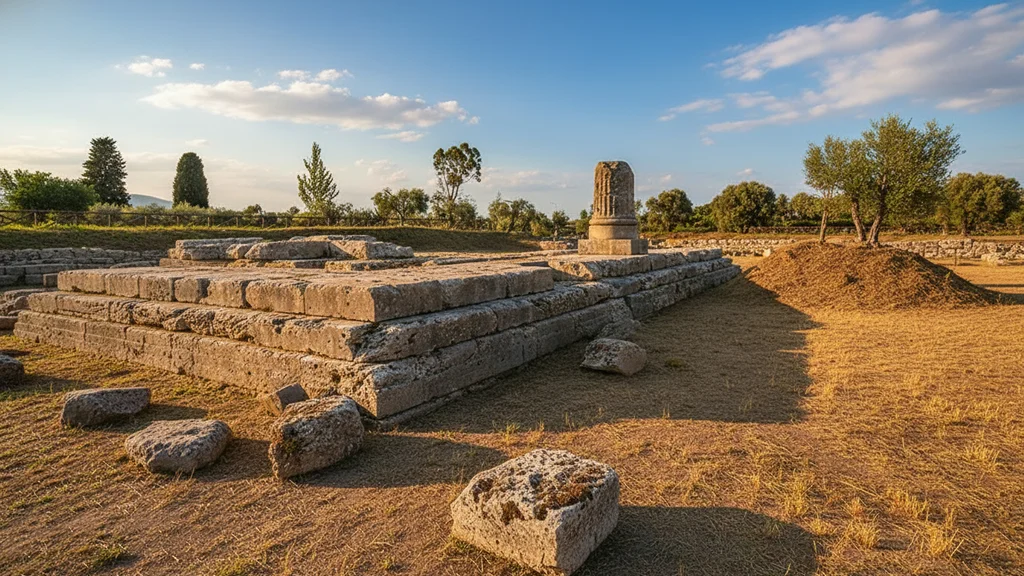
A key highlight of the park is the Sanctuary of Marasà, one of the finest examples of the evolution of the Ionic style in Italy. From this temple comes the famous acroterial group of the Dioscuri – marble sculptures depicting Castor and Pollux, who according to legend helped the Locrians win the Battle of the Sagra River. Another significant structure is the Doric temple of Casa Marafioti, dedicated to Zeus, near which a stone chest containing 37 bronze tablets documenting the polis's finances was discovered.
Another important find is the 4th-century BC theatre, built into a natural hillside, which could accommodate thousands of spectators. During the Roman period, the structure was modified by removing the lower rows of seating to adapt it for gladiatorial combat. Locri was also home to the poetess Nossis, whose epigrams focused on the world of women continue to paint a picture of the colony as a center of high literary culture.
This heritage is complemented by Casino Macrì, a 19th-century farmstead built on the foundations of Roman baths, where visitors can now admire mosaics and the statue of Togato di Petrara. The modern park features a refurbished National Archaeological Museum that presents over 4,000 years of regional history, from the Bronze Age to the Byzantine era. Thanks to meticulous attention to detail, Locri Epizefiri remains an open book of Magna Graecia's history, attracting scholars eager to explore the secrets of ancient civilization.
Discover the Treasures of Locri Epizefiri Archaeological Park – Frequently Asked Questions
What was ancient Locri Epizefiri in Magna Graecia?
Locri Epizefiri was one of the most important Greek colonies in Italy, founded in the 7th century BC. It became famous as the birthplace of the first written legal code in Europe (the laws of Zaleucus) and for its unique social structure based on a matrilineal system of inheritance.
What can you see at the Locri archaeological park?
The park features monumental defensive walls stretching 7.5 km, ruins of the Ionic temple of Marasà, a Greco-Roman theatre, the Centocamere residential quarter, and the National Archaeological Museum with a unique collection of terracotta tablets (pinakes).
What are the opening hours of the Locri archaeological park?
The park is open to visitors from Tuesday to Sunday, 09:00–20:00 (last entry at 19:00). The site is closed on Mondays.
How much does admission to Locri Epizefiri cost?
A standard ticket to the archaeological park costs €5.00. A combined ticket is also available for €6.00, which includes a visit to Palazzo Nieddu in the center of modern Locri.
How do I get to Locri from Lamezia Terme airport?
From Lamezia Terme airport, the best way to reach Locri is by direct bus with Autolinee Federico (journey takes approximately 2h 15m) or by Trenitalia train with a connection in Reggio Calabria.