The Church of San Giovannello in Gerace is an exceptional example of Byzantine architecture in southern Italy. This small church is one of the important monuments of medieval Gerace. Set on a rocky hill above Locri, it stands out for its simple, austere early medieval form. Also known as San Giovanni Crisostomo, the church remains an important part of the cultural identity of the Locride, attracting both historians and lovers of Eastern Christian art.
The town of Gerace, perched on a rocky plateau, developed in the early Middle Ages as a safer centre than the coastal Locri Epizephyrii. The movement of population from the coast is associated with Arab raids and the instability of the 9th–10th centuries. This shift strengthened Gerace's role as an important ecclesiastical centre (known as the “city of a hundred churches”), which to this day has preserved an exceptionally large group of medieval churches.
Gerace lies today in the Metropolitan City of Reggio Calabria, in the historic Locride, at an elevation of nearly 500 m a.s.l. It is precisely this position above the coast that explains why the medieval town developed as a naturally safer point than the earlier settlements on the Ionian Sea. In this landscape, San Giovannello best demonstrates the continuity between the Greek religious tradition and the urban history of Gerace.
Table of Contents
- The Byzantine Legacy in Calabrian Architecture – Influences on Churches and Sacred Buildings
- Architecture and Form of the Building
- Restoration of San Giovannello – Protecting Byzantine Heritage in the 20th Century
- Byzantine Calabria – Bastion of Greek Culture and Religion in the Middle Ages
- Norman Adaptation of Sacred Architecture in Calabria and Sicily
- Modern Technologies in Service of Conservation
- Practical Information
The Byzantine Legacy in Calabrian Architecture – Influences on Churches and Sacred Buildings
Byzantine architecture left a lasting mark on many parts of southern Italy, particularly in the region of Calabria. The Byzantine presence, which dominated here for several centuries, gave rise to numerous sacred buildings, some of which have preserved their original liturgical layout and modest stone forms. The Church of San Giovannello is usually associated with the 10th–11th century, placing it at a pivotal moment of transition between Byzantine rule and Norman domination.
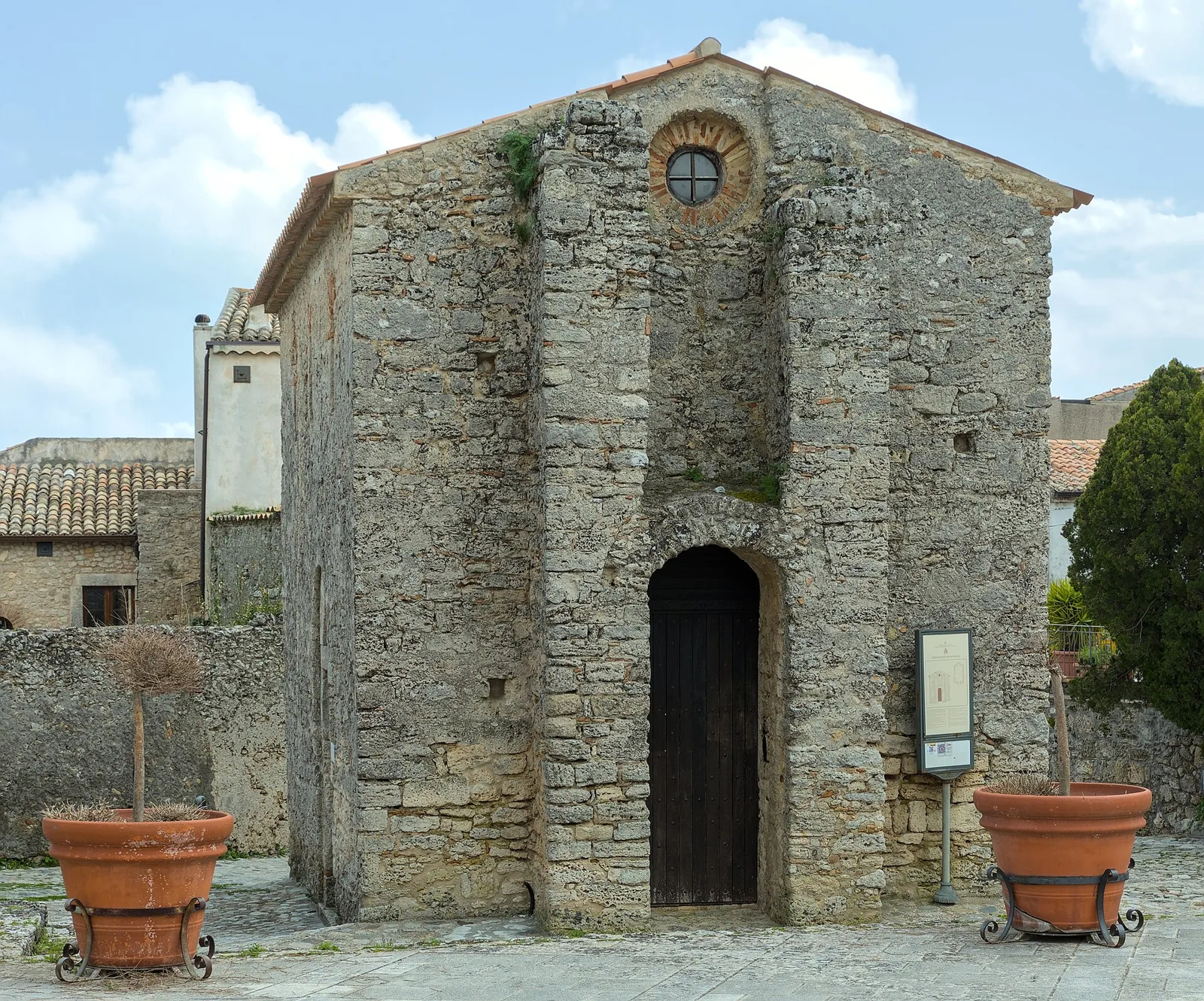
Churches and Chapels as Testimony of Byzantine Influence
In the case of the church in Gerace, it helps to know that San Giovannello (“little John”) is the popular name of the church that appears in official sources as San Giovanni Crisostomo (St John Chrysostom). The building is associated with the Greek liturgical tradition and medieval Byzantine monasticism; the term katholikon simply means the main church of a monastery.
Another exceptional example of Byzantine architecture in Calabria is the Cattolica di Stilo. This 10th-century church on a Greek-cross plan inscribed within a square, with five domes, is among the most important monuments of this type in the region. In the broader landscape, it is also worth remembering the oratory of San Marco in Rossano, most commonly dated to the 10th century, and southern Calabria and Bovesìa, where Greek heritage was present not only in architecture but also in culture.
| Comparative Feature | San Giovannello (Gerace) | Cattolica di Stilo |
|---|---|---|
| Building Plan | Single-nave, rectangular | Greek cross inscribed in a square |
| Exterior Decoration | Austere, stone and brick | Rich, brick patterns |
| Original Function | Church associated with the monastic tradition | Probably a hermitic church |
| Relation to Town | Part of dense urban fabric | Isolated on a mountainside |
Neo-Byzantine Elements in Calabria
After the great earthquake of 1908, the architecture of Reggio Calabria featured references to earlier historical forms, including those associated with the Byzantine tradition. This appeal to Byzantine aesthetics was a way of maintaining historical identity and a testament to cultural continuity rooted in regional architecture.
Watch on YouTube
Architecture and Form of the Building
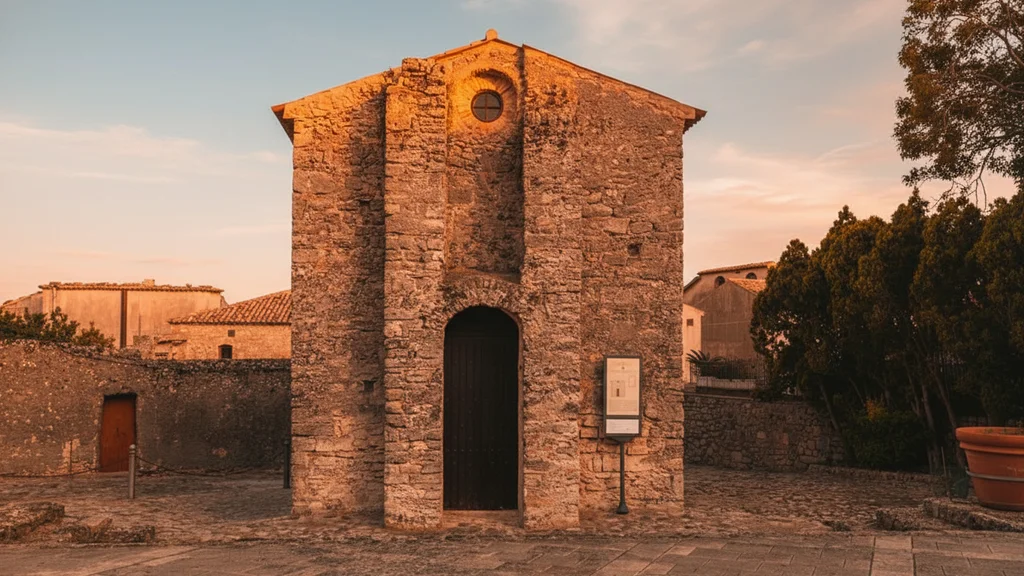
The architecture of San Giovannello is characterised by simplicity of form and clarity of divisions, typical of smaller Byzantine buildings. In a conservation description, the site is identified as a single-nave church with a Byzantinising character, founded in the 11th century, measuring about 4 × 7 × 5 m. It was built of local stone blocks and brick laid in mortar, under a simple gabled roof (Italian a capanna). At the western peak stands a characteristic screen bell tower, giving the building a modest profile that harmonises with the surrounding architecture.
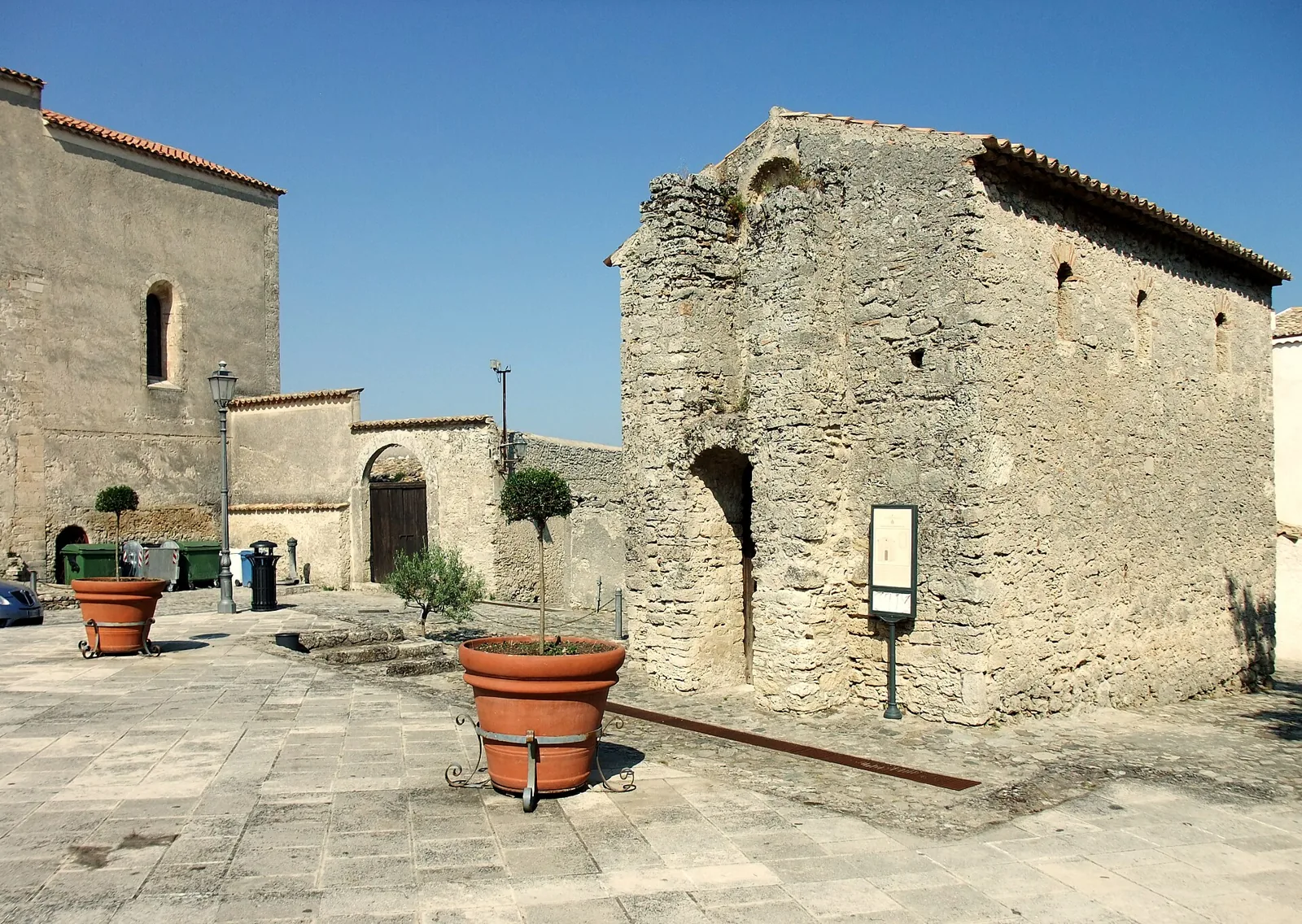
What draws attention in the body of the church is the economy of means and small scale, thanks to which the church fits well into the dense fabric of old Gerace. A semicircular apse projects to the east, while within the thickness of the wall are the prothesis and diaconicon niches, connected with the liturgical arrangement of the altar area. Rather than looking for architectural grandeur here, it is better to view it as a building subordinated to liturgy and the daily life of the monastic community. It is precisely this restraint that makes San Giovannello one of the most authentic witnesses to the Byzantine tradition in the town.
The interior follows the layout known from the Byzantine rite. The prothesis is the space on the north side of the presbytery where the Eucharistic gifts are prepared, while the diaconicon is on the south side and serves for storing vestments and liturgical vessels.
Restoration of San Giovannello – Protecting Byzantine Heritage in the 20th Century
Conservation in the Mid-20th Century
The Church of San Giovannello in Gerace underwent restoration processes in the 20th century, aimed at safeguarding its historic fabric. Although the church was in a difficult condition after decades of neglect, the actions taken by Italian conservation institutions made it possible to preserve the structure and the legible interior layout. Thanks to these works, the building has preserved its historic character and remains one of the important points on the map of medieval Gerace.
1961: structural restoration funded by the Cassa per il Mezzogiorno
After World War II, when San Giovannello required urgent intervention, Italian conservation services and state administration undertook the work. The key structural restoration was carried out in 1961 and was funded by the Cassa per il Mezzogiorno, the state development fund for southern Italy. It primarily involved securing and reinforcing the most important structural elements. These efforts made it possible to preserve the building further without disturbing its modest, medieval form.
Preserving the Byzantine Decoration
Particular attention was devoted to preserving the historic character of the interior and the legibility of the liturgical layout. Conservation works focused on protecting the historic fabric and conducting interventions in such a way as not to obscure the Byzantine identity of the church. It is precisely the restraint of these efforts that best serves today's experience of the church.
1997 and 2011: Further Conservation Work
Another intervention was carried out in 1997, and further conservation works were launched in 2011 by the Soprintendenza (the state heritage protection office); these included damp-proofing and the installation of monitoring systems. Care was also taken to make the building more accessible to visitors and to integrate it into the route through the historic centre of Gerace. As a result, San Giovannello has remained a living element of the urban landscape, rather than merely a closed monument viewed from outside.
Byzantine Calabria – Bastion of Greek Culture and Religion in the Middle Ages
Calabria in the Middle Ages was an important bastion of Greek culture and religion. During this period, the Greco-Byzantine rite dominated, and numerous monasteries testified to the deep roots of Eastern traditions. The Church of San Giovannello remains faithful to Byzantine simplicity, serving as a counterpoint to the majestic Norman cathedral erected in the 11th century, which symbolised the process of re-Latinisation of the region.
The significance of Calabria as a centre of Greek culture was also manifested in literature and scholarship. Figures such as Barlaam of Calabria (Barlaam of Seminara), a monk and scholar who later became Bishop of Gerace, played an important role in the rediscovery of ancient Greek in Western Europe. Barlaam was a teacher of such masters as Petrarch and Boccaccio, demonstrating that the heritage of the region extended far beyond architecture alone.
Contemporary Calabria has preserved traces of the Greek tradition beyond its monuments as well. In the Grecanica area, or Bovesìa, in the province of Reggio Calabria, the Greko language (Calabrian Greek) has survived. This is an important reminder that the Byzantine heritage of the region is not just churches but also liturgy, manuscripts and linguistic traditions that remain part of local memory.
Norman Adaptation of Sacred Architecture in Calabria and Sicily
The transformation of sacred buildings by the Normans encompassed not only Apulia but also Calabria and Sicily. This process began in the 11th century, when the Normans took over and adapted existing ecclesiastical centres. Many Byzantine churches preserved their original simplicity of form, yet were supplemented over time with Romanesque-Norman elements, depending on the location and the phase of rebuilding.
Integration of Styles and the Norman Legacy
San Giovannello, despite its modest dimensions, is a good example of the coexistence of traditions, where an austere facade conceals an interior with a layout typical of the Byzantine rite. The Norman legacy influenced the further development of sacred architecture in the region, leaving a lasting mark on the culture of southern Italy. Gerace's role as a strategic point underscores the importance of both traditions that shaped the character of this part of Italy.
Modern Technologies in Service of Conservation
In the face of Calabria's high seismic risk, the protection of sites such as San Giovannello today requires documentation tools and ongoing monitoring of the state of preservation. GENESIS stands for “GEstioNE del rischio SISmico per la valorizzazione turistica dei centri storici del Mezzogiorno”. The project concerns seismic risk management and the use of this knowledge in protecting and opening up the historic centres of southern Italy to tourism. In the case of small historic churches, this is particularly important, as even minor damage can quickly affect the entire structure.
For San Giovannello, a 2023 laser scan and 2024 photogrammetry were used, among other tools. The data collected served for modelling and documenting the building's state of preservation, work that allows the walls, deformations and signs of degradation to be monitored more precisely. Digital documentation, scanning and photogrammetry do not replace traditional conservation, but they provide a better basis for planning future interventions. For visitors, this means one thing – a greater chance that such places will remain safe and accessible in the decades to come.
Practical Information
Location: Via Duca d’Aosta, in the area of Piazza delle Tre Chiese, centro storico, Gerace (RC)
Hours: Small churches in Gerace may be opened seasonally, during events or after contacting the local information point, parish or municipality; the Comune di Gerace states that for opening dates and hours you should contact them directly at 0964 356243
Tickets: Free admission; the Comune di Gerace states that there is no entry fee
Getting there: From Locri to Gerace is about 10 km; by car the winding SP1 (formerly SS111) up from the Ionian coast usually takes 15–20 minutes. The nearest railway station is in Locri on the Ionian line.
The official website of the Comune di Gerace indicates access to the church from Via Duca d’Aosta, 89040 Gerace RC. This is practical information, because in the historic centre the names of squares and narrow streets can easily become confusing when walking there. It is best to treat Piazza delle Tre Chiese as a landmark and check current accessibility by phone before visiting.
The official website of the Orthodox Archdiocese of Italy gives the following contact for the Santuario di San Giovanni Crisostomo: e-mail [email protected] and tel. 320 346 6583. The Divine Liturgy takes place on the third Saturday of the month at 9:00. The church was granted to the Archdiocese in 2023 for free use.
Visiting the church itself usually takes 10–20 minutes, but it is best combined with a visit to the Norman cathedral and a walk through the historic centre. For the whole visit, it is worth allowing 1.5 to 3 hours. It is also worth bearing in mind that old Gerace has steep cobbled streets and limited parking – it is best to leave the car outside the historic core.
Frequently Asked Questions
What makes the Church of San Giovannello in Gerace unique?
The church is distinguished by its simple, austere form and strong connection to the Byzantine tradition. It is one of the most interesting examples of a small church with Greek liturgical roots in this part of Calabria.
What period does the Church of San Giovannello date from?
The building is usually dated broadly to the 10th–11th century. This framing best captures its association with the late Byzantine period and the early Norman transformations in the region.
Why does Gerace have so many Byzantine churches?
Gerace developed in the early Middle Ages as a safer centre than the coastal Locri Epizephyrii. The movement of population from the coast was associated with Arab raids and the instability of the 9th–10th centuries, and the town became an important ecclesiastical centre.
What functions does the Church of San Giovannello serve today?
Today it is a historic church, a point on the sightseeing route through historic Gerace and a place of Orthodox liturgy. The Divine Liturgy takes place on the third Saturday of the month at 9:00, and for accessibility you can contact the Comune di Gerace or the Orthodox Archdiocese of Italy.
What is the “Graeca a Gerace” project?
“Graeca a Gerace” is a project connected with the discovery of fragments of medieval Greek manuscripts from the 10th–12th centuries, found during the restoration of 15th-century choir books kept in the Cittadella Vescovile di Gerace; it is promoted by the Diocese of Locri-Gerace with the support of the Soprintendenza Archivistica e Bibliografica della Calabria.
Sources
The information in this article was verified against the following sources:
- Comune di Gerace - Chiesa di S. Giovanni Crisostomo – comune.gerace.rc.it
- archivi.cultura.gov.it – archivi.cultura.gov.it
- isprambiente.gov.it (PDF) – isprambiente.gov.it
- isprs-archives.copernicus.org (PDF) – isprs-archives.copernicus.org
- SANTUARIO DI SAN GIOVANNI CRISOSTOMO – Ortodossia – ortodossia.it
- Wikipedia – Gerace – en.wikipedia.org
Last updated: