The Diocesan Museum in Gerace (Museo Diocesano e del Tesoro della Cattedrale) is one of the key stops in Calabria for lovers of sacred art. It presents a collection of sacred works connected with the cathedral, the former diocese and nearby parishes. In the heart of this historic town, known as the Florence of the South or the town of a hundred churches (città delle cento chiese), one can see artefacts combining Byzantine, Norman and Latin influences.
The institution, established in 1996, found its home in the Cittadella Vescovile complex, to protect and promote the heritage of the co-cathedral basilica of Santa Maria Assunta and surrounding parishes. Gerace rises on a rocky hill that in the early Middle Ages, particularly in the 8th–9th centuries, became a refuge for people leaving ancient Locri Epizephyrii. This strategic location allowed the town to grow into an important spiritual centre, reflected in the monumental architecture of the episcopal complex.
A brief historical outline helps put this history in order. Gerace developed in the early Middle Ages as a town set inland, and the castrum of Gerace was captured by the Normans under Roger de Hauteville (Ruggero d’Altavilla), later Count Roger I of Sicily, in 1062. The present cathedral is essentially a Norman work of the second half of the 11th and 12th centuries, though the church was repeatedly altered after earthquakes, particularly following the catastrophe of 1783.
Table of Contents
- The Legacy of Byzantium and the Normans – Development of Sacred Art in Calabria
- The Staurotheke of Gerace – the Most Precious Byzantine Reliquary
- The Cathedral of Santa Maria Assunta in Gerace – Historic Heart of Sacred Art
- Cultural Influences on Sacred Art in Calabria – in the Diocesan Museum Collection
- Religious Manuscripts – Treasures of the Diocesan Museum
- Textiles and the Flemish Tapestry
- Museum Innovation and Education – Gerace Borgo Smart
- Practical Information
The Legacy of Byzantium and the Normans – Development of Sacred Art in Calabria
Calabria has a long tradition of sacred art, and in Gerace it can be read especially clearly. The Diocesan Museum shows the history of Byzantine and Norman influences that shaped the region for centuries. In the Middle Ages, Calabria remained an important area of Greek-Byzantine culture, and the later shift towards the Latin tradition did not erase those earlier layers.
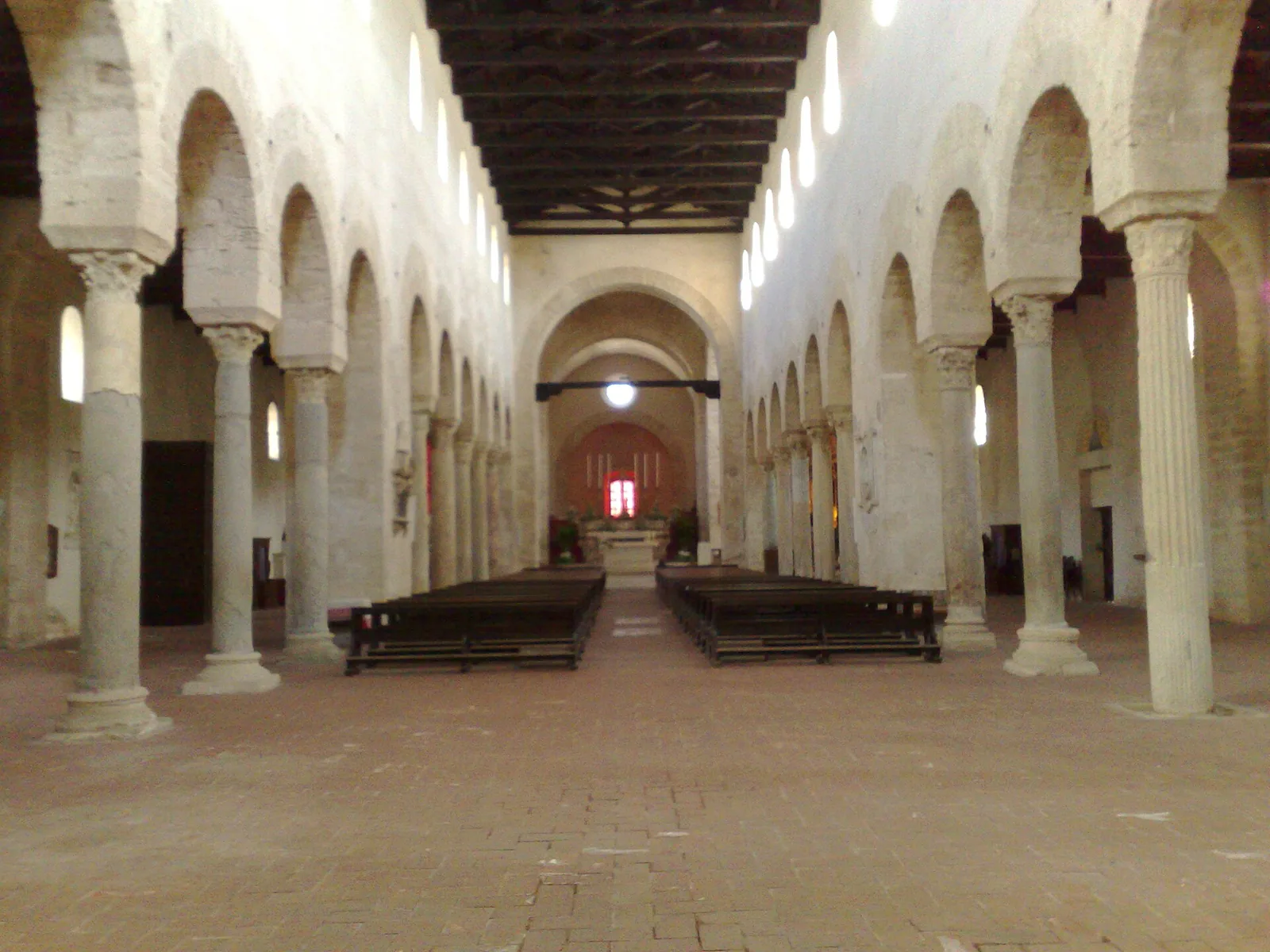
The later Normans left their mark on this Greco-Byzantine art landscape, above all through architecture and church organisation. In the Diocesan Museum in Gerace, one can see exhibits that illustrate this cultural interweaving. The collection includes liturgical objects, vestments, choral books, reliquaries and furnishings connected with the cathedral and the town’s former religious life.
| Element of the Cittadella Vescovile Complex | Historical and Functional Significance | Status in the Museum Project |
|---|---|---|
| Co-cathedral Basilica | Symbol of Norman power and a place of transition from the Greek-Byzantine tradition to the Latin one. | Open for worship after renovation funded by the PNRR. |
| Crypt (Soccorpo) | Extensive cathedral crypt linked to its historical liturgical background. | Current temporary museum location. |
| Palazzo Vescovile | Seat of episcopal authority and archives. | Part of the historic episcopal complex. |
| Seminary | Church institution for the formation of the clergy. | Future main exhibition venue. |
The museum collection complements the history of the cathedral and the former diocese. Manuscripts and religious texts provide liturgical context, while silverware, paraments and reliquaries show the material side of worship. Thanks to this, visitors can trace the development of Gerace’s religious traditions without separating the exhibits from the place they come from.
Watch on YouTube
The Staurotheke of Gerace – the Most Precious Byzantine Reliquary
The best-known and theologically significant object in the museum's collection is the Staurotheke, a reliquary of the Wood of the True Cross. This masterpiece of Byzantine goldsmithing dates from the 12th century; in Gerace it is associated with Bishop Athanasios Chalkeopoulos (Atanasio Calceopulo), who held office in 1461–1497. The Staurotheke is made of gilded silver and ranks among the most precious objects associated with the cult of relics in this place.
The name itself explains its function: a staurotheke is a reliquary intended for housing a fragment of the lignum crucis, or relic of the Wood of the True Cross. In the Byzantine and Latin worlds, such relics were among the most precious, used in liturgy, processions and as marks of a church's or bishop's prestige. The term derives from the Greek stauros (cross) and theke (container, case).
The object takes the form of a patriarchal cross measuring 15.7 cm in height and 8 cm in width. The front features quatrefoil decorations, while the reverse presents vegetal motifs. The Staurotheke was not only an object of worship but also a symbol of episcopal authority legitimisation.
The Cathedral of Santa Maria Assunta in Gerace – Historic Heart of Sacred Art
The Cathedral of Santa Maria Assunta as a Witness to History
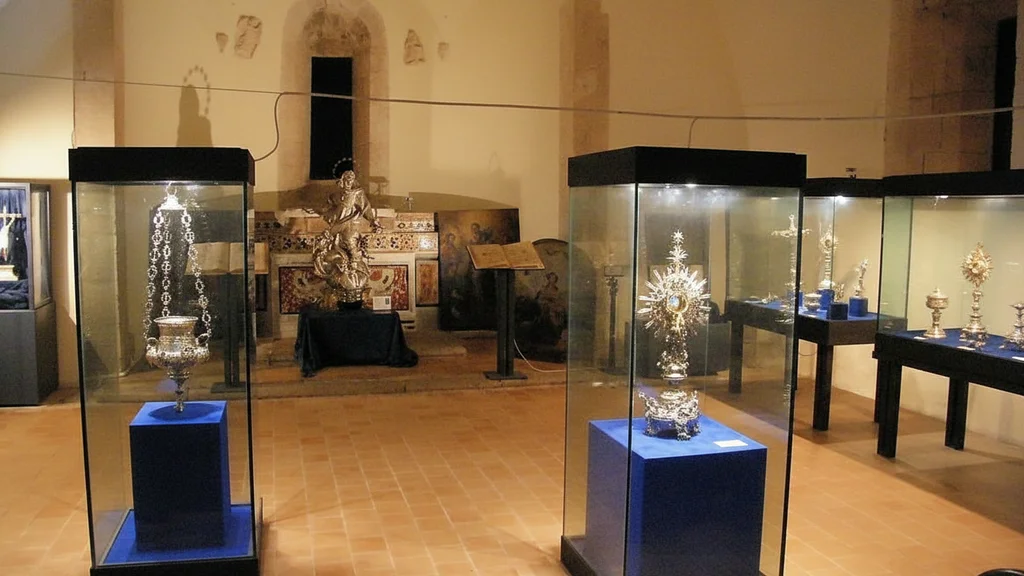
The Cathedral of Santa Maria Assunta in Gerace is one of the most important and oldest sacred monuments in Calabria. It was built in 1085–1120 on the remains of the earlier 8th-century church of Hagia Kyriake (Saint Kyriake). It covers 1,898 m², has three naves, and its style is described as Byzantine-Romanesque-Norman. Its present form is the result of a long history of construction, rebuilding and repairs following successive earthquakes.
Cultural and Artistic Significance
The cathedral played a significant role in the local community as a place of worship and a space for the development of sacred artistry. It has a basilican plan with three naves, supported by 20 ancient reused columns (spolia). The extensive soccorpo, or crypt, covers about 500 m² and has 26 columns. It is precisely the combination of Norman, Romanesque and Byzantine elements that makes the museum best viewed together with the church itself.
The Cathedral as a Centre of Tradition
The continuity of artistic traditions associated with the cathedral directly influences the museum's collections. The influences of Byzantine, Norman and later early modern styles shaped the temple's architecture and inspired the creators of the exhibits. The bell tower also reflects later transformations, clearly showing how layered the history of this place is.
Cultural Influences on Sacred Art in Calabria – in the Diocesan Museum Collection
The Diocesan Museum in Gerace brings together works of art and liturgical objects connected with the region’s complex religious history. The exhibits on display bear witness to the influences of numerous ecclesiastical traditions. One of the most significant elements of Byzantine heritage is the 12th-century staurotheke, together with Greek manuscript fragments discovered in the bindings of later choral books.
The next stage comprises Norman elements, strongly evident from the 11th century in the cathedral’s architecture and in the organisation of church space. Later exhibits include, among others, a chalice from 1726, Bishop Pellicano’s monstrance, wooden sculptures and liturgical paraments. Early modern paintings should not be overlooked either, including the large altarpiece (pala d’altare) with Saint Catherine of Alexandria from 1589 and paintings from the 17th and 18th centuries. Art evolved here from Greco-Byzantine roots towards Latin and early modern forms.
To see this interplay of influences, it is worth looking at the kinds of objects that make up the treasury and museum collection. These include reliquaries, monstrances, chalices, processional crosses, liturgical vestments, choir books and fragments of Greek codices. Such a range clearly shows the breadth of the collection – from the Middle Ages to the 18th century.
Religious Manuscripts – Treasures of the Diocesan Museum
The Diocesan Museum in Gerace, also known as the Museo Diocesano di Gerace, possesses an important group of manuscripts and parchment fragments. Beneath the covers of Latin choral books, parchment fragments belonging to medieval Greek manuscripts from the 10th–12th centuries were found. This collection, known as “Graeca a Gerace,” is an important key to understanding the process of Latinisation of Calabria.
The Collection of Religious Manuscripts
The collection comprises eleven Latin choir books from the late 15th century and seven Greek parchment fragments from the 10th–12th centuries discovered during their restoration. The exhibition “Graeca a Gerace” focuses precisely on these seven Greek fragments, found during work on the choir books produced at the end of the 15th century on the initiative of Bishop Athanasios Chalkeopoulos. The fragments document the diocese’s transition from the Greek rite to the Latin rite around 1480. Southern Calabria for centuries remained under strong Byzantine influence, so the presence of Greek fragments in Gerace is part of the wider history of the region.
Significance of the Manuscripts and Their Preservation
The manuscripts serve an educational function, enabling palaeographic research into medieval writing techniques. The transition to the Latin rite was gradual here, intensifying between the 15th and 16th centuries, and the secondary use of Greek parchments as bookbinding waste is one of the most eloquent traces of this change. Thanks to this, these unique testimonies to the dialogue between East and West remain important not only for the history of the Church but also for the history of all Calabria.
Textiles and the Flemish Tapestry
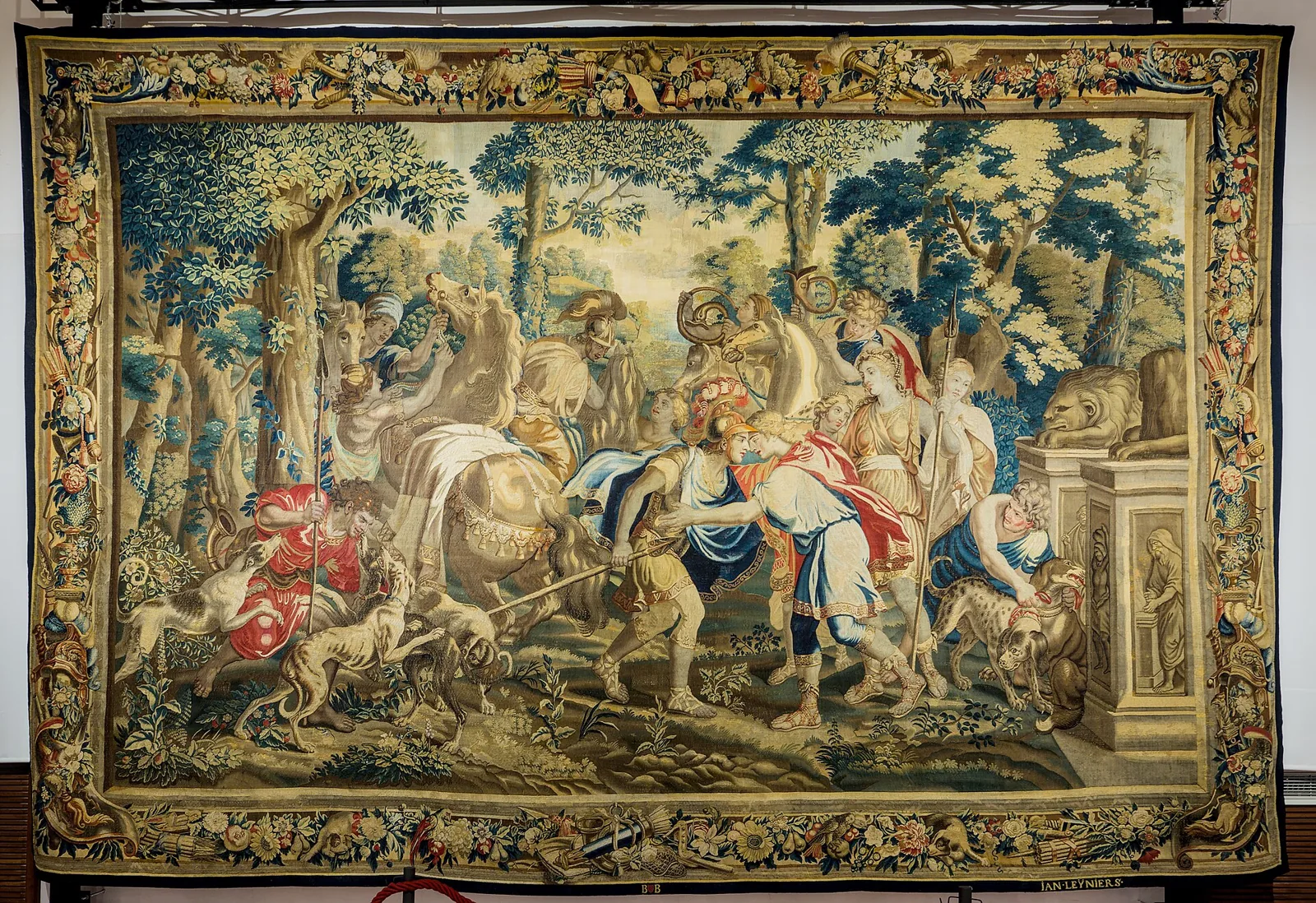
An exceptionally valuable element of the collection is the large-format Flemish tapestry from the 17th century. The Gerace tapestry measures 3.80 m in height and 5.84 m in width, so it affects the viewer above all through its scale and dense composition. It is signed by the Brussels weaver Jan Leyniers and was made around 1673–1680 after a design by Charles Le Brun. It shows an episode from the myth of Meleager told in Ovid’s Metamorphoses – the exact identification of the scene remains uncertain, and the tapestry is thought to be the only surviving piece of a larger cycle.
This is one of those works that immediately reveal the ambitions of former patrons and the broad artistic contacts of the ecclesiastical elite. Its very style and scale are a reminder that Gerace was not a provincial backwater but an important point on the sacred map of Calabria. In the museum, the tapestry contrasts well with the treasury’s metalwork and liturgical objects, because it shows another side of ecclesiastical patronage.
The textile section also preserves a rich collection of liturgical paraments, including chasubles and copes made from precious silks. A special place is occupied by products associated with the Catanzaro silk-manufacturing tradition of the 17th and 18th centuries. This part of the exhibition complements the treasury well – instead of metal and stone, you see colour, texture and the ceremonial splendour of the liturgy.
Museum Innovation and Education – Gerace Borgo Smart
The museum is developing educational and promotional activities linked to the “Gerace Borgo Smart” project. Such initiatives help visitors read the collection not only as a treasury but also as a story about the town, the cathedral and the long history of a cultural borderland. What matters most, however, is the direct encounter with the artefacts in the authentic setting of the former episcopal complex.
| Digital Technology and Service | Function and Application | Availability and Cost |
|---|---|---|
| Project digital materials | Supporting the narrative about the town's and cathedral's history. | Depends on the current project organisation. |
| Gerace Virtual Reality Experience | VR experience at the Museo Civico in Piazza Tribuna: 15–20 minutes, max. 10 participants, available with the Circuito Museale e Comunale ticket. | Availability is worth checking on site. |
| Art Laboratories | Workshops related to local craftsmanship and education. | Advance reservation may be possible. |
| Educational content | Help with interpreting the sacred collections. | Depends on the current offering. |
Practical Information
Location: Piazza Tribuna 1, Gerace (RC) – Cittadella Vescovile complex
Hours: in summer daily 9:15–13:00 and 15:00–20:00; in winter Tuesday–Saturday 9:30–12:45 and 15:00–17:00, Monday closed
Tickets: for current costs, contact the venue on 0964 356323
Getting there: The nearest railway junction is Locri on the Ionian line Reggio Calabria–Catanzaro Lido. From Locri to Gerace is about 10 km uphill on a provincial road, and with limited bus connections, the most reliable option is often a car, a taxi or checking local services in advance.
The entrance is from Piazza Tribuna 1. Official information indicates that the site has architectural barriers, so visitors with limited mobility should contact the staff before visiting. This contact is also useful for confirming admission costs and any organisational changes. In the summer season the opening hours are longer; in winter, the visit needs to be planned around shorter opening windows.
The museum and soccorpo deserve approximately 30–60 minutes. If you also plan to enter the co-cathedral and take a leisurely walk around the historic centre, it is sensible to allow 1.5–3 hours. Gerace sits on a hilltop, and the old town has steep sections and cobblestone streets, which matters for families with pushchairs and visitors with limited mobility.
In practice, it is wise to treat accessibility with caution. Routes to the buildings lead along sloping streets and cobblestones, and crypts and historic interiors often have stairs or uneven surfaces. Since architectural barriers are officially indicated, it is best to call 0964 356323 before arrival and confirm the actual entry conditions.
Frequently Asked Questions
What can you see at the Diocesan Museum in Gerace?
The museum houses the Staurotheke, a reliquary of the True Cross, fragments of Greek manuscripts known as “Graeca a Gerace,” precious textiles (including a large Flemish tapestry), and a treasury with reliquaries, chalices, monstrances and processional crosses.
What are the museum's opening hours?
In summer the museum is open daily 9:15–13:00 and 15:00–20:00. In winter it is open Tuesday to Saturday 9:30–12:45 and 15:00–17:00, and closed on Monday.
How much does admission cost?
For current admission costs, contact the venue directly on 0964 356323. This is the most reliable way to confirm the price before your visit.
Where exactly is the museum located?
The museum is located at Piazza Tribuna 1 in Gerace, within the Cittadella Vescovile complex, with current exhibitions housed in the co-cathedral basilica's crypt.
Is the museum accessible for visitors with disabilities?
Official information indicates the presence of architectural barriers. Due to Gerace's hilltop location, cobblestone streets, and stairs and uneven surfaces in historic interiors, it is best to contact staff before your visit to confirm entry conditions.
Sources
The information in this article was verified against the following sources:
- Museo diocesano di gerace – cultura.gov.it
- Comune di Gerace - Museo Diocesano – comune.gerace.rc.it
- Comune di Gerace - La cattedrale – comune.gerace.rc.it
- CALCEOPULO, Attanasio - Enciclopedia - Treccani – treccani.it
- Gerace - Enciclopedia - Treccani – treccani.it
- Cenni Storico Artistici - Cittadella Vescovile di Gerace – cittadellavescovilegerace.it
- A Gerace l’inaugurazione della mostra di manoscritti greci medievali “Graeca a Gerace” | La… – rivieraweb.it
- Città Millenaria – Explore Gerace – exploregerace.it
- Gerace Virtual Reality Experience – Explore Gerace – exploregerace.it
Last updated: