The Norman Castle in Gerace is a destination for travellers interested in medieval architecture, Calabria's history, and good viewpoints. Perched on a monumental sandstone rock at an altitude of approximately 470–500 metres above sea level, on a scenic foreground of Aspromonte, it offers a wide panorama of the Ionian coast and an insight into the history of one of the most important historic towns of the Locride area. Exploring these ruins, you will discover a place whose significance came above all from its control over the elevated part of Gerace and the routes between the sea and the hinterland.
Before the Normans reached Gerace, the town was already an important Byzantine centre in Calabria. It grew as a place of refuge for people fleeing coastal Locri after raids and instability on the coast in the early Middle Ages. The name Gerace itself is sometimes linked in local tradition to the Greek word hierax, meaning hawk, but this is more of a legend than a certain etymology.
Table of Contents
The Strategic Importance of the Norman Castle in Gerace
Construction History and Norman Conquests in Southern Italy
In the 11th century, as the Normans gradually took control of southern Italy, Gerace became an important point in their policy in Calabria. The conquest of the region was led primarily by Robert Guiscard and Roger I, and the town entered the Norman sphere of influence during this period. The location on a steep hill favoured defence and allowed control of the Locride territory and the routes connecting the coast with the mountainous hinterland.
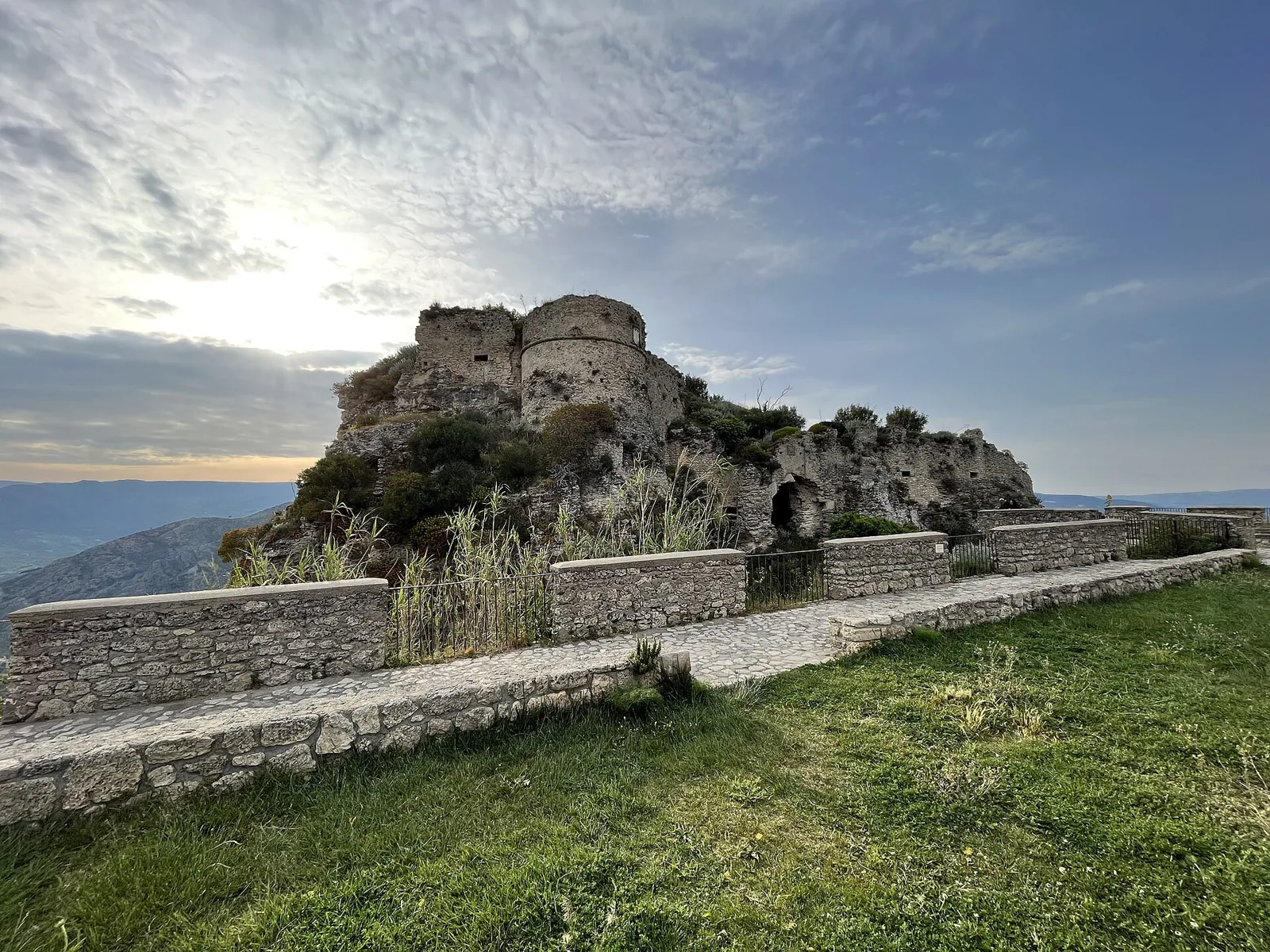
The view of the Ionian Sea was not merely a landscape bonus. For a medieval centre, what mattered above all was the ability to observe the surroundings and maintain control over the region amid Norman-Byzantine rivalry. This is precisely why the castle ruins still explain so well why Gerace was more important than its current scale would suggest.
| Topographic Feature | Description and Strategic Function |
|---|---|
| Absolute height | 470–500 m a.s.l.; dominance over communication routes |
| Rock formation | Sandstone; a site naturally predisposed for a defensive settlement |
| Orientation | Wide panorama of the Ionian coast and the Locride area |
Architecture and Castle Adaptations
The castle in Gerace is called Norman today, but its origins are earlier. Local sources link the original fortress of Santa Ciriaca with the proto-Byzantine period, dated to the 6th–8th century, and the Normans, followed by the Swabians, Angevins and Aragonese, restored and rebuilt it; in the 16th–17th centuries it served as a prison. The remains visible today are therefore the result of many building phases, not a single 11th-century construction. In Calabrian strongholds, the term "Norman" usually refers to the political epoch and rebuilds of the 11th–12th century, while the surviving walls may also include later interventions from the Angevin and Aragonese periods.
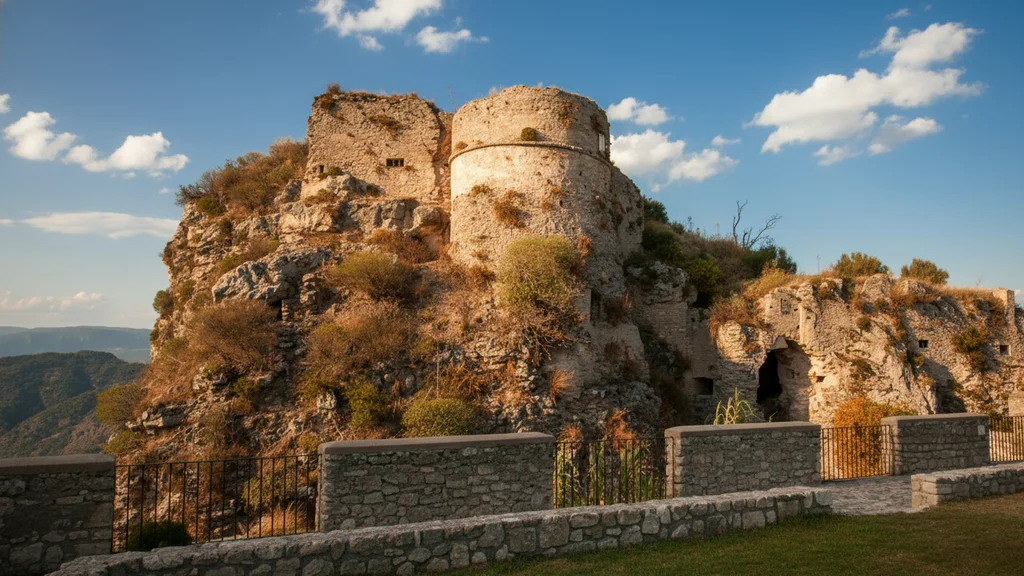
The official description of the castle lists several readable elements of the complex: a deep artificial moat, cut into the rock and separating the castle from the rest of the outcrop, and the former drawbridge supported by a still-existing pier carved into the rock. Within the ruins, sources also point to a rainwater drainage system and a well that local sources describe as Roman in origin. The preserved or described parts also include a small Byzantine oratory, an inner courtyard, a round Aragonese tower with a marble coat of arms, a facade with battlements and loopholes, and the entrance gate. Together they show the austere, practical architecture of a fortress adapted to difficult terrain and developed over successive centuries.
Period of Development under the Kingdom of Sicily
In the 12th century, after the formation of the Kingdom of Sicily, the castle in Gerace consolidated its role as an important fortress and a local administrative-defensive centre. Its significance stemmed from its location and control over a considerable part of the Locride, and successive authorities adapted it to changing political and military needs. Modernisations were related more to changes in siege techniques and dynastic conflicts than to a simple pattern of individual raids.
During the Aragonese period, the development of firearms necessitated further defensive adaptations. The Norman Castle in Gerace today constitutes ruins that attract visitors with the historical weight of the site and its picturesque location. It is one of those places where it is easy to understand how tightly geography, politics, and military affairs were intertwined in Calabria.
The Norman Castle in Gerace – Catalyst for Calabria's Development
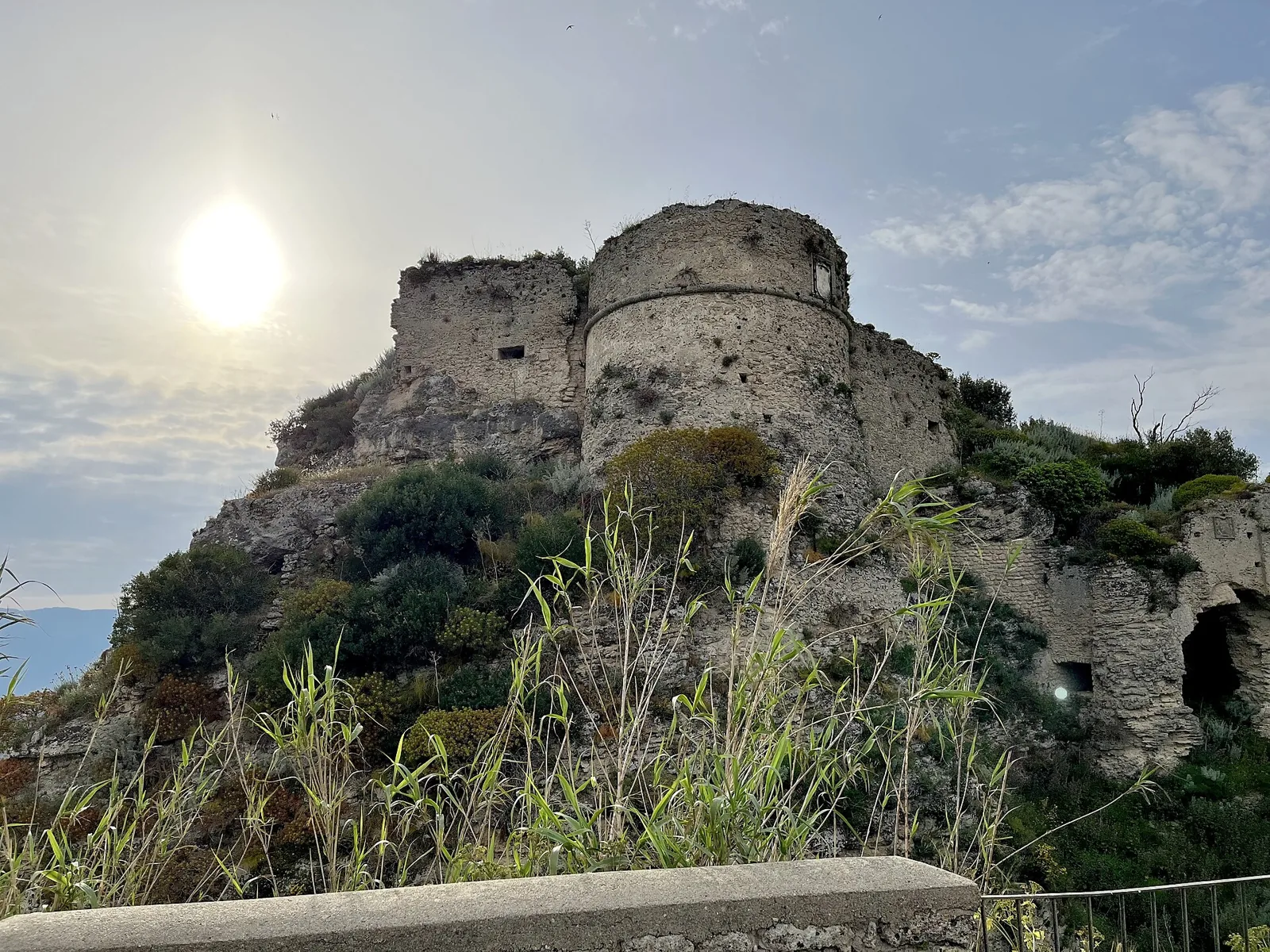
The castle in Gerace had above all strategic and defensive importance: it controlled the elevated part of the town and the routes between the Ionian coast and the hinterland. The beginnings of its special role in the Norman period date to the 11th century, when Robert Guiscard and Roger I took control of much of southern Italy. The castle became an important point of local power organisation, functioning in a town where Latin traditions overlapped with the existing Greek and Byzantine heritage.
Military Dominance and Stabilisation
The castle in Gerace served a defensive function but was also a tool of territorial control. Its presence reinforced authority over the surrounding area and over the routes connecting the coast with the interior of the region. In the realities of the 11th and 12th centuries, it was significant primarily in the context of Norman struggles with Byzantium and the ordering of local power structures.
Economic and Social Influences
The fortress strengthened Gerace's strategic position as a local centre of territorial control; later municipal sources also mention the town's importance for silk production. The Normans adapted solutions already present in the region, which helped incorporate local structures into the framework of the Kingdom of Sicily. In the case of Gerace, more important than spectacular stories of castle life is the fact that the fortress strengthened the town's position as a local centre of power.
Cultural Symbioses
The Normans laid the foundations for a cultural symbiosis of Norman and Byzantine traditions, most clearly visible in the Cathedral of Santa Maria Assunta. This monument from the 11th–12th century is one of the key examples of Norman architecture in Calabria. Gerace is not without reason sometimes called "the city of a hundred churches" – this traditional designation well captures the town's standing as one of the most important medieval sacred centres of the region.
In the cathedral nave there are 20 granite and marble columns, at least some of which sources associate with reused columns from ancient Locri Epizephyrii. In this context, the castle and the cathedral form a shared story of Gerace: a town that was not merely a fortress but a complete medieval organism.
The Castle's Legacy in the Region
Calabria's castles have remained enduring witnesses to medieval systems of power, borders, and territorial control. In Gerace, one can particularly well see the relationship between the fortress and the layout of the old town, its steep streets and stone buildings climbing towards the highest point of the hill. Today the castle's value lies not in the completeness of its walls, but in the readable relationship between the ruin, the town, and the landscape of the Locride.
Traces of the Past at the Norman Castle in Gerace
Archaeological Treasures from the Past
In the case of Gerace, the most valuable aspect is not so much a museum accumulation of artefacts as the sheer legibility of the site in the landscape. On the hilltop, one can see the remains of walls, sections of the defensive perimeter, and fragments of summit structures that allow one to imagine the former scale of the complex. It is primarily a historical-urbanistic and scenic site, not an archaeological site arranged like a classical exhibition with display cases.
Medieval Walls and Defensive Systems
The most tangible remains are sections of walls and relics of former fortifications integrated into the natural layout of the rocky hilltop. These best show how closely defence was linked to the topography of the site. Walking through the ruins, it is easy to see that the fortress was conceived as part of a larger urban system, not as a solitary stronghold detached from the rest of Gerace.
Drainage and the Well
Among the ruins, one can also discern traces of practical solutions, including systems for draining and collecting rainwater and a surviving former well. In such an elevated and exposed location, this was of fundamental importance for the functioning of the defensive complex. Even without detailed reconstructions, it is clear that the castle was designed with self-sufficiency in mind under difficult conditions.
Spatial and Scenic Context
Today this site works primarily through context: the ruins, the panorama, and the relationship with the historic town below. From a visitor's perspective, the most important things are the preserved fragments of structures and the chance to see how the castle dominated the Ionian coast and the Locride. It is precisely this perspective that best explains its former political and military role.
Watch on YouTube
Reconstruction and Protection Strategies for the Norman Castle in Gerace
Protecting Norman castles requires a combination of historical knowledge, conservation, and a cautious approach to the surviving fabric. The history of the castle in Gerace is also a story of the struggle against the forces of nature, especially after the great earthquake of 1783. This cataclysm seriously damaged the fortress structures and accelerated its fall into ruin, leading to the loss of its former defensive and functional roles.
Conservation Challenges
Work on the ruins requires detailed conservation documentation and the securing of the surviving walls. The main challenge remains the condition of the relics and their exposure to atmospheric conditions on the rocky, elevated terrain. For such a site, the priority is securing the walls and the legibility of the complex rather than full reconstruction.
Restoration and Securing the Ruins
The official CIS list provides for the restoration, return to use, structural consolidation and better presentation of the castle ruins in Gerace. Without project documentation, it is hard to say anything about the details of the works. This scope points to protective and conservation measures intended to stabilise the ruins and improve the way they are made accessible. In practice, the most important goal is preserving the authentic character of the place, not recreating the castle as a new, complete building.
Protection through Education and Tourism
In the case of Gerace, a crucial role is played by simply telling the story of the place in a readable way. The castle ruins work best when viewed as part of the broader history of the town, its cathedral, former churches, and the street layout climbing towards the hilltop. It is precisely the combination of a walk through the old town with an ascent to the castle that gives the fullest picture of medieval Gerace.
Funding as the Key to Success
The CIS "Calabria – Svelare Bellezza" list includes an item for the restoration, recovery, consolidation and enhancement of the castle in Gerace (no. A2_120). The applicant is the municipality of Gerace (Comune di Gerace), and the indicated funding amount is 2,500,000 euros. The project has medium priority. For ruins so strongly tied to the landscape, every investment should balance the protection of the monument with the convenience of visitors and should not lead to excessive "smoothing over" of the site.
Practical Information
Location: Castello district, the highest point of Gerace (470–500 m a.s.l.); the official entrance is from Viale Castello.
Access: From the upper part of the old town, the walk usually takes about 10–15 minutes on foot, uphill along historic, uneven stone streets
Visiting status: Primarily ruins viewed independently, not a regularly operating museum site; according to the municipality's official website, the site is always accessible.
Tickets: Admission is free.
Visit duration: A short walk to the ruins and time at the viewpoint usually takes about 20–30 minutes
Viewpoint: From the esplanade in front of the castle (the Baglio) you can see the whole valley down to the Ionian Sea and the Locride.
Getting to Gerace: Gerace lies about 10 km inland from Locri; by car the drive usually takes about 15 minutes via the SP1 provincial road (the former SS111).
Public transport: The nearest railway station is in Locri on the Ionian line Reggio Calabria–Catanzaro/Lamezia; Trenitalia indicates travel by train to Locri, followed by a bus to the centre of Gerace operated by Autolinee Federico S.p.A. The Locri–Gerace bus ticket cannot be purchased separately in Trenitalia systems; sales cover the combined train+bus journey as a single ticket.
The walk to the castle is scenic but can be demanding. The route leads uphill on uneven old town surfaces, so in summer it is worth bringing water and being mindful of sun exposure. The site may be difficult for wheelchairs and visitors with limited mobility due to the steep approach and cobblestone streets.
Frequently Asked Questions
What remains of the Norman castle in Gerace?
The castle retains primarily remains of defensive walls, sections of the perimeter, and fragments of structures at the hilltop. Remains of systems for draining and collecting rainwater are also visible, including a surviving former well. It is a ruin of great landscape and historical value, more legible in the terrain than as a classical exhibition of artefacts.
Can you see the sea from the castle ruins in Gerace?
Yes, the castle ruins offer a wide panorama of the Ionian Sea and the Locride area. The view is today one of the strongest reasons to make the climb – especially in good weather and clear air.
How do you get to the castle in Gerace?
The castle is reached via narrow streets of Gerace's historic centre, climbing towards the Castello district. From the upper part of the old town, the walk usually takes about 10–15 minutes, but you should expect uneven, cobblestone surfaces and a steep approach.
Who built the castle in Gerace?
The castle owes its current name and most important historical phase to the Normans, who took Gerace in the 11th century and strengthened an earlier complex (the Byzantine fortress of Santa Ciriaca). In practice, the visible remains are the result of several building stages and later rebuilds, not a single construction attributed solely to Roger I.
Why is the castle in Gerace in ruins?
The main cause of the castle's destruction was the devastating earthquake of 1783, after which the fortress began to lose its former functions and gradually fell into ruin. It is the effects of this cataclysm that best explain the current state of the site.
Sources
The information in this article was verified against the following sources:
- Comune di Gerace - Il Castello – comune.gerace.rc.it
- Comune di Gerace – comune.gerace.rc.it
- Il Castello di Gerace | Turismo Reggio Calabria – turismo.reggiocal.it
- Gerace | Trenitalia – trenitalia.com
- politichecoesione.governo.it (PDF) – politichecoesione.governo.it
- Il Castello – Explore Gerace – exploregerace.it
- Che cosa vedere a Gerace | Touring Club Italiano – touringclub.it
- Wikipedia – Gerace – en.wikipedia.org
Last updated: