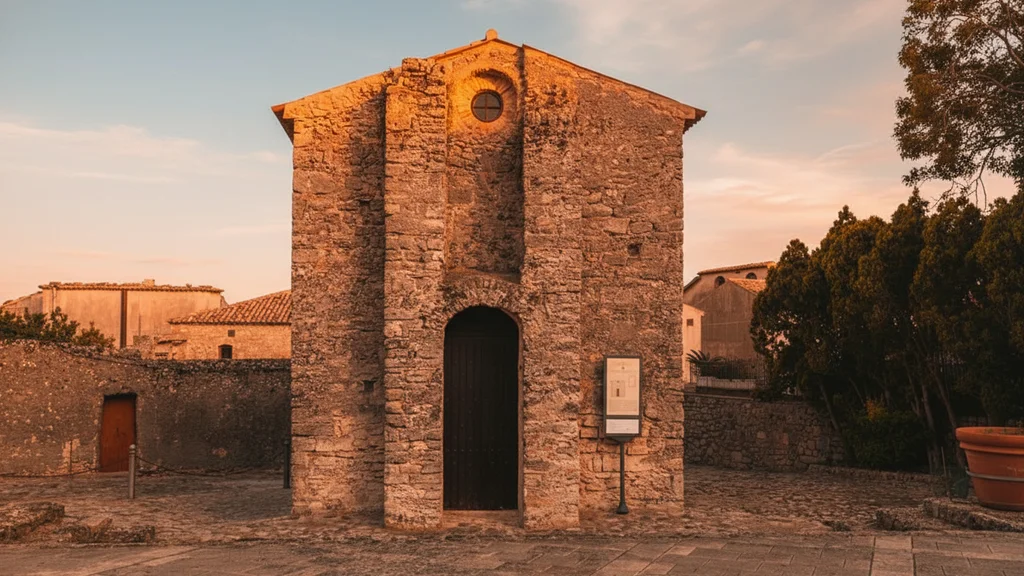
The Church of San Giovannello in Gerace is an exceptional example of Byzantine architecture in southern Italy, representing an architectural and spiritual expression of Calabria's heritage. Situated on the picturesque Aspromonte hill, it attracts attention not only for its history but also for its preserved sacred elements dating back to the 11th century. This temple, also known as San Giovanni Crisostomo, stands as a repository of cultural identity for the Locride region, captivating both history scholars and lovers of Eastern art.
The town of Gerace, perched on a rocky plateau, was founded as a result of the exodus of people from ancient Locri Epizephyrii in the 8th century. Saracen attacks and the threat of piracy forced coastal inhabitants to seek safer refuge inland. This migration also transferred the episcopal seat, turning Gerace into a “Sacred Mountain” dotted with numerous churches and monasteries, of which San Giovannello remains the most authentic testimony of the Greek rite.
The Byzantine Legacy in Calabrian Architecture – Influences on Churches and Sacred Buildings
Byzantine architecture left a lasting mark on many parts of southern Italy, particularly in the region of Calabria. The Byzantine presence, which dominated here for several centuries, gave rise to numerous sacred buildings that continue to fascinate with their complexity and beauty. The foundation of the Church of San Giovannello is dated between the 10th and 11th centuries, placing it at a pivotal moment of transition between Byzantine rule and Norman domination.
Churches and Chapels as Testimony of Byzantine Influence
A prime example of the monumental impact that Byzantine architecture had on the region is the Church of San Giovannello in Gerace. The building originally served as a katholikon – the main church of a female monastery dedicated to St. John Chrysostom. Archaeological research from 1995 revealed foundations and structures adjacent to the present-day temple, confirming the existence of a former monastic complex.
Another exceptional example of Byzantine architecture in Calabria is the Cattolica di Stilo. This ninth-century church, built on a square plan resembling a Greek cross with a central dome, illustrates the influence of Byzantine masters on local architecture. The interior of this temple is adorned with remarkable frescoes that not only reflect biblical motifs but also harmoniously combine elements of Eastern and Western Christian art.
| Comparative Feature | San Giovannello (Gerace) | Cattolica di Stilo |
|---|---|---|
| Building Plan | Single-nave, rectangular | Greek cross inscribed in a square |
| Exterior Decoration | Austere, stone and brick | Rich, brick patterns |
| Original Function | Katholikon of a female monastery | Probably a hermitic church |
| Relation to Town | Part of dense urban fabric | Isolated on a mountainside |
Neo-Byzantine Elements in Calabria
After the great earthquake of 1908, Reggio Calabria was rebuilt preserving certain features of Neo-Byzantine architecture. These elements can be seen in landmarks such as Villa Zerbi, which reference the centuries-old Byzantine heritage of the region. This appeal to Byzantine aesthetics was not merely an act of preserving historical identity but also a testament to cultural continuity deeply rooted in regional architecture.
Architectural Morphology and the Concept of Intentional Imperfection
The architecture of San Giovannello is characterised by simplicity of form and clarity of divisions, typical of smaller Byzantine buildings. The structure has a single nave, built from local stone, mortar, and brick, with a gabled roof of the “capanna” type. At the western peak stands a characteristic screen bell tower, giving the building a modest profile that harmonises with the surrounding architecture.
One of the most fascinating aspects of San Giovannello's architecture is what researchers describe as “unique imperfection.” The church's apse is not perfectly symmetrical; its twist, oscillating between 60 and 120 degrees, is a deliberate device of profound theological symbolism. This renunciation of geometric rationality in favour of asymmetry aims to create an atmosphere of intimacy, reflecting the Byzantine belief in the primacy of spiritual depth over outward ostentation.
Italian archaeologist Paolo Orsi described the church as a jewel that should be kept under a glass dome due to its extraordinary historical value. The technique of “environmental masking” causes the building to blend with its surrounding architecture, avoiding conspicuousness. The interior of San Giovannello strictly adheres to the requirements of Byzantine liturgical rite, with clearly visible niches for the Prothesis and Diaconicon in the altar area.
Restoration of San Giovannello – Protecting Byzantine Heritage in the 20th Century
Rehabilitation and Renovation in the Mid-20th Century
The Church of San Giovannello in Gerace underwent intensive restoration processes in the 20th century, aimed at restoring its former glory. Although the temple was in a difficult condition after decades of neglect, the actions taken by Italian institutions demonstrated the scale of commitment to heritage protection. Today, the church serves as the Pan-Italian Orthodox Sanctuary (Santuario Ortodosso Panitalico), restoring its original spiritual role.
The 1950s: Structural Reconstruction and Restoration
After World War II, when San Giovannello required urgent intervention, the Italian Ministry of Cultural Heritage (MiBAC) undertook the task of reconstruction. Roberto Pane, a renowned architect specialising in monument restoration, led works that included reinforcing key structural elements. These works were essential for ensuring the building's stability and enabled further stages of interior renovation.
Preserving the Byzantine Decoration
Particular attention was devoted to the church interior, especially fragments of Byzantine painting preserved in the apse. Through the use of specialised conservation techniques, some of the richly decorated details were restored, including Greek monograms serving as a link to the Byzantine era. These processes became an opportunity for education and promotion of Greco-Byzantine heritage throughout the Calabria region.
The 1990s: Completion of Works and Renewed Adaptation
Final restoration works focused on readapting the church for liturgical needs and protecting it from environmental impact. In 1997, the church was granted the status of Pan-Italian Orthodox Sanctuary, making it the most important point of reference for Orthodox faithful in Italy. Modern protective systems against wall erosion were also installed, safeguarding the historic fabric for decades to come.
Byzantine Calabria – Bastion of Greek Culture and Religion in the Middle Ages
Calabria in the Middle Ages was an extremely important bastion of Greek culture and religion. During this period, the Greco-Byzantine rite dominated, and numerous monasteries testified to the deep roots of Eastern traditions. The Church of San Giovannello remains faithful to Byzantine simplicity, serving as a counterpoint to the majestic Norman cathedral erected in 1045, which symbolised the process of re-Latinisation of the region.
The significance of Calabria as a centre of Greek culture was also manifested in literature and scholarship. Figures such as Barlaam of Calabria, Bishop of Gerace in the 14th century, played a decisive role in the rediscovery of ancient Greek in Western Europe. Barlaam was a teacher of such masters as Petrarch and Boccaccio, proving that Gerace was a vibrant intellectual centre in dialogue with the emerging humanism.
In recent years, knowledge of this region has been expanded thanks to the “Graeca a Gerace” project. During the renovation of Latin books, 39 parchment fragments hidden in their bindings were discovered. These manuscripts, dated from the 10th to the 12th century, contain liturgical texts and fragments of the Gospels, confirming Gerace's role as a centre of manuscript production at the crossroads of Eastern and Western cultures.
Norman Adaptation of Sacred Architecture in Calabria and Sicily
The transformation of sacred buildings by the Normans encompassed not only Apulia but also Calabria and Sicily. This process began in the 11th century, when the Normans became a catalyst for stylistic evolution. Many Byzantine churches preserved their original simplicity of form, yet were enriched with elements of Western architecture, such as pointed arches and carved Romanesque portals.
Integration of Styles and the Norman Legacy
San Giovannello, despite its modest dimensions, is a perfect example of stylistic harmony, where an austere facade conceals an interior of rich symbolism typical of late Byzantine architecture. The Norman legacy influenced the further development of Renaissance and Baroque styles in the region, leaving a lasting mark on the culture of southern Italy. Gerace's role as a strategic point underscores the importance of both traditions that shaped the unique character of this part of Italy.
Modern Technologies in Service of Conservation – The GENESIS Project
In the face of Calabria's high seismic risk, San Giovannello has become a testing ground for innovative methods of monument protection. The GENESIS project engaged research groups to create a digital model of the temple using Scan-to-BIM technology. Through laser scanning and drone photogrammetry, a precise point cloud was created, enabling monitoring of the building's structural condition.
These studies revealed significant structural problems, including mortar degradation caused by the presence of nitrates. As part of the renovation works, “stitch and unstitch” operations were carried out, aimed at restoring the functionality of stone structural elements. The application of BIM technology allows for better planning of future repairs and sharing knowledge about the monument through virtual tours and interactive multimedia maps.
Practical Information
Location: Via Cavour, centro storico, Gerace (RC)
Hours: Visit by prior arrangement; often open to tourists during summer season
Tickets: Free admission
Getting there: From Locri via SP1 road (approx. 10 km inland)
Frequently Asked Questions
What makes the Church of San Giovannello in Gerace unique?
The church is distinguished by its unique “intentional imperfection” – its apse is deliberately asymmetric, carrying deep theological symbolism. It is also one of the best-preserved examples of single-nave Byzantine architecture in Calabria.
What period does the Church of San Giovannello date from?
The building dates from the turn of the 10th and 11th centuries, constituting a key testimony to the transitional period between Byzantine and Norman rule in southern Italy.
Why does Gerace have so many Byzantine churches?
Gerace became a refuge for people fleeing Saracen attacks from the coast. As the new episcopal seat, the town became a spiritual centre of the Greek rite, resulting in the construction of numerous temples and monasteries.
What functions does the Church of San Giovannello serve today?
Today the church serves as the Pan-Italian Orthodox Sanctuary (Santuario Ortodosso Panitalico), a living centre of the Greco-Orthodox rite within the structures of the Metropolis of Italy of the Patriarchate of Constantinople.
What is the “Graeca a Gerace” project?
It is a scholarly initiative that led to the discovery of 39 fragments of Greek manuscripts from the 10th–12th centuries hidden in the bindings of later Latin books, shedding new light on the Byzantine heritage of the region.