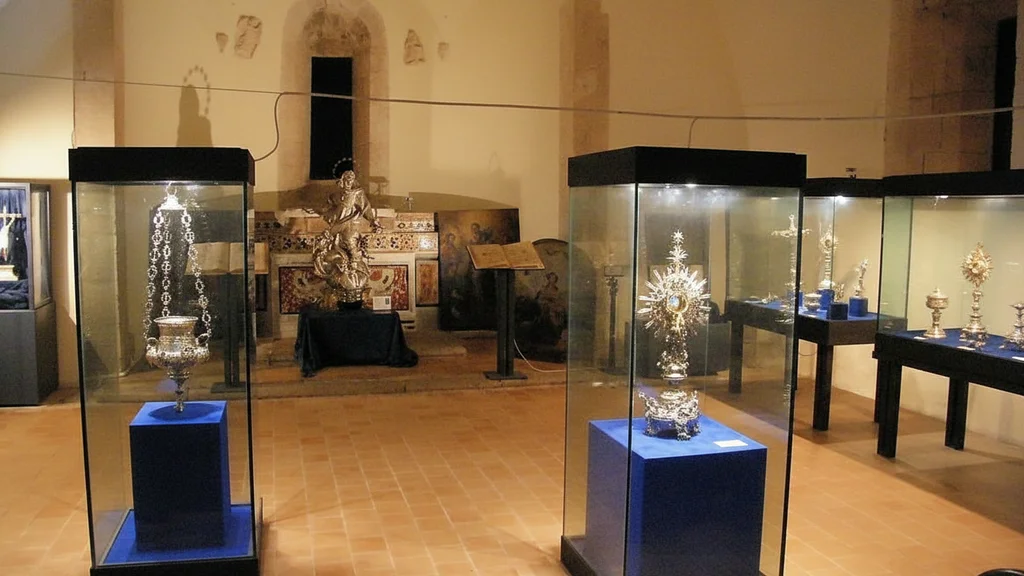
When visiting Calabria, the Diocesan Museum in Gerace (Museo Diocesano e del Tesoro della Cattedrale) is an essential stop for lovers of sacred art. This place of exceptional artistic and religious significance presents a rich collection of sacred works that constitute a living testimony to the cultural evolution of the Mediterranean basin. In the heart of this historic town, known as the Florence of the South, one can discover artefacts combining Byzantine, Norman, Arab, and Latin influences.
The institution, established in 1996, found its home in the Cittadella Vescovile complex, to protect and promote the heritage of the co-cathedral basilica of Santa Maria Assunta and surrounding parishes. Gerace rises on a sandstone hill that became a refuge for fugitives from ancient Locri Epizephyrii between the 7th and 9th centuries. This strategic location allowed the town to become a powerful spiritual centre, reflected in the monumental architecture of the episcopal complex built from 1045.
The Legacy of Byzantium and the Normans – Development of Sacred Art in Calabria
Calabria, a region full of cultural contrasts and historical depth, has a long tradition of sacred art that is inseparably linked to the Diocesan Museum in Gerace. The museum bears witness to the rich history of Byzantine and Norman influences that shaped the region. In the Middle Ages, Calabria was an important point on the map of Byzantium, which fostered the development of a unique aesthetic, visible in precisely crafted icons and rich decorative symbolism.
The later Normans left their mark on this Greco-Byzantine art landscape, introducing new architectural elements. In the Diocesan Museum in Gerace, one can admire exhibits that perfectly illustrate this cultural amalgam. The collection includes paintings, frescoes, and liturgical objects created by the hands of ancient masters, including chalices, vestments, and rich altar furnishings.
| Element of the Cittadella Vescovile Complex | Historical and Functional Significance | Status in the Museum Project |
|---|---|---|
| Co-cathedral Basilica | Symbol of Norman power, centre of the Latin rite. | Open for worship after PNRR renovation. |
| Crypt (Soccorpo) | Site of the first hermitic laurae (7th–8th c.). | Current temporary museum location. |
| Palazzo Vescovile | Seat of episcopal authority and archives. | Location of the Leyniers tapestry exhibition. |
| Seminary | Historic centre of public education. | Future main exhibition venue. |
Sculptures and bas-reliefs made in local workshops reflect the influences of various artistic styles. Religious manuscripts and texts complement the museum collection, providing a literary context. Thanks to this, visitors can trace the development of religious traditions and understand the role of art in shaping local community identities.
The Staurotheke of Gerace – the Most Precious Byzantine Reliquary
The most iconic and theologically significant object in the museum's collection is the Staurotheke, a reliquary of the Wood of the True Cross. This masterpiece of Byzantine goldsmithing dates from the 12th century, though it probably arrived in Gerace only in the 14th century. The Staurotheke is made of gilded silver, decorated with enamels, semi-precious stones, and pearls, testifying to the highest craftsmanship of its makers.
The object takes the form of a patriarchal cross measuring 15.7 cm in height and 8 cm in width. The front features quatrefoil decorations, while the reverse presents rich vegetal motifs. Research suggests the cross may have been made in Jerusalem or in Norman workshops in Sicily, places of a unique symbiosis of Eastern and Western goldsmithing technologies. The Staurotheke was not only an object of worship but also a symbol of episcopal authority legitimisation.
The Cathedral of Santa Maria Assunta in Gerace – Historic Heart of Sacred Art
The Cathedral of Santa Maria Assunta as a Witness to History
The Cathedral of Santa Maria Assunta in Gerace is one of the most important and oldest sacred monuments in Calabria. It was built in the 11th century during Norman times on the foundations of an earlier 8th-century Byzantine temple. It is the most extensive sacred building in the region, covering 1,898 square metres. The cathedral is distinguished by its stone defensive tower, built in 1562 as protection against Turkish pirate attacks.
Cultural and Artistic Significance
The cathedral played a significant role in the local community as a place of worship and a space for the development of sacred artistry. Within its walls, the faithful, pilgrims, and artists could gather, creating a vibrant spiritual centre. Although the museum's collections are currently housed in the basilica's crypt (soccorpo), the cathedral remains a fundamental element for understanding local tradition, representing a synthesis of Romanesque austerity and Eastern lightness.
The Cathedral as a Centre of Tradition
The continuity of artistic traditions associated with the cathedral directly influences the museum's collections. The influences of Byzantine, Norman, and Renaissance styles shaped the temple's architecture and inspired the creators of the exhibits. The physical proximity of the cathedral and museum encourages the discovery of rich religious heritage inscribed in stone and precious metal.
Cultural Influences on Sacred Art in Calabria – in the Diocesan Museum Collection
The Diocesan Museum in Gerace represents an exceptional collection of works of art that perfectly illustrate the complex cultural interactions of the region. The exhibits on display bear witness to the influences of numerous civilisations. One of the most significant is the Byzantine heritage, visible in paintings executed in tempera on wood, which reflect specialised artistic techniques and religious symbols of the era.
The next stage comprises Norman elements, strongly evident from the 11th century. Architecture and sculptures from this period are characterised by a harmony of form and functionality, visible in the construction of wooden altars and pulpits. Renaissance influences cannot be overlooked – the exhibitions present frescoes employing perspective and new approaches to light. Art evolved here from Greco-Byzantine roots to Renaissance harmony.
The museum treasury also houses one of the richest collections of sacred silverware in southern Italy. Works by Neapolitan and Sicilian masters dominate, such as the silver statue of the Madonna Assunta from 1772, crafted by Gaetano Dattilo. Rococo silver sculpture reached its peak of lightness here, evident in the precision of decorative details commissioned by Bishop Pietro Domenico Scoppa.
Religious Manuscripts – Treasures of the Diocesan Museum
The Diocesan Museum in Gerace, also known as the Museo Diocesano di Gerace, possesses an invaluable collection of manuscripts. In 1996, a sensational discovery was made – beneath the covers of Latin choral books, 39 parchment fragments belonging to medieval Greek manuscripts from the 10th–12th centuries were found. This collection, known as “Graeca a Gerace,” is key to understanding the process of Latinisation of Calabria.
The Collection of Religious Manuscripts
The collection comprises several dozen codices dated from the 11th to the 17th century. The oldest, such as fragments of the Gospel of St. Luke, illustrate Byzantine influences. Roman missals and breviaries from later periods demonstrate liturgical reforms following the Council of Trent. The transition to the Latin rite in 1480 under Bishop Calceopulo led to the secondary use of Greek parchments as bookbinding material.
Significance of the Manuscripts and Their Preservation
The manuscripts serve an educational function, enabling palaeographic research into medieval writing techniques. The museum collaborates with scientific institutes, offering access to valuable source material. Thanks to restoration processes, such as parchment reinforcement, these unique testimonies to the dialogue between East and West have survived in excellent condition for future generations.
Textiles and Arazzo – Flemish Masterwork
An exceptionally valuable element of the collection is the large-format Flemish tapestry from the 17th century, signed by Jan Leyniers. The Leyniers family was among the most prestigious weaving dynasties in Brussels. This tapestry, made according to cartoons by Charles Le Brun, court painter to Louis XIV, is one of the most important works of Flemish art in Calabria. It attests to the refined taste of the local prelates.
The textile section also preserves a rich collection of liturgical paraments, including chasubles and copes made from precious silks. A special place is occupied by products of the Catanzaro manufactory, which in the 17th and 18th centuries was a leader in silk fabric production. Preserved chiné à la branche fabrics reveal the richness of colours that for centuries graced services in the Norman cathedral.
Museum Innovation and Education – Gerace Borgo Smart
The museum is investing heavily in digital technologies as part of the “Gerace Borgo Smart” project. Thanks to this, sacred art becomes accessible to the modern visitor. Visitors can take advantage of a 360° virtual tour or see a hologram of Count Roger I, who tells the history of the town. These initiatives are part of a strategy to inscribe Gerace on the UNESCO World Heritage List.
| Digital Technology and Service | Function and Application | Availability and Cost |
|---|---|---|
| Hologram of Roger I | Character narrating the cathedral's history. | €3.00 (included in ticket) |
| Augmented Reality (AR) | Historical visualisations on borgo streets. | Free via smartphone. |
| Art Laboratories | Workshops in weaving, ceramics, and goldsmithing. | Paid (reservation required). |
| Virtual Reconstruction | Model of the Monastery of St. John Theristis. | Available in the museum. |
Practical Information
Location: Piazza Tribuna 1, Gerace (RC) – Cittadella Vescovile complex
Hours (summer season): Daily 09:30–12:45, 15:00–19:00
Hours (winter season): Closed on Mondays
Tickets: Approx. €3.00 (25% discount for FAI members)
Getting there: From Locri via SP1 road (approx. 10 km inland)
Frequently Asked Questions
What can you see at the Diocesan Museum in Gerace?
The museum houses the Staurotheke (reliquary of the True Cross) from the 12th century, the “Graeca a Gerace” collection of Greek manuscripts, Flemish tapestries by Jan Leyniers, and a rich treasury of Neapolitan and Sicilian silverware.
What are the museum's opening hours?
In summer, the museum is open daily from 09:30–12:45 and 15:00–19:00. In winter (November–March), it is closed on Mondays.
How much does admission cost?
Basic multimedia attractions (hologram, maps) typically cost around €3.00. FAI members receive a 25% discount.
Where exactly is the museum located?
The museum is located at Piazza Tribuna 1 in Gerace, within the Cittadella Vescovile complex, with current exhibitions housed in the co-cathedral basilica's crypt.
Is the museum accessible for visitors with disabilities?
Thanks to PNRR funding, the museum is progressively introducing accessibility improvements. However, due to the historic nature of the crypt and the hilltop location, it is advisable to contact staff in advance to arrange access details.