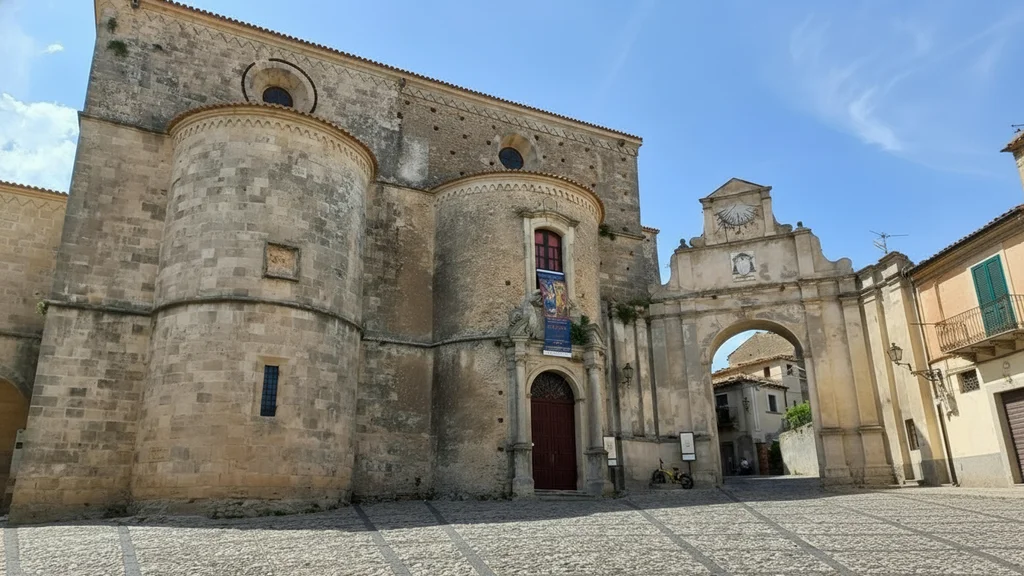
The Cathedral of Santa Maria Assunta in Gerace is one of the most significant monuments in Calabria, attracting the attention of both tourists and lovers of Italian culture. Although its impressive dimensions are often mentioned, for years its exact parameters have been debated, only adding to its mystical allure. This monumental basilica, with an area exceeding 1,690 square metres, dominates the Locride landscape, rising on a limestone cliff 500 metres above sea level. Situated in the picturesque town of Gerace, the cathedral bears witness to the rich history of the region and offers unforgettable aesthetic and cultural impressions.
Defensive Architecture and the Historical Role of the Cathedral
The Cathedral of Santa Maria Assunta in Gerace, also known as the Cattedrale di Gerace, is the principal sacred monument in Calabria, deserving special attention for its austerity. Its architecture combines unique Byzantine, Norman, and Latin influences, making it a rare example of European heritage. Construction of the present structure was carried out intensively during the Norman era between 1085 and 1120, though its foundations rest on the site of an earlier 8th-century place of worship dedicated to Saint Ciriaca. One of its most distinctive elements is the bell tower, which in its present form was built in 1562.
This tower served not only a religious but also a military function, protecting inhabitants from Turkish pirates threatening the coastline. The cathedral resembles a castle more than a traditional temple, which was typical of Norman defensive buildings in southern Italy. In 1222, the cathedral was solemnly reconsecrated in the presence of Emperor Frederick II Hohenstaufen, the legendary Stupor Mundi, underscoring the strategic importance of the town. Despite numerous disasters, such as the great earthquake of 1783, the building has preserved its monolithic form, constructed from blocks of local limestone.
| Key Historical Event | Year / Period | Significance for the Cathedral |
|---|---|---|
| Early Christian foundation | 8th century | Construction of the Church of St. Ciriaca on Byzantine structures. |
| First Norman consecration | 1045 | Official establishment of the cathedral under Bishop Pasqua. |
| Imperial reconsecration | 1222 | Ceremony with Frederick II Hohenstaufen. |
| Great earthquake | 1783 | Catastrophic damage and subsequent structural reconstruction. |
| Elevation to basilica | 2018 | Official decree of the Holy See recognising the temple's rank. |
Tourist Appeal of Gerace – the Cathedral as a Key Point of Interest
Gerace, a picturesque town in the heart of Calabria, known for its medieval architecture, attracts visitors from around the world. The town's name derives from the Greek word Geraki, meaning falcon, alluding to the inaccessible hilltop position of the settlement. One of the key points on the tourist map of the region is the cathedral basilica, whose majestic presence delights lovers of both history and sacred art.
The cathedral interior, based on a Latin cross plan, conceals a remarkable columnar system that captures the attention of every visitor. The main nave is separated from the side aisles by twenty columns of ancient granite and polychrome marble, most likely recovered from the ruins of Greek Locri Epizephyrii. The use of these ancient spolia was intended to demonstrate the triumph of Christianity over the pagan past, while maintaining respect for classical beauty. Above the naves stretches a ceiling of dark wood with a truss construction, which adds an austere, authentic warmth to the interior.
When visiting Gerace, it is worth noting other attractions such as the 11th-century medieval fortress and the Jewish quarter of Giudecca. The cathedral functions not only as a monument but also as the home of the invaluable Cathedral Treasury, exhibited in the Museo Diocesano. There, visitors can admire the 12th-century Byzantine Staurotheke – a reliquary of the Wood of the True Cross adorned with precious stones and pearls.
Unique Features of Calabrian Cathedrals – the Perspective of Santa Maria Assunta in Gerace
The Cathedral of Santa Maria Assunta in Gerace stands out from other cathedrals in the region thanks to its extraordinarily picturesque setting and unique architectural style. Its reputation as the largest church in Calabria is fully justified by its volume and historical significance as the centre of the diocese. The building impresses visitors with its massive and austere appearance, which composes beautifully with the surrounding limestone hills.
In the 20th century, the cathedral underwent a radical restoration during which Baroque side altars were removed to restore its original Norman appearance. This action revealed the pure Romanesque form, though it continues to spark debate among art historians who wish to preserve every era in the decor.
The Crypt – the Underground Heart of the Cathedral
The crypt, also known as the lower church or soccorpo, is considered the oldest and most fascinating part of the entire building in Gerace. Its history dates back to early medieval hermitages, and the Greek cross plan is clear evidence of the Byzantine roots of this place. This space covers approximately 500 square metres and is supported by twenty-six columns of various shapes and origins. They create a dense forest of pillars, between which low vaults span, building an atmosphere of deep mysticism and contemplation.
At the very centre of the crypt stands the Chapel of the Madonna dell'Itria, partially carved from rock and decorated in 1613 with polychrome marble. Since 1976, a precious 14th-century sculpture of the Madonna and Child has rested here, an outstanding example of Gothic art from the Pisan school. It is here, in the silence of the underground, that one best feels the continuity of faith that has endured in this place for over a thousand years.
Cathedral of Santa Maria Assunta – the Heart of Calabrian Culture
The Cathedral of Santa Maria Assunta in Gerace is the central point of local culture and tradition in Calabria, whose significance extends far beyond architecture alone. In 2018, the temple was officially elevated to the rank of minor basilica, confirming its universal importance for the Catholic Church. It is here that the most important celebrations take place, building the identity of residents and attracting tourists seeking authentic spiritual experiences.
The cathedral's architecture is often mentioned in the context of other impressive churches in the region. However, it is Gerace that offers a unique synthesis of styles, which has become a symbol of the region's resilience against historical storms and seismic cataclysms. A momentous ecumenical event was the 950th anniversary of the first consecration in 1995, when Catholic and Orthodox bishops jointly consecrated a new altar. This gesture was a symbolic return to the Byzantine roots of the region and emphasised the cathedral's role as a place of unity.
Practical Information
Location: Piazza Tribuna, Gerace (RC) – centro storico
Hours (summer season): 09:30–12:45, 15:00–19:00
Hours (winter season): Closed on Mondays
Tickets: Free admission to the basilica; Museo Diocesano approx. €3.00
Getting there: From Locri via SP1 road (approx. 10 km inland)
Frequently Asked Questions
Why is the cathedral in Gerace considered the largest in Calabria?
The cathedral in Gerace is recognised as the largest sacred building in the region due to its usable area exceeding 1,690 square metres and its monumental construction from local limestone, which dominates the surrounding area.
What ancient columns can be found in the cathedral?
The main nave contains 20 columns made of granite and marble, which were probably recovered from the ruins of the ancient city of Locri Epizephyrii. Additionally, 26 columns of diverse origin are placed in the crypt.
What are the cathedral's opening hours?
The cathedral is usually open from 09:30–12:45 and 15:00–19:00. In winter (November to March), it may be closed on Mondays.
Who attended the reconsecration of the cathedral in 1222?
The solemn reconsecration of the temple in 1222 was attended by Emperor Frederick II Hohenstaufen, known as Stupor Mundi, which gave the event enormous political and religious significance.
What is the Staurotheke and where can it be seen?
The Staurotheke is a 12th-century Byzantine reliquary of the Wood of the True Cross. This masterpiece of goldsmithing can be admired in the Museo Diocesano housed in the Cittadella Vescovile palace next to the cathedral.