The Norman Castle in Gerace is a fascinating destination for any lover of medieval architecture and history. Perched on a monumental sandstone rock at an altitude of approximately 470–500 metres above sea level, on the edge of the Aspromonte National Park, it offers not only breathtaking landscapes but also an insight into the dynamic history of Calabria. Exploring these ruins, you will discover the history of lands known as the Florence of the South and the impact the Normans had on the development of the entire Locride region.
The Strategic Importance of the Norman Castle in Gerace
Construction History and Norman Conquests in Southern Italy
In the second half of the 11th century, as the Normans extended their dominion to southern Europe, the castle in Gerace was a fundamental element of their defensive strategy. Under the command of Roger I of Sicily, who invaded Calabria between 1060 and 1090, the town became one of the most important bastions in the region. The location on a steep hill provided excellent conditions for defence against Arab and Byzantine raids, while simultaneously enabling control over the most important trade routes.
Contemporary topographic analysis shows that the town was divided into three sectors: Castello, Borghetto, and Borgo, reflecting the feudal structure. This layout allowed for gradual withdrawal of defensive forces towards the castle in the event of breaching the outer wall perimeters. The view of the Ionian Sea was therefore not an aesthetic asset but a decisive element of early warning, enabling monitoring of enemy fleet movements hours in advance.
| Topographic Feature | Description and Strategic Function |
|---|---|
| Absolute height | 470–500 m a.s.l.; dominance over communication routes |
| Rock formation | Sandstone; facilitated cistern construction, difficult undermining |
| Orientation | Coastline visibility from Capo Bruzzano to Roccella Ionica |
Architecture and Castle Adaptations
One of the castle's main elements was a massive donjon approximately 20 metres high, whose construction was supervised directly by Roger I. The fortifications were built on the remains of an earlier Byzantine fortress of Santa Ciriaca, testifying to the engineering genius of the Normans. The massive cylindrical central tower became a model for military architecture in southern Italy, designed to withstand prolonged bombardment from siege engines.
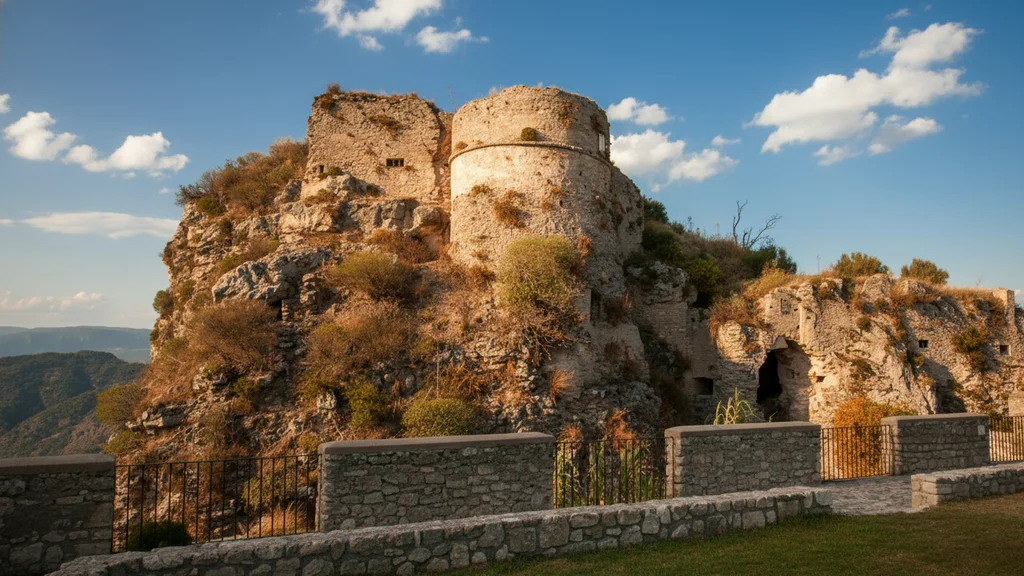
Besides the main tower, the castle comprised thick curtain walls and an advanced rainwater collection system based on cisterns carved directly into the rock. Communication with the town was via a ten-metre drawbridge resting on an intermediate pier carved from the rock. Chronicles, such as the History of the Normans by Amatus of Montecassino, confirm the castle's significance as an impregnable fortress that combined defensive severity with a residential function.
Period of Development under the Kingdom of Sicily
In the 12th century, when the Kingdom of Sicily was united by Roger II, the castle in Gerace began to serve as a royal residence. Its structures were expanded, with the addition of a palatial wing and a chapel, aimed at strengthening the position of the Sicilian kings in Calabria. Under the Hohenstaufen and Angevin dynasties, the castle was regularly modernised to meet new military techniques and reinforce its walls after Saracen raids.
During the Aragonese period, the development of firearms necessitated further modernisation, including the addition of gun ports adapted for arquebuses. The Norman Castle in Gerace today constitutes fascinating ruins that delight visitors with their historical significance and picturesque setting. This place is a symbol of Calabria's past, and its silhouette was immortalised by artists such as Edward Lear, who described it as carved from solid rock.
The Norman Castle in Gerace – Catalyst for Calabria's Development
The influence of the Norman Castle (Castello Normanno) in Gerace permeated many aspects of Calabrian life, affecting the military, political, economic, and cultural development of the region. Its history dates back to the 11th century, when the Normans, under Robert Guiscard and Roger I, seized control of southern Italian territories. The castle became the central point around which the region's new identity was shaped, combining Latin traditions with the existing Greek heritage.
Military Dominance and Stabilisation
The castle in Gerace not only served a defensive function but also ensured stability in areas previously plagued by feudal chaos. Its presence enabled the Normans to establish permanent strongholds that controlled important trade and communication routes. Operations were conducted from it against both Byzantines and Arab invaders, allowing power to be concentrated in the hands of the Hauteville dynasty.
Economic and Social Influences
The expansion of castles contributed to the flourishing of trade and agriculture, promoting the cultivation of olives, vines, and silk. The Normans effectively adopted technology acquired from the Arabs, stimulating local exchange of goods within the Kingdom of Sicily. The tradition of producing the legendary Greco di Gerace wine survives to this day, and its tasting in caves beneath the castle is an integral element of local gastronomic culture.
Cultural Symbioses
The Normans laid the foundations for a cultural symbiosis of Norman, Byzantine, and Arab traditions, most clearly visible in the Cathedral of Santa Maria Assunta. Built between 1085 and 1120, it is the largest sacred building in Calabria and a symbol of the transition to the Latin rite. The use of twenty ancient columns from the ruins of Locri Epizephyrii in the cathedral nave had symbolic significance – the new power rose on the foundations of antiquity.
The Castle's Legacy in the Region
Thanks to the Norman strategy, Calabria became an integrated region with a strong sense of cultural belonging. Castles have remained enduring witnesses to the past, continuing to attract attention as important monuments. Gerace's unique urban planning, with its street paving system using the cozzo method, still facilitates water drainage and provides grip on the steep approaches leading to the fortress.
Fascinating Archaeological Discoveries at the Norman Castle in Gerace
Archaeological Treasures from the Past
The castle in Gerace conceals a wealth of discoveries that shed new light on its medieval history. Research conducted by the Italian Ministry of Culture and the Università di Reggio Calabria has revealed artefacts confirming the site's strategic importance. The oldest ceramic finds date back to the 9th and 7th centuries BC, proving that the hill was settled long before the arrival of the Normans.
Medieval Walls and Defensive Systems
Excavations conducted since the 1980s have revealed fragments of original walls of local limestone up to 3 metres thick. These structures testify to engineering precision and the adaptation of techniques from northern France to local conditions. The discovered remains of drawbridge mechanisms reveal the advanced military skills of engineers serving at the Hauteville court.
Advanced Water System
The discovery of underground cisterns with a capacity of approximately 500 m³ between 2005 and 2008 shows how the Normans adopted Byzantine techniques. The system of drainage channels indicates the fortress's ability to survive prolonged sieges. Analysis of organic sediments allowed scientists to meticulously reconstruct the diet of the castle's inhabitants, which is rare in research on this era.
Traces of Daily Life and Military Artefacts
On the castle grounds, ceramics with Arab motifs and silver denarii bearing the image of Roger I were found. These discoveries, along with iron weapons and ornamental rings, allow a closer look at the daily aspects of life in the fortress. Gerace was an important point on the political map, where the influences of various Mediterranean civilisations intersected.
Reconstruction and Protection Strategies for the Norman Castle in Gerace
Protecting Norman castles is a challenge requiring the combination of archaeology with modern engineering. The history of the castle in Gerace is also a story of the struggle against the forces of nature, especially after the great earthquake of 1783. This cataclysm destroyed the upper storeys of the towers and caused the foundations to crack, forcing the fortress's inhabitants to abandon it.
Conservation Challenges
Undertaking work in Gerace requires the use of technologies such as laser scanning and 3D documentation. The main obstacles are limestone erosion and foundation subsidence on the sandstone bedrock. Additional damage was caused by the 1943 bombings, when one of the corner towers was destroyed by a direct hit from an aerial bomb.
Reconstruction and Use of Modern Methods
The work plan includes cleaning walls and replacing damaged elements in accordance with historical records. The application of traditional techniques combined with modern materials guarantees the preservation of the site's authenticity. In January 2026, the completion of key conservation works on the basilica and castle was announced, for which over 6.5 million euros from PNRR funds were allocated.
Protection through Education and Tourism
As part of the Smart Heritage project, Gerace uses modern technologies to popularise its history. The figure of Roger I d'Hauteville has become a digital guide who narrates conquests in holographic form. The film The Norman Dream, screened in castle spaces, combines real ruins with their digital reconstruction, attracting thousands of visitors annually.
Funding as the Key to Success
Securing stable funding from European funds enables the development of tourist infrastructure and further research. Collaboration with local initiatives allows the organisation of historical spectacles in the Baglio area, generating funds for ongoing conservation. Successfully securing funds from the National Recovery Plan has significantly accelerated the castle's revitalisation process, making it a model for other monuments in Calabria.
Practical Information
Location: Castello district, the highest point of Gerace (470–500 m a.s.l.)
Access: From Piazza del Tocco, uphill along cobbled streets (approx. 10 min walk)
Tickets: Free admission (ruins area)
Viewpoint: Belvedere delle Bombarde – panorama of the Ionian Sea
Getting to Gerace: From Locri via SP1 road (approx. 10 km inland)
Frequently Asked Questions
What remains of the Norman castle in Gerace?
The castle retains impressive foundations, fragments of limestone defensive walls, and the lower part of the massive cylindrical central tower. You can also see the remains of underground water cisterns carved into the rock and the outline of the former drawbridge.
Can you see the sea from the castle ruins in Gerace?
Yes, the castle ruins offer a spectacular panorama of the Ionian Sea and the entire Locride valley. The best viewpoint is the Belvedere delle Bombarde, from which on a clear day you can see the coastline from Capo Bruzzano to Roccella Ionica.
How do you get to the castle in Gerace?
The castle is reached via picturesque, narrow streets of Gerace's historic centre (Castello district). The best starting point is Piazza del Tocco, heading uphill along the characteristic cobbled roads laid using the cozzo method.
Who built the castle in Gerace?
Although the castle stands on Byzantine and Greek foundations, its present form is the work of the Normans. Construction of the key structures was supervised by Roger I of the Hauteville (Altavilla) dynasty after the conquest of Calabria in the 11th century.
Why is the castle in Gerace in ruins?
The main cause of the castle's destruction was the devastating earthquake of 1783, which collapsed the upper storeys and vault systems. Additional damage was sustained during the Allied bombings of 1943, when one of the corner towers was hit directly by an aerial bomb.