Sentiero dell'Inglese, a picturesque hiking trail located in Aspromonte in Calabria, offers exceptional opportunities to discover Greek culture and nature. The section connecting Bova and Amendolea delights with its diversity of landscapes and historical attractions. Thanks to easy access and a moderate difficulty level, it is an excellent choice for tourists with basic physical fitness. Plan your trip to fully enjoy the charm of this region.
Discovering the Greek Legacy on the Sentiero dell'Inglese
Passing through the picturesque terrain of Aspromonte, Sentiero dell'Inglese not only offers spectacular views and contact with nature but also transports tourists back in time, enabling them to discover the rich Greek history present in Calabria. This trail, also known as the Edward Lear Path, connects the cultural hearts of the region – Bova and Amendolea – which are steeped in traditions and history dating back to the times of Magna Graecia. This route, measuring approximately 110 kilometres in total, constitutes one of the most significant hiking corridors in southern Italy.
The ideological foundation of the trail lies in the notes left by Edward Lear, a British artist who traversed these lands in 1847. Lear described the landscapes and customs of the inhabitants with remarkable precision, and today's trail allows one to confront the views that fascinated him nearly two hundred years ago. Lear's visit helped break stereotypes about wild Calabria, revealing it as a place of deep Hellenic roots and extraordinary hospitality.
Greek Roots of Magna Graecia
The Calabrian region harbours a history linked to Greek colonisation, which took place as early as the 8th century BC. At that time, Greek settlers founded many towns and villages that became important cultural and commercial centres. This area, known as Magna Graecia, transformed Calabria into a cultural bridge between Greece and Italy. A series of ruins and artefacts that can be encountered along the trail confirm the presence of ancient Greeks who introduced their religions, customs and technologies here.
Culture and Architecture
Walking along the Sentiero dell'Inglese, one can come across many elements of Greek culture. The characteristic agricultural terraces and buildings that can still be found in Bova and Amendolea are examples of the Greek aptitude for architecture and agriculture. These structures are not only evidence of historical Greek settlement but also testimony to their ability to adapt to the difficult, mountainous terrain of Calabria. Modern-day Bova serves as the capital of the Bovesìa area, where Byzantine and Hellenic tradition remains alive in architecture and everyday life.
Mythology and Art
One cannot forget the deep influences of Greek mythology and art, which permeate almost every aspect of life in the region. In the legends associated with this place, one can find references to the tales of Odysseus, which is an excellent example of the influence of Greek heritage on local culture. Numerous archaeological finds throughout the Bovesìa region confirm the presence of ancient Greek cults and traditions among former inhabitants. For local communities, Edward Lear became a symbol of European recognition of their unique cultural distinctiveness.
Secrets of Aspromonte – Dynamic Nature and Terrain
Aspromonte, a mountain massif located in Calabria, is a remarkable example of the geographical and biological complexity of this Italian region. As the south-western extremity of the Apennines, Aspromonte offers spectacular views, attracting tourists from around the world. The Sentiero dell'Inglese trail enables the discovery of these charms during a hike among vegetation-covered peaks and picturesque valleys, where the boundary between mountains and sea is remarkably thin.
Terrain Formation
The Aspromonte region is characterised by a varied geological landscape, consisting mainly of crystalline metamorphic rocks such as gneisses and granites. The dominant landscape feature is the fiumare – wide, stony riverbeds that remain dry for most of the year. Fiumara Amendolea is the largest of these watercourses, constituting the structural axis of the entire regional topography and requiring hikers to be familiar with local hydrological conditions.
| Environmental Parameter | Characteristics of the Bovesìa Region |
|---|---|
| Main forest formations | Mediterranean maquis, holm oaks, pine forests |
| Terrain formations | Mountain ridges, fiumare, rock formations (Pentedattilo) |
| Highest peak on the route | Monte Cerasia (1,013 m a.s.l.) |
| Characteristic crop | Bergamot – a citrus fruit symbolising the province |
Natural Wealth
Aspromonte is a unique ecosystem protected within Aspromonte National Park, rich in flora and fauna diversity. Over 2,000 plant species, including 18% endemics, play a crucial role in the ecological landscape of the region. The Edward Lear Trail enables direct contact with these unique natural formations, from centuries-old olive groves to holm oak forests. The intense scent of bergamot accompanies hikers on many sections, creating an unforgettable atmosphere of a Mediterranean expedition.
Discovering the Trail from Bova to Amendolea – Attractions and Activities
The section connecting Bova with Amendolea is widely regarded as the heart of the Sentiero dell'Inglese. It can be completed in both directions, with the march from Amendolea to Bova being an intense ascent with an elevation gain of approximately 680 metres. The route from Bova to Amendolea is a steep descent, requiring sturdy footwear and optionally trekking poles to relieve the knees.
| Technical Parameter | Direction: Bova – Amendolea |
|---|---|
| Distance | approx. 7.9 – 8.0 km |
| Negative elevation | approx. -834 m |
| Maximum altitude | 820 m a.s.l. (Bova) |
| Walking time | half a day to a full day |
Maesano Waterfalls
One of the most interesting places on the route is the Maesano Waterfalls. These spectacular water cascades attract trekking and photography enthusiasts, offering unforgettable mountain landscapes. Trekking in Aspromonte in this area is an excellent opportunity to appreciate the beauty of Calabrian nature, particularly after periods of rainfall when the water gains in strength.
The Village of Bova
Bova, known as Chòra, is the ideal place to begin the hike. Strolling through the picturesque village, tourists have the opportunity to visit the historic ruins of the Norman castle and the Cathedral of Santa Maria dell'Isodia. It is worth visiting the Gerhard Rohlfs Museum of the Griko Language, which documents the history of the unique Griko dialect, still spoken among older residents.
Amendolea Vecchia – Historic Ruins
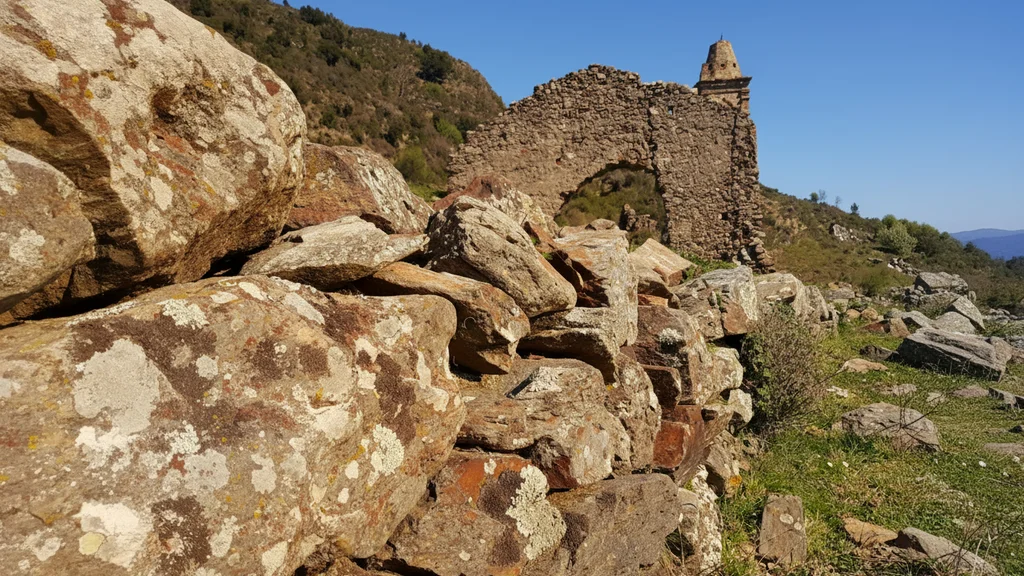
Near Amendolea lie the ruins of Amendolea Vecchia, a village abandoned after the flood of 1951. Dominating the area is Castello dei Ruffo, a mighty Norman fortification that once controlled movement in the river valley. On the settlement grounds, the remains of three Byzantine churches have survived, bearing witness to the rich religious history of this corner of Italy.
Linguistic Heritage and Gastronomy
This area is one of the few places where a Greek language with roots reaching back to antiquity is still used. Encounters with local elders who speak the Grecanico dialect are a priceless anthropological experience. The symbol of local cuisine is Lestopitta – a traditional unleavened flatbread fried in olive oil, served with spicy 'nduja or pecorino cheese. Another unique product is Musulupa cheese, shaped in wooden moulds with Byzantine patterns.
Aspromonte National Park – The Heart of Calabrian Tourism
Aspromonte National Park attracts attention thanks to its numerous natural attractions and opportunities for active recreation. Trails of varying difficulty levels enjoy great popularity, receiving high ratings on trekking platforms. An important element of the tourist system is the salvacondotto – a special document in which hikers collect stamps, entitling them to receive a trail completion certificate in the town of Staiti.
For history enthusiasts, the ruins associated with the "Greek presence" in the region are a true treat. Aspromonte also offers panoramic mountain landscapes whose scenery conceals mysterious remains of ancient civilisations. In towns such as Bova, the albergo diffuso model is being implemented – a dispersed hotel concept that allows the revitalisation of old houses and support of the local economy without destroying the historic urban fabric.
However, hiking through the park requires adequate logistical preparation. Drinking water availability is variable, and mobile phone coverage in deep valleys often disappears. It is recommended to have offline maps and to closely monitor water levels in the fiumare, as sudden water rises after rainfall can make it unsafe to continue the route through riverbeds.
Frequently Asked Questions
How long is the Sentiero dell'Inglese and how long does it take to complete?
The entire trail measures approximately 110 kilometres and is usually divided into 7 stages. The section from Bova to Amendolea is about 8 km and takes 4 to 5 hours to complete depending on walking pace.
Who was Edward Lear and why does the trail bear his name?
Edward Lear was a nineteenth-century English artist and traveller who described his journey through Calabria in 1847. The trail was designed to recreate the route of his historical expedition.
How do you get to the start of the Sentiero dell'Inglese?
The main hub is Reggio Calabria, from where you can take a Trenitalia train to Bova Marina. From there, it is best to reach Bova Superiore by local taxi, as public transport into the mountains is limited.
Is the trail safe for solo hikers?
The trail is safe provided you exercise caution when crossing fiumare after rain and carry GPS maps. It is also worth being aware of shepherd dogs guarding flocks in the higher parts of Aspromonte.
What is the Griko dialect encountered on the trail?
Griko is a unique dialect of the Greek language that has survived in Calabria since ancient times. Its centre is Bova, where you can still hear this language today and visit a museum dedicated to it.