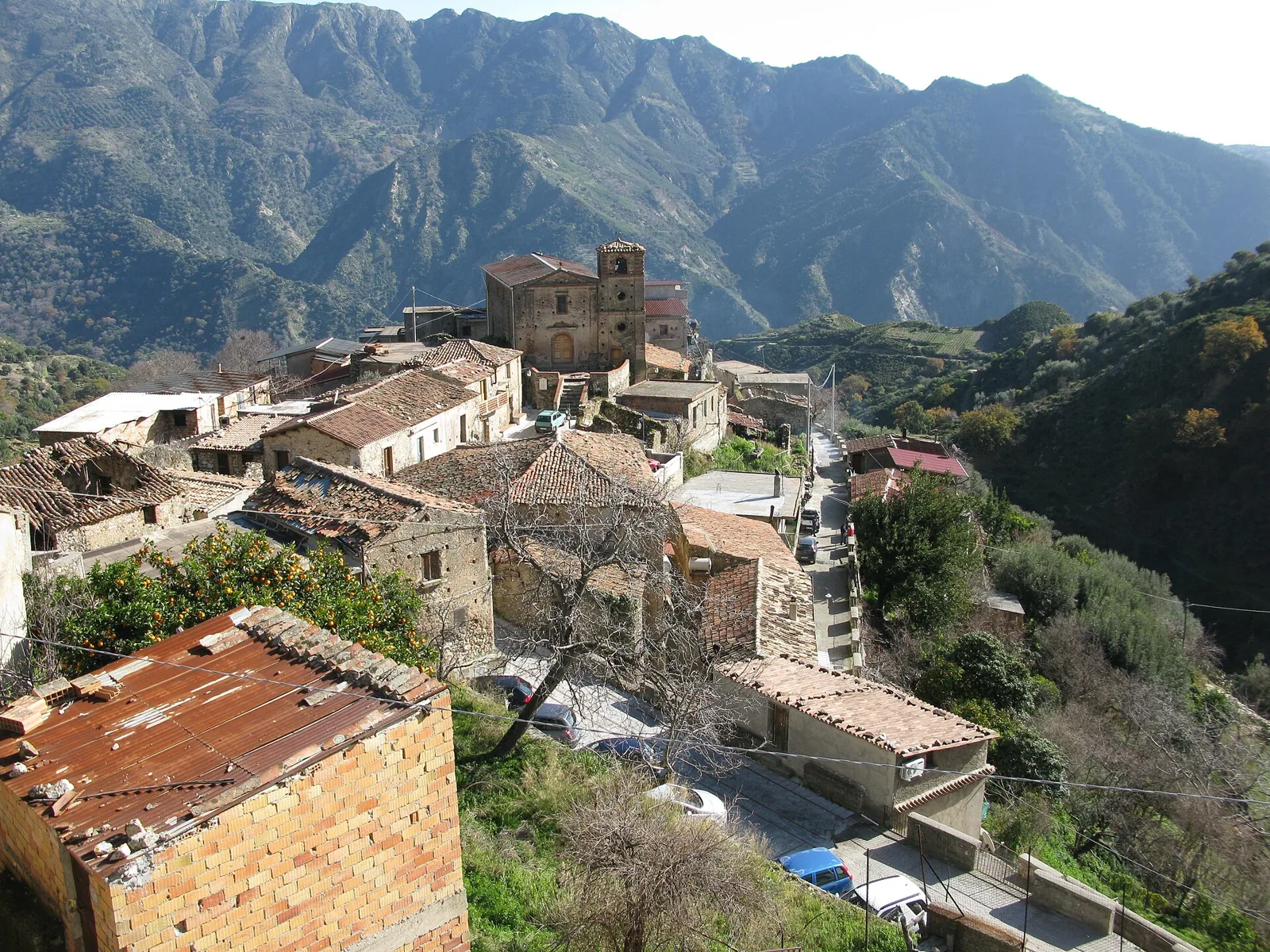
Bova is the capital of Bovesia – the last corner of Calabria where the language and culture of the Grecanici are still alive. Today’s Grecanici descend from the Greek-speaking population of southern Calabria, but their origins cannot be reduced to a simple, unbroken line from Magna Graecia colonists: scholars point to very old layers of settlement as well as a strong Byzantine-era contribution. This heritage is visible today in the greko language, street names, music, rituals and family memory of the villages of the Area Grecanica.
Table of Contents
The Grecanici – who are Calabria’s Greeks
The Calabrian Greeks (Grecanici) are descendants of the Greek-speaking population that inhabited southern Italy from the 8th century BC. The colonies of Magna Graecia – Locri Epizephyrii, Rhegion, Kroton, Sybaris – were among the most powerful cities of the ancient world. When the Roman Empire fell, Calabria came under Byzantine rule, which brought further waves of Greek immigration and reinforced the Hellenic character of the region.
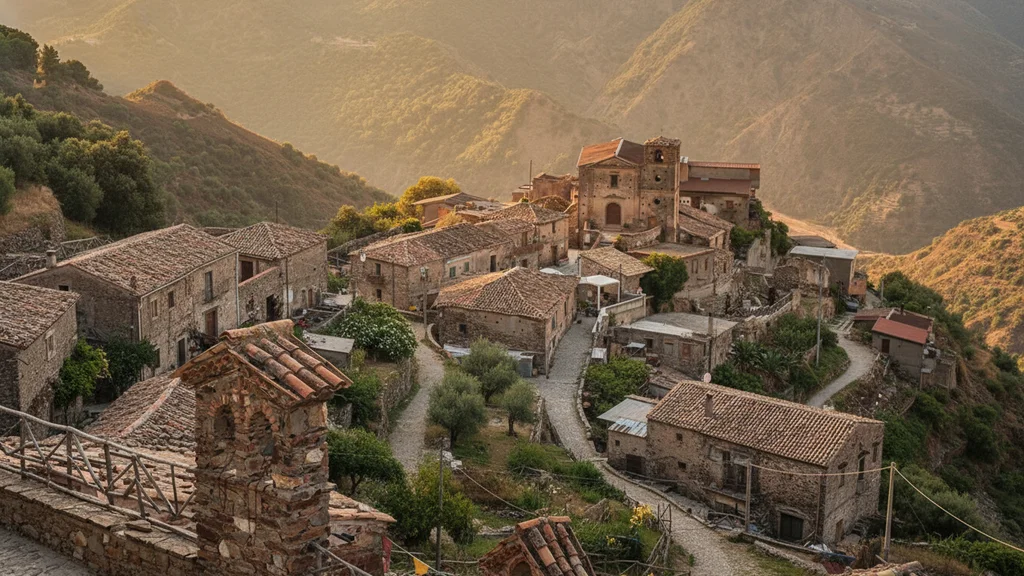
Over the centuries, Latinisation, the Norman conquest (11th century), and pressure from the Latin Church gradually displaced Greek. Yet in the mountain villages of Aspromonte – remote, cut off from major routes – the language and rites survived. Bovesia, an area encompassing roughly fifteen municipalities around Bova, became the last bastion.
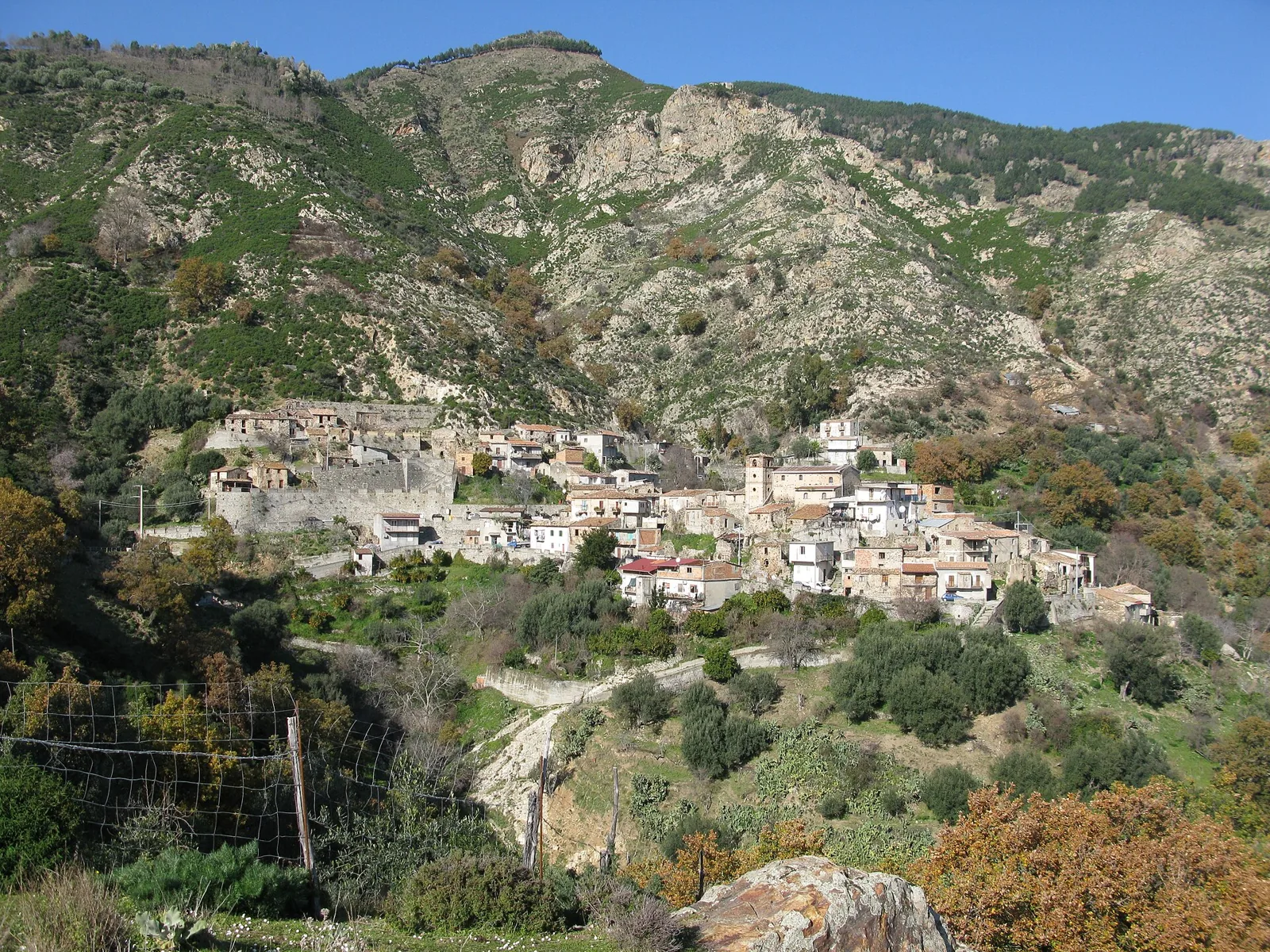
The historic Grecanico area included Bova, Bova Marina, Condofuri, Gallicianò, Roghudi and Roccaforte del Greco, and once extended across a wider belt of southern Aspromonte. In the 20th century the language’s reach shrank dramatically due to emigration, urbanisation and catastrophic floods; particularly significant were the floods of 1971 and 1973, after which Roghudi Vecchio was declared unfit for habitation and residents were gradually moved to the new settlement of Roghudi Nuovo, created on the coast near Melito Porto Salvo. Gallicianò is considered today one of the last villages where greko has survived relatively well.
In 1999, Legge 15 dicembre 1999, n. 482 was adopted, which protects historic linguistic minorities in Italy, including the Greek minority. This provides an important legal basis, but in practice the struggle for the language’s survival continues – UNESCO classifies it as severely endangered.
The municipalities of the Area Grecanica, local associations and schools, as well as inter-municipal cooperation structures such as the former Comunità montana dell’Area Grecanica and, today, among others, the Associazione dei Comuni dell’Area Grecanica and GAL Area Grecanica, are involved in protecting this heritage. Thanks to Law 482/1999, funding has become available for education, bilingual signage and cultural projects related to the Greek minority.
The Greko language – a living echo of antiquity
Grecanico (greko, greco di Calabria) is a Greek dialect that split from the common trunk many centuries ago. It is not identical to modern Greek – it preserves archaic grammatical forms and vocabulary that have disappeared from standard Modern Greek. At the same time, it has absorbed numerous borrowings from Latin, Calabrian, and Italian.
Linguist Gerhard Rohlfs, a German Romance scholar, devoted his life to studying this dialect in the first half of the 20th century. In his work he argued that greko preserves very old layers reaching back to the Greek of Magna Graecia, but the question of the language’s origins remains a matter of scholarly debate. In Bova, his name is carried by a museum dedicated to the greko language and to the historical-linguistic minority of Calabria’s Greeks.
There are at least two main positions in the scholarly debate. Rohlfs emphasised a strong continuity from the Greek of Magna Graecia, while other researchers, including Giuseppe Morosi and some later Hellenists, placed greater emphasis on the influence of medieval Byzantine Greek. The safest conclusion is that modern Calabrian greko combines very archaic layers with distinct Byzantine elements.
Feature |
Greko (Calabria) |
Griko (Apulia) |
|---|---|---|
Region |
Bovesia (prov. Reggio Calabria) |
Grecia Salentina (prov. Lecce) |
Estimated speakers |
very approximate and disputed estimates: approx. 500–1,000 |
approx. 10,000–20,000 |
UNESCO status |
Severely endangered |
Severely endangered |
Cultural festival |
Paleariza (usually in summer) |
La Notte della Taranta (August) |
Today greko is spoken mainly by the oldest residents of Bovesia. Younger generations understand individual words and phrases but do not use the language in daily conversation. In Bova, bilingual signs are visible throughout – street names and public buildings labelled in both Italian and greko. This is a symbol of a preservation policy, though linguists warn that without active intergenerational transmission, the dialect may fall silent within a single generation.
Watch on YouTube
Festival Paleariza and living traditions
The most important cultural event in Bovesia is the Festival Paleariza (from greko palea riza – “ancient root”), traditionally held in summer, usually in August. Depending on the edition, the programme and scale of the event vary, but the idea remains the same: in villages across Bovesia – Bova, Gallicianò, Roghudi, Condofuri – concerts of traditional music ring out, featuring:
- Lira calabrese – a three-stringed bowed instrument, preserved mainly in southern Calabria
- Tamburello – a frame drum accompanying the tarantella
- Zampogna – Calabrian pastoral bagpipes
- Organetto – a small diatonic accordion
In the Area Grecanica, the tarantella calabrese also plays an important role, performed to the accompaniment of the lira calabrese, tamburello, zampogna and organetto. Among contemporary popularisers of this tradition are the group Re Niliu and the traditional music researcher and performer Ettore Castagna.
The festival combines music with tastings of local cuisine. The cuisine of the Area Grecanica grows from the pastoral and mountain agriculture of Aspromonte: goat’s and sheep’s cheeses, homemade pasta, wild herbs, olive oil, and kid and lamb meat. Among the most distinctive local flavours, look for lestopitta, a simple flatbread traditionally fried by shepherds, capretto al forno or braised kid goat, and homemade pasta such as filatieddi/filateddhi; bergamot makes its way mainly into desserts, liqueurs and marmalades from the Ionian coast of the province of Reggio Calabria.
Holy Week and Palm Sunday are a time of local rites in Bova, with elaborately prepared palms. The most characteristic is the procession of the Pupazze, also called Parme: large female figures made from olive branches around a reed frame, decorated with flowers, fruit and the first produce of the season. According to local descriptions of the tradition, the figures gather, among other places, in Piazza Roma, proceed to the Santuario di San Leo for the blessing, and after the ceremony are dismantled into elements called steddhi and distributed to the faithful. This ritual is best understood through the lens of a living community tradition rather than by ascribing overly confident ancient interpretations to it.
What to see in Bova and the surrounding area
Bova itself, listed among the Most Beautiful Villages of Italy (Borghi più belli d’Italia), offers several sites directly linked to the Grecanico heritage:
- Museo della Lingua Greco-Calabra “Gerhard Rohlfs” – the greko language museum at Via Sant’Antonio, snc, opened in 2016 and dedicated to the historical-linguistic minority of Calabria’s Greeks
- Bilingual signs and inscriptions – scattered across the centre, on public buildings and churches
- Bova Cathedral – an important church of the former episcopal seat
- Gallicianò – a picturesque village in the Amendolea valley, one of the last places where greko has survived relatively well
The Museo della Lingua Greco-Calabra “Gerhard Rohlfs” has rooms with photographs, historical documents and audio-visual installations that organise the story of the greko language and research into the local minority. According to information from the Parco Nazionale dell’Aspromonte, the museum operates from Monday to Saturday from 09:00 to 13:00, while afternoon and Sunday visits require booking. This is the best starting point if you want to understand why Bova is the centre of the Area Grecanica, not just a pretty hill town on the slopes of Aspromonte.
Bova’s cathedral is the Concattedrale dell’Isodia / Santa Maria dell’Isodia, linked to the former Diocese of Bova. Its present form is largely early modern, as the church was damaged by earthquakes and subsequently rebuilt; inside is a particularly venerated image of the Madonna dell’Isodia. It is Bova’s former role as an episcopal seat that explains the standing of this church despite the town’s small size.
Bova is also home to the Museo di Paleontologia e Scienze Naturali del Geoparco dell’Aspromonte, housed in the former praetorium building. The exhibition covers about 300 m² and includes around 15,000 fossil specimens of flora and fauna, documenting, among other things, the environment of roughly 100,000–120,000 years ago. It is a good counterpoint to the language museum: one presents cultural memory, the other the natural history of this part of Aspromonte.
While walking through the centre, you will easily come across Piazza Ferrovieri d’Italia, where the steam locomotive FS 740.054 has stood since 1987. In Bova it is treated as a monument to emigration and progress, as well as one of the town’s most unusual landmarks. The place adds an important 20th-century chapter to the story: departures from mountain villages, changing ways of life and contact with the coast.
Bova lies at an altitude of about 820 m above sea level on the slopes of Aspromonte, and the drive leads from Bova Marina on the Ionian coast. The nearest railway station is Bova Marina on the Ionian line; from there it is about 11–14 km uphill to Bova and usually around 20–30 minutes by car, depending on the driver’s confidence and road conditions. If you are also planning to visit Gallicianò, add roughly another 15 km along a narrow, winding road and about 30 minutes of driving; for Bova itself allow 2–3 hours, and with Gallicianò and viewpoints – half a day.
The Grecanico heritage of Bova is not confined to museum display cases. You see it best in the combination of places: bilingual signs, churches, streets descending toward viewpoints, Paleariza, Palm Sunday rituals and family memories of the greko language. Visiting this town, you enter one of Calabria’s oldest cultural layers – still present, though fragile and dependent on whether the next generations choose to keep it alive.
Grecanico Heritage – frequently asked questions
Does anyone in Bova still speak Greek?
Yes, but the number of active greko speakers is small, and available data are very approximate and disputed – estimates are often in the order of 500–1,000 people, mostly the oldest generation. Younger residents tend to know individual words and phrases rather than using the language daily. UNESCO classifies the dialect as severely endangered.
When is the Paleariza festival?
Festival Paleariza is traditionally held in summer, usually in August, but its programme, scale and continuity depend on the particular edition. At its heart are traditional music concerts in the villages of Bovesia such as Bova, Gallicianò, Roghudi and Condofuri. Check the current programme before travelling.
What is the connection between Calabria’s Greeks and Magna Graecia?
The connection is real, but more complex than a simple story of unbroken continuity from antiquity. Some scholars emphasise very old layers of language and settlement reaching back to Magna Graecia, while others assign a greater role to Byzantine influences. The safest approach is to speak of a mixed heritage combining archaic and Byzantine elements.
How do I get to Bova?
Bova lies in the Aspromonte mountains, about 50–60 km by road from Reggio Calabria. The most convenient approach is by car from Bova Marina on the Ionian coast; from Bova Marina station to the centre of Bova it is about 11–14 km uphill, and the drive along switchbacks usually takes about 20–30 minutes. There is no direct rail connection – the nearest station is Bova Marina on the Ionian line.
Sources
The information in this article was verified against the following sources:
- Comune di roghudi – old.cittametropolitana.rc.it
- Bova | Turismo Reggio Calabria – turismo.reggiocal.it
- Museo Paleontologia e Scienze naturali dell'Aspromonte | Parco Nazionale dell'Aspromonte – parconazionaleaspromonte.it
- Museo della Lingua Greco-Calabra "Gerhard Rohlfs" | Parco Nazionale dell'Aspromonte – parconazionaleaspromonte.it
- Domenica delle Palme a Bova - Cathopedia, l'enciclopedia cattolica – it.cathopedia.org
- ruraledigitale.it (PDF) – ruraledigitale.it
- Wikipedia – Comunità montana dell'Area Grecanica – it.wikipedia.org
- Wikipedia – Griko people – en.wikipedia.org
Last updated: