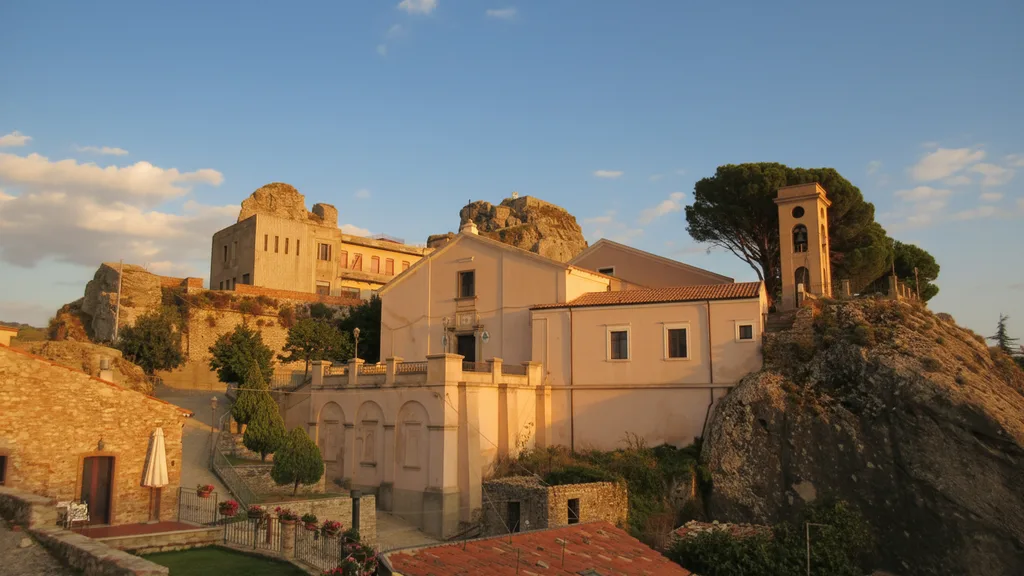
The Cathedral of Santa Maria dell'Isodia in Bova is one of the most important sacred sites in Calabria, attracting tourists with its unique charm. Situated on a picturesque rocky outcrop at an elevation of 820 metres above sea level, it resembles an island, and its history reaches back to Norman and Byzantine times. For lovers of Italy and enthusiasts of sacred architecture, this site constitutes a unique historical laboratory where Greek and Latin influences intertwine.
Historical Significance of the Cathedral in Bova for Calabria
The Cathedral of Santa Maria dell'Isodia, though currently serving as a co-cathedral, represents the cultural and religious heart of the region, particularly for the town of Bova. Built in the 11th century by the Normans on the ruins of an earlier 9th-century Byzantine basilica, this church is a symbol of the enduring grecanico identity. Stratigraphic research conducted since 1997 has revealed the walls of the original church, confirming continuity of worship from Palaeochristian times.
The Normans, building this cathedral after 1075, inscribed it in a series of sites of religious and military significance, creating an inseparable complex with the nearby castle. Thanks to the miraculous image of the Madonna dell'Isodia, the cathedral gained renown as a popular pilgrimage sanctuary, uniting the local community for centuries. The name Isodia derives from the Greek term Eisodia, meaning the Presentation of the Virgin Mary at the Temple, underscoring strong links with Eastern tradition.
The cathedral's influence on the region is not limited to the spiritual aspect but also encompasses a history full of dramatic twists. The church survived the devastating earthquakes of 1783 and 1908, as well as the French invasion of 1807, which brought numerous plunderings. Despite these cataclysms, the building always rose from the ruins, undergoing successive phases of baroquification and neoclassical restoration.
| Era / Year | Event | Nature of Changes |
|---|---|---|
| 9th century | Original foundation | Construction on a Palaeochristian structure in the Byzantine rite. |
| 1584 | Madonna sculpture | Creation of the Rinaldo Bonanno statue, centre of Marian devotion. |
| 1714 | SS. Sacramento altar | Creation of polychrome altar by Sicilian masters. |
| 1908 | Earthquake | Damage requiring facade reconstruction and bell tower reinforcement. |
| 1997 – present | Restoration and research | Closure of the building for worship to conduct excavations. |
Significance of the Cult of Our Lady of the Island for the Bova Community
The Cult of Our Lady of the Island – Cultural and Spiritual Heritage of Bova
In the very heart of Greek Calabria, in the picturesque town of Bova Superiore, stands the co-cathedral of Santa Maria dell'Isodia. The people of Bova have pilgrimaged to this sanctuary for generations, believing in the special protection of the Madonna over their difficult, mountainous terrain. The focal point of the cult is a marble statue of the Madonna and Child from 1584, created by the distinguished sculptor Rinaldo Bonanno.
This icon became an element binding the community together, particularly in moments of danger, such as periods of great drought or seismic activity. In 1614, Bishop Giovanni Camerota donated silver crowns for the Madonna and Child, expressing the highest recognition of the site's status. It is worth noting that the figure of Mary in Bova combines hieratic features with a subtle, human smile typical of Mannerism.
The most spectacular expression of local piety is the Pupazze procession on Palm Sunday, which concludes before the cathedral. Residents carry large female figures woven from olive leaves, constituting a unique syncretism of Christianity and the ancient myth of Demeter and Persephone. After being blessed at the cathedral, the figures are distributed, and the consecrated branches are believed to bring prosperity to homes throughout the year.
Southern Italian Architecture in the Cathedral of Santa Maria dell'Isodia – Traditions and Influences
The church's architecture is an excellent example of a style in which Norman austerity meets Baroque decorativeness. The church facade, divided by pilasters into three sections, conceals a three-nave interior with a basilican layout. The main portal, made of local tuff, is crowned with a bishop's coat of arms, manifesting the status of the former diocesan seat.
A Blend of Cultural Influences
Typical of the southern Italian region is the Sicilian-Norman style, visible in the solid, almost fortress-like walls of the cathedral. The interior maintains an austere dignity, with the main nave separated by elegant columns leading the eye towards the raised presbytery. An extremely valuable element is the Altar of the Blessed Sacrament from 1714, crafted using intarsia technique with polychrome marbles.
Comparison with Other Cathedrals in the Region
Similar architectural motifs can be found in the cathedrals of Monreale and Cefalù, but Bova is distinguished by its specific square-plan bell tower. This tower houses the famous campanone di marzo, whose sound every Friday in March marked the rhythm of Lent. Thanks to its wooden, gabled ceiling, the construction demonstrates greater resistance to seismic shocks than heavy masonry vaults.
Agriculture and Cultural Tourism in Bova – History and Contemporary Attractions
Bova, situated in the province of Reggio Calabria, has based its livelihood on the cultivation of olives and grapes on terraced fields for centuries. Contemporary cultural tourism in this region is strongly linked to the agricultural and culinary heritage, offering products with DOP and IGP status. Guests visiting Bova can participate in olive oil production workshops, which form an integral part of local agritourism.
Near the cathedral are other monuments, such as the Church of Saint Catherine and the ruins of the Norman castle, which complete the historical picture of the town. The region is famed for promoting such specialities as 'nduja and musulupara cheese, moulded in traditional, carved forms. The Cathedral of Santa Maria dell'Isodia remains the central point of the strategy to revitalise Bova as the capital of the Bovesìa area.
Currently the church is closed to the public due to ongoing archaeological and conservation work aimed at securing its structure. Nevertheless, the town's spiritual life revolves around its walls, and precious reliquaries can be admired at the Diocesan Museum in Reggio di Calabria. Every visit to Bova is a deep immersion in Byzantine civilisation, which has survived at the edges of the Italian Peninsula.
Frequently Asked Questions
What can you see in the Cathedral of Santa Maria dell'Isodia in Bova?
In the cathedral, you can admire above all the marble statue of the Madonna dell'Isodia by Rinaldo Bonanno from 1584 and the Baroque altar of polychrome marble from 1714. It is worth noting the Byzantine foundations discovered beneath the floor and the crypt system with former burial places.
What does the name Isodia mean in the cathedral's name?
The name Isodia is a Latinised form of the Greek word Eisodia, which refers to the feast of the Presentation of the Blessed Virgin Mary at the Temple. It is a clear trace of the region's Byzantine past and evidence of the strong roots of Greek tradition in the local Church.
What are the opening hours of the cathedral in Bova?
Currently the co-cathedral is closed for liturgical and tourist use due to ongoing archaeological and restoration work. Before a planned visit, it is worth checking current notices at the local tourist office or at the Diocesan Museum in Reggio Calabria.
When do the most important celebrations at the cathedral take place?
The key event is Palm Sunday with the Pupazze procession and celebrations in honour of the patron Saint Leo in May and August. Although the cathedral interior may be inaccessible, the main rituals take place in the square before the church and in surrounding churches.
Are there bishops' tombs in the cathedral?
Yes, beneath the main nave of the cathedral is a crypt system, including a putridarium, where church dignitaries and members of Bova's noble families were buried until the 18th century. These structures are currently the subject of anthropological research.