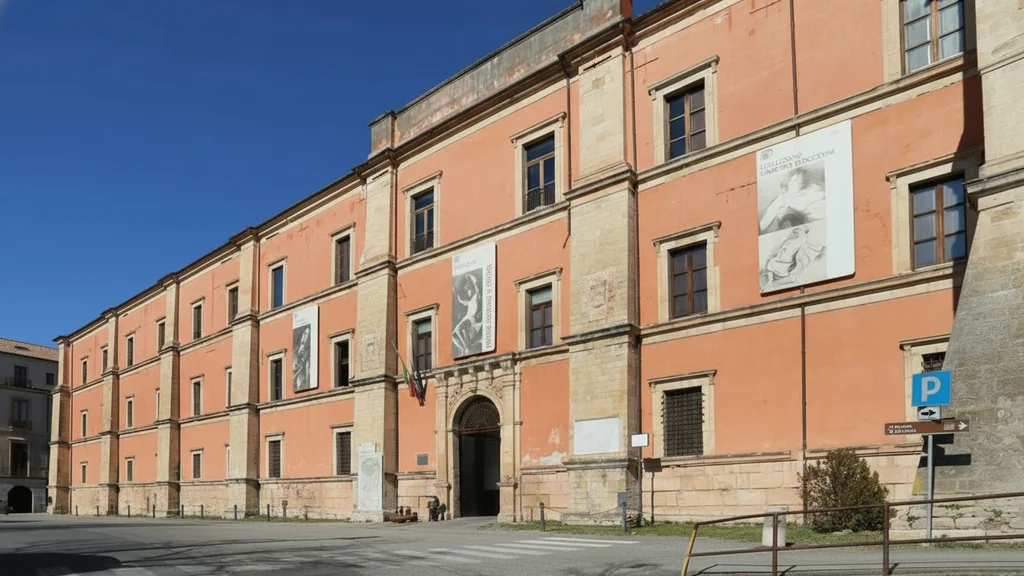
Located in the picturesque centre of Cosenza, Palazzo Arnone is a majestic example of Renaissance architecture, rising atop the Triglio hill at an elevation of 262 metres. It is also home to the Galleria Nazionale di Cosenza, where visitors can explore rich collections of Neapolitan and Calabrian art, currently managed by the Direzione Regionale Musei Nazionali Calabria under the aegis of the Ministry of Culture. Not only the permanent exhibitions attract attention, but also the numerous cultural events organised in the palace, making it a fundamental destination for art and culture enthusiasts seeking to understand the identity of the Mezzogiorno.
The Majesty of the Renaissance – Architectural Treasures of Palazzo Arnone
Palazzo Arnone: Harmonious Symmetry and Baroque Additions
Palazzo Arnone in Cosenza, one of the most important examples of Renaissance architecture in southern Italy, impresses with its majestic form, which harmoniously combines elements of that era with later Baroque influences. The building was constructed at the beginning of the 16th century on the initiative of brothers Bartolo and Ascanio Arnone, originally serving as a noble residence. Situated in the very heart of Cosenza, Palazzo Arnone became the home of the Galleria Nazionale di Cosenza, attracting art lovers from around the world.
The Renaissance style of the building dominates thanks to the symmetry of the facade and the use of classical architectural motifs, such as pilasters and arches. The exterior elevation, modelled on famous Roman examples such as Palazzo Farnese, emphasises the aesthetics of harmony and proportion. At the end of the 16th century, the building's function underwent a drastic change when it became the seat of the Regia Udienza – a Spanish administrative and judicial body, which gave it a severe, institutional character.
| Historical Phase | Building Purpose | Administrator / Owner |
|---|---|---|
| Early 16th century | Private noble residence | Arnone family |
| Late 16th – 20th century | Regia Udienza and Tribunal | Spanish State / Kingdom of the Two Sicilies |
| Until 1980 | Judicial prison | Italian State |
| From 1980 | Galleria Nazionale and Museums Directorate | Ministry of Culture |
Tradition and Modernity in the Heart of Cosenza
Over the centuries, Palazzo Arnone underwent several significant modernisations, including after devastating earthquakes. Despite this, its Renaissance character was preserved, enriched with defensive elements and impressive interior decorations, such as frescoes and stuccowork. The process of transforming a former prison into a modern museum required advanced lighting systems and microclimate control to protect priceless canvases in spaces that once served for incarceration.
These historic spaces now host rich art collections, both permanent and temporary exhibitions of contemporary artists, which the gallery in Cosenza actively supports. The building also houses the Nucleo Cosenza dei Carabinieri per la Tutela del Patrimonio Culturale, a unit responsible for protecting Italian cultural heritage. It is remarkable how the architecture has evolved from a symbol of judicial authority to an open centre for artistic education.
The Significance of Galleria Nazionale di Cosenza in Promoting Southern Italian Art
The Galleria Nazionale di Cosenza, housed in the majestic Palazzo Arnone, plays a key role in promoting Neapolitan and Calabrian art. Calabrian art is at the heart of the gallery's collection, effectively presenting local cultural identity and the artistic traditions of southern Italy. The holdings include numerous works by local creators, including portraits and religious scenes that highlight Calabria's artistic heritage.
In the context of Neapolitan art, the gallery serves as a cultural bridge connecting Calabria with Naples. The presence of Neapolitan influences in the collection, represented by such masters as Luca Giordano and Fabrizio Santafede, underscores the historical relations between Calabria and the Kingdom of Naples. Particular attention is drawn to the works of Mattia Preti, known as the "Cavaliere Calabrese," whose paintings such as "Sophonisba Receiving the Cup of Poison" and "The Martyrdom of St. Sebastian" demonstrate mastery of chiaroscuro and Baroque drama.
The museum undertakes numerous promotional activities aimed at spreading knowledge of local art at an international level. Digitisation of resources and catalogue publications contribute to popularising Calabria's artistic heritage. Notably, thanks to agreements with the Intesa Sanpaolo group, the gallery has been enriched with works dating back to the 15th century, including a painting attributed to Lazzaro Bastiani, "Christ on Calvary", which opens the Renaissance exhibition.
Thematic Exhibitions at Palazzo Arnone – A Treasury of Calabrian Culture
Palazzo Arnone in Cosenza is a place where history meets modernity, giving visitors a unique opportunity to understand the multi-layered culture of Calabria. Within the interiors of this Renaissance building, the Galleria Nazionale di Cosenza offers a wide range of thematic exhibitions. A particularly important element is the section dedicated to Umberto Boccioni, born in Reggio di Calabria, which comprises 65 graphic works from 1906–1915.
The exhibitions at Palazzo Arnone are deeply rooted in local history and art, while simultaneously transcending regional boundaries. An example is the preparatory studies for the famous painting "The Laugh," which allow visitors to trace the birth of Italian Futurism. The gallery also features a bronze copy of the sculpture "Unique Forms of Continuity in Space," a manifesto of dynamism and modernity in the heart of a historic building.
The cultural significance of these events cannot be overestimated, especially in the context of dialogue with contemporary art. The museum's holdings include works by artists such as Mimmo Rotella, Cesare Berlingeri, and Alfredo Pirri. Rotella's work, the master of décollage, is a perfect example of how the gallery connects traditional painting techniques with avant-garde experiments of the 20th century, promoting the aesthetic diversity of the region.
Cultural Events and Local Collaboration – The Strength of Galleria Nazionale di Cosenza
The Galleria Nazionale di Cosenza is a cultural institution that combines a rich collection of Italian art with active engagement in the development of the Calabria region. Collaboration with the Università della Calabria (Unical) enables the delivery of educational programmes that attract art history students. The institution has become a centre for research into monument conservation in southern Italy.
Collaboration with public institutions plays a fundamental role in the gallery's development. Thanks to support from Regione Calabria, the institution carries out EU projects under the PNRR framework, focusing on removing physical and cognitive barriers. From March 2026, a specialist training programme is being launched for staff, aimed at improving service for visitors with disabilities, making culture accessible to everyone without exception.
Organising cultural events is a central element of the gallery's activities. The 2026 calendar includes a contemporary photography exhibition "Visio Mentis" and a special Easter Monday opening. Of particular note is the "Hidden Treasures: Galleria Borghese" initiative, which through the Art Bonus mechanism will enable masterpieces from Roman collections to be brought to Cosenza, building the city's prestige as an important artistic centre.
Practical Information
Location: Via Guglielmo Tocci, Cosenza – Triglio hill (centro storico)
Hours: Tue–Sun 08:30–18:45 (last entry 18:15), closed on Mondays
Tickets: €5.00 full, €2.00 reduced (ages 18–25), free on the first Sunday of each month
Getting there: Cosenza centro storico, near Castello Svevo
Frequently Asked Questions
What can you see at the Galleria Nazionale in Cosenza?
The gallery features works by Baroque masters such as Mattia Preti and Luca Giordano, as well as a unique collection of 65 graphic works by Umberto Boccioni. The exhibition also includes contemporary art (e.g. Mimmo Rotella) and valuable deposits from Intesa Sanpaolo bank.
What is the history of Palazzo Arnone in Cosenza?
The palace was built in the 16th century as a private residence, later becoming the seat of a tribunal (Regia Udienza) and a prison. Since the 1980s, following thorough renovation, the building has served as a national museum and cultural centre.
How much does admission to the Galleria Nazionale cost?
A full-price ticket costs €5.00, while a reduced ticket for visitors aged 18–25 is €2.00. On the first Sunday of every month, admission is free for all visitors.
What are the museum's opening hours?
The Galleria Nazionale di Cosenza is open Tuesday to Sunday from 08:30 to 18:45. Last entry is at 18:15, and the museum is usually closed on Mondays.
Is Palazzo Arnone accessible for visitors with disabilities?
Yes, under the PNRR 2025–2026 projects, the gallery is implementing numerous accessibility improvements, including QR codes with Italian Sign Language (LIS) translation, tactile paths for blind visitors, and staff training in special education pedagogy.