The Cathedral of Santa Maria Assunta in Cosenza is one of the most important architectural monuments in Calabria, constituting the majestic and historic heart of the region. Built in the 12th century, it combines elements of Norman style with later reconstructions that reflect cultural and artistic changes over the centuries. Despite its local significance and extraordinary beauty, it has not been inscribed on the UNESCO World Heritage List. What makes it exceptional and why, despite efforts, has it not obtained the international status held by other Italian architectural gems?
Cathedral of Santa Maria Assunta in Cosenza – Architectural Evolution Through the Ages
The Cathedral of Santa Maria Assunta, commonly known as the Duomo di Cosenza, is a momentous example of sacred architecture in Calabria. Its history dates back to the 11th century, when it was built on the foundations of an older basilica, originally representing the Lombard-Romanesque style. The original features of this building included a basilican plan with three naves, a transept and apses, as well as a characteristic decorative portal supported by arcades and bifora windows adorning the facade.
The interior of the church was characterised by columns crowned with capitals featuring zoomorphic and vegetal motifs, which were the hallmark of Lombard sculptors of that era. Most of these elements were unfortunately destroyed during the tragic earthquake of 1184, but the 11th-century crypt beneath the main altar and precious column fragments survive to this day. The reconstruction that followed the cataclysm gave the building a new, more monumental character, combining Romanesque austerity with the emerging lightness of Gothic.
Under the influence of further destruction and modernisation needs in the 14th century, the cathedral underwent significant transformations in the Gothic style. A facade with pointed arch windows, impressive rose windows and slender pinnacles was added, while the interior was enriched with ribbed vaults, coinciding with the flourishing of Gothic art in Europe. The influences of Provençal artists were particularly strong here, which historians associate with Bishop Giovanni Rossi, who actively invested in the aesthetic development of the cathedral during that period.
In the 15th and 16th centuries, the cathedral gained Renaissance accents thanks to Bishop Pirro, who expanded the structure with a chapel containing his own tomb, clearly inspired by the works of Brunelleschi. The culmination of this phase was the construction of the 40-metre bell tower in 1515, constituting a harmonious combination of Gothic and Renaissance. All these changes, documented in diocesan archives and analysed by experts such as Giovanni Battista de Ritis, reveal the extraordinary historical richness and the building's adaptation to changing construction technologies.
Cathedral of Santa Maria Assunta in Cosenza – Centre of Social and Cultural Life
The Cathedral as a Centre of Religious Life
The cathedral in Cosenza serves not only as a place of worship but is a key element of the daily life of the city's residents. For centuries it has been the centre of the most important religious ceremonies, such as solemn masses, processions and pilgrimages, which strengthen social bonds. These events cultivate local traditions and reinforce cultural identity, making the Duomo the living heart of the community, rather than merely a lifeless architectural monument.
A Venue for Cultural Events
The building also plays an important role as a space for cultural gatherings, going beyond purely sacred functions. Within its walls, classical music concerts, sacred art exhibitions and festivals are regularly held, attracting crowds of tourists. As a result, the cathedral's artistic heritage remains alive, and modern forms of expression find a worthy setting here, fostering intergenerational exchange of experiences and popularisation of the region's history.
Tourism and Historical Education
The city's cultural infrastructure, including the numerous monuments of Cosenza, provides an educational foundation for younger generations and art history students. Organised school trips emphasise the historical significance of the region and build pride in the local national heritage. Visitors can admire unique treasures such as the Stauroteca di Cosenza, a precious cross-shaped reliquary given by Emperor Frederick II in 1222, which is a symbol of dialogue between different cultures.
The Cathedral's Impact on the Local Economy
The economic aspect cannot be overlooked, as the cathedral is the main magnet attracting tourist traffic to the city centre. Thousands of people visiting the church each year support local services, hotels and gastronomy, translating into real economic development of the region. Despite the lack of formal UNESCO inscription, the cathedral remains the foundation of Calabria's cultural heritage, generating interest that extends far beyond Italy's borders.
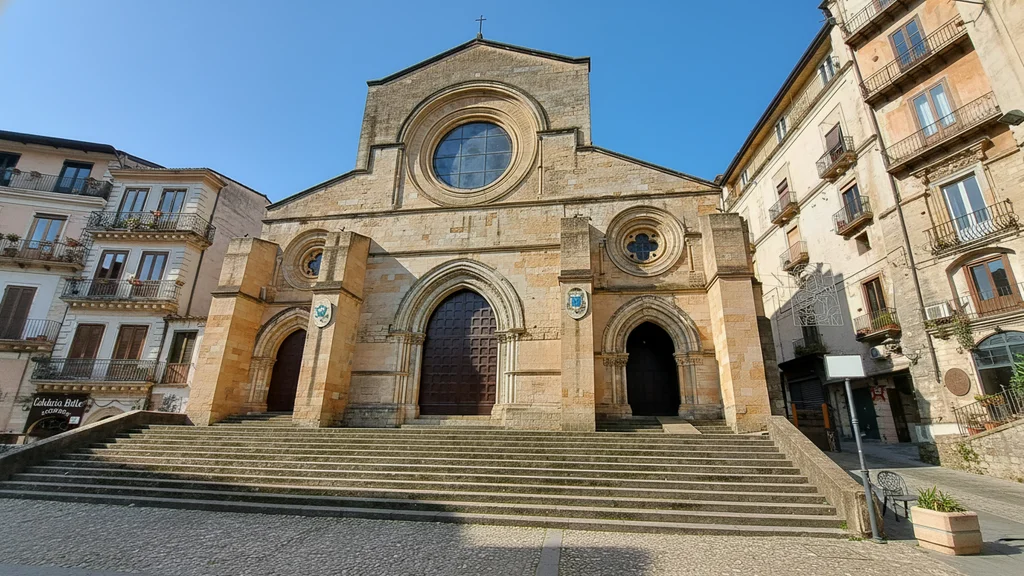
Architectural Treasures of Calabria – Cathedral of Santa Maria Assunta Among Other Monuments
Comparing the cathedral in Cosenza with other sacred monuments of the region, we perceive a fascinating diversity of influences shaped by the history of southern Italy. While the Duomo represents an evolution from Norman style to Baroque, other buildings in the region offer entirely different artistic perspectives, creating a cultural mosaic of Calabria.
| Monument | Architectural Style | Key Feature |
|---|---|---|
| Cosenza Cathedral | Norman-Gothic | Stauroteca reliquary and Bishop Pirro's tomb |
| Cattolica di Stilo | Byzantine | Five characteristic domes and precious frescoes |
| Catanzaro Cathedral | Renaissance-Modern | 42-metre bell tower and Gagini sculptures |
| Castello Murat | Fortification | Site of Joachim Murat's execution |
Cattolica di Stilo
One of the most contrasting examples is the Cattolica di Stilo, a small 9th-century Byzantine church famous for its perfect proportions and unique frescoes. While the cathedral in Cosenza impresses with its scale and centuries of reconstruction, the church in Stilo is testimony to Greek influences in the region. The juxtaposition of these two buildings demonstrates the complexity of Calabria's history, where Roman Catholicism clashed and intermingled with Eastern tradition.
Regional and Historical Significance
The Cathedral of Santa Maria Assunta plays an important cultural role, serving as a point of reference for smaller monuments such as the Grotta di San Ciriaco. Although less well known, this grotto offers insight into local hermitic religiosity, providing a counterbalance to the official tradition represented by the cathedral. All these sites together create a narrative about the spirituality of the south, which has survived numerous invasions, changes of dynasty and catastrophic earthquakes that have shaped the landscape of Calabria.
The Significance and Requirements of UNESCO Listing for Monuments in Italy
The significance of UNESCO World Heritage listing for monuments such as the cathedral in Cosenza is undeniable, as this status underscores the exceptional universal value of the site. Italy, the world leader in terms of the number of protected sites, makes excellent use of this prestige to promote its regions. Listing provides legal and financial protection, enabling the acquisition of international funds for costly conservation work and archaeological research.
The nomination process, however, is extremely rigorous and requires proof that the monument has preserved its authenticity and structural integrity. In the case of Cosenza, numerous reconstructions, though historically fascinating, may be a challenge in the context of meeting strict criteria concerning the original state of preservation. A further requirement is a sustainable management plan that guarantees the site will be protected from the negative effects of mass tourism and urban changes in its surroundings.
The cathedral in Cosenza, despite the lack of an official title, fulfils many of UNESCO's objectives through education and heritage protection. However, listing could become a catalyst for even greater international interest, which is crucial for regions grappling with economic challenges. Regardless of formal status, its role in Calabria's history remains unshaken, and the city continually strives to highlight its uniqueness on the European stage.
Frequently Asked Questions
Is the cathedral in Cosenza listed as a UNESCO World Heritage Site?
Currently the cathedral is not on the UNESCO World Heritage List, although it holds the status of an Italian national monument and is recognised by UNESCO as a Heritage of a Culture of Peace.
What is the Stauroteca and why is it kept in the cathedral in Cosenza?
The Stauroteca is a precious reliquary containing fragments of the True Cross, presented to the cathedral by Emperor Frederick II in 1222 on the occasion of its rededication after an earthquake.
What are the opening hours of the cathedral in Cosenza?
The cathedral is usually open to visitors daily from 8:00 to 12:30 and from 15:30 to 19:00, although visiting may be restricted during services.
When was the cathedral built and in what style?
The original building was constructed in the 11th century in the Romanesque style, but after the earthquake of 1184 it was rebuilt and repeatedly transformed, today combining Norman, Gothic and Baroque elements.
Are there tombs of famous figures in the cathedral?
Yes, the cathedral contains, among others, the tomb of Isabella of Aragon, wife of Philip III the Bold, which underscores the historical significance of this site for European dynasties.