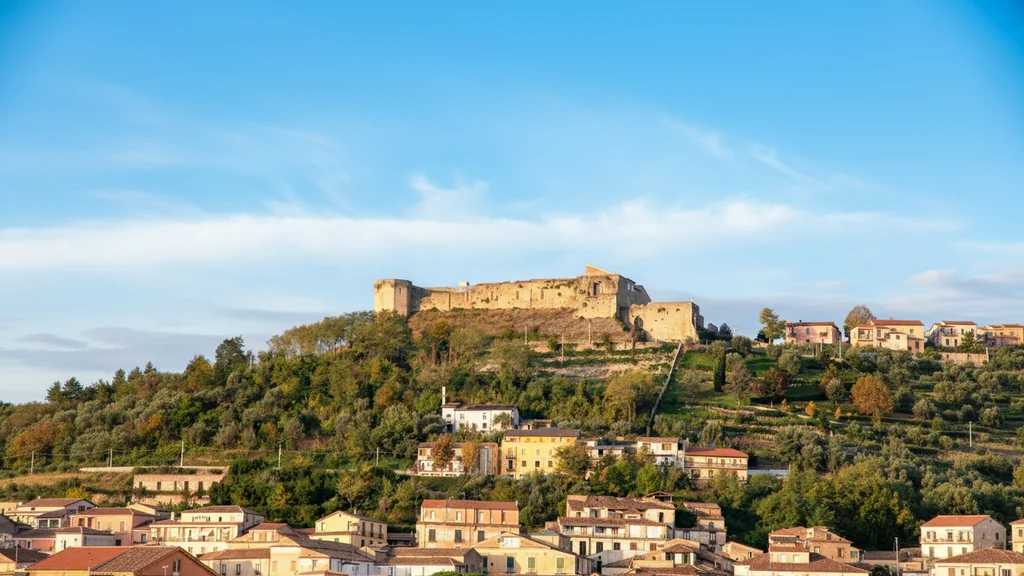
Castello Normanno-Svevo in Cosenza, majestically situated on Pancrazio Hill, stands as one of the most significant testimonies to the Norman-Swabian past and a symbol of regional sovereignty. The castle rises to approximately 383 metres above sea level, which in the medieval era provided strategic control over the valley of the Crati and Busento rivers. This commanding position not only offers fascinating insights into the turbulent history of Calabria, but to this day makes the monument the city's foremost landmark.
| Geographical Feature | Description and Location |
|---|---|
| Elevation | 383 m above sea level |
| Location | Pancrazio Hill (one of the seven hills of Cosenza) |
| Visibility | Sila Mountains, pre-Apennine range, Crati Valley |
| Original function | Control of trade routes and territorial defence |
Architectural Heritage of Castello Normanno-Svevo – A Testament Through the Ages
Castello Normanno-Svevo is not merely a fortress, but also a complex architectural structure that underwent numerous functional and aesthetic transformations over the centuries. The first stones of the castle were laid upon the foundations of much older fortifications, tracing their roots to the ancient Rocca Bretica from the 6th century BC. This historical aspect symbolises the fluidity of transitions between diverse cultures, from the Bruttii people through Byzantine and Arab times.
The major reconstruction of the castle took place under Frederick II of Swabia, who, carrying out modernisation around 1233, left behind a legacy rich in Romanesque and Gothic details. Under his supervision, Castello Normanno-Svevo acquired the form of a defensive bastion based on a rectangular plan with corner towers. Frederick II's architects employed the principles of the golden ratio in the construction, which inadvertently increased the building's resistance to the frequent seismic shocks in this region.
Over the years, the castle in Cosenza underwent further changes, including an expansion in the Aragonese style in the 15th century, which enriched it with a characteristic loggia known as a trabucho. As a result of modern renovations carried out between 2008 and 2015, the castle became a contemporary cultural centre. This revitalisation sparked controversy due to modern elements, such as the distinctive yellow external lift, which divides the opinions of conservators and residents alike.
Castello Normanno-Svevo is a symbol of continuous evolution, testifying to the changeability of the region's history and the power of its former rulers. Its position atop Pancrazio Hill creates not only strategic possibilities, but also offers spectacular views over the city of Cosenza. The evolving architecture reflects the influences of different eras, which interweave to create a picture of history that is ambiguous yet utterly fascinating.
The Strategic Significance of Castello Normanno-Svevo in the History of Cosenza
The Origins of Castello Normanno-Svevo
Castello Normanno-Svevo in Cosenza, also known as Rocca Normanna, is one of the most important castles in southern Italy. Situated on Pancrazio Hill, the castle secured the surrounding area and served as a strategic hub for the development of Cosenza as a whole. As early as 937, Byzantine authorities promoted the construction of a fort to protect the population from the devastating Saracen raids.
The castle emerges on the historical map from early medieval times as a fundamental defensive point. When the region came under Lombard control, it served as a bridgehead on the border with the Crati Valley, vital for the flow of trade. At the turn of the 9th and 10th centuries, when the Arabs seized control of the region, the fortress came under Arab occupation, before returning to Christian hands.
Norman Dominance and the Influence of the Hautevilles
The Norman era arrived at the beginning of the 11th century with the coming of Robert Guiscard, who around 1060 transformed the castle into a solid stronghold. Roger I of Sicily and his successor Roger II turned it into a residence worthy of rulers, reinforcing the walls and towers. The castle then became not only a military bastion, but also an administrative centre housing the royal curia.
During the reign of Roger II, the castle symbolised Norman dominance and the progressive Christianisation of Calabria. It was a place where privileges for local barons were documented and a base for troops suppressing rebellions. Unfortunately, the violent earthquake of 1184 seriously damaged the Norman structure, necessitating a later, radical reconstruction by the Hohenstaufen dynasty.
Swabian Rule – The Hohenstaufen Era
Under Frederick II's rule, the fortress was significantly expanded, becoming one of the largest forts in the Kingdom of Sicily. The impressive octagonal tower, still admired today, symbolises the might of medieval defensive construction and the emperor's passion for geometry. The octagon, combining the symbolism of square and circle, was a leitmotif of Frederician architecture, as also seen in the famous Castel del Monte.
The castle played a key role in political intrigues, serving as a camp for Frederick II's troops during his campaigns in the region. Hidden within the towers were secret passages and escape routes that led deep into Pancrazio Hill, connecting the castle with strategic points in the city. To this day, the structure remains a witness to changes from antiquity to the present, serving as a cornerstone of local identity.
Culture and Education at the Castle – Modern Functions of Castello Normanno-Svevo
Castello Normanno-Svevo in Cosenza has gained contemporary significance as a vibrant centre of culture and education. Following thorough renovation, the castle has ceased to be merely a silent witness to history, becoming a space open to residents and tourists alike. The modern use of the building fits into the broader context of promoting the cultural heritage of the Calabria region.
Museum and Historical Use
The castle serves as a museum, presenting archaeological exhibitions showcasing artefacts from the Norman and Swabian periods. Visitors can explore the Hall of Arms with its impressive cross-ribbed vaults and the dark dungeons that served as a political prison in the 19th century. The exhibitions illustrate past life in southern Italy, while educational programmes introduce young people to medieval conservation techniques.
Cultural Events and Festivals
The castle courtyard becomes a stage for prestigious events, such as South Italy Fashion Week and the comic festival "Le Strade del Paesaggio". One of the most widely covered initiatives is "Ballo del Ceppo" – a themed event inspired by the world of Harry Potter, which attracts fantasy fans to the austere castle interiors. Concerts and academic conferences bringing together historians from across Europe are also held here.
Role in Education and Tourism
The castle offers professional guided tours with historical interpretation, making it an essential point on the educational tourism map. Academic publications focusing on Frederician architecture popularise knowledge of this exceptional building beyond Italy's borders. The castle's significance is underscored by its role in social integration, attracting new explorers curious about what to see in Cosenza first.
The Castle on Pancrazio Hill as a Symbol of Calabrian Identity
The Castle's Significance in the Calabrian Landscape
Castello Normanno-Svevo in Cosenza is not merely an architectural gem, but also a symbol of Calabrian sovereignty across the centuries. The secret of its endurance lies in the role it played for the local community, reflecting the spirit of independence in the face of challenges. The castle survived numerous earthquakes, including the catastrophic ones of 1638 and 1870, rising from the ruins each time.
History as a Pillar of Local Identity
Built after 1000 AD, the castle served defensive, administrative and political functions, and even housed the royal mint during the Angevin period. Its strategic position meant that it dominated the city of Cosenza, reinforcing the region's identity as an impregnable fortress. The castle's history is inextricably linked with events from the Bruttii era to Aragonese rule, making it the heart of Calabrian collective memory.
The Castle as a Modern Cultural Centre
Today, the castle is a cultural centre that combines history with modern forms of artistic expression. Contemporary adaptations aim not only to conserve the structure, but also to adapt it to the needs of today's audiences. Thanks to the engagement of local authorities, the castle has become a dynamic symbol that proves that medieval walls can live a new life, attracting thousands of tourists every year.
| Key Dates and Events | Impact on the Castle |
|---|---|
| 1184 | Earthquake destroying the Norman structure. |
| 1233 | Major reconstruction by Frederick II of Swabia. |
| 1428–1434 | Residence of Louis III of Anjou and Margaret of Savoy. |
| 1638 | Another earthquake and the beginning of a period of decline. |
| 2015 | Completion of modern renovation and opening to visitors. |
Frequently Asked Questions
What are the opening hours of the castle in Cosenza and how much does a ticket cost?
The castle is usually open from Tuesday to Sunday, from 09:30–13:00 and 16:30–20:30. It is closed on Mondays, and ticket prices may vary depending on current temporary exhibitions and cultural events.
What is the history of Castello Normanno-Svevo in Cosenza?
The castle's history dates back to ancient times (Rocca Bretia), but its current form is the result of reconstructions carried out by the Normans (11th century) and Frederick II of Swabia (13th century). Over the centuries, it served defensive, residential and even prison functions.
What can you see at the castle in Cosenza?
Visitors can admire the Hall of Arms, the Frederician octagonal tower, the "dei fiordalisi" corridor with lily motifs, former prisons and viewing terraces with panoramic views over the Crati Valley and the Sila Mountains.
Is the castle accessible for people with disabilities?
Yes, during the last renovation a modern external lift was installed, providing access to the upper levels of the building for people with limited mobility, although its appearance has sparked aesthetic controversy.
Are special events held at the castle?
The castle is a vibrant cultural centre, hosting comic festivals, fashion shows (South Italy Fashion Week), concerts and themed events, such as Harry Potter-style Christmas Balls.