In the historic centre of Tropea stands the Norman Cathedral, officially known as Concattedrale di Maria Santissima di Romania. It is a place where the city's history is deeply intertwined with religious tradition and everyday life in the old centre. The church remains an important landmark of the former diocese of Tropea, which today belongs to the diocese of Mileto-Nicotera-Tropea.
The cathedral in Tropea was built by the Normans in the 12th century; local studies give the date as 1163 or link the start of construction to the end of the 12th century. The building was later damaged many times by earthquakes, and a local tradition from the Second World War tells of six unexploded bombs from 1943, two of which are kept in the cathedral.
Table of Contents
- Norman Architecture of Duomo di Tropea – A Synthesis of Tradition and Modernity
- Norman Influence on Religion and Culture in Southern Italy – Christian Reconquest and Cultural Syncretism
- Monuments and Artefacts of Norman Tropea – Secrets of the Medieval Past
- Saint Domenica and Blessed Francesco Mottola – Local Devotion in the Cathedral
- The Miraculous Intervention of the Madonna di Romania – History and Contemporary Devotion
Norman Architecture of Duomo di Tropea – A Synthesis of Tradition and Modernity
The Norman Cathedral in Tropea, known as Duomo di Tropea, is one of the most important landmarks of the historic centre. The cathedral was built by the Normans in the 12th century; local studies give the date as 1163, while other sources link the beginning of construction to the end of the 12th century. It is safest to describe it as a church of Norman-Romanesque character, later repeatedly transformed after earthquakes and successive restorations.
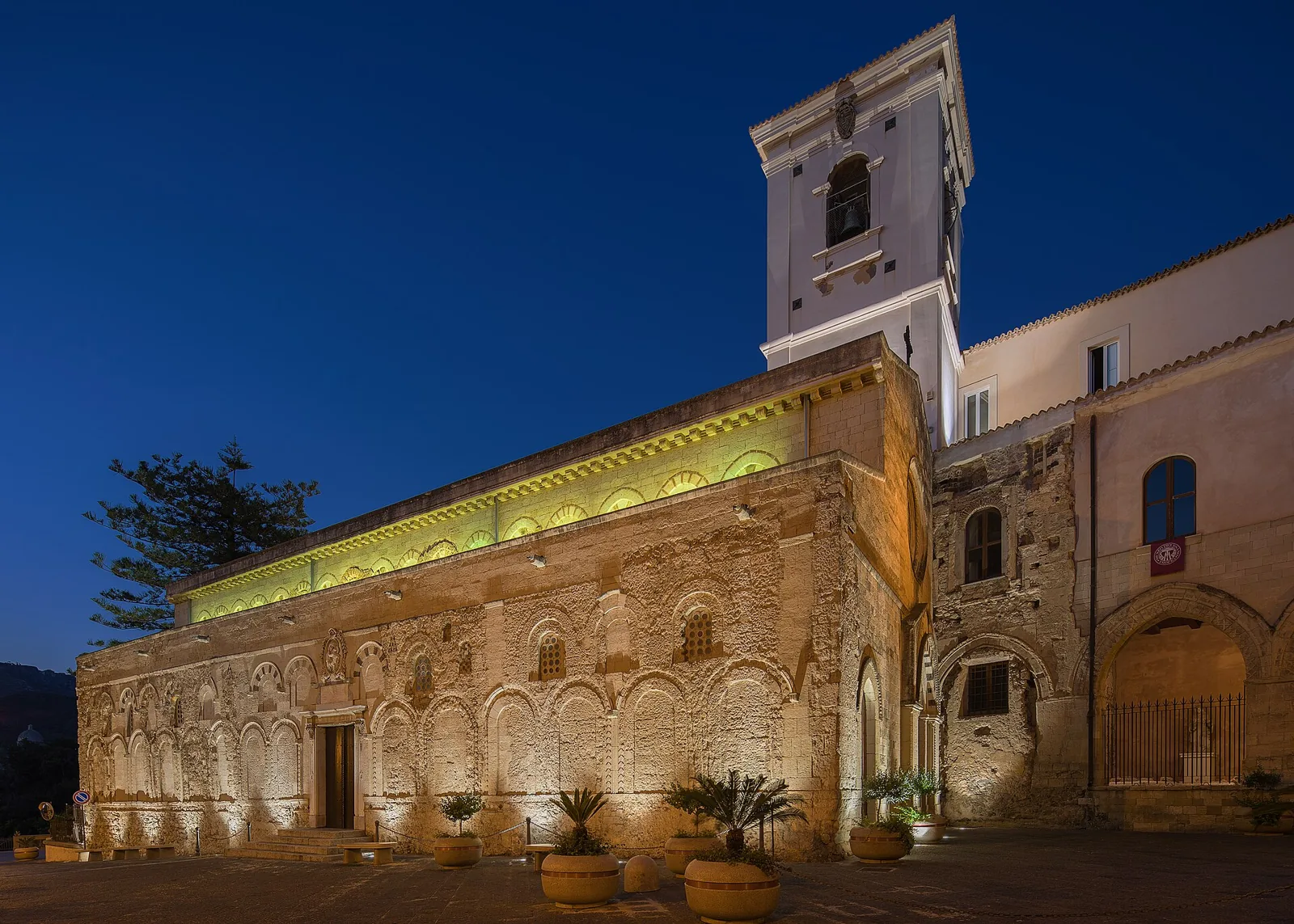
The main phases in the building's history help explain its appearance today. After the earthquake of 1783, the cathedral received a Neoclassical remodelling. Following seismic damage in 1905 and 1908, a stylistic restoration was carried out in 1926–1931, removing many Baroque and Neoclassical elements and aiming to restore the church's Norman appearance.
Key Architectural Elements of Duomo di Tropea
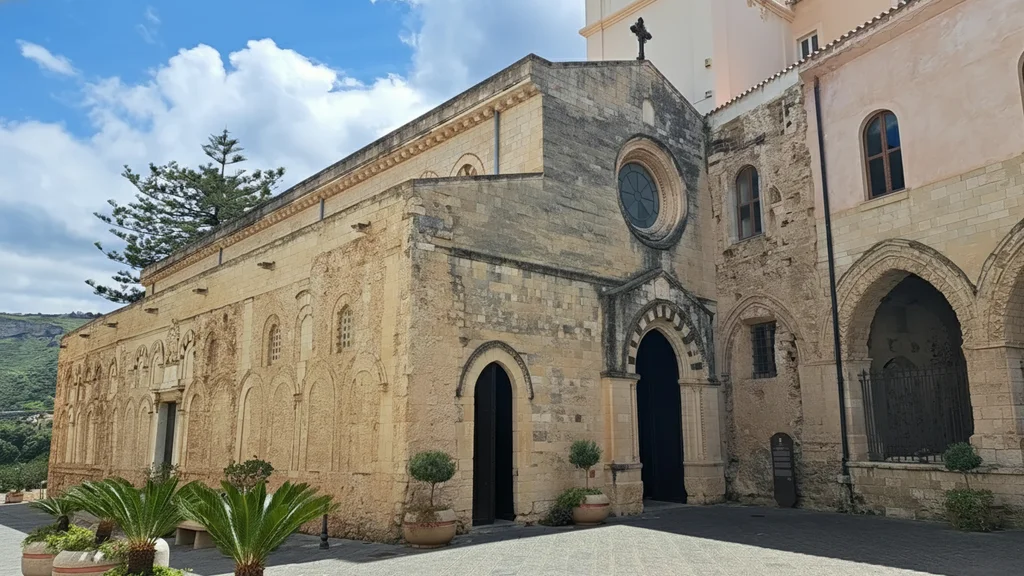
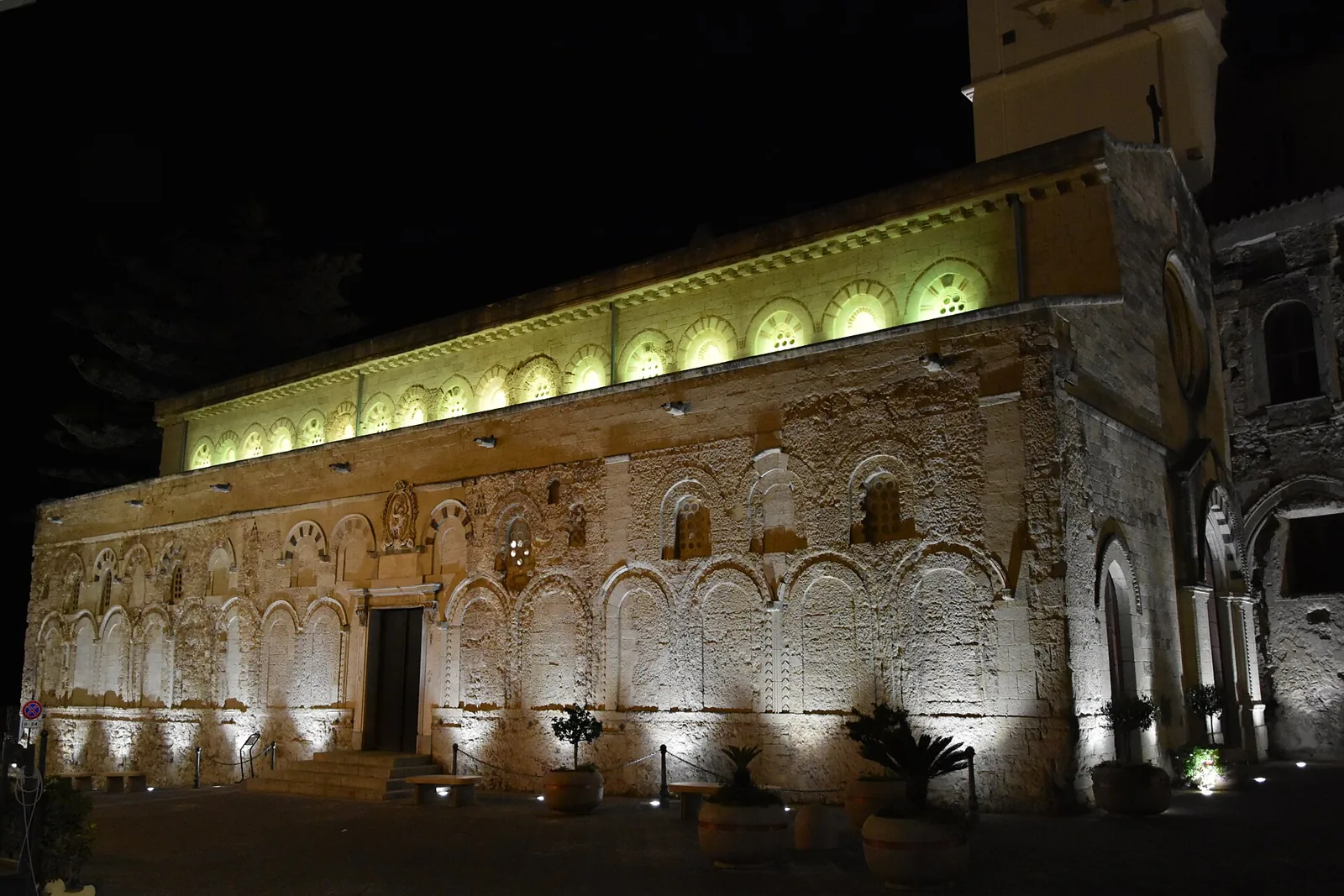
The building has a clear basilica layout with three naves, where the main nave distinctly dominates the side aisles. The structure and walls clearly show the use of local tuff, a material typical of this part of Calabria. The interior has retained its sacred, austere character, but its present appearance is the result of successive rebuilds and repairs.
Facade
The cathedral's facade, though modified numerous times over the centuries, still echoes Norman traditions and stands on solid medieval foundations. The focal point is a powerful 16th-century rose window with precise tracery that harmonises with the raw tuff used in the wall construction. Particularly valuable is the northern facade, considered the best-preserved part of the original structure, with a portal connecting the church to the former Bishop's Palace.
Interior Highlights
The cathedral interior is a three-nave basilica with tall arcades and a distinct, elongated spatial layout. Rather than seeking one pure style, it is better to view the church as a building transformed many times over the centuries. The most precious element of its furnishings remains the Madonna di Romania icon on cedar wood, attributed to Lippo di Benivieni or the Giottesque school and dated to the first half of the 14th century.
The interior also preserves important traces of local memory. Here you can find the tomb of Blessed Francesco Mottola and the tomb of the philosopher Pasquale Galluppi. Valuable historic works also include the Gazzetta family tomb from 1530 and a relief of the Resurrection from the mid-16th century, attributed to the Gagini workshop – a famous family of sculptors active in Sicily and southern Italy.
It is precisely the presence of the Madonna di Romania icon that makes the Duomo not just a monument but a living sanctuary of Tropea. Maria Santissima di Romania is the city's patron saint, and her feast day is celebrated on 9 September.
Crypt
The underground areas and older layers of the building are of interest to historians, but they are not the main reason for visiting today. For most visitors, what matters most is the cathedral's form, the atmosphere of the interior, and the strong bond between the church and Tropea's religious identity.
| Architectural Element | Material and Style | Period of Construction / Modification |
|---|---|---|
| Main facade | Light yellow tuff, Norman tradition | 12th c. / 16th c. |
| Interior layout | Three-nave basilica, Norman-Romanesque character | 12th c. / later transformations |
| Central rose window | Carved stone, Renaissance style | 16th c. |
| Entire building | Church repeatedly rebuilt and restored | 12th c. / after 1783 and in 1926–1931 |
Norman Influence on Religion and Culture in Southern Italy – Christian Reconquest and Cultural Syncretism
In the 11th century, the Normans – the Hauteville dynasty (Italian: Altavilla) – took Calabria from Byzantine influence and gradually brought local dioceses back under the jurisdiction of the Roman Church, with the Latin language and rite. This change triggered a deep political and ecclesiastical reorganisation of the region. In this context, sacred foundations such as the cathedral in Tropea were part of building a new order.
Latinization and Religious Development
The Normans supported the strengthening of the Latin rite and the reorganisation of dioceses in Calabria. The process of Latinisation was not instantaneous, however – alongside new church foundations, the Greek tradition also persisted here for a long time. The cathedral in Tropea fits well into this broader picture of religious change in southern Italy.
Cultural Syncretism and Scholarship
The Norman kingdom had a distinctly multicultural character, and various linguistic and religious traditions coexisted in southern Italy. It is this broad context that helps us understand the era in which the cathedral in Tropea was built. One need not, however, ascribe to the town itself the role of a great scholarly centre to appreciate the significance of these changes for all of Calabria.
Monuments and Artefacts of Norman Tropea – Secrets of the Medieval Past
Tropea is a place where Norman history comes alive not only within the cathedral walls but also in the preserved works of sacred art. The Duomo interior houses the Black Crucifix (Crocifisso Nero), whose dating varies in the sources – from the 15th century to a period no earlier than the 17th century. Among the sculptures, the Madonna del Popolo from 1555 stands out, associated with Giovanni Angelo Montorsoli, a pupil of Michelangelo.
The Diocesan Museum, housed in the former Bishop's Palace, displays treasures linked to the history of the local Church and the cathedral itself.
Watch on YouTube
Saint Domenica and Blessed Francesco Mottola – Local Devotion in the Cathedral
Alongside the Madonna di Romania, the cathedral is also a living centre of devotion to Saint Domenica – Tropea's co-patron saint together with the Madonna, said by tradition to have been born in what is now Santa Domenica di Ricadi, near the city. Her relics rest beneath the co-cathedral's main altar, and the chapel dedicated to her is one of the most visited places of worship inside.
The church also holds the tomb of Blessed Francesco Mottola, a local priest and founder of religious congregations who was beatified in 2021, as well as that of the philosopher Pasquale Galluppi. Together with the miraculous Madonna icon, these figures form the religious identity of present-day Tropea and explain why residents treat the Duomo as the heart of their community.
The Miraculous Intervention of the Madonna di Romania – History and Contemporary Devotion
The cult of the Madonna di Romania rests on the belief in her miraculous protection of the city through disasters. According to tradition, on 27 March 1638, after Bishop Ambrogio Cordova ordered a penitential procession in response to a predicted earthquake, Tropea was one of the few towns in the region to escape unscathed from the great earthquake that devastated Calabria that year.
A second miracle is said to have taken place on 24 July 1943. During an Allied air raid, a plane dropped six bombs over the city, which, instead of hitting the centre, fell into a nearby garden where children were playing and lodged in the ground without exploding. Bishop Cribellati then had army engineers disarm two of them and place them inside the cathedral, where they still hang on the walls today as a votive offering.
The most important religious celebration associated with the city's patron saint falls on 9 September, the anniversary of the icon's coronation. A solemn procession with the miraculous image passes through the streets of the historic centre – for residents, it is the most important day of the year, symbolising the Madonna's protection over the city.
The cathedral is located at Piazza del Duomo in Tropea's historic centre, just a few minutes' walk from Corso Vittorio Emanuele and the viewpoints above the cliff. A visit to the interior usually takes about 15–30 minutes, and with the Diocesan Museum 30–45 minutes. Remember to wear clothing covering shoulders and knees, and check the opening hours and museum access directly before your visit, as they change seasonally and depend on services.
According to the regulations of the Museo Diocesano di Tropea, to be confirmed before visiting, the museum operates in March–April and October–November from 10:00–13:00 and 15:00–17:30. In June and September, the listed hours are 10:00–13:00 and 19:00–22:00, and in July–August 19:00–24:00. In other months or outside these hours, group entry is available by reservation.
Frequently Asked Questions
What can you see in the Norman Cathedral in Tropea?
In the cathedral, you can see above all the Madonna di Romania icon, the Black Crucifix and the historic interior furnishings. Also look at the three-nave basilica layout, the tomb of Blessed Francesco Mottola, and the church's connection to Tropea's religious history.
When was Tropea Cathedral built and what is its architectural style?
The cathedral was built by the Normans in the 12th century; local studies give the date as 1163 or link the start of construction to the end of the 12th century. It is best described as a church of Norman-Romanesque character, later repeatedly transformed after earthquakes and restorations.
What are the opening hours of Tropea Cathedral?
Opening hours are best checked directly before your visit, as they change seasonally and depend on services. When planning your visit, remember to wear clothing covering shoulders and knees.
Who was the Hauteville family mentioned in the cathedral's history?
The Hauteville (Altavilla) family was a Norman dynasty that played a key role in the conquest and reorganisation of southern Italy in the 11th century. Its era is also associated with the development of church foundations and the strengthening of the Latin rite in Calabria.
What elements of religious devotion are associated with the cathedral?
The cathedral is associated above all with the Madonna di Romania icon, the chapel of Saint Domenica, and the tomb of Blessed Francesco Mottola. These elements best show the continuity of local devotion and the importance of the Duomo for the people of Tropea.
Sources
The information in this article was verified against the following sources:
- beweb.chiesacattolica.it – beweb.chiesacattolica.it
- BeWeB - Cattedrale - Tropea : Chiesa della Madonna di Romania – beweb.chiesacattolica.it
- BeWeB - Diocesi : Tropea – beweb.chiesacattolica.it
- La storia – Diocesi di MILETO-NICOTERA-TROPEA – diocesimileto.it
- La Chiesa Concattedrale di Maria Santissima di Romania | Tropea Tourism – tropea-tourism.com
- Maria SS. di Romania (Concattedrale) - Santuari Italiani – santuaritaliani.it
- Evoluzione Architettonica della Cattedrale di Tropea – tropea-tourism.com
- Tropea 1943, quelle bombe "miracolosamente" inesplose – ilvibonese.it
- Domenica di Tropea – it.wikipedia.org
Last updated: