In the heart of picturesque Tropea stands the Norman Cathedral, officially known as Concattedrale di Maria Santissima di Romania. This remarkable place offers a journey through time, showcasing exquisitely preserved architecture from the Norman era that bears witness to the power of the Hauteville (Altavilla) dynasty in southern Italy. The cathedral not only captivates with its aesthetics but also reveals the rich history and religious heritage of the Costa degli Dei region.
Norman Architecture of Duomo di Tropea – A Synthesis of Tradition and Modernity
The Norman Cathedral in Tropea, known as Duomo di Tropea, is a prime example of the harmonious blending of architectural styles characteristic of Norman cathedrals in Sicily. Built around 1094, it represents a classic example of the Norman-Arab-Byzantine style typical of sacred buildings of this period. Its foundation dates to the era of Roger I, known as the Great Count, who played a crucial role in the Latinization of Calabria.
Key Architectural Elements of Duomo di Tropea
The building features an elongated three-nave basilica layout, where the main nave dominates the side aisles with its height. The support system relies on octagonal pillars made of polychrome stone blocks, devoid of traditional bases. This structural solution emphasises the austerity and monumentalism so typical of the Norman vision of sacred space.
Facade
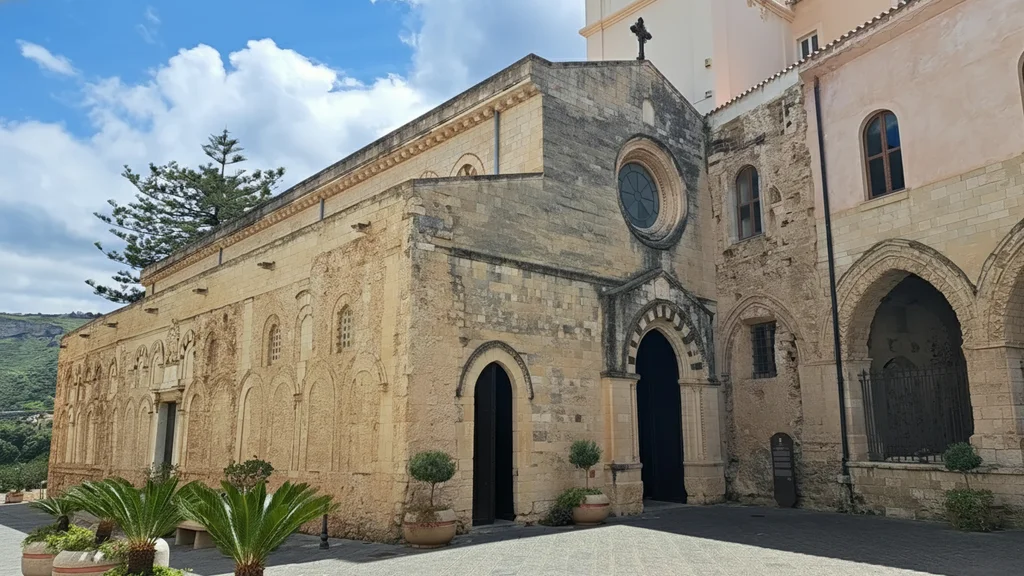
The cathedral's facade, though modified numerous times over the centuries, still echoes Norman traditions and stands on solid medieval foundations. The focal point is a powerful 16th-century rose window with precise tracery that harmonises with the raw tuff (tuffo giallino) used in the wall construction. Particularly valuable is the northern facade, considered the best-preserved part of the original structure, with a portal connecting the church to the former Bishop's Palace.
Interior Highlights
The cathedral interior is a three-nave basilica with tall arcades supported by massive columns. Pointed arches, bridging Romanesque and early Gothic styles, lend the space a dynamic character. The barrel vault supplemented with lunettes creates a monumental space conducive to contemplation and prayer, while the use of dark volcanic stone in the details creates a striking contrast with the light sandstone.
The main apse preserves decorative elements from Norman times, serving as a bridge between intricately carved Islamic details and Christian symbols. It is here that the region's most precious painted treasure can be found – the Madonna di Romania icon, dated to 1230–1330. This painting, executed on cedar wood in the Byzantine manner, is attributed to the artist Lippo Beninvieni.
Crypt
Beneath the cathedral lies a crypt containing medieval episcopal tombs and reliquaries from the Norman era. The crypt stylistically references hypogea, characteristic of Norman architecture across the Mediterranean basin. Archaeological research in 1926 revealed beneath the main nave the remains of an even older Byzantine sacellum, upon which the Normans erected their church.
| Architectural Element | Material and Style | Period of Construction / Modification |
|---|---|---|
| Main facade | Light yellow tuff, Norman style | 12th c. / 16th c. |
| Octagonal pillars | Polychrome stone, Norman style | 12th c. |
| External apses | Tuff and volcanic stone, Arab-Norman style | 12th c. (reconstruction 1926-29) |
| Central rose window | Carved stone, Renaissance style | 16th c. |
Norman Influence on Religion and Culture in Southern Italy – Christian Reconquest and Cultural Syncretism
The impact of the Normans on the development of religion and culture in southern Italy cannot be overstated. In the 11th and 12th centuries, the Hauteville dynasty spearheaded the Christian reconquest that encompassed Sicily as well as the regions of Calabria and Apulia. Their presence played a decisive role in the Latinization of regions previously dominated by Byzantine and Muslim influences.
Latinization and Religious Development
In Tropea and across southern Italy, the Normans promoted the introduction of the Roman Latin rite. This process involved the construction of monuments such as the Duomo di Tropea, which integrated elements of Arabic style into sacred architecture. In 1475, the cathedral was granted the right to issue indulgences for all of Calabria, making it a key point on the region's pilgrimage map.
Cultural Syncretism and Scholarship
The Normans fostered a unique multinational culture under the rule of Roger II, who embraced ethnic diversity. Greeks, Arabs, Jews, and Latins coexisted in the region, leading to intense scholarly exchange. Arab scholars translated Greek texts into Latin, significantly contributing to the 12th-century renaissance, and Tropea became an important bridge between East and West.
Monuments and Artefacts of Norman Tropea – Secrets of the Medieval Past
Tropea is a place where Norman history comes alive not only within the cathedral walls but also through numerous artefacts. The Duomo interior houses the Black Crucifix (Crocifisso Nero) from the 17th century, a moving example of the iconography of suffering. Among the sculptures, the Madonna del Popolo from 1555 stands out, the work of Fra Angelo da Montorsoli, a pupil of Michelangelo himself.
Another extremely significant site comprises the ruins of the Norman castle and the early Christian necropolis discovered beneath Largo Duomo. Over 50 "a cupa" type graves from the 5th–7th centuries were found there, proving the continuity of settlement at this location. Among the finds is the Hirene Conductrix inscription, which contains the first historical record of the town's name.
The Diocesan Museum, housed in the former Bishop's Palace, displays cathedral treasures including 17th-century sculptures and 14th-century frescoes. Of particular note are two unexploded bombs from 1943, kept in the cathedral as evidence of the miraculous intervention of the city's patron saint. These objects, alongside coins from the reign of Roger I, constitute an invaluable source of knowledge about Calabria's turbulent history.
Saint Blaise – Relics in Tropea Cathedral and Their Cultural Impact
The relics of Saint Blaise in Tropea Cathedral are an essential element of the region's cultural identity. Saint Blaise, an early Christian martyr, is regarded as the patron saint of those suffering from throat ailments. The Normans built a special chapel in the northern apse to house these precious remains with dignity, symbolising their piety and commitment to the city's religious prestige.
Relics imported from the regions of Byzantium and Rome became a symbol of unity among the faithful under the new Norman rule. Today, the relics of Saint Blaise attract numerous pilgrims, and their presence is inseparably linked to local festivals. The Norman Cathedral in Tropea bridges past and present, revealing the complexity of the Normans' cultural contribution to the development of Christianity in southern Europe.
The Miraculous Intervention of the Madonna di Romania – History and Contemporary Devotion
The cult of the Madonna di Romania is inseparably linked to the history of miracles attributed to her intercession in moments of greatest peril. During the earthquake of 1638, the Virgin Mary reportedly warned Bishop Ambrogio Cordova in his dreams, enabling the town to escape destruction. In commemoration of this event, a solemn thanksgiving procession takes place every year on 27 March.
Further evidence of the patron saint's protection over Tropea came during the plague epidemic of 1660, which bypassed the town despite devastating surrounding regions. The most important religious celebration falls on 9 September, commemorating the coronation of the miraculous image in 1877. This event draws thousands of faithful and tourists, forming the heart of the identity of the community inhabiting the Coast of the Gods.
Frequently Asked Questions
What can you see in the Norman Cathedral in Tropea?
In the cathedral, you can admire the miraculous 13th-century Madonna di Romania icon, the Black Crucifix, Renaissance sculptures by pupils of Michelangelo, and unique Norman-Arab architecture. Also worth noting are the World War II memorabilia and the richly decorated external apses.
When was Tropea Cathedral built and what is its architectural style?
The cathedral was built by the Normans around 1094. It represents the Romanesque-Norman style with clear Arab and Byzantine influences, evident in the use of pointed arches and the polychrome stonework of tuff and volcanic rock.
What are the opening hours of Tropea Cathedral?
The cathedral is generally open to visitors from 10:00–13:00 and 17:00–20:00. Admission is free, though visitors should remember to wear appropriate clothing covering shoulders and knees.
Who was the Hauteville family mentioned in the cathedral's history?
The Hauteville (Altavilla) family was a Norman dynasty that conquered southern Italy in the 11th century. They were the founders of many key sacred buildings in the region, including Tropea Cathedral, aiming to strengthen the Latin rite in Calabria.
Where are the relics of Saint Blaise?
The relics of Saint Blaise are housed in a specially prepared chapel in the northern apse of the cathedral. They are placed in a medieval reliquary adorned with maritime motifs, referencing Tropea's fishing traditions.